
1. Conceptual Framework: Defining Composite and Synthetic Populations

The transition from traditional landraces to improved open-pollinated populations marks a critical shift toward precision genetics. While landraces offer localized adaptation, their inconsistent performance necessitated the development of Composite and Synthetic Varieties. These populations are designed to be “polymorphical yet stable,” providing a genetic structure that is heterogeneous enough to adapt to environmental flux but uniform enough to meet certification standards.

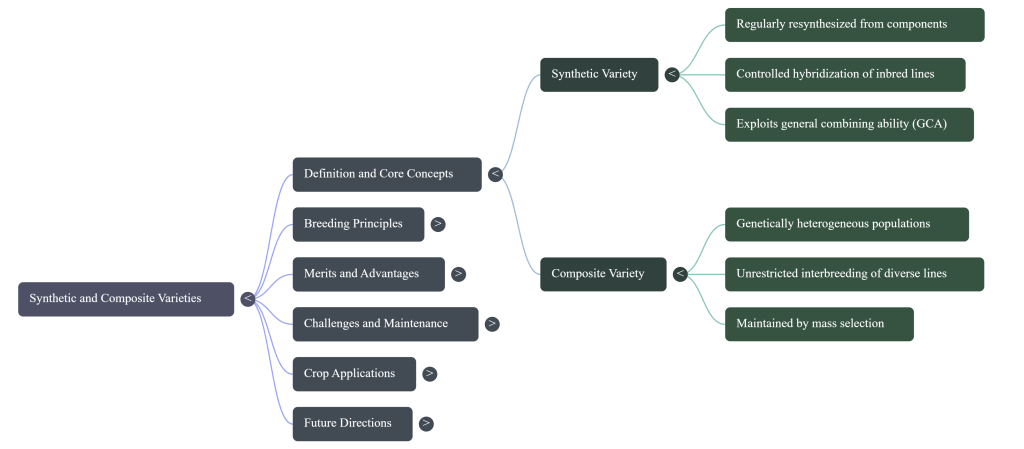
The fundamental distinction lies in the methodology of parental selection and mating control. Composite Varieties are developed by intercrossing a large, diverse base of parental lines followed by mass selection. Synthetic Varieties are more technically refined, consisting of an open-pollinated population developed through the random mating of selected genotypes—often inbred lines or clones—previously tested for their General Combining Ability (GCA). A historical cornerstone of this methodology is the Stiff Stalk Synthetic (SSS), the first synthetic hybrid produced at the University of Iowa in 1950 using 16 specific strains.

Key Genetic Entities
- Inbred Lines: Homozygous lines (ideally derived from parents with proven GCA) used to capture and stabilize specific traits.
- Clones: Genetically identical vegetative units, essential for forage crops like alfalfa, where polycross-progeny tests guide selection.
- Landraces: Genetically diverse, locally adapted populations that serve as the primary source for identifying resilient alleles.
In mixed species, the strategic ideal is to select superior inbred lines derived from parents with high combination capacity, ensuring that the resulting variety maintains productivity across successive generations.
2. The Breeding Blueprint: How They Are Made
While composites rely on naturalized stabilization, synthetics require a high degree of controlled engineering to capture and maintain heterosis.
Steps to Create a Composite
- Selection of Diverse Parents: Geneticists identify lines with specific traits (e.g., drought tolerance, pest resistance).
- Seed Mixing: Seeds from these genetically distinct but complementary parental lines are physically bulked.
- Unrestricted Interbreeding: The mixture is planted in isolation, allowing for random mating and the accumulation of favorable alleles over several generations.
- Mass Selection: Population stability is achieved through continuous mass selection, where only the top-performing individuals are harvested to form the subsequent generation.
Steps to Create a Synthetic
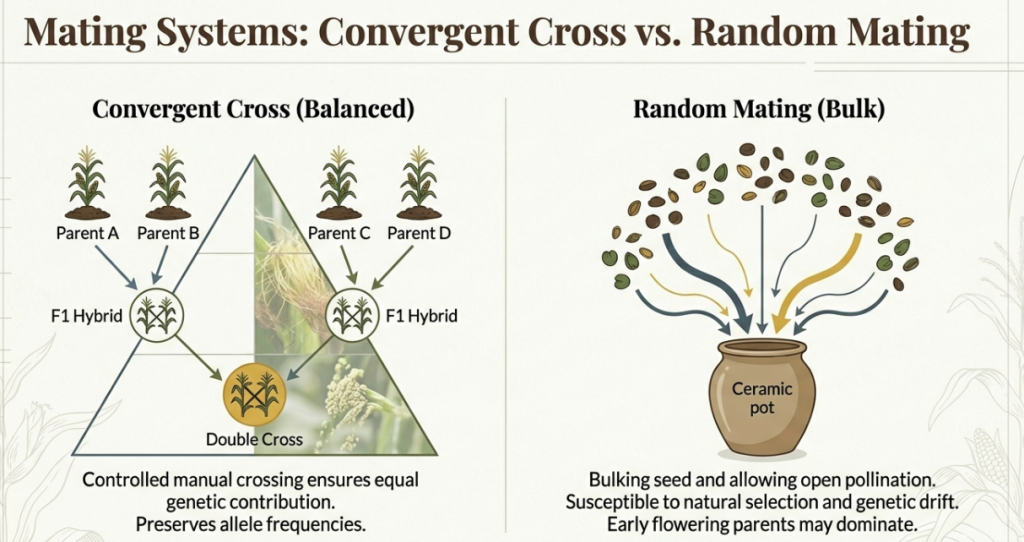
Developing synthetics involves two distinct mating “blueprints” to ensure parental contribution:
- The Convergent Cross Method: A controlled, balanced approach where single crosses and subsequent double crosses are performed to ensure every parental line contributes equally to the final population.
- The Random (Seed Bulk) Method: A simpler approach where equal quantities of seed from all parental inbreds are bulked and allowed to interbreed, though this risks unequal contribution due to varying germination rates or fecundity.


3. Development Methodologies: The Architecture of Breeding
The Synthetic Development Process:
- Inbred/Clone Development: Pure lines are established (or clones identified for species like alfalfa or orchardgrass).
- GCA Testing: Parents are evaluated using polycross or top-cross systems to confirm their ability to produce superior offspring.
- Hybridization: Selected elite parents are intercrossed in all possible combinations to capture heterosis.
- Yield Prediction: Developing synthetic varieties requires a high degree of technical precision to capture heterosis without the prohibitive costs of annual hybrid seed production. The mathematical foundation of this process is Wright’s Equation, which allows breeders to predict the performance of the stabilized generation:

Where:
- F2: Expected yield of the synthetic variety.
- F1: Average yield of the first-generation hybrids from all possible parental crosses.
- P: Average performance of the pure parental strains.
- n: Number of parental lines included.

The Breeding Scheme: From Pre-Selection to Synthesis
- Pre-Selection: Parents are evaluated for GCA and Specific Combining Ability (SCA). For small genetic groups (n<10), the Latin Square System is the preferred experimental design for testing.
- The Crossing Phase:
- Polycross: Used for clones (e.g., alfalfa) in isolated blocks.
- Diallel Cross: Controlled crossing of all possible pairs; essential for calculating F1 in Wright’s Equation.
- Top-cross: Crossing lines with a broad-base tester to evaluate GCA.
- Synthesis (Syn-0 to Syn-2): Seeds from individual hybrids are mixed in equal quantities. Genetic equilibrium is typically reached in the Syn-2 generation (involving 2 to 64 parents), which serves as the baseline for commercial performance.
Methodological Evaluation: Convergent Cross vs. Random Method
| Feature | Convergent Cross Method | Random Method |
|---|---|---|
| Technical Approach | Controlled single/double crosses (e.g., EPS20 Reid populations). | Bulking equal seed quantities (e.g., EPS21 Non-Reid populations). |
| Allele Retention | High; preserves rare alleles through balanced contribution. | Risk of loss; natural selection favors more “productive” seeds. |
| Genetic Drift | Minimal; maintains intended gene frequencies. | High; adaptive advantages of certain inbreds can alter the pool. |
| Strategic Use | Best for related inbreds to prevent inbreeding depression. | Caution required; fecundity differences can skew the population. |
4. The “Why” of the Match: Choosing the Right Technique
The selection of the blueprint is dictated by the crop’s natural mating system and the type of gene action we wish to exploit.
Composites for Self-Pollinators
Primary Logic: Maximizing environmental flexibility in species like wheat, rice, faba bean, and brown sarson.
- Genetic Buffering: In self-pollinated crops, composites provide a “safety net”; the high level of genetic heterogeneity ensures that different genotypes within the population can survive varying stressors.
- Stability: These populations are less prone to inbreeding depression, allowing for high stability in low-input or resource-poor environments.
Synthetics for Cross-Pollinators
Primary Logic: Exploiting Additive Gene Action and hybrid vigor in species like maize, rye, and alfalfa.
Phenotypic Uniformity: Despite being genetically heterogeneous, synthetic varieties are selected to be phenotypically uniform in maturity and height, facilitating mechanical harvesting.
Exploitation of GCA: While hybrids primarily exploit non-additive gene action (SCA), synthetics are designed to capture more of the additive gene action.
5. Comparative Analysis: Merits, Achievements, and Differentiators
The strategic choice of variety hinges on the trade-off between peak yield and environmental stability. Breeders must account for the use of DHS (Duplication Haploid Single) lines; while they accelerate production, they pose a long-term risk of reducing genetic variation within the population, potentially limiting future selection gains.
Strategic Comparison: Composite vs. Synthetic Varieties
| Aspect | Composite Varieties | Synthetic Varieties |
|---|---|---|
| Genetic Structure | Genetically heterogeneous (High diversity) | Genetically homogeneous (Uniform population) |
| Gene Action | Focus on trait complementarity and adaptation. | Exploits Additive gene action (General Combining Ability) |
| Yield Potential | Moderate; extremely stable | High; captures partial heterosis |
| Yield Decline | Low; stabilized by mass selection. | Predictable decline in Syn-2 (25-50% of vigor) |
| Environmental Adaptability | Superior in marginal/unstable systems | Moderate; optimized for intensive systems |
| Maintenance | Mass selection and periodic new parents | Reconstitution from original parental stocks |
| Cost of Production | Lower; minimal technical inputs required. | Higher; requires controlled access and GCA testing. |
| Ideal Farming System | Resource-poor/Low-input farming | Commercial/High-input agricultural zones |

Localized Achievements and Stability
Synthetic varieties have proven their worth in regions where hybrid infrastructure is lacking. Specific successes include the “Syn 65” (Sangam) maize cultivar in India and the “Pusa Kalyani” brown sarson variety. In Iraq and Sub-Saharan Africa, these varieties have provided a critical buffer against climate volatility. While synthetics may yield one-third less than conventional hybrids, their protein content is often higher (9–13% vs. 7–9%), providing superior nutritional value per acre.
6. Maintenance Strategies: Mitigating Genetic Erosion and Heterosis Loss
The primary risk in open-pollinated systems is the decline of hybrid vigor according to the Hardy-Weinberg Law. In subsequent generations (F2,F3), the loss of heterosis is quantitatively predictable: 50% for dichotomous hybrids, 33% for triplet successions, and 25% for tetraploid successions.
Maintenance Protocols
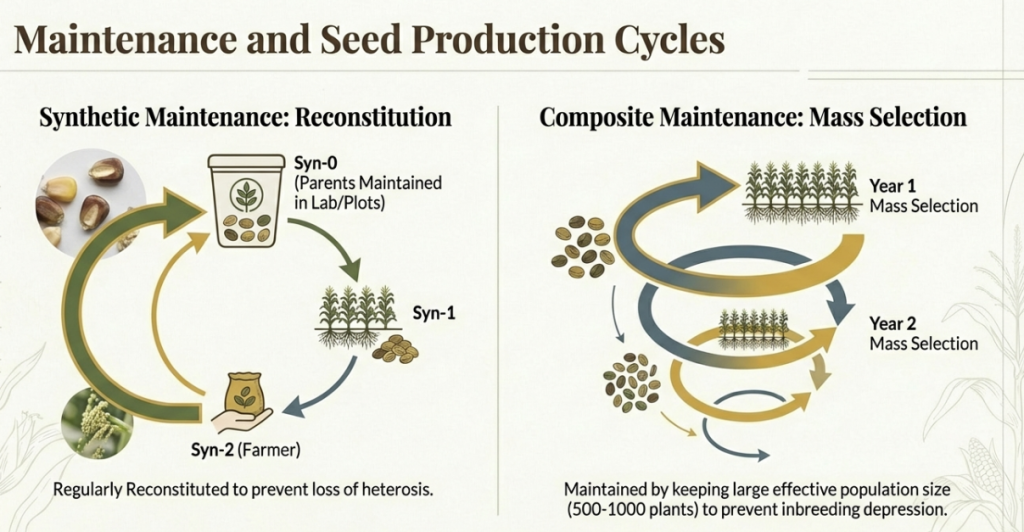
- Composites: Focused on mass selection. Breeders must periodically introduce new parental lines to replenish the genetic base and counter genetic drift.
Composite Variety Maintenance
- Execute Mass Selection: Implement mass selection in every generation. Select only top-performing individuals for the next seed cycle to enhance performance while maintaining genetic heterogeneity.
- Recharge the Genetic Base: Introduce new, superior parental lines periodically. This prevents the fixation of deleterious alleles and replenishes diversity to sustain long-term environmental adaptability.
- Synthetics: Must be reconstituted from original parental stocks (inbreds or clones) preserved in isolation. If not reconstituted, the variety eventually deteriorates into a standard open-pollinated variety with diminished yield.
Synthetic Variety Maintenance
- Isolate Multiplication Plots: Enforce strict isolation distances to prevent foreign pollen contamination. Controlled pollination is the primary defense for maintaining the specific allele frequencies of the synthetic.
- Implement Post-Synthesis Mass Selection: After initial synthesis, maintain the population through routine mass selection in isolated plantings, as per Lonnquist (1961), to sustain hybrid vigor.
- Trigger Periodic Reconstitution: When performance deteriorates, return to the original parental strains maintained in research stations. If not reconstituted regularly, the synthetic effectively degrades into a standard Open-Pollinated Variety (OPV).
Best Practices for Preservation
- Isolation Integrity: Maintain strict distances and utilize the Latin Square design for parental evaluation to prevent foreign pollen contamination.
- Parental Stock Preservation: Keep original lines in secure, isolated research stations for periodic “Syn-0” remaking.
- Representative Sampling: Harvest at least 100 pods (in maize) from superior plants to maintain the genetic integrity of the variety.
- Yield Trial Monitoring: Conduct multi-location trials to track the Syn-2 performance against standard checks.
7. Molecular Evaluation Standards: SSR Marker Integration
Molecular monitoring provides the empirical evidence required to detect invisible genetic erosion. Phenotypic uniformity is insufficient for quality control; genetic stability must be verified at the allelic level.
SSR Marker Integration
Utilize Simple Sequence Repeat (SSR) markers to track the genetic structure of the population. These markers are mandatory for:
- Estimating allelic frequency shifts within the population.
- Assessing unbiased average heterozygosities across loci to monitor inbreeding levels.
- Quantifying the Nei’s distance (1972) between the current generation and the original Syn-0 inbreds.
Statistical Validation and the “Drift Threshold”
Compare observed allelic frequencies against expected frequencies (assuming equal parental contribution) using Chi-square tests for goodness of fit. Because multiple loci are audited simultaneously, apply the Bonferroni correction to handle the high number of independent tests (e.g., 34 independent tests for 17 loci).
Establish a strict Drift Threshold based on Crossa (1989): a sample size of 40 individuals is the absolute minimum required to preserve alleles with frequencies higher than 0.1. Falling below this threshold significantly increases the probability of random frequency fluctuations and the permanent loss of beneficial alleles.
8. Commercial Distribution and Population Reconstitution
For commercial reliability, standardizing the variety at the Syn-2 generation is required for diploids, as this is the point where the population reaches genetic equilibrium (Walsh 2006). Distribution of Syn-1 is generally avoided due to the lack of seed volume and the ongoing shifts in heterozygosity.
The Reconstitution Standard
The “Reconstitution Standard” must be triggered if the variety exhibits a statistically significant decline in yield or stress tolerance. This involves remaking the variety from the original parental strains (clones or inbreds) kept in isolation. This reset capability distinguishes the synthetic system from standard OPVs and is critical for multi-year commercial viability.
Seed Production Specialist Checklist
- Genetic Distance Verification: Target low Nei’s distance scores relative to the original parental base via SSR audit.
- Polycross Progeny Testing: Re-evaluate parental GCA periodically to ensure the underlying components still produce superior progeny.
- SSR-Based Stability Audits: Execute Chi-square analysis with Bonferroni corrections to verify allelic frequency stability across generations.
- Isolation Distance Compliance: Confirm that all multiplication plots meet the “go/no-go” distance requirements to prevent contamination.
These integrated protocols ensure that synthetic and composite varieties serve as stable, high-performing components of global seed systems. By combining theoretical genetic rigor with molecular safeguards, breeders can provide farmers with resilient crops capable of delivering stable food security in varying environmental conditions.
9. Future Horizons: Molecular Breeding and Synthetic Genomics
The integration of advanced biotechnological tools is transforming classical breeding into a high-throughput science.
- Molecular Markers (AFLP and SSR): AFLP (Amplified Fragment Length Polymorphism) markers are specifically valuable for identifying genetic dissimilarity among potential parents. This ensures maximum heterosis in the resulting synthetic and prevents the “long time” traditional clonal selection requires.
- Gene Editing (CRISPR): Targeted modification of quantitative trait loci (QTL) allows for the insertion of drought or disease resistance alleles directly into the synthetic background.
- Synthetic Genomics: This represents the “re-engineering of existing biological elements” to design artificial biological systems. The strategic goal is the creation of viable minimal genomes—streamlined genetic platforms optimized for the parallel throughput production of biofuels and pharmaceuticals.

10. Conclusion: Strategic Takeaways for Modern Agriculture
The successful deployment of composite and synthetic varieties rests on a delicate equilibrium between genetic diversity and high-performance uniformity. Synthetic varieties, guided by Wright’s Equation and the exploitation of heterosis, offer a robust alternative to high-cost hybrids, while composites provide the ultimate safety net for resource-poor farmers in marginal environments. As global temperatures fluctuate and populations rise, the mandate for agricultural scientists is to bridge the gap between these sophisticated genomic discoveries and practical, field-level farming methods to ensure a resilient global food supply.

Image Summary



Questions/Answers
1. What is the main difference between composite and synthetic varieties?
The main difference between composite and synthetic varieties lies in their breeding methods, genetic structures, and how they are maintained. While both are types of population varieties, they differ significantly in the selection of parents and the exploitation of hybrid vigor.
Development and Breeding Method
- Composite Varieties: These are created by mixing the seeds of many genetically distinct but complementary parent lines and allowing them to interbreed freely over several generations. The focus is on increasing genetic diversity and allowing natural or mass selection to gradually improve population performance.
- Synthetic Varieties: These are developed through the controlled hybridization of a restricted number of specific inbred lines, clones, or other genotypes that have been previously tested for their General Combining Ability (GCA). They are synthesized by crossing these selected parents in all possible combinations.
Genetic Structure and Uniformity
- Genetic Diversity: Composite varieties are genetically heterogeneous and possess high diversity, which ensures better adaptability to changing environmental conditions. Synthetic varieties are relatively genetically homogeneous and phenotypically uniform compared to composites, although they still contain different genotypes.
- Hybrid Vigor (Heterosis): Synthetic varieties are designed specifically to exploit heterosis to increase yields. In contrast, while composites may utilize some heterosis, their primary advantage is the retention of genetic variety to promote resilience.
Maintenance and Reconstitution
- Maintenance: Composite varieties are typically maintained through mass selection, where the best-performing plants are chosen for seed production in each generation. Synthetic varieties are uniquely defined by the fact that they are regularly reconstituted from their original parental components (clones or inbred lines), which are separately maintained by the breeder.
- Seed Quality: It is generally easier to maintain the seed quality of synthetics because they can be reconstituted using the original, “cleaned” inbred parents if performance deteriorates. Composites, being more complex populations, are more prone to genetic drift and loss of diversity over time.
Performance and Suitability
- Yield Potential: Synthetic varieties generally have a higher yield potential than composites due to the exploitation of hybrid vigor, though this yield may decline in advanced generations if not reconstituted.
- Stability and Adaptability: Composite varieties often provide greater yield stability and better tolerance to broad environmental stressors (like drought or pests) due to their high genetic diversity.
- Cost: Composites are typically cheaper to produce and require less technical expertise, making them suitable for resource-poor farmers in low-input systems. Synthetic varieties have higher production costs and require more intensive breeding programs.
2. How does the number of parents affect a synthetic’s yield?
The number of parents used to develop a synthetic variety significantly affects its yield by balancing the reduction of inbreeding depression against the intensity of parental selection.
The relationship between the number of parents and the expected yield (Y) is often described by Sewall Wright’s formula: Y=C−nC−S. In this equation, C represents the mean yield of all possible crosses among parents, S is the mean performance of the parents (after selfing), and n is the number of parents.
Key Effects of the Number of Parents on Yield
- Reduction of Inbreeding: Increasing the number of parents (n) decreases the term (C−S)/n, which represents the amount of inbreeding depression. A higher number of parents results in a larger effective population size, which helps maintain higher yield levels in advanced generations.
- Intensity of Selection: A smaller number of parents allows breeders to practice more intensive selection, including only the very best genotypes with the highest general combining ability (GCA). As n increases, the average performance of the selected parents (C) typically declines because it is difficult to find a large number of parents that are all equally superior.
- Yield Stability: Synthetic varieties with a higher number of parents tend to have more stable performance across different environments and growth factors due to their broader genetic base. Smaller synthetics may experience unpredictable changes in yield from one generation to the next.
Determining the Optimum Number
Because of the trade-off between reducing inbreeding and maintaining high parental performance, there is an optimum number of parents for maximum yield.
- Research Recommendations: Many scientific studies suggest an optimum of about 5 to 10 parents. For example, studies in maize have identified 5 to 8 parents as ideal.
- Breeding Practice: In practice, commercial breeders often use a wider range of parents than research recommends. For instance, about 40% of registered synthetic alfalfa varieties in the U.S. and France are constructed from more than 10 components to ensure uniformity, distinctness, and safety against the loss of a parental clone.
- Genetic Form Matters: The level of inbreeding for a specific n also depends on whether the parents are homozygous inbred lines, clones, or populations. For example, to achieve the same level of inbreeding in a diploid synthetic, one would need twice as many homozygous inbred lines as clones.
3. Why might resource-constrained farmers prefer synthetics over single-cross hybrids?
Resource-constrained farmers may prefer synthetic varieties over single-cross hybrids primarily because synthetics offer a more economical and stable alternative that is better suited to low-input and unpredictable environments.
The following reasons detail why resource-constrained farmers might favor synthetics:
1. Ability to Save and Reuse Seed
One of the most significant advantages is that farmers can produce and save their own seed for several generations.
- Single-cross hybrids require farmers to purchase fresh, high-priced seed for every planting because their performance drops significantly in the second generation due to the loss of hybrid vigor.
- Synthetics are designed to be maintained by open pollination. Because they are genotypically heterogeneous, they do not experience a drastic decline in yield (inbreeding depression) after the first generation, allowing farmers to eliminate the recurring cost of buying new seeds each year.
2. Environmental Resilience and Yield Stability
Farmers with limited resources often operate in “difficult ecologies” or marginal lands where abiotic and biotic stresses are common.
- Population Buffering: Synthetics are genetically heterogeneous populations. This diversity provides “population buffering,” where different genotypes within the variety are adapted to slightly different environmental conditions. This makes them more stable and less vulnerable to erratic rainfall, drought, heatwaves, or disease outbreaks than genetically uniform single-cross hybrids.
- Adaptability: Synthetics have a wide genetic base, which helps them adapt better to fluctuating or unstable environmental conditions.
3. Lower Input Requirements
Synthetic and composite varieties are often associated with lower input requirements compared to intensive hybrid systems.
- They typically require fewer expensive external inputs, such as fertilizers and pesticides, making them more appropriate for low-input agriculture practiced by resource-poor farmers.
- In contrast, single-cross hybrids are often developed for high-input, intensive agricultural systems where they can maximize their high performance potential.
4. Reduced Technical and Financial Barriers
The production and delivery of single-cross hybrid seed is a “cumbersome” and “costly” process that requires strong infrastructure and technical expertise often lacking in remote or resource-poor areas.
- Lower Production Costs: Developing and maintaining synthetic varieties is significantly cheaper than producing hybrid varieties.
- Accessibility: In many developing regions, a lack of strong public sector seed industries means that hybrid seeds are dominated by the private sector and may not reach inaccessible tribal or remote regions. Synthetics provide a viable alternative where hybrid seed and the related inputs are simply too expensive for the local economy.
4. How is the General Combining Ability tested in synthetics?
Testing the General Combining Ability (GCA) is a critical stage in the development of synthetic varieties, typically occurring after an initial evaluation of the parents’ per se performance. The goal is to identify genotypes that produce superior offspring when crossed with a wide range of other genotypes.
Breeding programs primarily use three methods to test for GCA:
1. Polycross-Test
This method is commonly used for crops that can be easily cloned, such as alfalfa and herbage grasses.
- Procedure: Selected parental clones are planted in an isolated polycross-block to ensure random inter-pollination among them. Originally, it was proposed to plant each clone in 20 different locations within the block to assure randomness, though this is often reduced to 10 replications.
- Evaluation: The progeny resulting from this open pollination are harvested and grown in yield trials across multiple locations and densities to provide a reasonable estimate of the parent’s GCA.
2. Topcross-Test (Apical Cross)
The topcross test is frequently preferred in maize breeding because it is often less labor-intensive than laying out a polycross-block.
- Procedure: Candidate parental lines are crossed with a common tester, which is usually a variety with a broad genetic base or a mixture of all potential parents.
- Evaluation: If a mixture of all parents is used as the tester, the results are considered genetically equivalent to a polycross-test. These crosses are then phenotyped for yield and other traits across various years and locations.
3. Diallel Cross
This is considered the most complete evaluation of potential parents.
- Procedure: All potential parents are intercrossed in every possible combination.
- Evaluation: This method allows breeders to estimate both GCA and Specific Combining Ability (SCA). However, because it is extremely laborious, diallel designs are frequently used in research projects but are rarely employed for practical large-scale breeding.
Key Considerations in GCA Testing
- Early Testing: In hybrid breeding, early-generation lines (e.g., S1 lines) are often tested for GCA. Research shows that a line’s performance in topcrosses remains relatively constant after the S1 generation, meaning further selfing may not be necessary if the sole goal is developing a synthetic.
- Selection Intensity: Once GCA is tested, breeders typically select the top 10% of superior strains to form the base (Syn-0) generation of the synthetic variety.
- Molecular Tools: Modern breeding may supplement these tests with molecular markers (like SSR or AFLP markers) to identify genetic dissimilarity and select parents that will maximize heterosis when combined.
5. Why are synthetic varieties more susceptible to genetic drift?
Synthetic varieties are particularly susceptible to genetic drift primarily because they are developed from a very restricted number of parents compared to other population varieties like composites.
The specific reasons for this susceptibility include:
1. Restricted Number of Parents
The selection theory of synthetics is defined by the fact that the variety results from a limited number of parental components (often as few as 5 to 10). This small effective population size makes the variety statistically more vulnerable to random fluctuations in allele frequencies. Unlike composite varieties, which are developed from a “large base of genetically varied parental lines,” the narrow genetic foundation of synthetics provides less of a buffer against random genetic changes.
2. Small Sample Sizes During Maintenance
When synthetic varieties are maintained or reconstituted, breeders often use relatively small samples to represent the population. For example, if only about 40 plants are used in plant-to-plant crosses, random genetic drift can introduce unexpected changes in allelic frequencies that were not present in the original parental lines. This can lead to the loss of specific alleles, especially if their initial frequency is low.
3. Unequal Parental Contributions
In maintenance methods where seeds are bulked and allowed to mate randomly, natural selection can exacerbate the effects of drift. If certain parental lines have adaptive advantages—such as higher germination rates, better early vigor, or superior seed production ability—they will contribute more to the next generation than less adapted lines. This results in an unequal contribution of genes, causing the population to drift away from its intended balanced genetic composition and potentially leading to a loss of genetic variability.
4. Consequences of Drift in Synthetics
In advanced generations, genetic drift combined with recombination can lead to:
- Loss of Heterosis: The random loss of desirable alleles or changes in gene frequency can cause a decline in the hybrid vigor that synthetics are designed to exploit.
- Unpredictable Performance: Very small synthetics can exhibit unpredictable changes from generation to generation in both yield and morphological appearance.
- Reduced Stability: Genetic drift can narrow the genetic base even further, making the variety more sensitive to environmental changes and disease outbreaks compared to more diverse populations.
6. How do these varieties perform in low-input farming systems?
In low-input farming systems, both composite and synthetic varieties generally perform well because they offer greater yield stability and environmental resilience compared to high-input alternatives like single-cross hybrids. Their performance is characterized by the following factors:
Performance of Composite Varieties
Composite varieties are specifically noted for their suitability in low-input environments.
- Low Input Requirements: They are designed to require fewer external inputs, such as synthetic fertilizers and pesticides, making them appropriate for farmers with limited financial resources.
- Adaptability and Resilience: Due to their high genetic diversity (heterogeneity), they possess better adaptability to changing environmental conditions. They show enhanced tolerance to abiotic stressors like drought and salinity, as well as biotic stressors like disease outbreaks.
- Targeted Use: In regions with “difficult ecologies,” such as tribal or remote areas with poor infrastructure, composites are often the preferred choice for resource-constrained farmers.
Performance of Synthetic Varieties
While sometimes associated with intensive systems, synthetics are increasingly valued as a stable, low-cost alternative in low-input settings.
- Stability in Fluctuating Environments: Synthetic varieties constitute polymorphical and stable populations that offer high adaptation to environmental variations. Their productivity in unstable environmental conditions is often superior to that of hybrids.
- Cost-Effectiveness: They provide a viable alternative in developing countries where hybrid seeds and the related high-input costs are too expensive for local economies.
- Organic Farming Interest: There is a renewed interest in using synthetic varieties among organic and low-input farmers in the USA, Europe, and Africa due to their stable yields and wide adaptation.
Core Mechanisms for Stability
The superior performance of these varieties in low-input systems stems from their genetic structure:
- Population Buffering: Because these varieties are genetically heterogeneous, they possess “population buffering”. This means the population consists of an aggregate of different genotypes, each adapted to slightly different stressors, which protects the overall crop from total failure during erratic weather or pest attacks.
- Seed Saving: A critical advantage for resource-constrained farmers is the ability to save and reuse seed for several generations without the drastic yield decline seen in hybrids, which require fresh, expensive seed every year.
7. Why do commercial breeders use more parents than research recommends?
Commercial breeders often use a higher number of parents than the 5 to 10 typically recommended by research to prioritize risk management, yield stability, and legal compliance over theoretical maximum yield.
While research suggests that using a small number of parents (around 5) allows for more intensive selection of the very best genotypes, commercial practice often involves constructing synthetic varieties from more than 10 components due to the following practical considerations:
1. Risk Management and Parental Loss
Commercial breeders must account for the long-term maintenance of parental lines, particularly clones. If a variety is built on very few parents, the loss of even one parent to disease or maintenance failure can jeopardize the ability to reconstitute the variety. Using a larger number of parents provides a “safety margin,” allowing the breeder to overcome the loss of a specific component without destroying the variety’s integrity.
2. Yield Stability
Synthetic varieties constructed from very few parents tend to have inferior yield stability compared to those with a broader genetic base. In commercial agriculture, consistent performance across different years and environments is often more valuable than achieving the highest possible yield in a single optimal environment. Larger parental sets provide better “population buffering” against environmental fluctuations.
3. Predictability of Performance
Very small synthetics are highly susceptible to unpredictable changes from one generation to the next. These fluctuations can affect both the yield and the morphological appearance of the crop, which is undesirable for commercial reliability and seed certification standards.
4. Uniformity and Legislative Requirements
To register and sell a variety, breeders must satisfy strict legislative requirements for Uniformity, Distinctness, and Stability (UDS). While a narrow genetic base might seem to favor uniformity, breeders often find that a specific, larger combination of parents is necessary to achieve the precise phenotypic similarity required by law while maintaining sufficient vigor.
5. Availability of High-Quality Germplasm
The theoretical optimum number of parents is not fixed; it depends on the quality of the breeding material available. If a breeder has access to a large number of clones with similarly high General Combining Ability (GCA), the actual optimum number for that specific population can easily exceed ten. As breeding programs mature and more high-performing lines are developed, the trend has been toward using increasing numbers of parents.
6. Minimizing Inbreeding Depression
From a practical standpoint, increasing the number of parents is considered an “easy approach” to minimize inbreeding depression in advanced generations. By maintaining a larger effective population size, breeders can ensure that the yield does not decline drastically when farmers or seed producers grow the variety through multiple generations of open pollination.
References
Ahmed Hasan, S., Khudhur Sahi, M., & Mejbel Abdullah, R. (2022). Synthetic Varieties, its Composition, Deduction and Evaluation Comparing with its Fore Parents. Scientific Research Journal of Agriculture and Life Sciences, 02(02), 1–6. https://doi.org/10.47310/srjals.2022.v02i02.020
Becker, H. C. (1988). BREEDING SYNTHETIC VARIETIES OF CROP PLANTS. Plant Genetics and Breeding Review, 181–64.
Butrón, A., Tarrio, R., Revilla, P., Malvar, R. A., & Ordás, A. (2003). Molecular evaluation of two methods for developing maize synthetic varieties. In Molecular Breeding (Vol. 12). www.agron.missouri.edu/ssr.html.
Dhillon, B. S., & Jat, S. L. (2024). Developing synthetics as a byproduct of hybrid maize breeding. In Indian Journal of Genetics and Plant Breeding (Vol. 84, Number 3, pp. 317–321). Indian Society of Genetics and Plant Breeding. https://doi.org/10.31742/ISGPB.84.3.1
Tehulie, N. S., Mekonnen, F., Mekonnen, A., Hassen, A., Ebrahim, S., & Abebe, S. (2025). Composite and Synthetic Varieties Development, Maintenance, Merit and Achievements: A Review. Agricultural Reviews, (Of). https://doi.org/10.18805/ag.rf-289
Welu, G. (2016). Development and Applications of Synthetic Varieties in Crop Improvement. International Journal of Engineering Development and Research, 4. www.ijedr.org


Related posts:
 The Evolutionary Genomics of Crop Plants: From Ancestral Polyploidy to Modern Pangenomes
 Global Strategies for Crop Germplasm Conservation: Integrating Farmer-Based In Situ Methods with Biotechnological Innovation
 The Architecture of Agricultural Resilience: A Definitive Guide to Centers of Origin and Genetic Diversity
 Evolutionary Dynamics of Plant Breeding Systems: A Comprehensive Analysis of Mating Strategies
 The Secret of the Seed: An Aspiring Learner’s Guide to Hybrid Vigor and Plant Development


