
Glossary of Key Genetic Concepts
Variance: A statistical measure of the spread or diversity in a population’s traits, categorized into genetic and environmental components.
Asexual Reproduction: The production of offspring from a single parent without the fusion of gametes, resulting in a genetically identical clone.
Epistatic Effects: Complex genetic interactions where the expression of one gene is dependent on one or more “modifier genes.” These interactions are uniquely preserved through clonal propagation.
Genotype: The total internal genetic blueprint of an individual organism.
Phenotype: The observable characteristics of a plant, resulting from the interaction of its Genotype and the Environment (P = G + E).
Totipotency: The biological ability of a single plant cell to divide and produce all the differentiated cells required to regenerate an entire new organism. This is the foundation of modern tissue culture and micropropagation.
1. Introduction
The strategic management of clonally propagated crops is a fundamental pillar of global agricultural productivity, encompassing high-value staples such as potato, cassava, and banana. In these systems, we leverage asexual reproduction to bypass the genetic shuffling of meiosis, allowing for the immediate fixation of superior genotypes. To maximize genetic gain, the breeder must critically evaluate the transition from generating genetic variation via sexual crossing to the rigorous maintenance of elite lines through optimized selection protocols. This guide provides a technically rigorous framework for navigating the quantitative and physiological complexities of clonal improvement.

The “True to Type” Challenge: Sexual vs. Asexual Reproduction
The holy grail for a grower is producing “true to type” plants—offspring that perfectly mirror the parent’s performance. In most horticultural crops, seeds are a liability because they are highly heterozygous. This genetic complexity means seeds introduce too much “noise,” whereas cloning preserves the “music” of a superior genotype.
| Feature | Sexual Propagation (Seeds) | Asexual Propagation (Cloning) |
|---|---|---|
| Genetic Outcome | High variation; rarely “true to type.” | Genetically identical “twins.” |
| Reproduction Rate | Slower; requires specialized organs. | Rapid; produces large populations quickly. |
| Impact on Quality | Variations affect yield and quality. | Fixes favorable characters perfectly. |
| Biological Basis | Meiosis and recombination. | Mitosis; fixes additive, dominance, and epistatic effects. |

2. Foundations of Clonal Propagation and Breeding Principles
The biological imperative of clonal reproduction lies in the preservation of the “fixed” genetic state. Unlike seed-based breeding, which manages population frequencies, clonal breeding focuses on the identification and immortalization of a single, exceptional individual. Understanding the structural basis of this reproduction is the first step in successful crop improvement.
Defining the Clone
Clonally propagated crops utilize asexual structures to maintain variety integrity. According to the foundational definitions in the field, a “clone” refers to genetically identical progeny derived from a single parent. Propagation structures include:
- Tubers and Roots: e.g., Potato, Sweet Potato, Cassava.
- Stem Cuttings and Runners: e.g., Sugarcane, Strawberry.
- Corms and Rhizomes: e.g., Banana, Curcuma caesia.
- Apomictic Seeds: Defined specifically as seeds developed without meiosis, effectively serving as natural clones.
Historically, the dominance of clones in agriculture is the result of two distinct lineages:
- Indigenous Plant Breeding (IPB): This is the selection process utilized by farmers for more than 60 centuries. Indigenous breeders have traditionally dominated many agricultural regions by maintaining “Farmer-bred Varieties” (FVs).
- Formal Plant Breeding (FPB): A scientific approach conducted on research stations, utilizing multi-location trials and quantitative genetics to develop “Modern Varieties” (MVs).
It is a vital “aha!” moment for any educator to realize that FPB has often struggled because farmers frequently prefer their own FVs over scientific MVs. This preference highlights the farmer’s trust in the stability and local adaptation of their established clones.
The Clonal Lifecycle: Breaking and Fixing Genetic Variation
The breeding of clonally propagated crops is a strategic exercise in disrupting and then restoring genetic uniformity. Because clones remain genetically identical across generations, the breeder must move through a disciplined three-step sequence—the Principle of Clone Breeding—to generate and then secure elite performance.
- Breaking the Cycle (The Crossing Step): The breeder initiates sexual reproduction by crossing selected parents. This “breaks” the clonal state to create new genetic variation in the form of sexual seeds.
- Selection from Variation: Each seed plant is a unique potential variety. The breeder evaluates this massive diversity to identify rare “superstar” individuals that outperform the population mean.
- Fixing the Genotype (Return to Asexual Reproduction): Once a superior individual is identified, the breeder returns to asexual reproduction (e.g., via tubers, cuttings, or tissue culture). This “fixes” the total genotype, ensuring the elite traits are preserved without further recombination.
This cycle is particularly powerful in polyploid crops. As ploidy increases, the number of possible allelic interactions—such as dominance and epistasis—increases exponentially. The clonal lifecycle allows us to “lock in” these complex interactions that would otherwise be lost in the genetic shuffling of a sexual seed system.
The Fundamental Principle of Selection
The core breeding strategy, as established by Grüneberg et al., involves “breaking” the clonal cycle with a sexual crossing step (often using polycross nurseries) to generate new genetic variation. Following this recombination, the breeder returns to asexual reproduction for all subsequent selection and maintenance phases.
Strategic Analysis: In this paradigm, every individual seed plant is a potential finished variety. Because clonal propagation fixes the entire genotype—encompassing additive, dominance, and epistatic effects—we can capture and maintain heterosis indefinitely. The breeder’s priority is thus to identify these “transgressive segregants” early and multiply them without genetic drift.
3. Methodologies for Clonal Multiplication: From Field to Lab
The choice between traditional vegetative methods and modern in vitro protocols is a strategic decision dictated by multiplication speed, cost-effectiveness, and phytosanitary requirements.
Vegetative Propagation Techniques

Field-based methods remain essential for commercial-scale multiplication:
- Layering and Air Layering: Used extensively in Lychee. This involves inducing roots on a branch while it remains attached to the mother plant through cortex removal and the application of moistened substrates.
- Air Layering (Lychee): Requires Humidity and a “girdling” technique where a ring of bark is removed and encased in a moistened substrate.
- Mound Layering (Cashew): Effective for establishing rooted shoots directly into polybags.
- Cuttings: Softwood, semi-hardwood, and hardwood cuttings are utilized based on tissue maturity. Papaya and Guava semi-hardwood cuttings respond optimally under intermittent mist with bottom heat (30°C).
- Semi-hardwood Cuttings (Papaya ‘Honey Gold’): Success depends on Humidity and Mist; these require intermittent mist and an optimal bottom heat of 30°C to root successfully.
- Softwood Cuttings (Guava ‘Banaras Local’): Often treated with IBA (400 mg/kg) in sand media to achieve high rooting rates.
- Hardwood Cuttings (Figs): Robust cultivars like ‘Bither’ can achieve up to 90% emergence in field conditions.
- Single-node Stem Cuttings (Persimmon): Success is dictated by Seasonality; cuttings taken from root suckers in late June or July perform significantly better than those taken in August.
- Modified Ring Budding: A critical technique for Guava and other fruit trees. Research indicates a mean success rate of 71.89% to 75.85%. Decisively, the highest success rates (88.52% to 89.74%) occur in May, while the lowest rates (52.45% to 60.36%) occur in September, marking May as the mandatory window for large-scale operations.
- Specialized Natural Cloners: Runners, Bulbs, and Rhizomes
Nature was cloning long before the first propagator. Many plants have evolved specialized hardware to duplicate themselves, which we simply optimize for production.- Strawberry Runners (Spotlight): Success depends on node order. In the cultivar ‘Biro’, the 2nd node provides the best rooting; however, in ‘Pocahontas’, the 1st node is superior.
- Onion Bulbs (Spotlight): Bulb formation is a response to Photoperiod. For the cultivar ‘Rijnsburger’, a long-day photoperiod of 17 hours or more is required to trigger bulb development at lower temperatures.
- Ginger/Curcuma Rhizomes (Spotlight): These underground stems are used for mass multiplication. Labs can induce “microrhizomes” in just 45 days using a high concentration of sucrose (9%).
In Vitro/Tissue Culture Protocols
When we need thousands of plants in a sterile, controlled environment, we move In Vitro (into the glass). We use media like Murashige and Skoog (MS) or Murashige and Tucker (MT) to sustain growth.
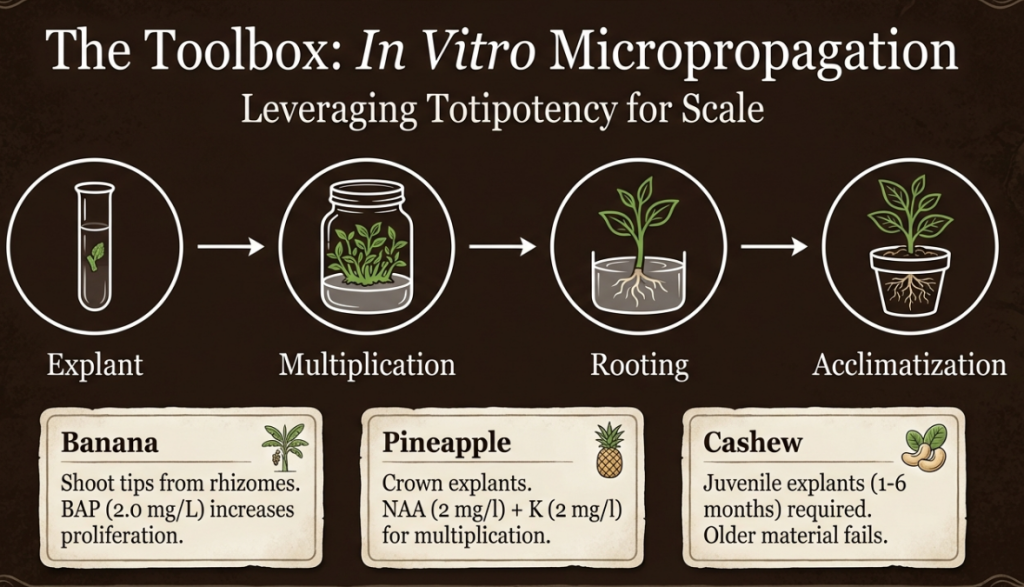
The 3 Pillars of Lab Success:
- Media Composition: A precise balance of inorganic salts and energy (usually 3% sucrose).
- Explant Selection: Choosing appropriate tissue, such as nodal segments of Pomegranate ‘Ganesh’ or lateral buds from Pineapple crowns.
- Proper Sterilization: Utilizing agents like Sodium Hypochlorite (NaOCL) at 0.2% to ensure a germ-free start.
Chemical Conductors: The Role of Growth Regulators (Phytohormones)
In the lab, we are the conductors of a chemical orchestra. We use phytohormones to signal the cells to multiply or root.
| Phytohormone Group | Specific Examples | Master Propagator Insight |
|---|---|---|
| Cytokinins | BAP (2.0 mg/L), Kinetin | Stimulates shoot proliferation (e.g., in Banana). |
| Auxins | BA (4.5 µM), IBA, NAA | Induces rooting; stimulates shoot growth (e.g., in Guava). |
| Gibberellins | GA3 | Promotes lateral bud burst and shoot elongation. |
The “Hormonal Balance” Insight: Transitions are key. For Guava, moving from the “multiplication” stage to the “rooting” stage requires subculturing the shoots into a 1/2 strength MS medium fortified with 1 g/L activated charcoal and specific auxins to ensure fast, extensive root growth.
Micropropagation exploits totipotency to achieve rapid, true-to-type multiplication. We must adhere to specific hormonal concentrations for success:
- Banana: Shoot tips isolated from rhizomes; culture on MS medium fortified with BAP (2.0 mg/L). Elongation is stimulated by IAA (0.1 mg/L) and 10% coconut water.
- Pineapple: Lateral buds from the crown; utilize MT medium with NAA, IBA, and K (2 mg/L each).
- Papaya: Lateral buds or shoot tips; proliferation requires MT medium with 0.5 mg/L BA and 0.1 mg/L NAA, while rooting is achieved at high frequency using IBA.
- Cashew: Tanzanian elite clone AC4 performs best on MS media with specific macro-elements; juvenile explants (1-6 months) show significantly higher sprouting vigor.
- Guava: Nodal explants on MS medium supplemented with BA (4.5 µM); high concentrations of auxins or gibberellins are generally avoided during shoot multiplication.
Strategic Analysis: While traditional methods offer low-cost implementation, in vitro protocols provide the exponential multiplication rates necessary for the rapid dissemination of Modern Varieties (MVs).
4. Quantitative Genetics and Selection Theory
Mathematical rigor in clonal breeding is predicated on the concept of broad-sense heritability (H2). Because clonal propagation maintains the entire genome intact, H2 is the most accurate predictor of selection response.
Broad-Sense Heritability (H2)
On a single-plant basis (H1), heritability is defined as the ratio of genetic variance (σg2) to phenotypic variance (σp2):

Where σe2 represents environmental variance. When genotypes are replicated n times, the modified formula for heritability (Hn) becomes:

Replication effectively reduces the environmental noise, thereby raising the heritability of the mean.

Identifying the Superior Genotype
The breeder’s challenge is to overcome the variance caused by external factors to identify the true genetic potential of a plant.
| Component | Definition | Impact on Selection |
|---|---|---|
| Genetic Variance (σg2) | Diversity driven by the plant’s total DNA constitution. | The “signal” the breeder seeks to fix and replicate. |
| Environmental Variance (σe2) | Diversity caused by external factors (soil, light, water). | The “noise” that can mask a poor genotype or mimic a good one. |
The Clonal Advantage: Clonal propagation is uniquely suited for polyploids because it allows the breeder to fix the total genetic variance. In traditional seed crops, only simple additive effects are easily passed on. In clones, however, dominance and epistatic effects remain “fixed.” This is why a complex hexaploid sweet potato can be mass-produced while maintaining its specific, synergistic genetic interactions. With this mathematical understanding of heritability, we can now determine the most efficient way to allocate field resources.
Selection Effectiveness
Effectiveness is defined as the proportion of top phenotypes selected that are expected to be the best genotypes. As a consultant, I must emphasize that selection response in clones is “complete”—we fix all epistatic and dominance effects, unlike seed crops where only additive variance (h2) is typically utilized.
Strategic Analysis: There is a mathematical trap when H1 is low. Increasing selection intensity (p) in low-heritability environments decreases selection effectiveness. This occurs because extreme phenotypic values are more likely to be the result of favorable environmental “luck” (positive σe2) rather than superior genetics, leading to a high rate of false positives.
5. Optimization of Selection Trials: The Replication Debate
The breeder’s most difficult trade-off in initial trials is whether to prioritize replication (precision) or the number of unique genotypes (diversity) within a fixed trial area.
The Aikman & Langton Model
The consensus among quantitative geneticists, notably Aikman & Langton (1983), is that for a fixed trial area, the strategic goal must be to maximize the number of unique genotypes.
| Heritability Level | Impact of Replication | Recommended Approach |
|---|---|---|
| High (H1=0.9) | Marginal; Hn cannot significantly exceed H1. | Single-plant trials; maximize diversity. |
| Intermediate (H1=0.5) | Modest benefit to precision; often fails to offset lost genotypes. | Single-plant trials are generally superior. |
| Low (H1=0.1) | Large impact on Hn but requires 10-fold replication. | Ignore low-H1 traits or accept lower precision for higher diversity. |
Key Finding: Replication is only mathematically justified when very high selection intensities are applied to characters with extremely low heritability. In all other scenarios, it is superior to grow one representative plant of more genotypes.
Strategic Analysis: The greatest risk in early-stage breeding is the “left in the seed packet” risk. By occupying trial space with replicates, the breeder leaves potentially elite genotypes in storage. This concludes that the opportunity cost of lost genetic diversity is far higher than the gain from increased phenotypic precision. These findings are statistically robust, holding true even when genetic variation follows a non-Normal (Beta) Distribution or exhibits Negative Skewness.
6. Socio-Economic Perspectives: Formal vs. Participatory Breeding
A variety’s mathematical superiority in a trial is irrelevant if it fails the test of farmer adoption. This requires harmonizing quantitative rigor with end-user requirements.
Categorizing Breeding Approaches
- Formal Plant Breeding (FPB): Scientist-led, heavy focus on quantitative genetics and on-station trials. Produces Modern Varieties (MVs).
- Indigenous Plant Breeding (IPB): A 60-century tradition of farmer selection that has domesticated the world’s clonal staples. Produces Farmer-bred Varieties (FVs).
- Participatory Plant Breeding/Selection (PPB/PVS): Collaborative models designed to bridge the gap between FPB and IPB.
The Adoption Gap
In many regions, FVs continue to dominate despite decades of scientific intervention. This disparity suggests that FPB often optimizes for yield in high-input environments while neglecting the complex stress-tolerance and quality traits prioritized by farmers.
Strategic Analysis: The historical failure to include farmers in the selection process has undermined the adoption of scientifically improved clones. To be successful, the transition from Section 5’s single-plant trials to variety release must include PVS stages to ensure the mathematically “best” genotypes also possess the local adaptation required by the end-user.
7. Conclusion
Effective clonal breeding is a synthesis of quantitative precision and physiological expertise. We must prioritize maximizing genetic diversity in initial trials—growing single plants of as many genotypes as possible to avoid leaving superior candidates “in the seed packet.” Once identified, these elite genotypes must be maintained and disseminated using technically precise multiplication methods—ranging from air layering during the May success peak to MS-based in vitro protocols—while ensuring that the breeding objectives are co-developed with the farmers who will ultimately grow them.

Image Summary


Questions/Answers
1. How do breeders use sexual crossing to improve asexual clones?
Breeders improve asexual clones by interrupting the cycle of vegetative propagation with a sexual crossing step to generate new genetic variation. Because clones are genetically fixed and typically highly heterozygous, they do not produce “true-to-type” offspring through seeds; instead, sexual reproduction allows for the recombination of genes, creating thousands of unique genotypes from which superior individuals can be selected.
The following strategies are used to leverage sexual crossing for clonal improvement:
1. Recombination and Fixation of Heterosis
- Generating Variation: Crossing two heterozygous parents produces a segregating F1 population where each seed plant is a potential new variety.
- Fixing Hybrid Vigor: Once a superior individual is identified from this sexual population, its unique genetic combination—including additive, dominance, and epistatic effects—is “fixed” and maintained indefinitely through asexual multiplication. This allows breeders to exploit heterosis (hybrid vigor) more effectively than in seed-propagated crops, where such combinations would be broken apart by subsequent sexual generations.
2. Ploidy Manipulation and Analytical Breeding
- Capturing Wild Diversity: Many clonal crops (like potatoes and bananas) have wild relatives with lower ploidy levels. Breeders use analytical breeding to decrease the chromosome number (using haploids) to capture diversity from these wild species through crossing.
- Sexual Polyploidization: Breeders use 2n gametes (unreduced pollen or eggs) to return these improved diploid hybrids to higher ploidy levels (e.g., tetraploid) through unilateral or bilateral sexual polyploidization.
- Evolutionary Breeding: In triploid crops like bananas, breeders use diploid crosses that produce 2n eggs to broaden the genetic base and create new tetraploid or secondary triploid hybrids.
3. Trait Introgression from Wild Species
- Resistance and Stress Tolerance: Sexual crossing is the primary method for introgressing specific traits (such as disease resistance or drought tolerance) from wild species into adapted cultivated clones.
- Backcrossing: While challenging due to inbreeding depression in clonal species, backcrossing can be used to transfer specific major genes into an elite clonal background.
4. Mating Designs for Parental Selection
- Combining Ability: Since the performance of a clone itself is not always a good predictor of its value as a parent, breeders use sexual crosses to evaluate General Combining Ability (GCA) and Specific Combining Ability (SCA).
- Polycrossing: To facilitate random mating among multiple selected parents, breeders use polycross nurseries, where selected genotypes are grown together in isolated plots to produce synthetic populations through natural insect or wind pollination.
5. Overcoming Flowering Barriers
- Flowering Induction: Many clonal crops have reduced flowering or are sterile. Breeders use special protocols to force sexual reproduction, such as manipulating photoperiod and light intensity, applying phyto-hormones, or grafting difficult-to-flower clones onto more profuse-flowering understocks (e.g., grafting sweet potato onto Ipomoea nil or potato onto tomato roots).
Once these sexual crosses produce seeds, the resulting seedlings undergo several years of clonal selection (e.g., A-clones, B-clones) to evaluate them for yield, quality, and stability across multiple environments before a final genotype is released as a new commercial variety.
2. What are the major challenges of maintaining virus-free clonal varieties?
Maintaining virus-free clonal varieties is one of the most difficult and expensive aspects of clonal crop management. The major challenges include the following:
- Ease of Transmission via Vegetative Parts: Unlike seed-propagated crops where many pathogens are filtered out during seed development, viruses are easily transmitted through the vegetative plant parts (stems, tubers, cuttings) used for clonal propagation.
- Lack of Chemical Controls: Viruses are particularly threatening because, unlike fungal or bacterial diseases, they cannot be controlled with chemicals. Control depends entirely on preventing infection and spread by insect vectors, such as aphids and whiteflies.
- Vulnerability to Epidemics: Because all plants in a clonal variety are genetically identical, they are all equally susceptible to the same strain of a pathogen. This uniformity means that once a virus enters a population, it can cause a devastating epidemic that destroys the entire crop.
- Difficulty and Time Required for Purification: If a variety becomes infected, restoring it to a virus-free state is a lengthy process. Methods such as thermotherapy (heat treatment) followed by meristem culture (using the often virus-free tissue at growing tips) are required. For crops like sweet potato, this process can take at least 18 months.
- Maintenance Logistics: Traditional maintenance involves protecting a small number of “mother plants” in expensive, vector-proof greenhouses. Scaling this up to produce “S-clones” (seed clones) for farmers requires rigorous “roguing” (removing any plant showing symptoms) and selecting production sites in cool highlands or coastal areas where insect vectors are less active.
- Infrastructure and Distribution Gaps: In many tropical and subtropical regions, the distribution channels for certified virus-free material are nearly non-existent. Small-scale farmers often rely on their own or neighbors’ potentially infected materials, and they may lack the resources to separate seed production from commercial production areas.
- Storage Challenges: Most clonal propagules are fresh, succulent materials that are difficult to store for long periods without deteriorating or becoming prone to further infection.
Because a unique clone cannot be reproduced by crossing its parents again, failing to safeguard it from systemic viral infection can lead to the permanent loss of that specific variety.
3. How does farmer participation influence the selection of local cultivars?
Farmer participation significantly influences the selection of local cultivars by ensuring that new varieties align with specific local needs, environmental constraints, and consumer preferences. This collaborative process, often termed Participatory Plant Breeding (PPB) or Participatory Variety Selection (PVS), contrasts with formal plant breeding (FPB) by prioritizing stability and diverse criteria over broad spatial adaptation.
Expanded Selection Criteria
One of the most profound ways farmers influence selection is through the use of a much broader range of criteria than scientists.
- Attribute Volume: Research indicates that farmers may use up to 51 attributes to describe and distinguish varieties, whereas scientists often focus on about 11.
- Diverse Priorities: Beyond yield, farmers select for traits such as palatability (grain and straw), storage life, processing qualities, and culinary characteristics. For example, in sweet potato breeding, farmers prioritize root size and shape, drought tolerance, and mealiness after cooking.
- Visual Screening: Farmers primarily use visual screening in early stages to eliminate genotypes with unacceptable visual characteristics (size, shape, color), preventing undesirable clones from progressing into late-stage trials.
Local Adaptation and Risk Management
Farmer participation is essential for developing cultivars suited to marginal or highly variable environments.
- Decentralized Selection: In regions like the Andes, microclimates vary so significantly that broad adaptation is unrealistic; successful breeding there requires decentralization and farmer participation to ensure varieties are adapted to local soil, rainfall, and pests.
- Stability Over Yield: Farmers in stress-prone environments often prefer yield stability (the ability to produce some yield even in the driest years) over high yield potential in favorable years.
- Buffering Risk: Farmers tend to maintain genetic diversity through heterogeneous cultivars to buffer against total crop failure, a strategy that contradicts the modern breeding trend toward uniformity.
Management of Genetic Diversity
Farmers play a unique role in identifying and maintaining local genetic resources.
- “Volunteer” Seedlings: In many clonally propagated crops like cassava, potato, and yam, farmers observe and incorporate “volunteer” plants (spontaneous hybrids from sexual reproduction) into their stocks of clones, effectively generating and fixing new diversity.
- Maintaining Ideotypes: Farmers successfully maintain varietal ideotypes based on highly heritable morphological traits even in the presence of extensive gene flow.
- In Situ Conservation: By saving and selecting their own seed, farmers provide a dynamic conservation approach, allowing local cultivars to evolve in response to changing natural and artificial selection pressures.
Transformation of the Breeding Process
Incorporating farmers transforms the breeding cycle from a supply-driven model to a demand-driven one.
- Faster Adoption: Because farmers gain intimate knowledge of varietal performance during the selection process, adoption rates for selected varieties are higher and occur much faster—sometimes as early as three years after starting a program.
- Increased Efficiency: PPB in early selection steps increases efficiency by minimizing the risk of making wrong selection decisions regarding traits that formal breeders might otherwise ignore.
- Empowerment: The cyclic nature of participatory programs enriches both the farmers’ negotiation capabilities and the scientists’ understanding of indigenous knowledge.
4. How do breeders force flowering in crops that rarely bloom?
To force flowering in crops that rarely bloom or are difficult to cross, breeders employ several specialized protocols and techniques focused on environmental manipulation, grafting, and chemical stimulation:
- Environmental Manipulation: The most critical factors affecting flowering are photoperiod (day length) and light intensity. By controlling these variables in greenhouse settings, breeders can simulate the specific conditions required to trigger a plant’s reproductive phase.
- Grafting: This is a common technique used across several species to induce or enhance flowering:
- Sweet Potato: Flowering can be easily induced by grafting the crop onto Ipomoea nil (a related species with 30 chromosomes).
- Potato: Breeders may graft difficult clones onto the roots of tomato plants. This technique can improve the amount and duration of flowering and reduce the likelihood of the plant aborting newly pollinated flowers.
- Cassava: Stems from non-flowering varieties are sometimes grafted onto profuse, early-branching understocks. While this may not always induce flowering in the first season, there is evidence of a “carryover effect” when those grafted branches are used as planting material in the subsequent season.
- Exogenous Phyto-hormone Application: Chemical stimulants are used to promote earlier and more abundant blooms. In cassava, for instance, breeders apply indole acetic acid (IAA) and naphthalene acetic acid (NAA) directly to the foliage to encourage reproduction. In other cases, growth regulators like Gibberellic acid (GA3) may be used to stimulate bud burst or growth.
- Specialized Propagation Environments: For potatoes, crossings are often made using flower sprouts obtained from cuttings of field plants. These are then grown in nutrient solutions within greenhouses to ensure a controlled environment that maximizes the chances of successful flower development and pollination.
These interventions are necessary because many clonally propagated crops have been selected for vegetative products (like tubers or roots), which often results in reduced natural fertility and limited flowering.
5. What is the role of unreduced 2n gametes in bananas?
In the breeding of bananas and plantains (Musa spp.), unreduced 2n gametes (gametes possessing the sporophytic chromosome number of the parent) serve as critical tools for ploidy manipulation and broadening the genetic base of the crop.
The roles of 2n gametes are specialized based on the breeding objective:
1. Generating Tetraploid Hybrids
Because cultivated bananas and plantains are typically triploid (3x) and highly infertile, 2n gametes are essential for creating new genetic variation.
- Mechanism: Breeders hybridize triploid “female” parents with diploid “male” parents. Some triploid parents (such as the ‘Gros Michel’ banana or ‘Laknau’ plantain) occasionally produce unreduced triploid eggs.
- Result: When these unreduced eggs are fertilized by normal haploid (n) pollen from diploid accessions, the resulting offspring are tetraploid hybrids (4x).
2. Capturing Allelic Diversity
Unreduced gametes allow breeders to capture and transfer the unique genetic combinations found in established clones.
- Fixing Traits: Heterozygous triploid clones, which have been selected by farmers over centuries for their performance, act as sources of allelic diversity.
- Transfer to Progeny: These diverse alleles are delivered to the next generation (the tetraploid hybrids) via the 2n eggs, where they are further broadened by the addition of alleles from the diploid parent.
3. Creating New Triploid Hybrids
Unreduced gametes also play a role in Unilateral Sexual Polyploidization (USP) to create triploid hybrids.
- Diploid Crosses: Triploid Musa hybrids can be produced by crossing selected diploid stocks, provided that one of the parents produces 2n gametes (either unreduced pollen or unreduced eggs).
- Secondary Triploids: In advanced breeding schemes, secondary triploids can be created by crossing elite tetraploids with diploids, both of which produce normal reduced (n) gametes.
4. Analytical and Evolutionary Breeding
The use of 2n gametes is a cornerstone of analytical breeding, a strategy designed to capture germplasm diversity from wild or unadapted species that often exist at lower ploidy levels. By utilizing unreduced gametes, breeders can move genetic material between ploidy levels to improve crop adaptation and resistance to pests and diseases, such as Black Sigatoka and Panama disease.
6. Can you explain how analytical breeding uses ploidy manipulation?
Analytical breeding is a strategic approach that utilizes ploidy manipulation—the intentional increasing or decreasing of complete chromosome sets—to capture genetic diversity from wild species and incorporate it into elite cultivated clones. This method is particularly effective for major food crops like potatoes, yams, cassava, and bananas, which often have wild relatives with lower ploidy levels.
The process generally follows a cycle of reduction and restoration of ploidy levels:
1. Capturing Diversity through Ploidy Reduction
Many elite clonal crops are polyploid (e.g., tetraploid potatoes), while their wild relatives are often diploid.
- Haploid Extraction: Breeders use specialized techniques to produce haploids or dihaploids (plants with half the standard chromosome number) from cultivated varieties. In potatoes, maternal haploids are often obtained via parthenogenesis or anther culture.
- Diploid Crossing: These reduced-ploidy clones are then crossed with diploid wild species. This stage allows breeders to easily “capture” desirable traits from wild germplasm—such as disease resistance or environmental stress tolerance—into a simplified genetic background.
2. Restoring Ploidy through Sexual Polyploidization
Once diversity is captured at the lower ploidy level, breeders must return these improved hybrids to the crop’s original polyploid state to restore vigor and yield. This is achieved using 2n gametes (unreduced pollen or eggs that possess the full somatic chromosome number of the parent).
- Unilateral Sexual Polyploidization (USP): A cross between a diploid (2x) producing 2n gametes and a tetraploid (4x), resulting in tetraploid offspring (n + 2n = 4x).
- Bilateral Sexual Polyploidization (BSP): A cross between two diploids that both produce 2n gametes, creating a novel tetraploid (2n + 2n = 4x).
3. Overcoming Biological Barriers
Analytical breeding uses specific genetic systems to ensure these crosses are successful:
- Endosperm Balance Number (EBN): In crops like potato, successful hybridization requires a 2:1 ratio of maternal to paternal contributions to the endosperm for normal seed development. Breeders manipulate ploidy levels to satisfy this “dosing system”.
- Meiotic Mutants: Breeders identify and use meiotic mutants that naturally produce 2n gametes, facilitating the jump back to higher ploidy levels.
Examples in Major Crops
- Potato: Breeders use dihaploids to introgress late blight resistance from wild diploid species like Solanum microdontum, then use 2n gametes to move that resistance back into the cultivated tetraploid pool.
- Banana and Plantain: Because triploid bananas are often sterile, breeders use evolutionary breeding. They cross diploid species that produce 2n eggs with normal diploid pollen to create tetraploid hybrids, which can then be crossed back with diploids to produce new, improved triploid varieties.
By utilizing these ploidy shifts, analytical breeding allows for a more precise broadening of the genetic base than traditional crossing, enabling breeders to exploit the heterosis (hybrid vigor) and non-additive gene effects that are fixed and maintained through clonal propagation.
7. Why can’t viruses in clonal crops be controlled with chemicals?
Viruses in clonal crops cannot be controlled with chemicals because they are systemic pathogens that reside inside the plant’s cells and are distributed throughout its vegetative parts.
The sources highlight several reasons for this lack of chemical control:
- Internal vs. External Pathogens: Chemical treatments, such as surface sterilization, are effective only for eliminating pathogens that are external to the plant material, such as those found on the outside of tubers. Because viruses live within the host’s cellular machinery, they are unreachable by these types of treatments.
- Targeting Vectors Instead of Viruses: Since the virus itself cannot be treated chemically, control efforts are focused on the insect vectors (primarily aphids and whiteflies) that spread them. Breeders use intensive applications of insecticides to prevent vector populations from developing and infecting “mother plants”.
- Need for Physical Removal: To restore an infected variety to a virus-free state, breeders must use physical and biological methods rather than chemical ones. This typically involves thermotherapy (prolonged heat treatment to inhibit viral replication) followed by meristem culture. Meristems are used because these fast-growing terminal points are often the only part of an infected plant that remains virus-free.
- Genetic Vulnerability: Because all plants in a clonal variety are genetically identical, they are equally susceptible to the same strain of a virus. Once a virus bypasses external protections, there is no internal genetic variation to prevent it from devastating the entire crop, and no chemical “cure” to stop its progression.
8. How do breeders use reciprocal recurrent selection to exploit heterosis?
Reciprocal recurrent selection (RRS) is a systematic breeding method used to exploit heterosis (hybrid vigor) by simultaneously improving two complementary gene pools to produce superior hybrids. While traditionally associated with seed crops like maize, it is increasingly viewed as the “way ahead” for clonally propagated crops to move beyond trial-and-error selection and achieve consistent genetic gains.
The process of using RRS to exploit heterosis involves the following strategies and steps:
1. Defining Heterotic Groups
- Establishment of Populations: Breeders first identify or create at least two genetically divergent populations (Population A and Population B).
- Complementary Traits: These heterotic groups are often selected based on their specific combining ability (SCA), where their cross results in high-performing progeny. For example, in sweet potato, breeders have identified the “Jewel” gene pool (North American varieties) and the “Zapallo-SPK” gene pool (South American and African varieties) to test for heterotic effects.
2. Mating and Testing for Combining Ability
- Inter-pool Crossing: Genotypes from Population A are crossed with a “tester” from Population B (and vice-versa) to evaluate their Specific Combining Ability (SCA).
- Evaluating Progeny: The resulting hybrids are tested in various environments to identify which parental combinations produce the most “spark” of genetic superiority, which is often driven by non-additive effects like dominance and epistasis.
- General Combining Ability (GCA): RRS also improves the populations based on their GCA values, ensuring that the average performance of the gene pools increases over time.
3. Within-Group Recombination
- Population Improvement: Once the best-performing inter-pool hybrids are identified, the specific parents that produced them are recombined only within their respective original populations.
- Cycle Repetition: This creates a new version of Population A and Population B (C1, C2, etc.) that contains a higher frequency of beneficial alleles for heterosis.
4. Fixation and Exploitation of Non-Additive Effects
- Capturing Hybrid Vigor: Because clonally propagated crops are highly heterozygous, their performance is largely determined by non-additive gene action.
- Fixing the Genotype: In clonal breeding, once a superior individual is identified from an RRS cross, its unique genetic combination—including all additive, dominance, and epistatic effects—is “fixed” and maintained indefinitely through asexual multiplication. This allows breeders to exploit complex genetic interactions that would be broken apart in seed-propagated crops.
5. Integration with Modern Technologies
- Genomic Selection (GS): Breeders use Genomic Predicted Cross-Performance (GPCP) to select parents based on the predicted total genetic value of their progeny. This balances the need to increase beneficial additive alleles while preserving the heterozygosity required to exploit dominance effects.
- Inbred Progenitors: In crops like cassava, breeders are exploring the use of doubled haploids to create inbred lines within heterotic groups. This would allow for “designing” outstanding hybrids by crossing two homozygous lines, eliminating within-family variation and making the identification of superior clones more predictable.
6. Crop-Specific Applications
- Bananas and Plantains: The “evolutionary breeding approach” for Musa species is considered a form of RRS, using diploid and tetraploid gene pools to develop triploid varieties.
- Cassava: RRS is proposed as a means to move off the current yield plateau by forming heterotic gene pools that separate the improvement of additive and non-additive effects.
9. How do breeders synchronize flowering between early and late-branching types?
To synchronize flowering between early-flowering genotypes and late-branching (or non-flowering) types, breeders use a combination of staggered planting, chemical induction, and specialized horticultural techniques. This is particularly challenging in crops like cassava, where flowering is often linked to branching: early-branching types flower much sooner (4–5 months) than erect, late-branching types (10 months or more).
Breeders employ the following strategies to overcome these temporal barriers:
1. Staggered Planting
The most common manual strategy is to clone and plant the same genotype at different intervals throughout the year. By staggering the planting dates, breeders ensure that receptive flowers from the early-branching types are available at the same time as those from the later-branching parents.
2. Exogenous Phyto-hormone Application
Breeders can induce earlier and more abundant flowering by applying growth regulators directly to the foliage. In cassava, for example, the application of indole acetic acid (IAA) and naphthalene acetic acid (NAA) is used to stimulate reproductive development.
3. Grafting Techniques
Grafting is a powerful tool to force flowering in difficult or late-branching clones:
- Induction by Understocks: Stems from late-flowering or non-flowering varieties are grafted onto profuse, early-branching understocks.
- Carryover Effect: While grafting may not always induce flowers in the first season, branches taken from these grafts and used as planting material in the subsequent season often show a “carryover effect” that results in successful flowering.
- Interspecific Grafting: In other clonal crops, breeders graft difficult clones onto related species known for profuse blooming, such as grafting potato onto tomato roots or sweet potato onto Ipomoea nil.
4. Environmental Manipulation
Breeders manipulate the greenhouse or field environment to trigger the reproductive phase. Photoperiod (day length) and light intensity are identified as the most critical factors influencing the timing and abundance of flowers in vegetatively propagated crops.
5. Leveraging Multiple Flowering Cycles
Fortunately, many clonal genotypes flower more than once during a single growing cycle. This provides breeders with multiple windows of opportunity to find a match between parents that would otherwise be out of sync.
10. How can markers help in pyramiding multiple disease resistances?
Molecular markers facilitate the pyramiding of multiple disease resistances by allowing breeders to identify and combine specific resistance genes or quantitative trait loci (QTLs) without relying solely on phenotypic observation. This process is particularly valuable in clonal crops like potatoes and cassava where traditional breeding is slow.
Markers assist in pyramiding through the following mechanisms:
- Simultaneous Selection for Multiple Traits: Markers enable the “pyramiding” of multiple monogenic traits or several QTLs for a single target trait, such as broad-spectrum resistance, into a single plant genotype. This is often achieved through marker-assisted introgression, which speeds up the broadening of the genetic base by allowing breeders to select for desired resistance genes while simultaneously selecting against the undesirable parts of the wild relative’s genome.
- Managing Major and Minor Genes: Breeders can use markers to identify and temporarily exclude major monogenic resistance genes while they accumulate multiple minor genes with additive effects. Once a target level of “horizontal” resistance is reached, the single major gene can be crossed back in to create a “pyramid” that combines both minor and major gene effects for enhanced long-term stability.
- Early-Stage Screening: Markers allow for selection at the seedling stage, which significantly shortens the lengthy breeding cycle by eliminating susceptible individuals before they are multiplied for expensive field trials.
- Overcoming Environmental Constraints: Markers are essential for selecting traits whose phenotypic expression depends on specific environmental conditions or developmental stages. For instance, markers can identify resistance to a specific virus in regions where the pathogen is not currently present, preventing accidental outbreaks during the testing phase.
- Maintaining Recessive Alleles: Markers can be used to track and maintain recessive resistance alleles during complex crossing or backcrossing schemes that would otherwise be invisible to visual selection.
- Prolonging Resistance Life: In the context of “vertical” (single-gene) resistance, pyramiding multiple resistance genes from different wild species can prolong the durability of the resistance, making it harder for the pathogen to overcome the plant’s defenses.
While pyramiding is highly effective for monogenic traits, it remains challenging for complex traits where many small-effect QTLs are involved or where markers for multiple sources of resistance are not yet available due to high rates of recombination.
11. Can horizontal resistance provide more durable protection against crop pests?
Yes, horizontal resistance provides significantly more durable and stable protection against crop pests compared to single-gene vertical resistance. While vertical resistance is often complete but unstable, horizontal resistance is polygenic (multiple-gene) and quantitative, allowing it to provide permanent protection that is beyond the capacity for micro-evolutionary change of the parasite.
The sources highlight several reasons why horizontal resistance is more durable:
- Stability Against New Strains: Unlike vertical resistance, which typically breaks down as new races or strains of a parasite emerge, horizontal resistance remains unaffected by the parasite’s ability to evolve. This eliminates the “boom and bust” cycle often seen in cultivar production.
- Mechanism of Control: Horizontal resistance is designed to control “auto-infection” (where parasites are born or hatched on the host they are infecting), which can only be managed through polygenic mechanisms.
- Comprehensive Health: Breeders can use horizontal resistance to target all locally important parasites simultaneously, achieving a level of “good health” for the plant that effectively removes the need for pesticides.
- Population Immunity: Horizontal resistance works alongside biological controls to reduce the parasite’s population growth to zero or below, creating population immunity even if individual plants are not entirely immune.
Historical and Biological Examples of Durability
- Maize in Tropical Africa: After the accidental introduction of Tropical rust (Puccinia polysora) in the 1940s, African maize varieties developed high levels of horizontal resistance through natural and subconscious selection. This resistance has endured for half a century without any suggestion of breaking down.
- Ancient Clones: Crops like aroids, bananas, dates, ginger, and yams possess high levels of horizontal resistance that has endured for centuries or even millennia.
- Potatoes: In Mexico, horizontally-resistant potato cultivars like Sangema and Tollocan require only one or two fungicide sprays per season, compared to 25 sprays for susceptible varieties.
Challenges in Selection
Despite its durability, horizontal resistance can be easily obscured by several misleading variables during the breeding process. Factors such as parasite interference (where parasites move from susceptible plants to resistant ones, making the latter look susceptible) or environmental erosion (where a cultivar appears less resistant because it is moved to an area with higher disease pressure) often lead breeders to underestimate its value.
Because horizontal resistance is quantitative, it never provides the 100% “total” protection of vertical resistance, but it can reduce damage to negligible levels permanently. For these reasons, it is highly recommended for participatory plant breeding, as it avoids the “heart-breaking” failure of cultivars when single-gene resistances inevitably break down.
Bibliography
Acquaah, G. (2012). Breeding clonally propagated species. In Principles ofPlant Genetics and Breeding (2nd ed., pp. 374–381). John Wiley and Sons.
Aikman, D. P., & Langton, F. A. (1983). REPLICATION IN INITIAL SELECTION TRIALS OF CLONALLY PROPAGATED CROPS. In Euphytica (Vol. 32).
Antônio Bisognin, D. (2011). Brazilian Society of Plant Breeding. Printed in Brazil Breeding vegetatively propagated horticultural crops. In Crop Breeding and Applied Biotechnology (Vol. 1).
Ceballos, H., Kawuki, R. S., Gracen, V. E., Yencho, G. C., & Hershey, C. H. (2015). Conventional breeding, marker-assisted selection, genomic selection and inbreeding in clonally propagated crops: a case study for cassava. In Theoretical and Applied Genetics (Vol. 128, Number 9, pp. 1647–1667). Springer Verlag. https://doi.org/10.1007/s00122-015-2555-4
Gemenet, D. C., & Khan, A. (2017). Opportunities and challenges to implementing genomic selection in clonally propagated crops. In Genomic Selection for Crop Improvement: New Molecular Breeding Strategies for Crop Improvement (pp. 185–198). Springer International Publishing. https://doi.org/10.1007/978-3-319-63170-7_8
Grüneberg, W. J., Mwanga, R., Andrade, M., & Espinoza, J. (2009). Selection methods part 5: Breeding clonally propagated crops. In Plant Breeding and Farmer Participation.
McKey, D., Elias, M., Pujol, M. E., & Duputié, A. (2010). The evolutionary ecology of clonally propagated domesticated plants. In New Phytologist (Vol. 186, Number 2, pp. 318–332). https://doi.org/10.1111/j.1469-8137.2010.03210.x
Mumm, R. H. (n.d.). New Line Development and New Line Evaluation: Clonally Propagated Cultivars. In Plant Breeding E-Learning in Africa. Retrieved https://pbea.agron.iastate.edu
Nybom, H., & Lācis, G. (2021). Recent large-scale genotyping and phenotyping of plant genetic resources of vegetatively propagated crops. In Plants (Vol. 10, Number 2, pp. 1–30). MDPI AG. https://doi.org/10.3390/plants10020415
Sharma, K., & Thapa, T. (2021). The Various Methods used for the Clonal Propagation in Horticultural Crops: A Review. Agricultural Reviews, (Of). https://doi.org/10.18805/ag.r-2136
V, S., Garkoti, P., Singh, A., & Thakur, A. (2025). BREEDING WITHOUT SEEDS: INNOVATIONS IN CLONAL CROP IMPROVEMENT. 5(8). www.agriindiatoday.in
Werner, C. R., Gaynor, R. C., Sargent, D. J., Lillo, A., Gorjanc, G., & Hickey, J. M. (2023). Genomic selection strategies for clonally propagated crops. Theoretical and Applied Genetics, 136(4). https://doi.org/10.1007/s00122-023-04300-6


Related posts:
 The Evolutionary Genomics of Crop Plants: From Ancestral Polyploidy to Modern Pangenomes
 Global Strategies for Crop Germplasm Conservation: Integrating Farmer-Based In Situ Methods with Biotechnological Innovation
 The Architecture of Agricultural Resilience: A Definitive Guide to Centers of Origin and Genetic Diversity
 Evolutionary Dynamics of Plant Breeding Systems: A Comprehensive Analysis of Mating Strategies
 The Secret of the Seed: An Aspiring Learner’s Guide to Hybrid Vigor and Plant Development


