
1. Introduction: The Strategic Imperative of Genetic Diversity

The global state of agricultural biodiversity has reached a critical juncture. As we confront the necessity of feeding a population projected to exceed nine billion by 2050, our reliance on an increasingly narrow genetic base—dominated by a few elite cultivars—presents a systemic risk to food security. To mitigate this, we must recognize that Crop Germplasm Conservation is not merely a preservation exercise but a strategic imperative to maintain the evolutionary potential of our crops. Central to this mission are Plant Genetic Resources (PGRs): the sum total of all alleles within a plant species and its wild relatives.

A robust conservation framework requires a mandatory synergy between traditional agricultural knowledge and modern science. While gene banks provide a vital archive, they cannot replicate the dynamic selective pressures of the field. Conversely, traditional farming systems are increasingly vulnerable to rapid-onset pathogen pressure and climate shifts. Constructing a resilient agricultural future depends on our ability to integrate these dual pathways, starting with a deep technical understanding of the mechanisms that drive and preserve genetic variation.

1.1 Why Genetic Diversity is Our Global Insurance Policy
Plant Genetic Resources (PGRs) are the biological “source code” of our planet. Technically, PGRs represent the totality of alleles within a plant species and its wild relatives. This diversity is driven by molecular engines: DNA mutations (the ultimate source of new variation), recombination during sexual reproduction (which reshuffles traits), and gene flow (the movement of genes between populations).
To manage this complexity, we categorize these resources into four primary “tiers” of diversity:
| Source Type | Key Characteristic | Primary Benefit to Breeders | Example (from Source) |
|---|---|---|---|
| Wild Relatives | Occur in nature; genetically similar to crops but undomesticated. | Unique alleles for disease resistance and abiotic stress tolerance. | Wild wheat relatives (Aegilops tauschii) |
| Landraces | Regionally adapted varieties maintained by traditional farmers. | High local adaptation, yield stability, and nutritional density. | Titicaca folk potato varieties |
| Elite Cultivars | Modern, human-selected varieties bred for commercial use. | High yield and uniform performance in optimized settings. | IR64 high-quality rice |
| Breeding Stock | Improved genetic material and mutant lines in active R&D. | Immediate foundation for the next generation of improved crops. | Induced mutant lines for stress response |
The “Funnel of Vulnerability”: The Domestication Bottleneck
To understand why we must conserve these plants, consider the “Funnel of Vulnerability.” Thousands of years ago, humans began selecting wild plants for specific traits like larger seeds or non-shattering pods. This selection acted like a funnel: while we gained high-yielding crops, we filtered out the vast majority of the ancestral “allelic bandwidth.” This Domestication Bottleneck has left modern agriculture with high productivity but dangerously narrow genetic diversity. Without the raw material of mutations and recombination found in the wild, our modern crops are genetically fragile, lacking the resilience to withstand a rapidly changing climate.

The Multi-Dimensional Value of PGRs
To address this erosion, we must recognize that PGRs provide value across three critical pillars:
• Biological: Serving as a reservoir for resistance to biotic stress (pathogens, pests) and abiotic stress (drought, salinity, and temperature extremes).
• Economic: Supporting high-value specialty markets; for instance, the Vanilla planifolia industry relies on natural vanillin derived from cured fruits, which commands a massive premium over synthetic alternatives.
• Sociological: Preserving traditional knowledge and farmer sovereignty, acknowledging that indigenous communities are the de facto curators of our shared biological heritage.
2. Foundations of Genetic Variation and its Role in Crop Improvement
Genetic variation is the “raw material” of the plant breeder’s craft and the biological engine of climate resilience. It provides the diverse allele bandwidth necessary for crops to adapt to drought, salinity, and shifting pest dynamics. Without this variation, selection—whether natural or artificial—stagnates, leaving our agricultural systems brittle.
The following table evaluates the drivers of genetic diversity and their strategic impact on crop development:
| Source of Diversity | Technical Mechanism | Strategic Impact on Crop Improvement |
|---|---|---|
| Mutation | Spontaneous or induced DNA sequence changes; involves programmed DNA double-strand breaks (DSBs). | Accelerates the development of novel traits (e.g., stress tolerance) without disrupting elite backgrounds. |
| Genetic Recombination | Reciprocal exchange (crossovers – COs) or gene conversion (non-crossovers) during meiosis. | Breaks undesirable linkages and assembles favorable trait combinations; exploits heterosis. |
| Gene Flow | Transfer of genetic material between populations via pollen or intentional breeding. | Facilitates “genetic rescue” in small populations but requires biosafety to prevent “superweed” formation. |
| Hybridization | Crossing genetically distinct individuals (intervarietal to intergeneric). | Exploits hybrid vigor and introduces unique alleles for disease resistance from diverse genetic backgrounds. |
| Polyploidy & Introgression | Whole-genome duplication or targeted transfer of segments from wild relatives. | Enhances metabolic vigor and abiotic stress tolerance; introduces resistance genes (e.g., Lr genes from wild wheat). |
| Epigenetics | Heritable variation in gene expression without altering the underlying DNA sequence. | Offers a layer of rapid adaptive response to environmental stressors and climate fluctuations. |
| Genetic Drift | Random fluctuations in allele frequencies, particularly in small populations or isolated collections. | Can lead to the loss of rare but valuable alleles; necessitates frequent monitoring of both in situ and ex situ reservoirs. |
Despite these natural drivers, modern agriculture is constrained by the “domestication bottleneck.” Repeated selection for uniform performance has significantly reduced the allele bandwidth of elite cultivars compared to their wild progenitors. To reclaim this lost diversity, we must pivot toward the primary centers of diversity where landraces continue to evolve.
The following table evaluates the hierarchy of germplasm available to the strategic breeder:
| Germplasm Type | Strategic Advantage | Genetic Characteristics | Integration Challenge |
|---|---|---|---|
| Wild Crop Relatives (CWR) | Extreme tolerance to salinity, heat, and diverse pathogens. | Wide allele bandwidth; untapped genetic reservoirs. | Reproductive barriers and significant linkage drag of deleterious traits. |
| Landraces | High yield stability in marginal agroecosystems; local niche adaptation. | Highly heterogeneous; molded by specific ecological niches. | Low to moderate edible yields; heavy dependence on human agency for survival. |
| Elite Cultivars | Outstanding performance; optimized for commercial/mechanized systems. | Narrow allele bandwidth; selected for uniformity. | High vulnerability to environmental shocks due to a narrow genetic base. |
Navigating the International Regulatory Landscape: CBD, Nagoya, and ITPGRFA
The management of plant germplasm has undergone a strategic shift from being viewed as an “international public good” to a resource governed by national sovereignty and equitable benefit-sharing. This regulatory evolution ensures that the providers of genetic diversity are fairly compensated, though it introduces significant complexities for agricultural research and breeding programs.

The Regulatory Pillars
• The Convention on Biological Diversity (CBD): This established the foundational mandate of sovereign rights over genetic resources, ending the era of “common heritage.”
• The Nagoya Protocol: This supplementary agreement provides the operational mechanism for Access and Benefit-Sharing (ABS). It requires researchers to secure Prior Informed Consent (PIC) and establish Mutually Agreed Terms (MAT), creating a rigorous paper trail for germplasm utilization.
• ITPGRFA: The “Seed Treaty” addresses the specific needs of agriculture through a Multilateral System (MLS) for food and forage crops, facilitating easier exchange while protecting Farmers’ Rights.
The Convention on Biological Diversity (CBD) and the Nagoya Protocol establish the legal framework for Access and Benefit-Sharing (ABS). However, the ITPGRFA (International Treaty on Plant Genetic Resources for Food and Agriculture) provides a critical Multilateral System that facilitates the open exchange of core food crops while protecting Farmers’ Rights.
Comparison of International Frameworks
| Framework | Core Objective | Mechanism of Exchange | Impact on Researchers/Breeders |
|---|---|---|---|
| CBD | Conservation and sustainable use of biodiversity. | Bilateral: Direct negotiation with national authorities. | High administrative burden; requires navigating varying national laws. |
| Nagoya Protocol | Fair and equitable sharing of benefits. | Bilateral: Governed by PIC and MAT legal contracts. | Creates legal liability for biopiracy if compliance is not strictly met. |
| ITPGRFA | Global food security through agricultural exchange. | Multilateral: Pooled germplasm available via Standard Material Transfer Agreements (SMTA). | Simplifies access to essential food crops; provides legal certainty for breeding. |
Top-down regulations must be integrated with practical conservation strategies to ensure that these legal protections translate into biological preservation.

3. The In Situ Paradigm: A Farmer-Based Approach to Landraces
In situ conservation—the maintenance of genetic resources within their original agroecosystems—is vital because landraces are “products of the human habitat.” They are not static artifacts; they are dynamic populations shaped by the interplay of environmental selection and human seed management. For on-site conservation to be plausible, we must decouple its goals from immediate breeding benefits, treating the preservation of evolutionary processes as an end in itself.

Strategic planning must reject the “simple replacement” view—the unilinear model suggesting that modern technology inevitably erodes traditional diversity. Evidence from tropical centers of diversity supports a multilinear model of partial technology adoption, where farmers integrate modern seeds without discarding their biological heritage.

3.1 Implementation Methods
1. Genetic Reserves/Wild Habitats: Establishing biological reserves (like UNESCO MAB programs) where wild relatives can interact with their native ecosystems.
2. On-Farm/Field Conservation: The sustainable management of landraces by farmers within traditional agricultural systems.
The Five Guiding Principles of On-Site Conservation
As defined by Stephen B. Brush, successful on-site conservation must follow these pillars:
• Complementarity: On-site efforts must act as a back-up and partner to gene banks, sharing a common institutional framework.
• Minimalism: We must avoid creating heavy, rigid bureaucracies. Instead, we should encourage activities that farmers are already performing.
• Continuity: Reinforce existing local institutions and incentives rather than trying to build entirely new systems from scratch.
• Development Goals: Conservation is only viable if it meets the farmer’s needs—specifically, increasing farm income and food security.
• Internationalism: Germplasm is an international public good; its protection requires global collaboration across borders.
3.2 The Evolutionary Advantage
The defining advantage of the “Living Laboratory” is the constant evolutionary process. Unlike seeds in a freezer, plants in the field undergo continuous selection pressure from pests, diseases, and shifting climate patterns. This allows for the spontaneous generation of new, co-adapted gene complexes—innovations that “static” storage cannot replicate.
Case Studies in De Facto Strategic Conservation
• Peru (Andean Potatoes): In the Tulumayo and Paucartambo valleys, farmers manage potato diversity as a portfolio. Crucially, research reveals the “fallacy of equating change with loss”: Tulumayo, despite being more modernized and commercially integrated, maintains higher diversity (average 10.3 varieties per household) than the more traditional, isolated Paucartambo (9.6 varieties). Farmers consciously subdivide farms to grow modern varieties for market and native landraces for culinary and cultural value.
• Mexico (Maize): In Chiapas, farmers utilize “creolization” (acriolloizado). By managing seed through infrequent replacement, they allow an admixture of local and improved germplasm. This management practice creates hardy, locally adapted varieties that outperform “pure” improved seed on marginal soils.
• Thailand (Rice): In the Chiang Mai Valley, the high rate of variety turnover (every three years) actually augments diversity. Farmers acquire traditional varieties at a higher rate than modern ones (29 vs. 11 instances), and the adoption of modern rice has increased the village-level diversity index in 75% of surveyed cases.
Institutional frameworks must therefore support these de facto conservationists by meeting their dual development goals of increased farm income and food security.
The Three Pillars of In Situ Advantage
• Continuation of Evolutionary Processes: Unlike seeds “frozen” in storage, plants in the field generate new, adapted alleles by evolving alongside contemporary pests and weather patterns.
• Ecosystem Conservation: This method protects the entire habitat, maintaining the complex symbiotic relationships (such as those with soil microbes and pollinators) that sustain the species.
• Maintenance of the Information Base: In situ conservation preserves local farmer knowledge regarding “culinary quality” and “market premiums” (Brush, p. 157). This knowledge is essential for understanding how traits perform in real-world human habitats.
Four Categories of Germplasm
• Wild Crop Relatives: Species occurring in their habitat without human intervention, sharing genetic similarities with crops.
• Weedy Relatives: Semi-domesticated species that often thrive on field margins or fallowed areas.
• Perennial Species: Especially tree species; these rarely have specific genetic conservation objectives and do not depend on human agency for reproduction.
• Landraces: Ancient, regionally adapted crop populations associated with “cradle areas” of domestication and maintained by traditional farming practices.
4. Ex Situ and Biotechnological Frontiers: The Case of Vanilla planifolia
Ex situ conservation is our “Cold Storage Insurance Policy.” By moving genetic material into controlled facilities, we protect it from the chaos of the natural world.

For species like Vanilla planifolia, the farmer-based in situ model requires a technological redundancy. This orchid possesses a dangerously narrow genetic pool due to centuries of vegetative propagation, making it uniquely vulnerable to the rapid spread of vanilla wilt caused by Fusarium oxysporum f. sp. vanillae. In the Totonacapan region of Mexico—the center of origin where the Totonac and Aztec civilizations first utilized vanilla—this pathogen pressure threatens both biological heritage and the natural vanillin industry.
Biotechnological intervention, specifically in vitro micropropagation, serves as a safeguard against extinction. The process is refined into five strategic stages:
1. Mother Plant Selection: Identifying high-yield, pathogen-free specimens.
2. Disinfection and Establishment: Eliminating contaminants while preserving tissue integrity.
3. Shoot Proliferation: Utilizing plant growth regulators to stimulate multiple axillary buds.
4. Elongation and Rooting: Developing independent root systems.
5. Acclimatization: Gradual transition to greenhouse conditions.
To enhance vigor, we utilize Temporary Immersion Systems (TIS). Unlike semisolid methods, TIS offers semi-automated, periodic contact with liquid media, which, when paired with specialized LED lighting, significantly increases biomass and metabolic quality. A critical biological synergy is the incorporation of Orchid Mycorrhizal Fungi (OMF), which enhances plant resilience and growth through symbiotic nutrient exchange.
• Temporary Immersion Systems (TIS): We are moving beyond traditional semisolid lab methods to semi-automated liquid culture. These TIS bioreactors provide a “metabolic quality” boost, allowing for the mass production of disease-free plantlets with significantly higher vigor.
• Orchid Mycorrhizal Fungi (OMF): This is a “biological upgrade” for the plant’s roots. By inoculating lab-grown plantlets with symbiotic microscopic fungi, we enhance their metabolic quality and resilience to stress, effectively bridging the gap between the sterile lab and the harsh field.
These systems, combined with genomic selection, LED lighting, and precision tools like CRISPR/Cas9, allow us to preserve biological heritage while meeting the demands of a sustainable global industry.
The economic driver for this conservation is the vanilla pod’s value, developed through a rigorous six-stage curing process:
1. Harvesting: Detaching mature pods from the peduncle.
2. Killing: Thermal treatment (63–65°C) to stop growth and trigger the conversion of glucovanillin (the precursor) into vanillin.
3. Sweating: Fermentation to develop the characteristic chocolate brown color.
4. Drying: Sunlight exposure to reduce moisture to 25%.
5. Conditioning: Refining the aroma profile over at least one month.
6. Sorting: Grading for international packing and export.
5. Implementation Frameworks: Principles and Policy Tools
Effective germplasm management requires a shared institutional framework that prevents competition between laboratory and field strategies.
Storage Tiers for “Orthodox” Seeds
For seeds that survive drying (orthodox seeds), we use a tiered storage approach:
• Short-Term: 1 to 1.5 years at 20–22°C (45–50% humidity).
• Medium-Term: Up to 5 years at 0–10°C (20–30% humidity).
• Long-Term: Stored in basic collection centers at -18 to -20°C to maximize viability over decades. (Note: While some historical records omit the negative sign, biological standard for long-term cryopreservation of orthodox seeds requires sub-zero temperatures to halt metabolic decay.)
Five Guiding Principles for Strategic Conservation
1. Complementarity: In situ methods must act as a dynamic back-up and variation generator for gene banks (ex situ).
2. Minimalism: Favoring existing farmer activities over rigid, centralized bureaucracies that are prone to political and financial vulnerability.
3. Continuity: Reinforcing existing incentives, such as local seed fairs and traditional exchange networks.
4. Development Goals: Ensuring conservation efforts meet the dual goals of increasing farm income and ensuring food security through market-based inducements.
5. Internationalism: Treating germplasm as an international public good, requiring global cooperation and funding via the Multilateral System (MLS).
The Role of Grassroots and Information Bases
Monitoring these agroecosystems requires an “Information Base” that simultaneously tracks crop populations, human demographics, and environmental factors. Grassroots Organizations and “Seed Savers Networks” are essential to this base, as they possess the proximity and trust needed to work in marginal areas. Institutions like the Clavijero Botanical Garden exemplify this framework, linking high-tech propagation with the practical needs of traditional custodians.
The Great Contrast: Mechanisms, Advantages, and Limitations
| Feature | In Situ (The Living Lab) | Ex Situ (The Vault) |
|---|---|---|
| Primary Location | Natural habitats / Traditional farms | Gene banks, labs, botanical gardens |
| Evolutionary Status | Dynamic: Ongoing adaptation to nature | Static: Evolution is suspended |
| Accessibility | Difficult: Requires field travel/monitoring | High: Cataloged and ready for breeders |
| Cost & Infrastructure | Low institutional / High social participation | High tech / High facility & energy costs |
| Main Risk | Natural disasters and habitat loss | Equipment failure and genetic drift |
Why Gene Banks Are Not Enough: The Case for Living Evolution
We often treat ex situ gene banks as the ultimate backup, yet these “seeds on ice” represent a frozen snapshot of the past. To ensure the future of food, we must prioritize in situ (on-site) conservation.
Frozen vs. Active: The Evolutionary Difference
• Frozen Conservation (Ex Situ): Gene banks serve as vital safety nets against extinction and natural disasters. However, they isolate germplasm from the environment, effectively “pausing” the evolutionary clock.
• Active Conservation (In Situ): By maintaining landraces in the “human habitat” of the farmer’s field, we preserve the software of evolution. This allows for ongoing recombination, mutation, and gene flow, ensuring that crops continue to adapt to emerging pests and shifting climates.
In situ conservation maintains “co-adapted gene complexes” that are molded and regenerated in specific ecological niches. We aren’t just saving seeds; we are saving the biological processes that generate new traits for the next century.
Common Forms of Ex Situ Conservation
• Seed Gene Banks: The primary method for long-term storage of orthodox seeds—those that can withstand low temperatures and severe desiccation.
• Botanical Gardens: Living collections used for research, education, and the maintenance of species that do not produce easily stored seeds.

• Biotechnological Methods: Includes In Vitro Culture (laboratory regeneration) and Cryopreservation (storage in liquid nitrogen) for endangered or vegetatively propagated species.

Biotechnological Catalysts: Transforming Diversity into Stability
Meeting 2050 food demands necessitates a transition from slow phenotypic selection to data-driven genomic manipulation. To resolve the polygenic complexity of stress traits, we must employ high-precision catalysts to unlock the potential of our genetic reserves.
Evaluation of Emerging Breeding Tools
• CRISPR/Cas9: This system allows for precise, non-transgenic modifications to stress-responsive transcription factors, such as the DREB (dehydration-responsive element-binding) and CBF (C-repeat binding factor) complexes. This enables the rapid development of drought-resilient traits without the regulatory burden of traditional GMOs.
• Genomic Selection (GS) & Marker-Assisted Selection (MAS): These tools leverage whole-genome markers to predict breeding value. By bypassing full phenotypic evaluation, breeders can identify superior genotypes in the juvenile stage, significantly accelerating the breeding cycle.
• Mutation Breeding: The use of physical mutagens (Gamma rays) and chemical agents—specifically EMS (ethyl methanesulfonate) and sodium azide—accelerates the creation of novel alleles. These mutations can enhance antioxidant defense and water-use efficiency without compromising existing agronomic traits.
The Recombination Landscape
Meiotic recombination is the engine of genetic diversity, initiated by DNA double-strand breaks (DSBs) catalyzed by the SPO11 enzyme complex. By understanding meiotic “crossovers” (Type I and Type II), breeders can manipulate the recombination landscape. This precision allows for the breaking of linkage disequilibrium (LD), enabling the resolution of quantitative trait loci (QTL) and the assembly of favorable gene combinations while purging deleterious traits.
The Synergy: How Different Approaches Work Together
The most robust conservation strategy is based on Complementarity. Ex situ collections act as a vital backup for the field, while in situ settings provide a constant source of new, evolved alleles that “static” gene banks lack.
Five Guiding Principles for Integrated Conservation
1. Complementarity: On-site methods must enhance the sustainability of ex situ storage by preserving the habitats that generate new gene complexes.
2. Minimalism: Avoid rigid bureaucracies. Efforts should encourage activities already found in farming systems to ensure they do not fade under social or economic shifts.
3. Continuity: Reinforce existing institutions and market incentives rather than creating redundant new ones.
4. Development Goals: Conservation must increase farmer income and meet human needs to be politically and socially viable.
5. Internationalism: Germplasm is an international public good; its protection requires global collaboration.
Why the “Back-and-Forth” is Essential
1. Genetic Rescue: If a gene bank collection suffers from loss of viability or genetic drift, it can be replenished by returning to the original center of diversity.
2. The Information Base: Farmers in areas like the Tulumayo Valley (Peru) or Chiapas (Mexico) provide the ecological data required to understand trait performance. Notably, in Chiapas, the addition of improved varieties actually augmented the maize germplasm rather than eroding it (Brush, p. 158).
3. Future-Proofing: In situ populations are currently developing the traits needed for future climate extremes—traits that gene banks can periodically “capture” and secure.
5. Case Studies: Potatoes in the Andes and Vanilla in Mexico
Case 1: The Farmer-Based Approach (Peru)
In the central Andes, the cradle of potato diversity (Solanum spp.), highland farmers manage an incredibly complex system. They cultivate four ploidy groups (ranging from diploid 2n=24 to pentaploid 2n=60) and seven different species and subspecies. On a single farm, a household may maintain 30 to 40 distinct types of potatoes, consciously subdividing their land to grow landraces alongside modern varieties.
• Key Lesson Learned: Conservation is driven by utility; farmers preserve diversity because these landraces command higher market prices and offer unique culinary value that modern clones cannot match.
Case 2: The Biotechnological Rescue (Mexico)
At the Clavijero Botanical Garden, the focus is on Vanilla planifolia. Because vanilla has been propagated vegetatively for centuries from a limited number of individuals, its genetic pool is dangerously shallow. This makes it a “sitting duck” for Fusarium wilt. Scientists use micropropagation to create a “clean” foundation for the industry.
• Key Lesson Learned: When natural populations reach a genetic dead-end, ex situ biotechnology is the only way to “reboot” the species with disease-free stock.
6. Conclusion: The Future of Global Germplasm Resilience

Crop germplasm conservation is no longer a choice between the field and the laboratory; it is a mandatory synergy. While biotechnological innovations provide the “technological redundancy” needed to survive acute pathogen threats, the multilinear evolutionary models of traditional farmers provide the long-term adaptive capacity of our species. We must empower farmers as the primary custodians of our biological heritage, ensuring that the laboratory supports, rather than replaces, the field. Only this integrated strategy can secure a resilient global food system.

Image Summary


Questions/Answers
1. What is the difference between in situ and ex situ conservation?
The primary difference between in situ and ex situ conservation lies in whether the genetic resources are maintained within their natural habitats or in artificial, human-managed environments. While distinct in their approach, the sources emphasize that these two strategies are complementary and should be integrated into a holistic conservation plan.
In Situ Conservation (On-Site)
In situ conservation refers to the maintenance and recovery of viable populations of species in their natural surroundings. In the case of domesticated or cultivated species, this occurs in the surroundings where they developed their distinctive properties.
• Location: It takes place “on-site,” which includes natural habitats (such as national parks, wildlife sanctuaries, and genetic reserves) and traditional farming systems (on-farm or home gardens).
• Dynamic Process: A key advantage is that it allows species to continue to adapt and evolve alongside their natural surroundings, pests, and changing climates. This maintains the evolutionary processes that generate new germplasm.
• Management: It relies heavily on human agency in agricultural settings, particularly farmers who engage in the de facto conservation of landraces by planting diverse mixtures for subsistence and commercial use.
• Categories: Methods include genetic reserves for wild species and on-farm management for traditional crop varieties.
Ex Situ Conservation (Off-Site)
Ex situ conservation involves the preservation of components of biological diversity outside their natural habitats. It is primarily used to safeguard populations that are under immediate threat of destruction or genetic erosion.
• Location: It takes place “off-site” in specialized facilities such as gene banks, botanical gardens, arboreta, and laboratories.
• Static/Managed Environment: Germplasm is typically maintained in an artificial environment where metabolic activity is often suspended or reduced to ensure long-term stability. This approach isolates the collection from ongoing natural evolutionary processes.
• Accessibility: It provides easier and ready access to materials for researchers and breeders to evaluate and utilize specific traits for crop improvement.
• Methods:
◦ Seed Storage: The most common method, involving the storage of orthodox seeds at low temperatures and low moisture content.
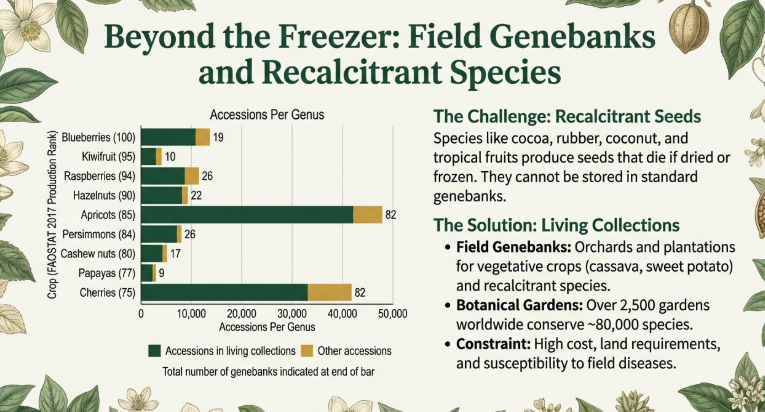
◦ Field Gene Banks: Maintaining living plants in orchards or plantations, which is necessary for recalcitrant species (seeds that cannot survive drying/freezing) or clonally propagated crops (like banana, potato, and apple).
◦ In Vitro Storage: Culturing plant tissues (meristems, cells) in sterile media, often under slow-growth conditions.
◦ Cryopreservation: Suspending growth indefinitely by storing materials in liquid nitrogen at -196°C.
Comparison Summary
| Feature | In Situ Conservation | Ex Situ Conservation |
|---|---|---|
| Location | Natural habitat / Farmer’s field | Outside natural habitat (Gene bank, Garden) |
| Evolution | Dynamic; allows continued evolution/adaptation | Static; evolutionary processes are halted/isolated |
| Primary Goal | Ecosystem and habitat preservation | Safeguarding against immediate loss or extinction |
| Key Advantage | Maintains gene complexes in their ecological niche | Facilitates direct utilization by breeders |
| Risks | Vulnerable to climate change, pests, and land use shifts | Vulnerable to equipment failure, funding cuts, and genetic drift |
While ex situ methods have traditionally dominated the conservation movement due to their direct utility for breeders, there is a growing recognition that in situ methods are vital for maintaining the long-term sustainability of the global gene pool. Successful conservation models, such as those for the Pantiange Heigu rice landrace in China, now systematically combine both strategies to ensure both the survival and the continued availability of genetic diversity.
2. How do crop wild relatives contribute to global food security?
Crop wild relatives (CWR) are wild plant species that are genetically related to cultivated crops and serve as a vital, irreplaceable repository of genetic diversity for global food security. Their contribution is primarily through providing the “raw material” necessary for breeding resilient and productive crop varieties.
1. Reservoirs of Genetic Resilience
Unlike modern cultivars, which often have a narrow genetic base due to the “domestication bottleneck,” crop wild relatives have maintained high levels of genetic variation. They harbor unique alleles and co-adapted gene complexes that allow them to survive in harsh, diverse ecological niches. This diversity is crucial for:
• Abiotic Stress Tolerance: CWR possess genes for enduring extreme environments, including drought, salinity, heat, cold, and nutrient-deficient soils. For example, wild relatives of peanuts and wheat have been used to introduce drought tolerance and salinity resistance into commercial lines.
• Biotic Stress Resistance: They often contain natural resistance to evolving pests and diseases that threaten uniform modern crops. Specific examples include leaf rust resistance in wheat derived from Aegilops tauschii and resistance to root-knot nematodes in tomatoes from Solanum peruvianum.
2. Enhancing Nutritional and Quality Traits
Wild plants often possess higher nutritional value than their cultivated counterparts. By recombining genes from these wild sources, breeders can improve the protein content, essential amino acids, antioxidants, and micronutrients (such as iron and zinc) in staple food crops. They also contribute to better “keeping quality” and unique physical attributes, such as fruit firmness or red-flesh pigmentation, which can be commercially valuable.
3. Adapting Agriculture to Climate Change
As climate change increases the frequency of extreme weather events, the role of CWR in developing “climate-smart” crops has become an urgent necessity. Because CWR continue to adapt and evolve in their natural habitats, they provide a continuous supply of novel genetic material that can help crops adjust to shifting temperatures and altered precipitation patterns. Introgression of these traits is seen as a key strategy for maintaining stable yields in increasingly unpredictable environments.
4. Supporting Ecosystem Stability
CWR are not only useful for breeding but are also central to maintaining sustainable agro-ecosystems. Biodiversity, which includes CWR, underpins ecosystem productivity and functioning, providing essential services such as clean air, water, and soil health. By preserving these species in their natural habitats (in situ conservation), the evolutionary processes that create new, useful genetic variation are maintained, serving as a long-term “insurance policy” for the global food supply.
In summary, crop wild relatives act as a foundational resource for crop improvement. They provide the genetic diversity needed to shield agriculture from biological and environmental threats, thereby ensuring that the world’s food systems remain resilient and capable of feeding a growing population.
3. What role do smallholder farmers play in preserving genetic diversity?
Smallholder farmers are the primary active custodians of agricultural biodiversity, playing an essential role in in situ (on-farm) conservation of genetic resources. Because traditional crop varieties, known as landraces, are “products of the human habitat,” they depend on continuous cultivation and cannot be preserved through isolation in biological reserves alone.
Smallholder farmers preserve genetic diversity through the following roles:
1. “De Facto” Conservation of Landraces
Smallholders frequently engage in de facto conservation by continuing to plant ancient crop populations alongside or instead of modern varieties. In regions of high diversity, such as the Andes for potatoes or Mexico for maize, farmers often manage mixed planting systems, growing improved varieties for market potential while keeping traditional ones for household consumption, culinary appeal, and religious or cultural significance. These landraces often possess unique alleles associated with resistance to local pests, diseases, and extreme weather.
2. Maintaining Evolutionary Processes
Unlike static seed banks, on-farm conservation allows for ongoing evolutionary processes. Farmers act as selection agents, choosing seeds based on specific traits such as grain weight, shape, color, and aroma. Their management practices, such as planting different varieties in close proximity, facilitate spontaneous hybridization and “creolization” (the mixing of local and introduced germplasm). These practices generate new genetic combinations that allow crops to adapt to changing environmental conditions, including climate change.
3. Utilization of Marginal Environments
Smallholders often work in marginal agroecosystems—such as high-altitude basins or nutrient-poor soils—where modern high-yielding varieties are disadvantaged. For example, the “Pantiange Heigu” rice landrace in China is cultivated at 2680 meters above sea level, surviving in cold, waterlogged peat soils where other cultivars might fail. By maintaining these varieties, farmers preserve the specialized genetic material required for resilience in extreme environments.
4. Stewardship and Landscape Management
Indigenous and smallholder communities often engage in broader landscape stewardship, such as maintaining “forest gardens” or orchards of native species like the Pacific crabapple (Malus fusca). Through techniques like prescribed burning, clearing, and fertilizing, these communities “assist succession,” engineering landscapes to increase the distribution and productivity of valued food plants.
5. Complementing Global Gene Banks
Farmer-based conservation provides a critical backup and complement to ex situ gene banks. While gene banks are vital, they can suffer from genetic drift over time and are isolated from the pests and climatic shifts that continue to affect crops in the field. Smallholders maintain much larger amounts of germplasm than is economically feasible to store off-site, preserving a wide range of “exotic” characteristics that may not currently interest commercial breeders but could be essential for future food security.
6. Social and Knowledge-Based Preservation
The preservation of diversity is deeply tied to traditional ecological knowledge (TEK) and local social dynamics. Farmers, particularly women, often lead the selection and stabilization of new traits, ensuring the intergenerational transfer of both the seeds and the knowledge required to grow them. Community seed systems and networks for exchanging varieties further help to disperse and fix valuable genetic novelties across regions.
4. How do gene banks protect crops from genetic erosion?
Gene banks protect crops from genetic erosion by acting as ex situ (off-site) repositories that safeguard genetic diversity from immediate threats such as habitat destruction, climate change, and the replacement of traditional landraces with uniform modern varieties. By maintaining millions of accessions—estimated at around 7.4 million globally—these facilities preserve the “raw material” needed for future crop improvement.
Gene banks employ several key strategies to prevent the loss of genetic variability:
1. Specialized Storage Technologies
The method of protection depends on the biological nature of the crop:
• Seed Banks: For “orthodox” seeds (those that survive drying and freezing), gene banks use low moisture (3–7%) and sub-zero temperatures (typically -18°C to -20°C). These conditions minimize metabolic activity, which delays seed aging and maintains genetic integrity for 50 to 100 years.
• Field Gene Banks: Recalcitrant species (seeds that die if dried) and clonally propagated crops (like banana or potato) are maintained as living collections in orchards or plantations. This allows for direct observation and evaluation, though these collections remain vulnerable to local pests and weather.
• In Vitro and Cryopreservation: To provide a more secure backup for clonal crops, gene banks use tissue culture (slow growth) or cryopreservation in liquid nitrogen at -196°C. At these ultra-low temperatures, all cellular divisions and metabolic processes are stopped, allowing for theoretically unlimited storage without genetic alteration.
2. Safety Duplication and the “Safety Net”
To protect against localized disasters, equipment failure, or civil strife, gene banks utilize safety duplicates—genetically identical subsamples stored at different geographic locations.
• Svalbard Global Seed Vault: Located in the remote Arctic, this facility serves as the ultimate safety net, housing duplicate samples from the world’s most important collections to ensure they survive even in the event of global crises.
• Regional Networks: Collaborative networks, such as those in Latin America and India, ensure that unique accessions are backed up across different national and international sites to prevent accidental loss.
3. Restoration and Repatriation
Gene banks provide a vital service by restoring germplasm to countries that have lost their native diversity due to war or natural disasters. For example, the ICRISAT gene bank has restored thousands of accessions to countries like Botswana, Ethiopia, Nigeria, and Somalia, allowing them to regain precious agricultural heritage that had disappeared from their natural habitats.
4. Preventing “Domestication Bottlenecks”
Modern breeding often focuses on a narrow set of high-yielding varieties, leading to a “bottleneck” where many useful genes are lost. Gene banks counteract this by prioritizing the collection and characterization of Crop Wild Relatives (CWR) and landraces. These materials harbor unique alleles for pest resistance, drought tolerance, and nutritional quality that can be introgressed back into modern crops to enhance their resilience.
5. Management and Characterization
To ensure stored material is actually useful and not just “lost” in a freezer, gene banks engage in systematic characterization. Using genomic tools like SNP markers and DSI (Digital Sequence Information), curators can identify unique genotypes, eliminate redundant duplicates, and locate specific traits needed for climate adaptation.
Summary of Gene Bank Collection Types:
• Active Collections: Maintained for the medium term (10–20 years) and immediately available for distribution to breeders and researchers.
• Base Collections: Stored for the long term (50+ years) for “posterity,” acting as a secure backup to the active collection.
While gene banks are a powerful defense against genetic erosion, the sources note they face ongoing challenges, including funding cuts, the high cost of maintaining living field collections, and the need for regular regeneration to replace aging seed stocks without introducing genetic drift.
5. What challenges do smallholders face from agricultural intensification and globalization?
Agricultural intensification and globalization present significant interconnected challenges for smallholder farmers, primarily by undermining the traditional systems that sustain crop genetic diversity and local food security.
The challenges include:
1. Genetic Erosion and Vulnerability
The hallmark of agricultural intensification is the widespread adoption of genetically uniform, modern high-yielding varieties. This process often leads to “genetic erosion,” an accelerated loss of traditional landraces from the extant gene pool as they are replaced by modern technology. Because these modern varieties are genetically narrow, their dominance increases the vulnerability of smallholder production systems to shifting pests, diseases, and climate-related temperature extremes.
2. Market Displacement and Globalization
Globalization drives market dynamics that often displace traditional farming systems, threatening a cornerstone of global food security. Smallholders face increased competition from large-scale, highly mechanized industrial agricultural systems. In some cases, the importation of non-local commodities or food aid (such as wheat) can undercut the price of locally produced food, encouraging farmers to abandon traditional local crops.
3. Institutional Disincentives and Marginalization
Smallholders frequently encounter policy frameworks that favor intensive agriculture over traditional methods:
• Credit and Input Packages: National agricultural policies may create disincentives by tying agricultural credit to the use of modern varieties or requiring the adoption of a “package” of modern inputs (fertilizers and pesticides) to receive support.
• Extension Focus: Agricultural extension programs often focus exclusively on modern varieties, even in marginal areas where traditional crops may have a comparative advantage.
• Subsidies: National programs may subsidize specific industrial crops (like rice) while neglecting traditional staples (like potatoes), lowering the competitiveness of the latter in national markets.
4. Demographic and Social Pressures
The persistence of traditional diversity is threatened by shifting social dynamics:
• Urbanization and Migration: Globalization facilitates the migration of younger generations to urbanized environments for off-farm employment, leading to a gradual erosion of the traditional ecological knowledge and labor required to maintain landraces.
• Poverty and Lack of Assets: Many smallholders operate under a “subsistence-oriented” model, lacking sufficient land or capital to ensure the intergenerational continuity of their farming systems.
5. Environmental and Systemic Stressors
Intensification often involves a transition toward monoculture and standardized seed lots, which reshape agro-ecosystems and reduce the “effective population size” of the gene pool. This is compounded by environmental drivers like climate change, which further endangers small-scale, sustainable agriculture and causes a contraction in the distribution ranges of crop wild relatives and landraces.
In summary, while smallholders are the primary custodians of agricultural biodiversity, the pressures of modernization and globalized markets often leave them poverty-stricken and structurally marginalized, making it difficult to continue their vital role in in situ conservation.
6. What are the biggest risks to the Svalbard Global Seed Vault?
Based on the sources, the Svalbard Global Seed Vault (SGSV) is designed to be the “ultimate safety net” for global crop diversity, but it still faces specific operational and environmental risks.
The biggest risks and challenges identified in the sources include:
• Failure of Refrigeration or Electricity: The vault is kept at a constant -18°C (0°F) to ensure low metabolic activity and delay seed aging. While the surrounding sandstone bedrock and permafrost act as a natural fail-safe, the sources note that if the refrigeration equipment or electricity supply fails, the temperature will rise to the bedrock’s ambient -3°C (27°F) within several weeks.
• Moisture Infiltration: Moisture is a critical threat to seed longevity. To mitigate this risk, seeds must be stored in special four-ply packets that are heat-sealed to exclude moisture before being placed in plastic containers.
• Melting Icecaps and Rising Sea Levels: The facility was built 130 meters (430 feet) above sea level specifically to address the risk of flooding. This height was calculated to ensure the site remains dry even in a scenario where the global icecaps melt completely.
• Lack of On-Site Staff: The facility is managed by the Nordic Genetic Resource Center, but there is no permanent staff on-site. This could potentially impact the speed of response to mechanical failures or other site-specific emergencies.
• Dependency on Primary Genebanks: While the vault itself is a “safety net,” its success is dependent on the health of the global genebank network. The sources point out that traditional genebanks are frequently threatened by mismanagement, accidents, equipment failures, funding cuts, and natural disasters. Because Svalbard primarily houses “spare” duplicate copies, the loss of a primary collection remains a systemic risk to the overall diversity the vault is meant to protect.
• War and Civil Strife: Although the vault is located in a remote area chosen for its stability, the sources highlight that war and civil strife have recently destroyed several national genebanks (such as in Syria), underscoring the extreme global conditions that make the vault’s “insurance policy” necessary but also vulnerable to the scale of such crises.
7. How does climate change threaten the survival of wild crop relatives?
Climate change threatens the survival of crop wild relatives (CWR) through a combination of habitat loss, range contraction, physiological disruptions, and increased pressure from pests and diseases. Because these wild species often exist in specific ecological niches, they are highly vulnerable to the rapid environmental shifts associated with global warming.
The specific threats include:
1. Contraction of Geographic Ranges and Extinction Risks
Bioclimatic modeling suggests that climate change will cause a significant reduction in the suitable areas where CWR can survive.
• High Extinction Rates: In the case of wild populations of peanut (Arachis spp.), potato (Solanum spp.), and cowpea (Vigna spp.), studies suggest that 16% to 22% of these species may go extinct by 2055.
• Loss of Range Size: Most of these species are projected to lose as much as 50% of their current range size.
• Coffee Vulnerability: Approximately 60% of wild coffee species are currently categorized under IUCN threatened criteria, making them highly susceptible to being lost before they can even be genetically sequenced for conservation.
2. Habitat Shifts and Dispersal Limitations
Climate change is driving a “poleward shift” in suitable habitats, forcing species to move into entirely novel ranges to survive.
• Forced Migration: Species distribution models for native North American apples show that sweet crabapple (Malus coronaria) habitat may move entirely out of its current U.S. range into southeastern Canada by 2070.
• Adaptation Lag: Woody perennials (such as wild fruit trees) have long generation times and extended juvenile phases, meaning they are likely too slow to adapt to these rapid climatic shifts naturally. If they cannot migrate fast enough to keep pace with changing environmental niches, they face extirpation.
3. Physiological and Phenological Disruptions
Rising temperatures and altered precipitation patterns directly impact the biological cycles of wild plants.
• Phenological Mismatches (Asynchrony): Warming temperatures lead to earlier flowering times. This creates a risk of “asynchrony,” where trees bloom before their essential insect pollinators are available, potentially leading to reproductive failure.
• De-acclimation and Frost Damage: Warmer winter days can cause plants to lose their “cold hardiness” prematurely. If followed by a late-spring frost, these de-acclimated buds can suffer severe damage.
• Abiotic Stress: The increased frequency of extreme weather events—such as prolonged droughts, intense heatwaves, and flooding—directly translates into physiological stress that can destabilize wild populations.
4. Increased Biotic Pressures (Pests and Pathogens)
Warmer conditions often favor the expansion of harmful organisms that wild relatives must compete with.
• Expanded Range of Pests: Warmer climates can accelerate the lifecycles of pests and expand the geographical range of both insects and pathogens into areas previously occupied by CWR.
• Increased Susceptibility: Trees already under environmental stress, such as those suffering from drought, are often more susceptible to infestations. For example, infestations of tent caterpillars on the Pacific crabapple (Malus fusca) have shifted from once-a-decade cycles to nearly annual occurrences.
5. Erosion of Genetic Integrity
Climate change contributes to a broader process of genetic erosion, where the number and frequency of regionally adapted alleles are depleted. As wild populations shrink and become fragmented, they lose the allelic richness and heterozygosity needed to evolve and survive future shocks. This loss is particularly critical because CWR are the primary reservoirs of the very genes (for drought and heat tolerance) that will be needed to help cultivated crops adapt to the same changing climate.
References
Carvajal-Yepes, M., Petroli, C., Correa, M., Breseghello, F., Tapia, G., Salazar, E., Chassaigne, A., Ferreyra, M., Reyes-Herrera, P. H., Guzmán, M., Mendoza, A., Vidal, R., Condón, F., de Almeida, N., Fernandez, E., Rodríguez, L., Solano, W., Morales, A. J., Velásquez-Flores, B. L., … Sansaloni, C. (2026). Strengthening national genebanks through genomics and regional collaboration: Lessons from Latin America and the Caribbean. Global Food Security, 48, 100899. https://doi.org/10.1016/j.gfs.2025.100899
Engelmann, F. (2011a). Germplasm collection, storage, and conservation. In Plant Biotechnology and Agriculture: Prospects for the 21st Century (pp. 255–267). Elsevier. https://doi.org/10.1016/B978-0-12-381466-1.00017-1
Engelmann, F. (2011b). Use of biotechnologies for the conservation of plant biodiversity. In In Vitro Cellular and Developmental Biology – Plant (Vol. 47, Number 1, pp. 5–16). https://doi.org/10.1007/s11627-010-9327-2
García-Vázquez, G., Carrión, G., Gutiérrez-Mora, A., & Mata-Rosas, M. (2026). In Vitro Culture Strategies for the Conservation and Sustainable Use of Vanilla planifolia Andrews: A Comprehensive Review. Journal of Zoological and Botanical Gardens, 7(1), 9. https://doi.org/10.3390/jzbg7010009
Jo, O., Ro, A., & Oh, S. (n.d.). In vitro Germplasm collection and storage: A review 1 Imarhiagbe O. International Journal of Biology Research. Retrieved www.biotechjournals.com
Migicovsky, Z., Warschefsky, E., Klein, L. L., & Miller, A. J. (2019). Using living germplasm collections to characterize, improve, and conserve woody perennials. In Crop Science (Vol. 59, Number 6, pp. 2365–2380). Crop Science Society of America. https://doi.org/10.2135/cropsci2019.05.0353
Pérez, M. L., Cabrera Castellano, C., Royo, O., & Seijo, J. G. (2026). Smallholders farmers defying global genetic erosion: documenting 60 years of peanut landrace conservation in a South American diversity center. Biodiversity and Conservation, 35(1). https://doi.org/10.1007/s10531-025-03231-6
Priyanka, V., Kumar, R., Dhaliwal, I., & Kaushik, P. (2021). Germplasm conservation: Instrumental in agricultural biodiversity—a review. In Sustainability (Switzerland) (Vol. 13, Number 12). Multidisciplinary Digital Publishing Institute (MDPI). https://doi.org/10.3390/su13126743
Rukhsar, A. D., Mushtaq, A., Sanjay, K., & Monica, R. (2015). Agriculture germplasm resources: A tool of conserving diversity. Scientific Research and Essays, 10(9), 326–338. https://doi.org/10.5897/sre2015.6206
Tesse, R., Bahlaouan, B., El Antri, S., & Boutaleb, N. (2025). Plant biotechnology for the conservation of Argania spinosa (Skeels L): optimising propagation and sustainable valorisation. International Journal of Environmental Studies, 82(1), 240–256. https://doi.org/10.1080/00207233.2024.2405461
Upadhyaya, H. D., Gowda, C., & Sastry, D. (2008). Plant genetic resources management: collection, characterization, conservation and utilization. In An Open Access Journal published by ICRISAT SAT eJournal ⏐ ejournal.icrisat.org-1 (Vol. 6). http://www.icrisat.org/
Yokomizo, G. K. I., Francisconi, A. F., Gonzaga, D. L., Zucchi, M. I., Pinheiro, J. B., & de Oliveira, E. J. (2026). Genetic diversity and population structure research in active bank germplasm (BAG) cassava genotypes using diversity arrays technology (DArT). Genetic Resources and Crop Evolution, 73(1). https://doi.org/10.1007/s10722-025-02702-7


Related posts:
 The Evolutionary Genomics of Crop Plants: From Ancestral Polyploidy to Modern Pangenomes
 ढलौटे फोहोरको बायोचार र Trichoderma afroharzianum सँग मिलेर टमाटरमा हुने जराको रोग नियन्त्रण
 Modern Plant Breeding: Accelerating Genetic Gain and Climate Resilience through Integrated Genomic Selection and Synthetic Biotechnology
 Sulphur Nutrition Boosts Rapeseed Growth and Pest Resistance
 Boosting Rice Yield and Stress Tolerance with PGR-Based Seed Priming


