We are conditioned to believe that our fortunes are the products of merit, grit, and the occasional stroke of luck. We view our social lives as a benign collection of independent choices, insulated from our professional trajectory or psychological stability. This is not merely a delusion; it is a fatal strategic error. To ignore the law of emotional infection is to sign a warrant for your own psychological and professional execution.
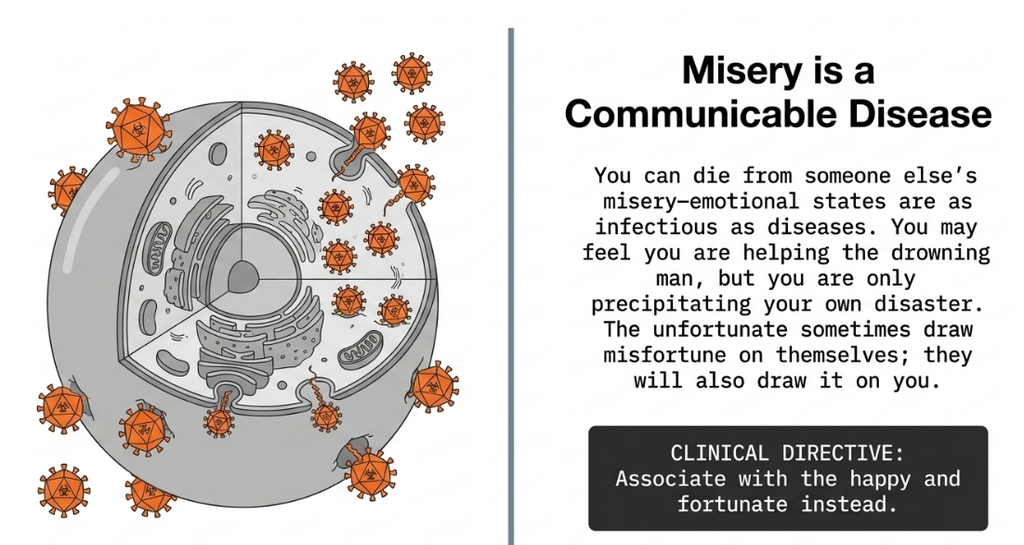
The reality is clinical and unforgiving: emotional states are as infectious as biological diseases. You do not inhabit a vacuum; you inhabit an ecosystem where the pathogens of misery and instability are looking for a host. Your success and your sanity are directly proportional to the emotional health of the people you allow into your immediate orbit.

The Case of the “Infector”: How One Person Can Topple a Kingdom
History reveals that certain individuals possess an inherent instability that radiates outward like a storm, destroying everything in its wake. The most potent “infector” of the nineteenth century was Marie Gilbert, better known as Lola Montez. She did not ruin lives through calculated malice, but through a fundamental maelstrom of chaos that she churned up wherever she landed.
Her victims were not the weak-willed, but high achievers bypassed by their own reason. Alexandre Dujarier, owner of the most influential newspaper in France, saw his life descend into wreckage the moment he took Montez as a mistress. His business interests soured, his social standing evaporated, and he was eventually killed in a duel sparked by a drunken argument over her.
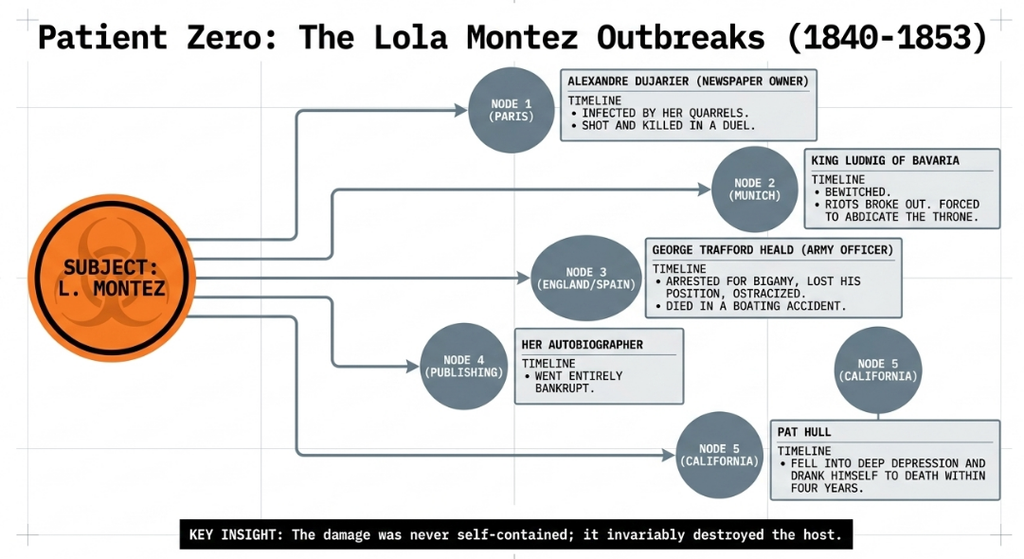
In Munich, King Ludwig of Bavaria fell under the same spell. Seeking an audience, Montez bypassed the king’s sentries and burst into his room; in the struggle, the front of her dress was torn, and her bare breasts were brazenly exposed. This raw, chaotic force of character immediately bypassed the king’s reason. Ludwig, formerly a noted miser, began showering her with riches, naturalized her as a citizen, and made her a countess. She became the most powerful force in the kingdom, treating ministers with disdain and inciting civil unrest. By 1848, the infection had spread from the palace to the populace; riots broke out, and the once-beloved king was forced to abdicate.
Montez was dangerous because her instability was magnetic. She made her victims feel “more alive” through the sheer intensity of the drama she created—an intensity that is, in fact, the first symptom of a terminal social disease. As the law states: “You can die from someone else’s misery—emotional states are as infectious as diseases.”

The Drowning Man Paradox: Why Pity Is a Dangerous Virtue
When we witness someone trapped in a “long run of bad luck,” our cultural programming triggers pity. We see a “drowning man” and feel a moral imperative to reach out. In the realm of power, this is a psychological trap. You are not providing a lifeline; you are precipitating your own disaster.

The source of this law is blunt: “The unfortunate sometimes draw misfortune on themselves; they will also draw it on you.” There is a critical distinction between those struck by external catastrophe and the chronic infector who manufactures their own ruin. When you attempt to “help” the latter, the infector remains unchanged, but you will inevitably become unhinged.

The danger lies in the “guilt by association.” By tethering your reputation to an unstable individual, you inherit their pathology in the eyes of the world. You will waste valuable time and energy trying to free yourself from a disaster you did not create, only to be pulled under by the very person you sought to save.
The “Cassius” Effect: Identifying the Chronic Dissatisfier
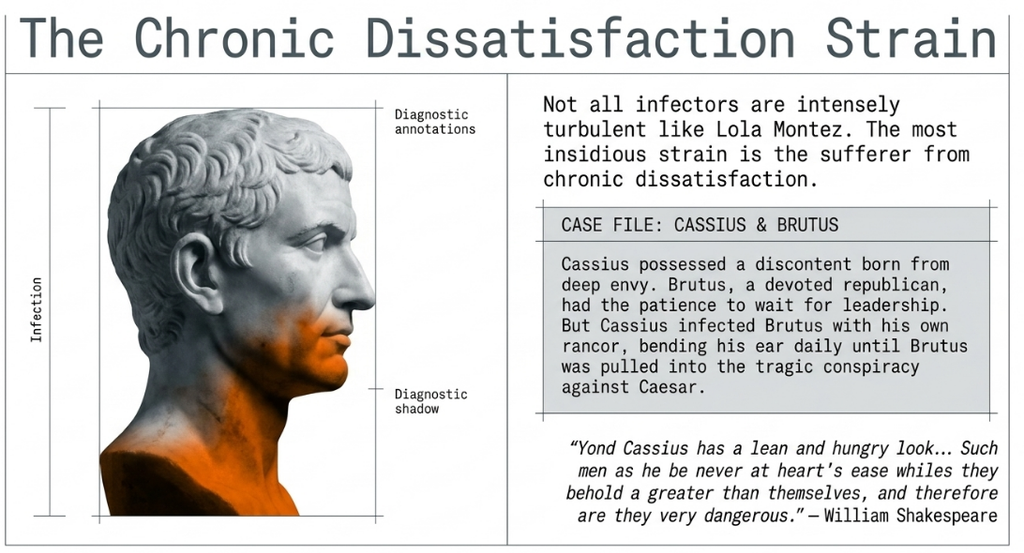
Infection is not always a sudden explosion; often, it is a slow, corrosive seepage. Consider the case of Cassius and Brutus. Julius Caesar, a master of intuition, sensed the “interminable sourness” of Cassius and passed him over for promotion, favoring Brutus instead. Caesar’s clinical instinct was correct, but he failed to prevent the infection from spreading.

Cassius, driven by a pathological envy he could not contain, spent his days bending Brutus’s ear, infecting the devoted republican with his own rancor. He masked his internal dissatisfaction behind a veil of political idealism, slowly overwriting Brutus’s reason until the tragedy of the conspiracy was inevitable.
To protect your sovereignty, you must conduct a clinical audit of your circle. Infectors often present themselves as victims, making it difficult to see that their miseries are self-inflicted. Look for these markers of pathology:
- A turbulent history: A past defined by recurring drama rather than sustained achievement.
- A trail of wreckage: A long line of broken relationships and bridges burned behind them.
- Career volatility: A consistent inability to find peace or footing in their professional life.
- Radiating intensity: A “force of character” that makes you lose your objective perspective and feel unmoored.
Strategic Osmosis: The Positive Side of Contagion
The law of infection is a double-edged blade. If you can be destroyed by the misery of others, you can also be elevated by their grace. This is the elite secret of emotional osmosis: strategically infecting yourself with the qualities you lack.
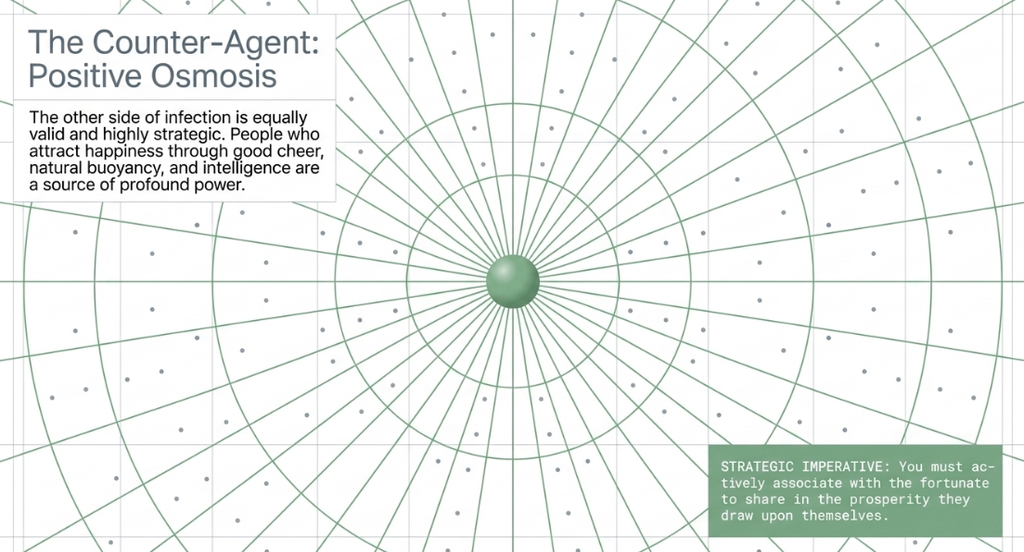
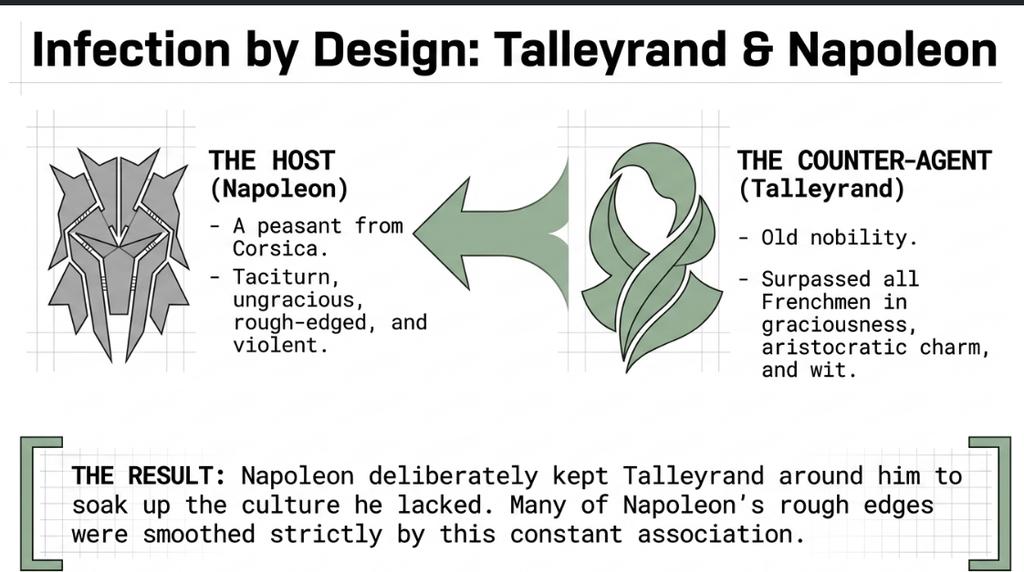
Napoleon Bonaparte, a “peasant from Corsica” by temperament—taciturn, ungracious, and prone to violence—understood this. He kept his minister Talleyrand close, despite their differences, specifically to soak up the aristocratic charm, wit, and effortless grace he lacked. Over time, association with Talleyrand’s refinement smoothed Napoleon’s rough edges.
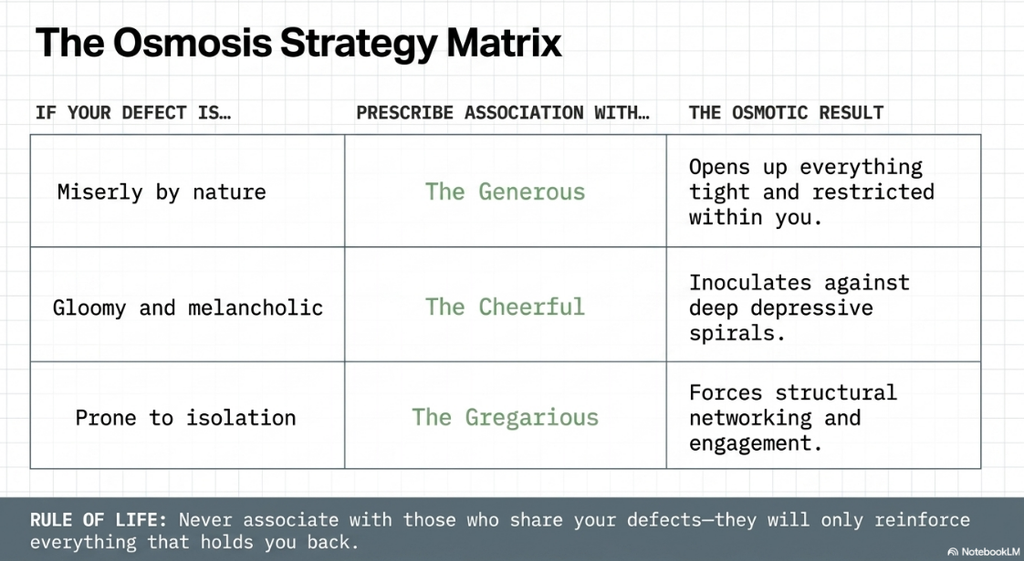
You must choose your associations with the precision of a chemist.
- If you are miserly, associate with the generous.
- If you are gloomy, gravitate to the cheerful.
- If you are prone to isolation, befriend the gregarious.
As the Mirror for Princes instructs:
“Do you not observe how sesame-oil is mingled with roses or violets and how, when it has been for some time in association with roses or violets, it ceases to be sesame-oil and is called oil of roses or oil of violets?”
The Only Cure: The Art of Social Quarantine
Once you identify an infector, there is only one viable strategy: Quarantine.
An emotional virus is unseen; it enters your pores without warning, spreading silently before you are even aware of the infection. Do not argue. Do not attempt to rehabilitate them. Do not pass them on to your friends, or you will find yourself enmeshed in the resulting fallout.
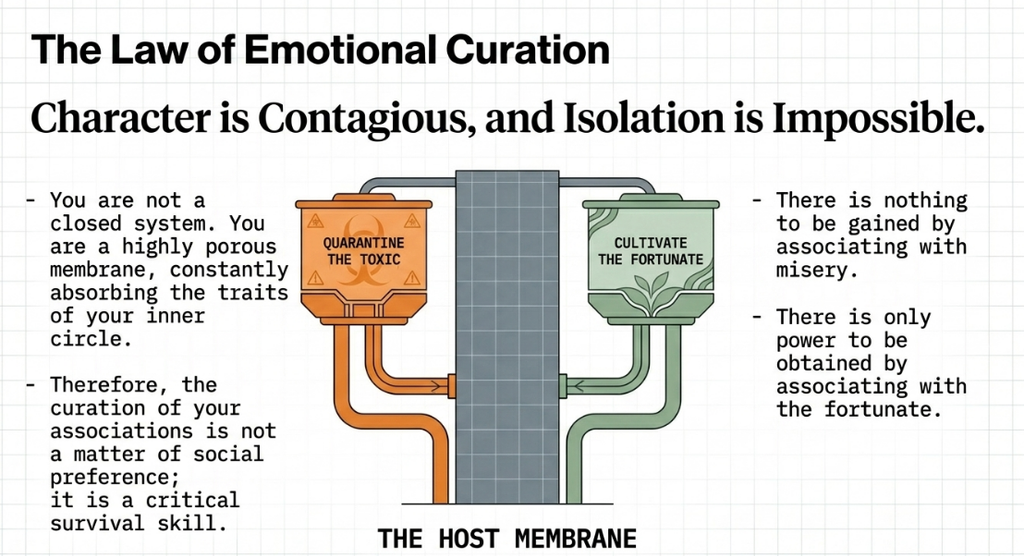
Pity is a luxury you cannot afford. The incurably unhappy have a particularly strong infecting power because their emotions are so intense. By the time you recognize the discontent in their eye, it is often too late.
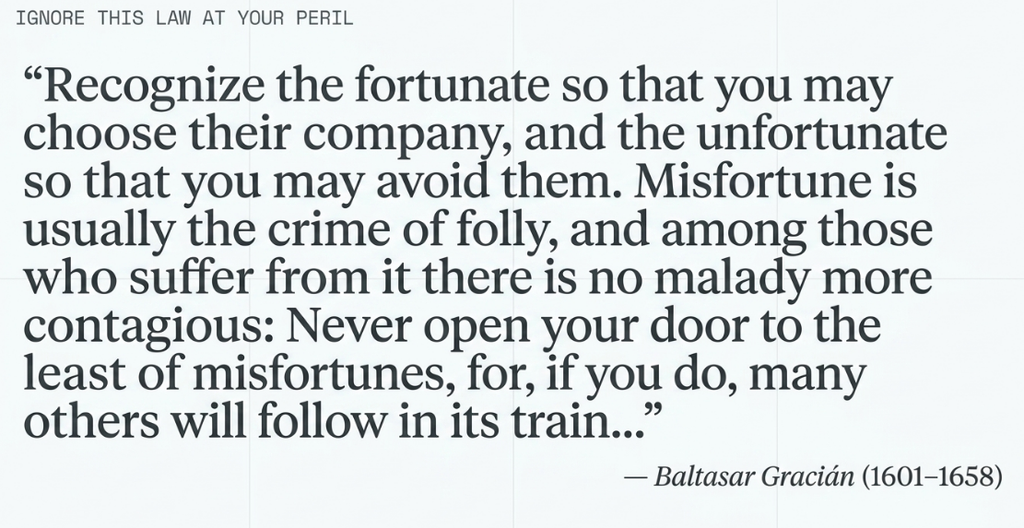
Audit your current social circle with clinical detachment. Are there people who consistently draw “bad luck” into your field? Do you feel drained or unhinged after their departure? Recognize that misfortune is usually the crime of folly, and there is no malady more contagious. Never open your door to the least of misfortunes, for if you do, many others will surely follow in its train.
Choose your associations as if your life depends on them—because it does. Do not die of another’s misery.
Image Summary

References


Related posts:
 First Law of Power: Why Your Best Work Might Be Your Biggest Liability: Lessons from the Architecture of Power
 Second Law of Power: Why Your Best Friend Might Be Your Worst Business Partner: The Strategic Case for Using Enemies
 Third Law of Power: The Hidden Hand: Why Your Total Honesty is a Strategic Liability
 Fourth Law of Power: Why Your Biggest Career Move Might Be Saying Nothing at All: Lessons in Strategic Silence
 Fifth Law of Power: The Invisible Shield: Why Your Reputation Is More Powerful Than Your Skills