The Ghost in the Room
Long before you speak your first word in a boardroom or submit a single proposal, a ghost has already entered the room. This entity is your reputation, an invisible force that dictates how every subsequent action you take will be interpreted. We often wonder why individuals with objectively superior talent lose to those with a “name,” but the reality is that the world rarely has the time to uncover your true character.
The people around us, even our closest confidants, remain fundamentally mysterious and unfathomable. Because the “secret recesses” of the human heart are unknowable, society is forced to rely on appearances as a barometer for judgment. In this vacuum of certainty, your reputation becomes the proxy for your soul.
Winning Without a Single Arrow: The Power of the “Sleeping Dragon”
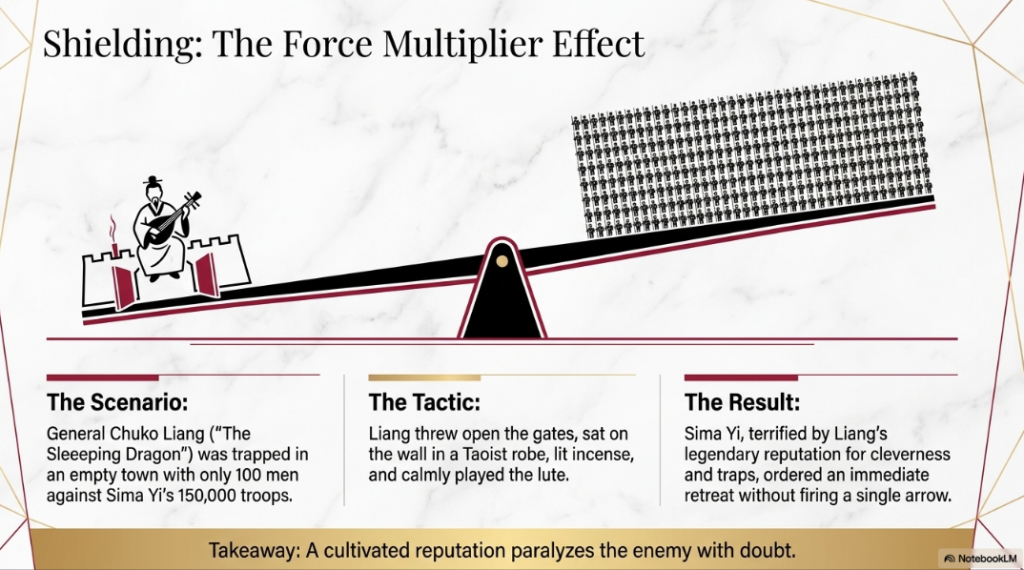
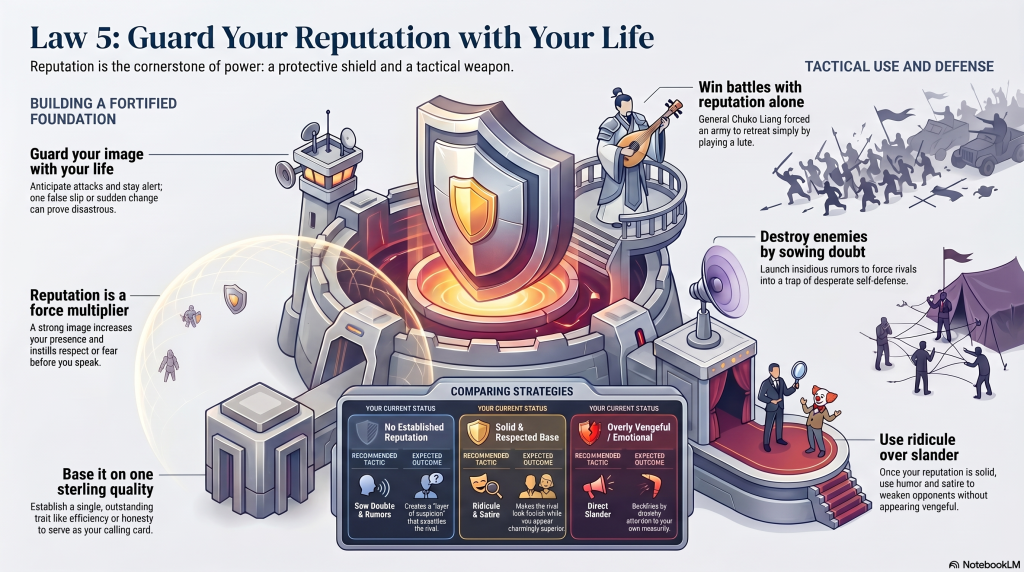
During China’s War of the Three Kingdoms, the legendary general Chuko Liang, known as the “Sleeping Dragon,” faced a hopeless siege. He was resting in a small town with only a hundred men when an enemy force of over 150,000 troops under Sima Yi approached. Rather than panicking, Liang orchestrated a masterpiece of psychological theater.
He ordered his men to hide, threw open the city gates, and took a seat atop the city wall, wearing a Taoist robe. He lit incense, played his lute, and began to chant, pretending not to notice the vast phalanx of soldiers below. Sima Yi, who knew Liang’s reputation for cunning, was stunned by the display of serenity.
He concluded that the open gates were a sophisticated trap and ordered an immediate retreat. Liang won a total victory without firing a single arrow because his reputation for having a “trick up his sleeve” was more terrifying than any army.
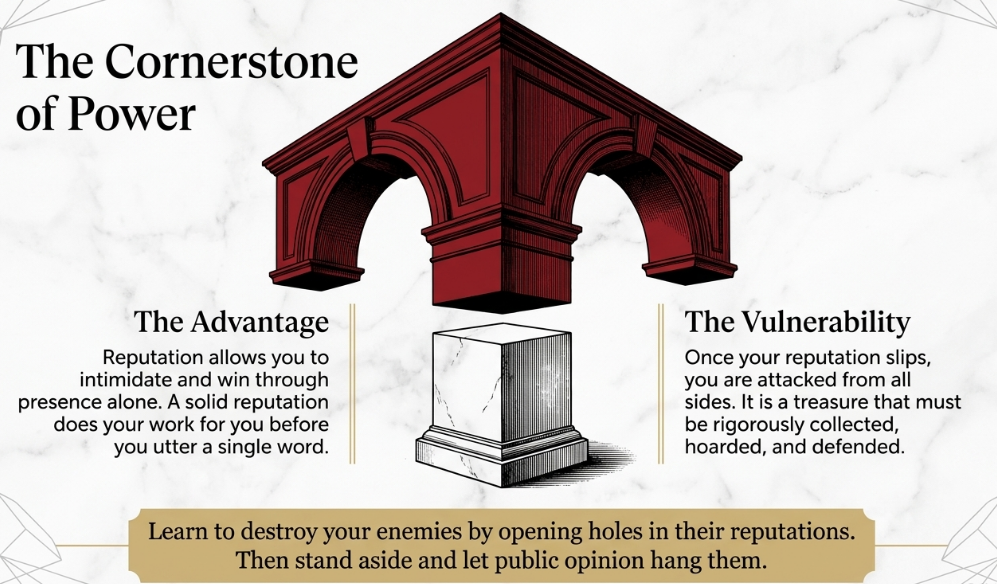
“Through reputation alone, you can intimidate and win; once it slips, however, you are vulnerable and will be attacked on all sides.”
The Sower of Doubt: How to Build Power from Zero
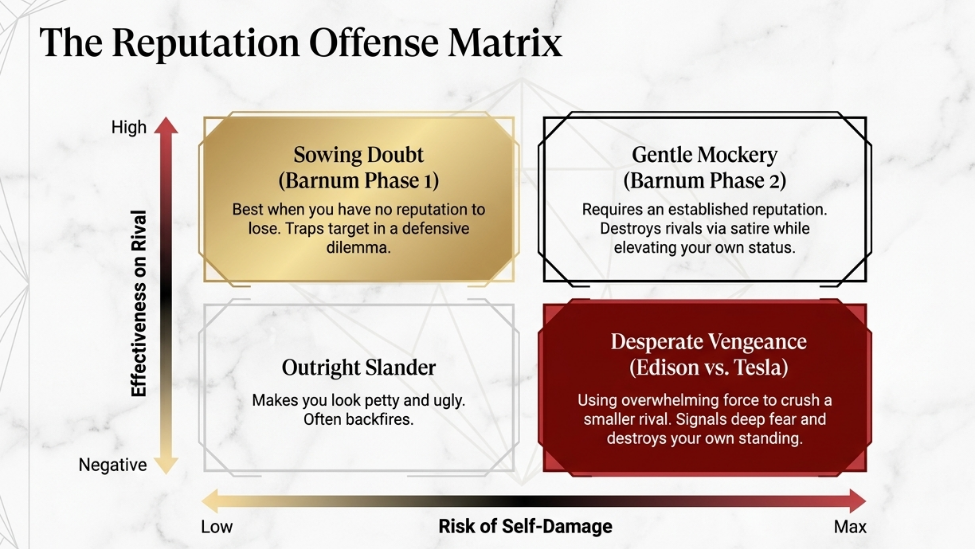
If you have no established name to bank on, your primary strategy must be to neutralize the reputation of your rivals. P.T. Barnum mastered this when he sought to purchase the American Museum but was rebuffed in favor of the directors of Peale’s Museum. Because Peale had a “better name,” Barnum had to level the playing field by opening holes in his opponent’s image.
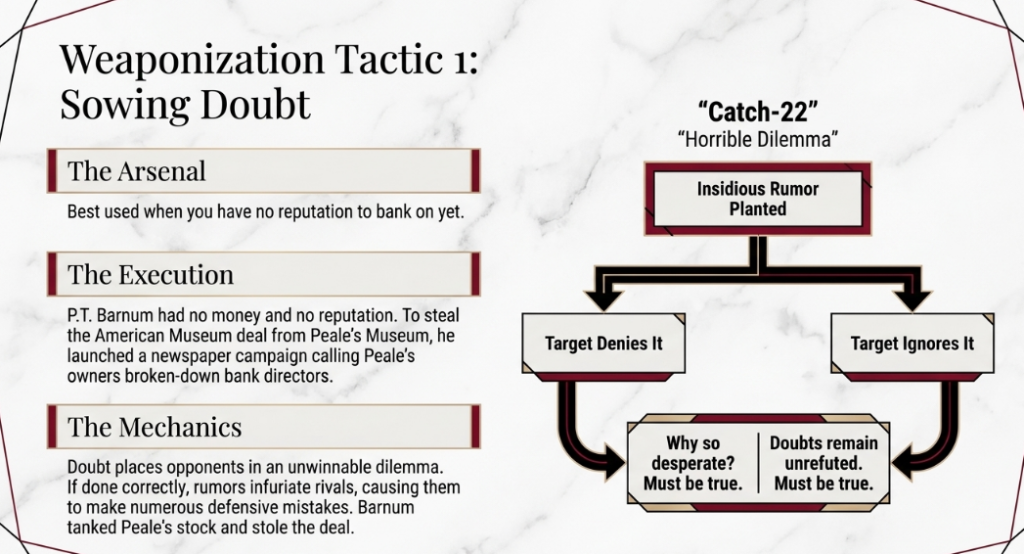
He launched a relentless letter-writing campaign in the newspapers, calling the owners a bunch of “broken-down bank directors.” He warned the public that their acquisition of a new museum would spread their resources too thin, leading to financial instability.
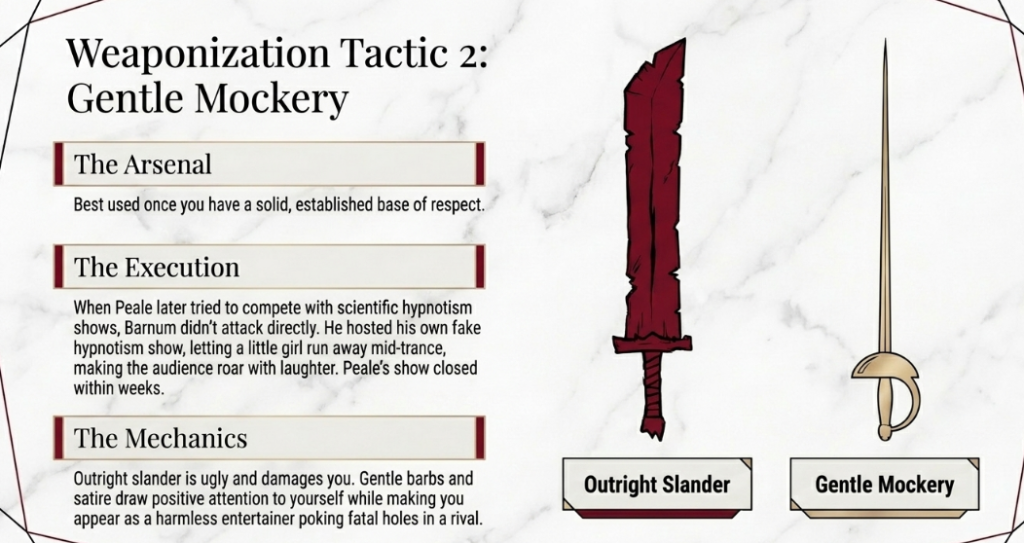
The beauty of this strategy lies in the horrible dilemma it creates for the target:
- If the directors defend themselves, they appear desperate and lend credibility to the rumor.
- If they ignore the attack, the insidious doubt continues to grow in the public mind.
- By the time the dust settled, the stock plummeted, and the owners reneged on the deal, selling to Barnum.
The Barometer of Appearance: Why the World Judges the Cover
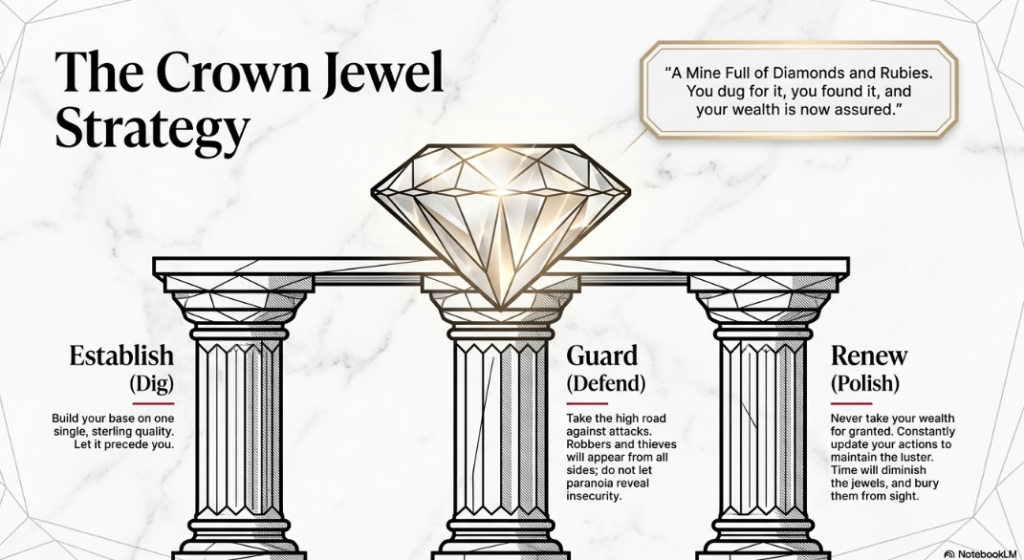
In the social realm, appearances are the only currency that consistently trades at par. To master this, you must establish one “sterling quality”—a single, defined trait that acts as your calling card. This quality sets you apart and, once established, it places others under a spell, allowing you to maneuver with far less scrutiny.
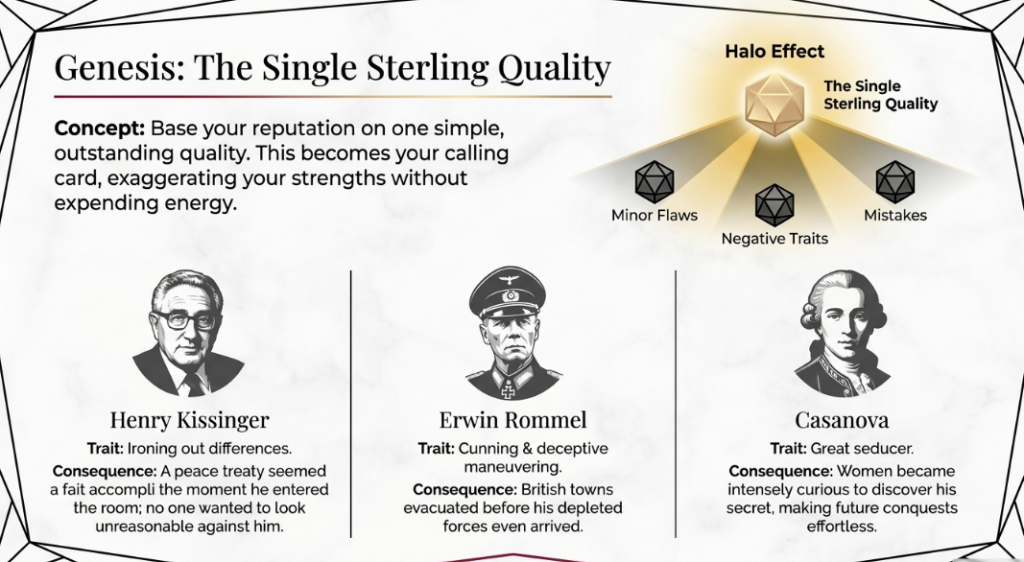
Consider the force-multiplying power of a solid reputation:
- Erwin Rommel: During WWII, his reputation for deceptive maneuvering struck such terror that entire cities were evacuated at the mere news of his approach, even when his forces were outnumbered five to one.
- Henry Kissinger: Much of the success of his “shuttle diplomacy” rested on his reputation for ironing out differences; no one wanted to appear “unreasonable” to him, making peace treaties seem like a fait accompli.
- Casanova: His reputation as a great seducer made women immensely curious to discover his secrets, effectively doing the work of conquest before he even arrived.
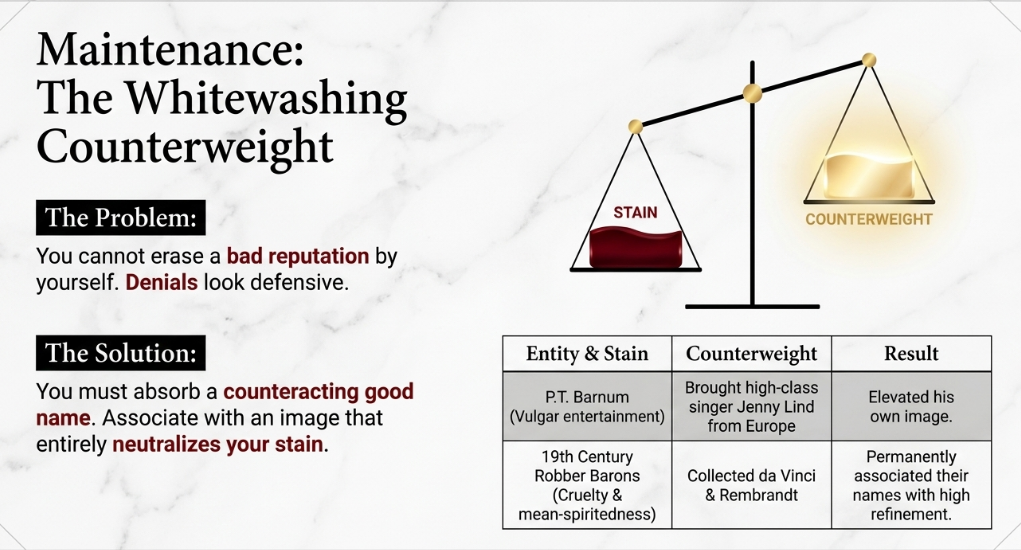
Crucially, a reputation for one trait—such as honesty—can serve as the perfect mask. It provides a “sterling” cover that allows you to practice all manner of deception without raising suspicion.
The Double-Edged Blade: When Attacks Go Too Far
Attacking a rival’s reputation is a potent weapon, but it must be handled with the precision of a surgeon. Thomas Edison learned this when he tried to ruin Nikola Tesla by claiming alternating current (AC) was inherently unsafe. Edison staged cruel spectacles, electrocuting household pets to “prove” his point.
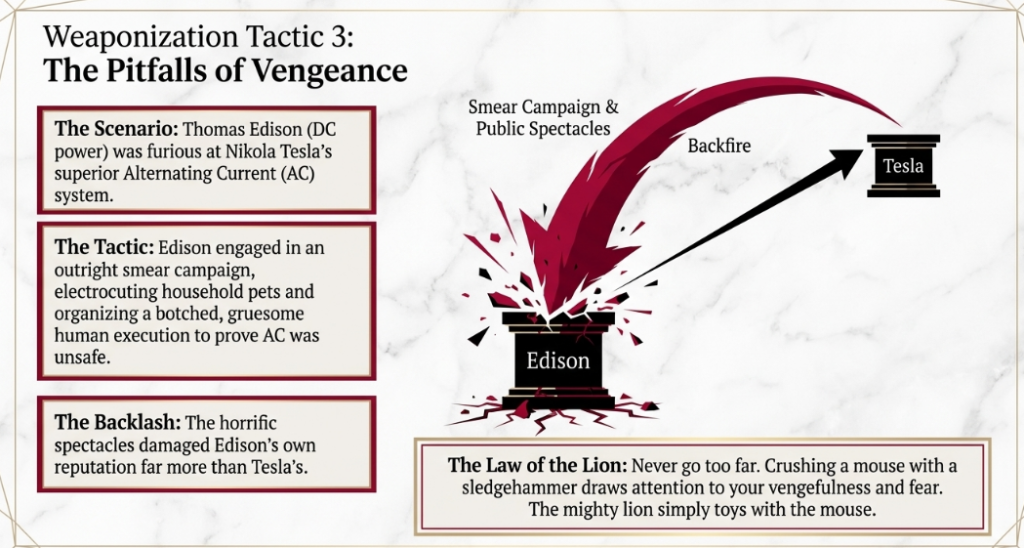
The campaign culminated in a botched, state-authorized execution by electrocution, where the prisoner was “only half killed” and the procedure had to be repeated. This awful spectacle backfired; instead of ruining Tesla, it made Edison appear vengeful and petty.
The lesson is that a solid reputation should be used like a lion toying with a mouse. Once your standing is secure, use satire and ridicule to weaken opponents rather than ugly slander.
“It is easier to cope with a bad conscience than with a bad reputation.”
The Shifting Light: The Tale of the Half-Eaten Peach
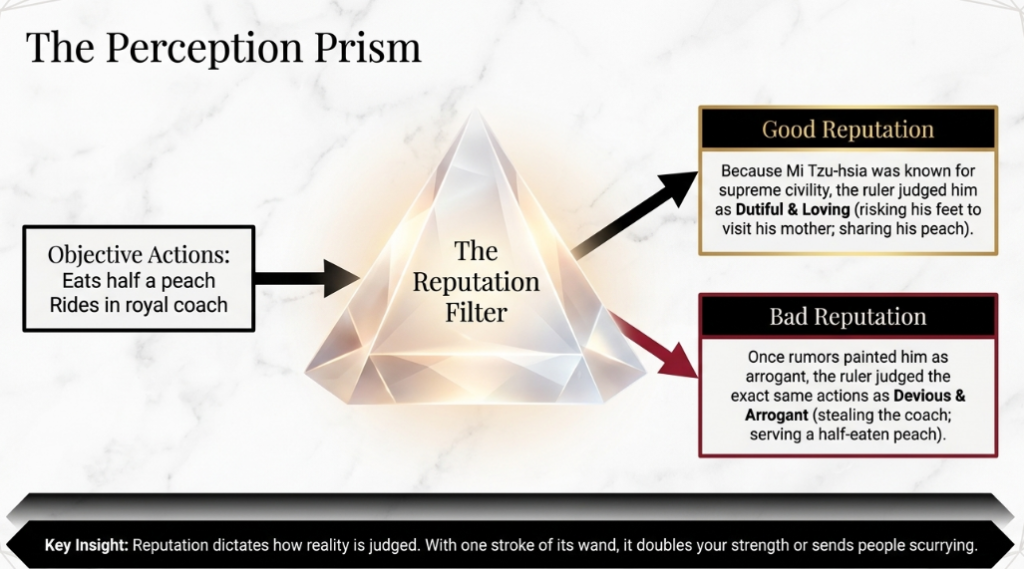
Reputation is the lens of perception through which all your actions are filtered. The story of Mi Tzu-hsia and the ruler of Wei illustrates this fragility. When Mi Tzu-hsia was the ruler’s favorite, his illegal use of the royal carriage was praised as an act of filial duty. When he shared a half-eaten peach with the ruler, it was seen as a sign of sacrificial love.
However, once envious courtiers damaged his reputation, the ruler saw those same actions in a new light. The carriage ride became “deviousness,” and the peach became an “insult.” Mi Tzu-hsia suffered the penalties not for his actions, but for the decay of his image.
Conclusion: Mastering Your Fate
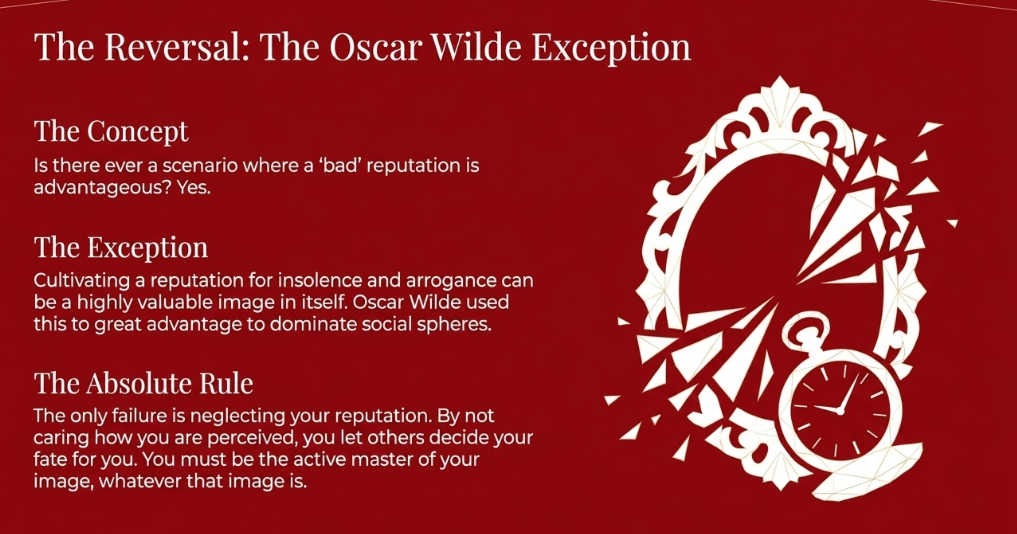
There is no “reversal” to the law of reputation. In a world of appearances, you cannot opt out of being judged. By neglecting your image, you are simply handing the pen to your enemies and letting them write your story for you.
Your reputation is a mine full of diamonds and rubies that you have worked hard to dig for. You must guard it with your life and constantly renew its luster, for time and neglect will eventually diminish its brilliance.
If you were to step out of the room right now, what is the one “sterling quality” your reputation would leave behind?
Image Summary
Reference


Related posts:
 Sixth Law of Power: The Art of Being Seen: 5 Provocative Lessons from the Masters of Attention
 How to Win Friends and Influence People: Complete Chapter-by-Chapter Notes
 First Law of Power: Why Your Best Work Might Be Your Biggest Liability: Lessons from the Architecture of Power
 Second Law of Power: Why Your Best Friend Might Be Your Worst Business Partner: The Strategic Case for Using Enemies
 Third Law of Power: The Hidden Hand: Why Your Total Honesty is a Strategic Liability