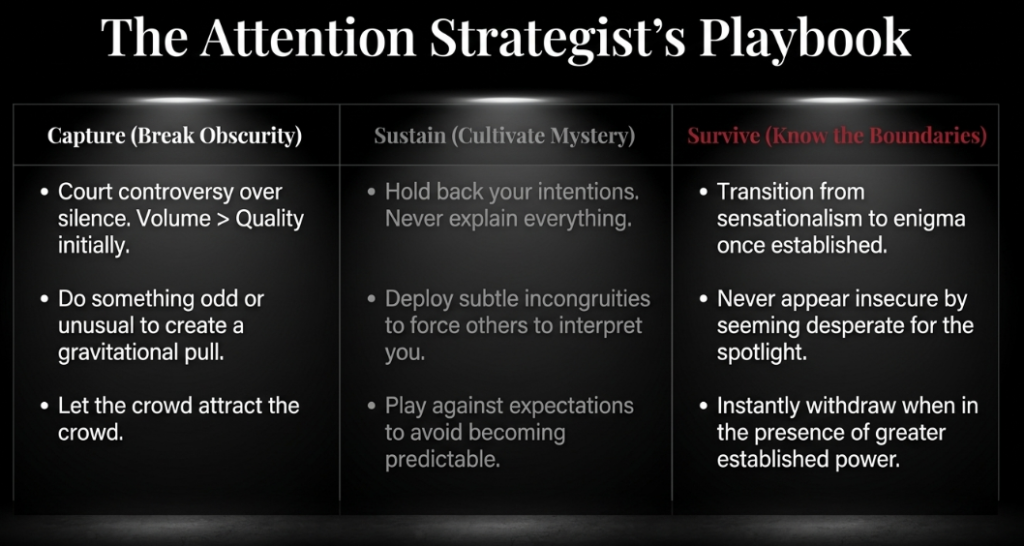
In a landscape saturated by the bland and timid masses, the greatest threat to your power is not failure or critique—it is terminal social invisibility. We exist in a hyper-visual reality where appearance dictates the perceived weight of existence; that which is unseen counts for exactly nothing. To be ignored is to be buried in oblivion. To transcend the collective mediocrity, you must transform yourself into a magnetic anomaly, appearing larger, more vibrant, and more inexplicable than those around you.

History’s most effective power players recognized that attention is the primary lever of influence. By deconstructing the high-performance strategies of master attention-magnets, we can uncover how to weaponize notoriety and secure a permanent seat at the center of the public’s narrow, fluctuating gaze.
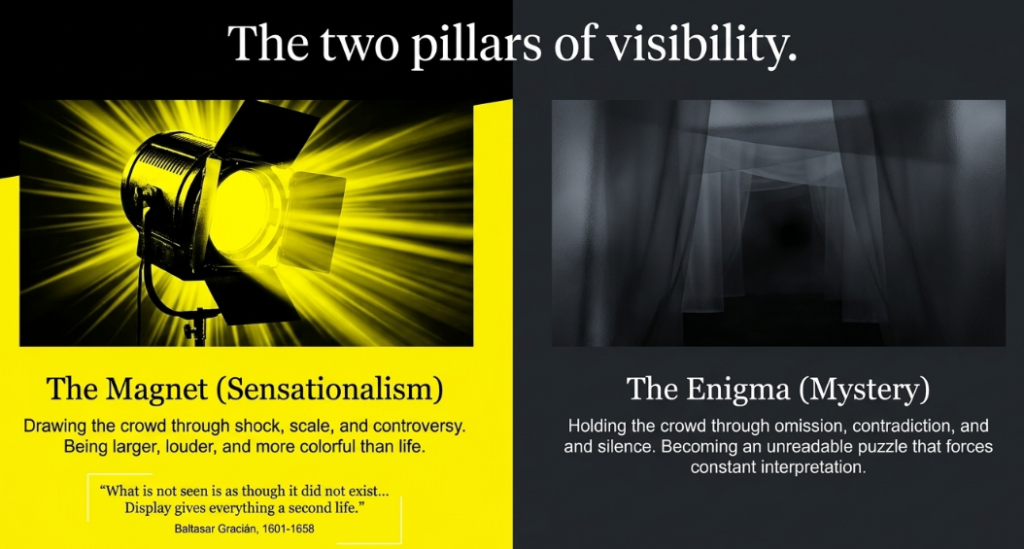
1. Notoriety is the Only Currency That Matters
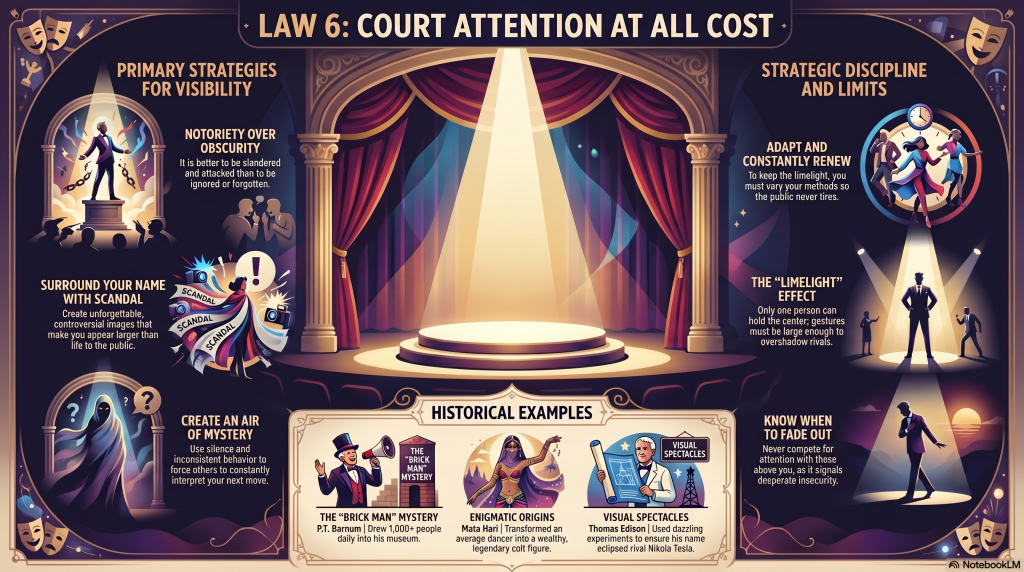
In the economy of influence, the quality of the signal is secondary to its volume. Whether the crowd offers adulation or vitriol is irrelevant; the only fatal outcome is silence. Strategic infamy serves as a cognitive shield against the threat of being forgotten.

P.T. Barnum mastered this early in his career through a calculated engagement with scandal. In 1836, his employer, Aaron Turner, orchestrated a “pattern interruption” by starting a rumor that Barnum was actually the Reverend Ephraim K. Avery—a man infamously acquitted of murder but still held guilty in the court of public opinion. The mob’s attempt to lynch Barnum did more than just create a scene; it provided a level of social signaling that ensured a packed house for the circus every night. Barnum realized that the public’s obsession with “the murderer” was a more powerful draw than any standard advertisement. He later applied this to his Fiji Mermaid hoax, fueling national debate over a monkey-fish carcass. He understood that being slandered was strategically superior to being ignored.
“Every crowd has a silver lining.” — P.T. Barnum
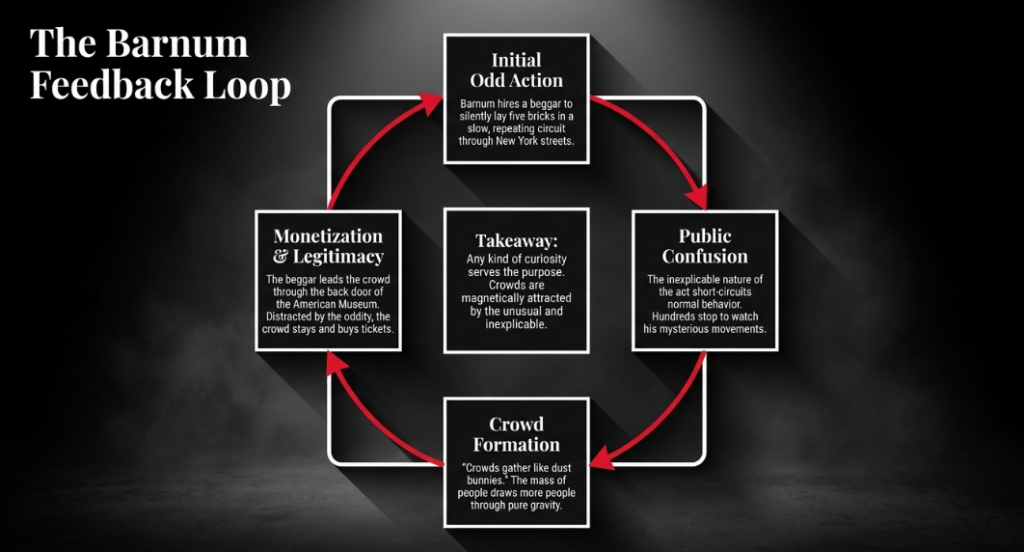
2. Create a Puzzle, Not a Presentation
The lure of the inexplicable. To capture the public imagination, move beyond simple displays. Create a puzzle that exploits the human brain’s innate need for closure.
Calculated tactical absurdity. Consider Barnum’s “bricklaying man.” He hired a beggar to move bricks in a silent, serious circuit, never answering questions. This behavior was a masterclass in cognitive friction.
The dust bunny effect. A single person stopping to watch a bizarre act triggers a cascading social proof effect. Onlookers gather like dust bunnies. Curiosity inevitably leads them through the door.
The enigma of the aristocrat. Count Victor Lustig utilized similar mechanics. He traveled with a Japanese chauffeur—an exotic sight at the time—and received blank telegrams at all hours. By nonchalantly tearing up these fakes, he forced those around him to obsess over his hidden significance.
Sucking attention from competitors. When you are a mystery, you become the focal point. Your competitors fade because the mind cannot look away from an unsolved riddle.
3. The Power of the “Air of Mystery”
In a world that has grown banal through over-exposure, mystery is a supreme strategic advantage. What cannot be seized and consumed creates an aura of unassailable power. Margaretha Zelle, the woman who became Mata Hari, understood that controlled disclosure is more provocative than total transparency.
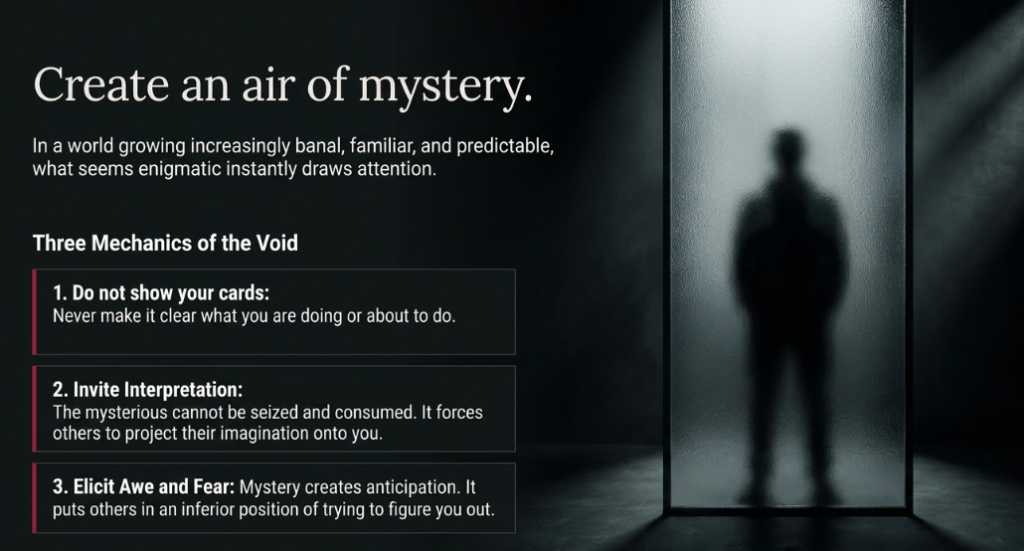
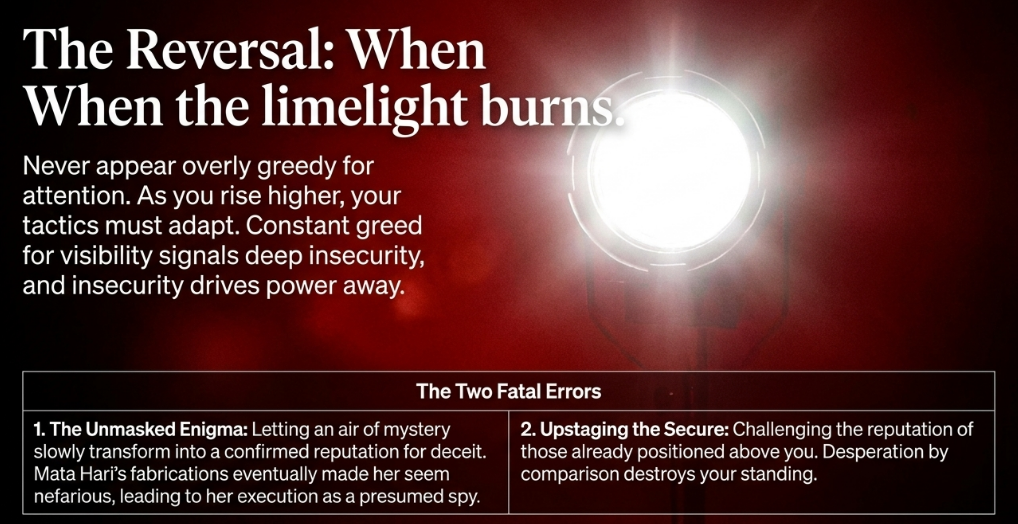
Zelle was not a superior dancer, nor was she exceptionally beautiful. Her power lay in her “dance of the veils”—a metaphor for her entire existence. She revealed and concealed simultaneously, teasing the imagination of the Parisian elite to do her marketing for her. She replaced her stolid background in Friesland, Holland, with a fabricated lineage of Javanese princesses and sacred Hindu rites. By constantly shifting her origin story, she ensured the public could never “grasp” her, making her mediocre talents appear divinely inspired. This principle of notoriety at any cost is echoed in the Indian Fable of the wasp Pin Tail, who stung a prince simply to ensure his name would be known.
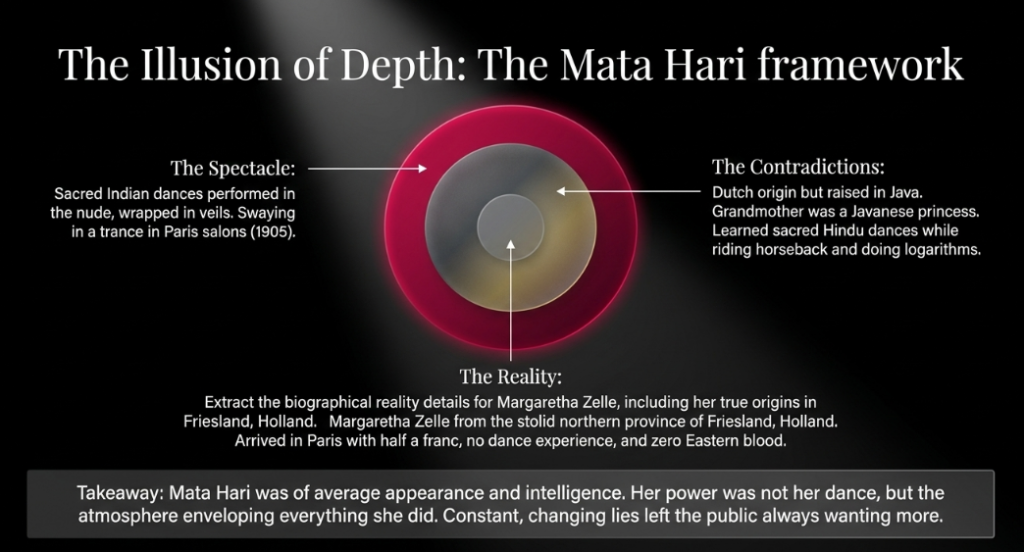
“A name without fame is like fire without flame. There is nothing like attracting notice at any cost.” — Indian Fable
4. When Trapped, Invoke “Feigned Madness”
Attention is an offensive weapon, but it is also a vital defensive tool. When cornered, you must create a scene that cannot be read, inspiring fear and trembling in those who would otherwise crush you.
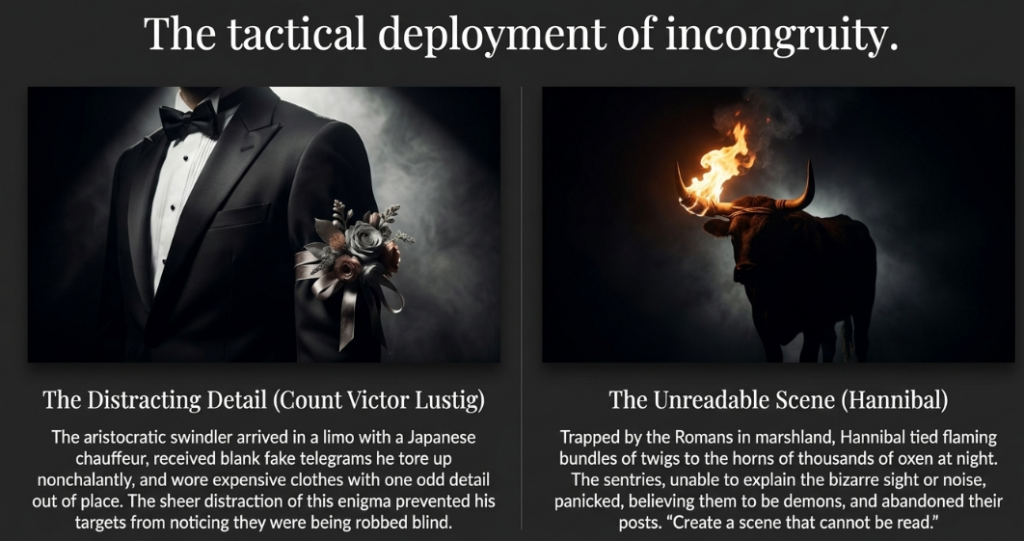
During the Second Punic War, Hannibal maneuvered out of a death trap by weaponizing the inexplicable. Trapped in a marsh by the Roman general Fabius, Hannibal ordered bundles of twigs fastened to the horns of thousands of oxen. When lit at night, these created the visual of a massive, supernatural army ascending the mountainside. The Roman sentries, paralyzed by this “puzzle,” fled their posts in a panic. Hannibal used the “feigned madness of Hamlet” tactic—creating a scene with no apparent rhyme or reason to make his forces appear larger and more terrifying. The mysterious doesn’t just distract; it inflates your perceived power.
5. The Fatal Error of Overshadowing the “Sun”
A cautionary analysis: there is a clinical distinction between drawing notice and being “greedy for attention.” The latter signals a level of insecurity that repels power. Most importantly, you must never violate the master-apprentice social hierarchy by attempting to outshine those above you.
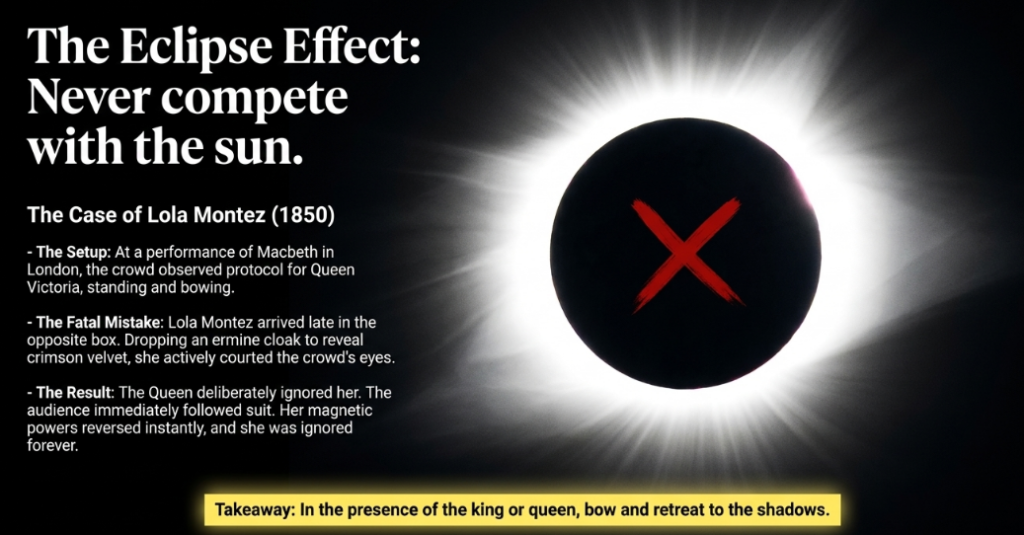
Lola Montez provides the ultimate case study in this failure. In 1850, at a performance of Macbeth, Montez attempted to hijack the limelight from Queen Victoria. Arriving late to ensure all eyes were on her, she dropped her ermine cloak to reveal a scandalous gown of crimson velvet and a diamond tiara. By challenging the Queen’s status in her own presence, Montez triggered a defensive collective response from the assembly. The royal couple’s deliberate refusal to acknowledge her box served as a social death sentence. Her magnetic powers were instantly reversed; society fled her company, and she was cast into exile. To avoid being a “flash in the pan,” you must know when to retreat to the shadows.
Conclusion: The Limelight is a Narrow Beam
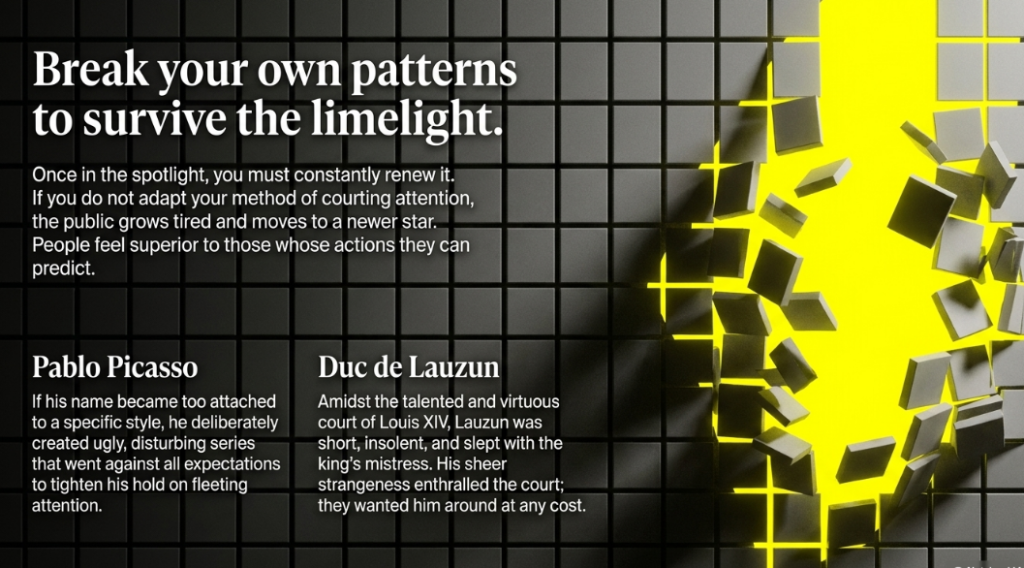
The limelight is a narrow beam of light that can accommodate only one actor at a time. To remain in its focus requires constant vigilance and the courage to evolve. If your methods become predictable, the public will inevitably grow tired and move on to a newer star.
Consider the career of Pablo Picasso. Whenever the public became too comfortable with his style, he deliberately upset their expectations with something new, even “ugly” or disturbing. He recognized that people feel superior to those they can predict; by playing against expectations, he maintained his control over their fleeting attention.
You must now face a diagnostic question: are you prepared to court scandal and engineer enigmas to maintain your relevance, or will you succumb to the terminal oblivion of the bland and timid masses?
Image Summary
Reference


Related posts:
 Fifth Law of Power: The Invisible Shield: Why Your Reputation Is More Powerful Than Your Skills
 How to Win Friends and Influence People: Complete Chapter-by-Chapter Notes
 First Law of Power: Why Your Best Work Might Be Your Biggest Liability: Lessons from the Architecture of Power
 Second Law of Power: Why Your Best Friend Might Be Your Worst Business Partner: The Strategic Case for Using Enemies
 Third Law of Power: The Hidden Hand: Why Your Total Honesty is a Strategic Liability