
1. Introduction: The Talent Paradox
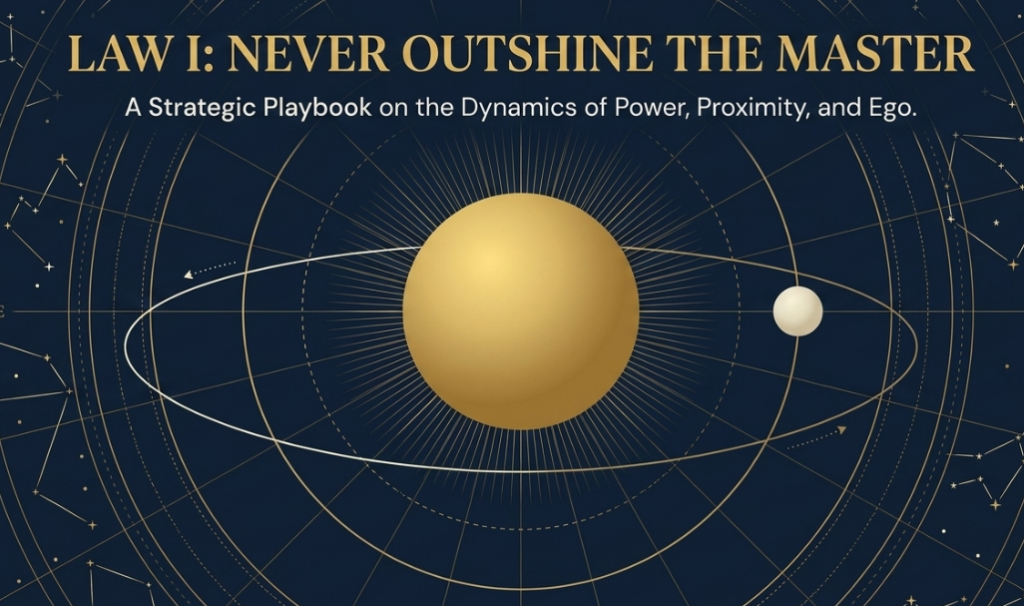
In the modern meritocracy, we are indoctrinated with the belief that brilliance is its own shield. We assume that by parading our sharpest wit, our most refined talents, and an unflagging work ethic, we secure our ascent. However, history—and the cold mechanics of human psychology—suggests a far more precarious reality. The “Law of Power” dictates a counterintuitive truth: your greatest professional assets can become your most lethal liabilities the moment they provoke insecurity in those above you. To truly attain the heights of power, you must master the art of making your superiors feel comfortably superior. In your desire to impress, if you display too much of your own light, you do not inspire admiration; you trigger a primal, defensive fear.

2. The Danger of “Inadvertent Brilliance.”
The most treacherous path is often walked by those who are naturally gifted. Consider the tragic end of Astorre Manfredi, the Prince of Faenza. At eighteen, Manfredi was the personification of “inadvertent brilliance”—endowed with a natural charm, grace, and physical beauty that captivated his subjects and commoners alike. When the suffocatingly narcissistic Cesare Borgia laid siege to his city, Manfredi surrendered. Despite Borgia’s reputation for cruelty, he initially spared the young prince, allowing him to remain in his court with complete freedom.

However, Manfredi’s mere presence was a constant, silent insult to Borgia’s own lack of charisma. By simply being himself—by existing with such effortless spirit—Manfredi outshone the master without lifting a finger. Within a year, Manfredi was found in the River Tiber with a stone around his neck. When dealing with a person who is “monstrously insecure,” your “authenticity” is not a virtue; it is an act of strategic carelessness. In the presence of power, being yourself is a luxury you cannot afford, for the master interprets your natural grace as a competitive maneuver.
“It is a deadly but common misperception to believe that by displaying and vaunting your gifts and talents, you are winning the master’s affection. He may feign appreciation, but at his first opportunity, he will replace you with someone less intelligent, less attractive, less threatening.”
3. The Party That Cost a Fortune—and a Life
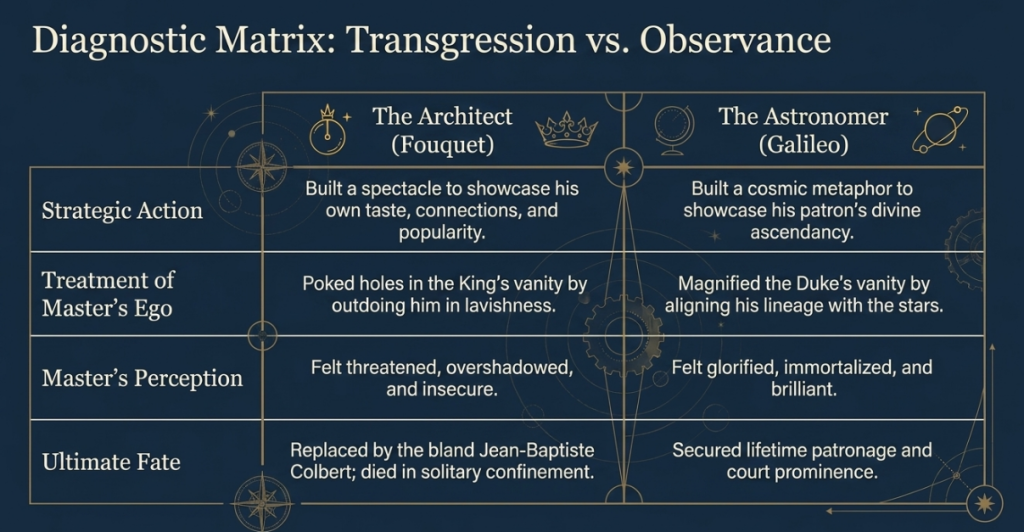
In 1661, Nicolas Fouquet, the finance minister to Louis XIV, committed the fatal error of attempting to buy the King’s affection with a display of magnificence. Suspecting his favor was waning, Fouquet hosted a legendary celebration at his new chateau, Vaux-le-Vicomte. It was a spectacle of seven-course meals featuring Orient-inspired delicacies, a premiere play by Molière, and a fireworks display that dazzled the most brilliant nobility of Europe.

Fouquet intended the evening to be a tribute to his loyalty. Instead, Louis XIV saw a man who was more popular, more tasteful, and wealthier than the King himself. Fouquet had inadvertently made the “Sun King” feel like a secondary character in his own kingdom. The next day, Fouquet was arrested and sentenced to spend the final twenty years of his life in solitary confinement. He was replaced by Jean-Baptiste Colbert, a man who was strategically “bland” and “famous for his parsimony.” Colbert understood that his own dullness served as a perfect canvas for the King’s glory; he ensured that every penny liberated from the treasury went directly into Louis’s hands to build Versailles—a palace designed to be even more magnificent than the one that cost Fouquet his freedom.
4. Mastering the “Cosmic Compliment”
Where Fouquet failed through vanity, Galileo Galilei succeeded through masterful alignment. In the early 17th century, Galileo lived in a state of precarious dependence on various patrons. When he discovered the moons of Jupiter in 1610, he realized that masters do not care about “empirical truth” or “scientific gadgets”—they care about their name and their glory.
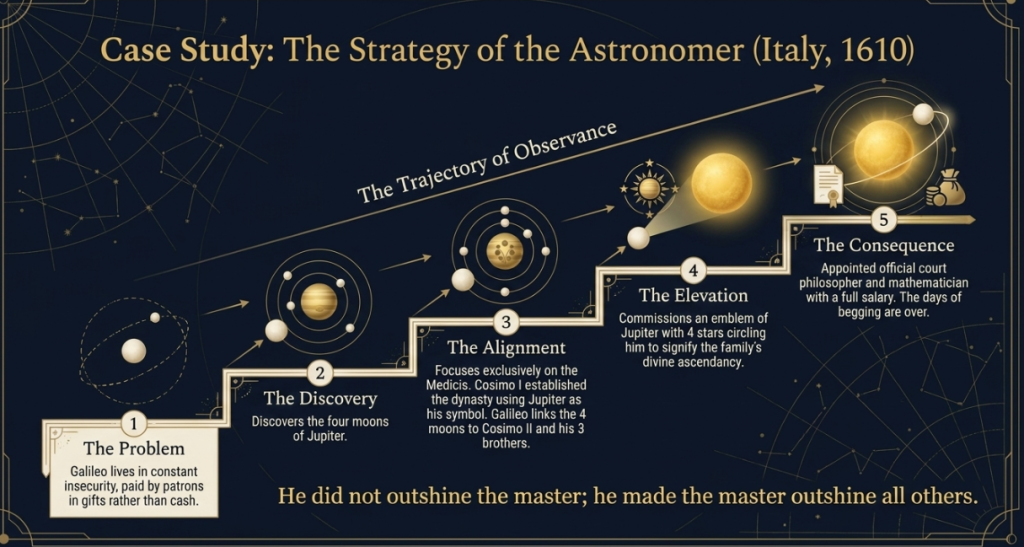
Rather than presenting his discovery as a personal triumph of science, Galileo turned it into a cosmic event dedicated to the Medici family. He announced that the four moons “offered themselves” to his telescope at the same time as Cosimo II’s enthronement, linking the four stars to the four Medici brothers. By literally aligning them with the heavens, Galileo gave his patrons a divine legitimacy that outweighed any invention. He did not challenge their intellectual authority; he made them appear more brilliant than all other courts in Italy. In return, he was appointed official court philosopher with a full salary, ending his days of begging for patronage.
5. The Fatal Trap of Familiarity
Status is a fragile construct, and the higher one rises, the easier it is to fall into the trap of assuming equality. Sen no Rikyu, the premier tea master and favorite of Emperor Hideyoshi, learned this at the cost of his life. Despite being a trusted adviser with his own apartment in the palace, Rikyu made an unforgivable miscalculation: he had a wooden statue of himself, wearing sandals—a symbol of nobility—placed in a prominent temple within the palace gates.
To the Emperor, this was a sign that Rikyu had lost his sense of limits. He had forgotten that his power was a gift from the master, not an inherent right. By presuming to share the same visual space as the royalty who passed by, Rikyu signaled that he believed he had earned his position on his own. Hideyoshi ordered his suicide shortly after. The rule is absolute: never let the favors you receive go to your head, and never assume that a master’s love grants you the right to rival their stature.
6. Practical Strategies for Strategic Humility
To navigate the ego-driven waters of the professional world, one must adopt specific tactical behaviors derived from the “Keys to Power”:
- Discreet Flattery: Overt flattery is clumsy and invites the suspicion of peers. Discreet flattery—subtly puffing up the master’s ego so they feel responsible for your success—is far more potent.
- The “Naive” Approach: If you are more intelligent than your superior, you must occasionally appear the opposite. Act naive. Commit harmless mistakes that do not hurt you in the long run but provide the master the opportunity to “bestow the gifts of his experience” upon you. Masters who cannot teach often feel a rancor that eventually turns into ill will.
- Ascribing Ideas: If you possess more creative ideas, find ways to ascribe them to the master in as public a manner as possible. Frame your most brilliant advice as merely an “echo” of the master’s own wisdom.
- Playing the Jester: If you possess superior wit, use it to make the master appear as the “dispenser of amusement.” Do not let your humor make the master seem cold or surly by comparison. Tone down your sociability so as not to block the master’s radiance.

7. The “Falling Star” Exception (The Reversal)
There is a single condition under which the rules of strategic humility are suspended: the Reversal. If your superior is a “falling star,” their power is already beginning to fade into the sky. In this scenario, there is nothing to fear from outshining them.

If the master is weak, you may “discreetly hasten his downfall” by outperforming him at key moments. However, you must gauge their strength with surgical accuracy. If they are very weak, let nature take its course. If they remain firm in their position but you are more capable, you must bide your time and be patient. It is the natural course of things that power eventually weakens. Your goal is to outlive the master so that you may eventually outshine them on your own terms.
8. Conclusion: Becoming the Sun’s Shadow
The core philosophy of Law 1 is not about self-effacement for its own sake; it is about absolute control. By choosing to disguise your strengths, you avoid becoming a victim of another’s insecurity and remain the master of your own progress.

The relationship between a subordinate and a superior is best understood through the image of the stars and the sun. As Baltasar Gracián observed: “All superiority is odious, but the superiority of a subject over his prince is not only stupid, it is fatal.” There can be only one sun at a time. To survive and thrive, you must be willing to fade into the sky and find ways to heighten the intensity of the “master star.”
Ask yourself: In your current professional constellation, are you an “eighteen-year-old Manfredi,” blinded by your own natural grace, or are you a Galileo, strategically positioning yourself to eventually become the sun?
Reference: