The Exhaustion of Chasing: Why Your Idea of Power is Likely Wrong
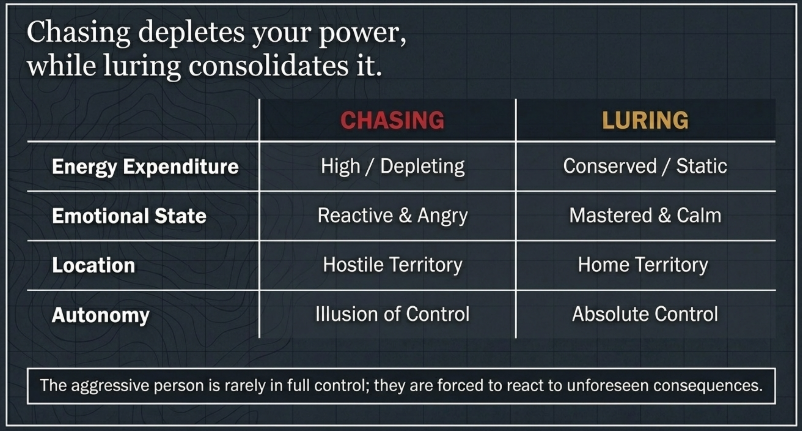
Most people operate in a state of perpetual reaction, a condition that leads inevitably to resource depletion and strategic paralysis. They respond to the moves of competitors, the whims of superiors, and the chaotic friction of daily crises. This “chasing” is a fundamental misunderstanding of influence. When you are forced to react, you have surrendered the initiative; you are no longer the director of the engagement, but a puppet of your opponent’s design.
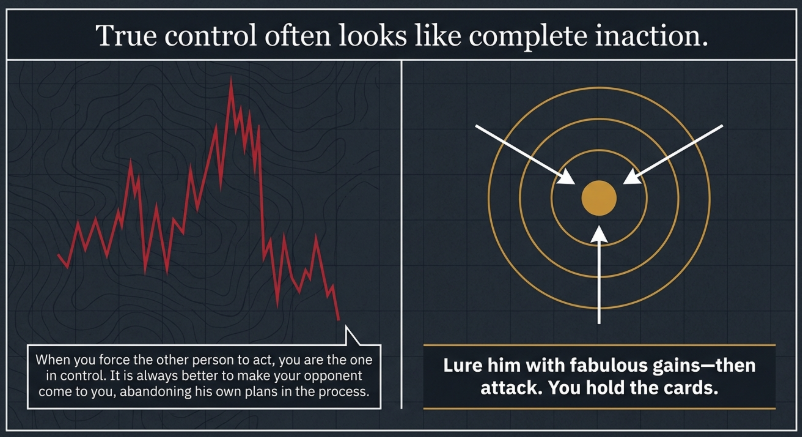
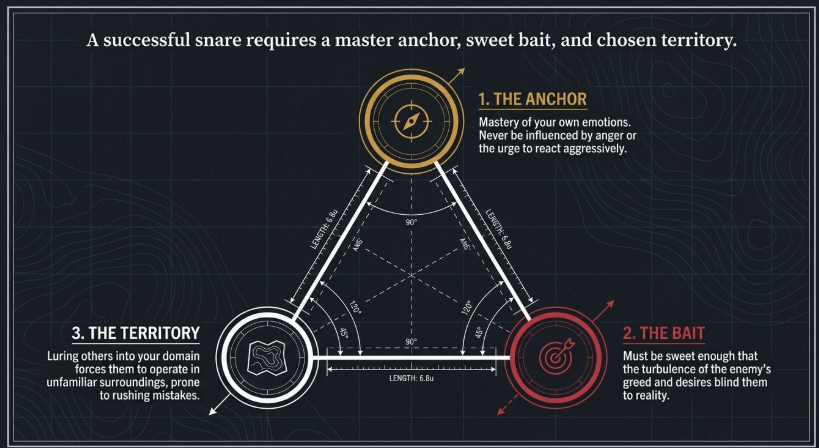
There is a stark distinction between aggressive action and effective action. Aggression is often a series of rash, energy-consuming maneuvers that exhaust the player. Effective action, by contrast, is characterized by a calculated stillness. True control belongs to those who master Law 8: Make other people come to you—use bait if necessary. By forcing an opponent to act, you dictate the psychological terrain and ensure you are the one holding the cards.
The Art of the Honeyed Trap: Luring Your Opponent into Abandoning Their Plans
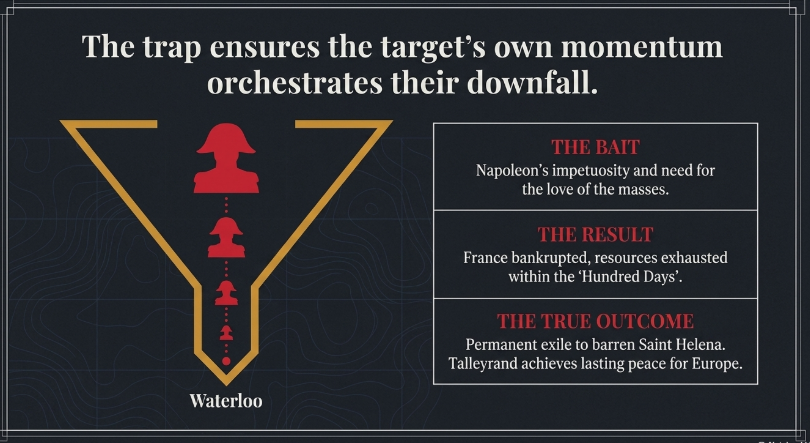
In 1814, as the major powers of Europe gathered at the Congress of Vienna to dismantle the remains of the Napoleonic Empire, the shadow of the exiled Emperor loomed large. While other statesmen plotted Napoleon’s assassination or argued for a more remote exile, Talleyrand—Napoleon’s former foreign minister—remained unnervingly calm.
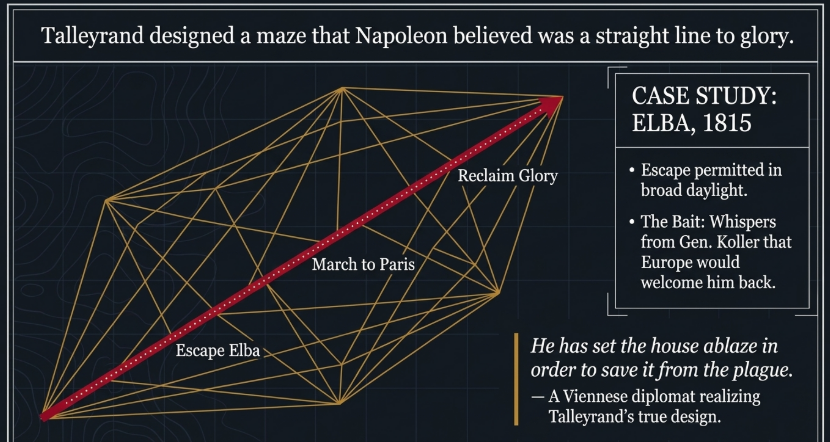
Talleyrand had initially attempted direct persuasion, arguing that Napoleon was still a threat and should be banished further away. However, his colleagues viewed him as fearful and weak, ignoring his advice. Recognizing that words had failed, Talleyrand shifted to a more sophisticated “behavioral” strategy. He stopped pushing his opinion and instead began pulling the strings of a trap.
He utilized Austria’s General Koller to whisper “sweet bait” into Napoleon’s ear: promises that the European powers would welcome his return and that the English would look the other way during his escape. Talleyrand played on Napoleon’s impetuosity and his desperate need for glory. Lured by these fabricated gains, Napoleon escaped Elba only to find a bankrupt France with exhausted resources. By forcing Napoleon to come to him, Talleyrand ensured the Emperor would lead himself into a final, crushing defeat at Waterloo.
“He has set the house ablaze in order to save it from the plague.”
Geography as a Weapon: Why Making Them Come to You Wins Wars
The 1905 naval conflict between Russia and Japan serves as a masterclass in the principle of “emptiness and fullness.” Though the Russians possessed a numerically superior navy, the Japanese Marshal Togo Heihachiro utilized misinformation to induce a calculated depletion of his enemy’s strength.
Togo first baited the Russian fleet into leaving the Baltic Sea with rumors of a swift, decisive victory. Because Japan’s ally, Great Britain, controlled the Suez Canal, the Russians were forced to sail 6,000 miles around the Cape of Good Hope. Crucially, once the fleet passed the Cape, Togo spread a second false story: that the Japanese were sailing to launch an immediate counterattack. This forced the Russians to complete the remainder of the grueling journey on “combat alert.”
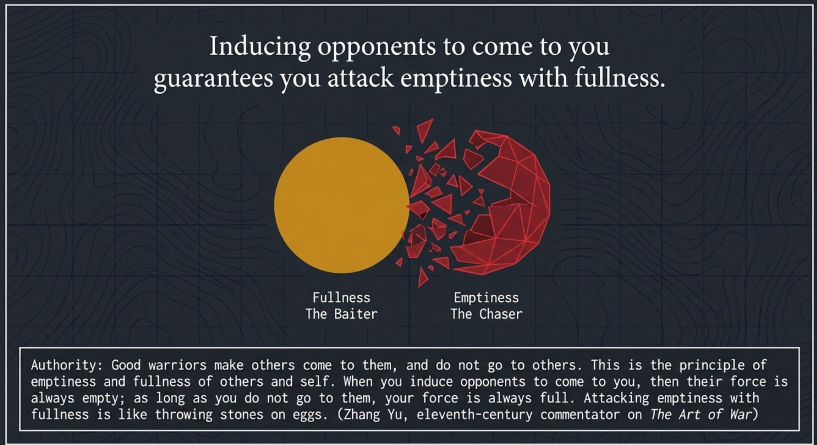
By the time the Russians reached the Tsushima Strait, their seamen were overworked, tense, and physically broken. The Japanese, conversely, had been waiting “at their ease.” Togo forced the opponent to operate in hostile territory where they had no bearings. As the eleventh-century commentator Zhang Yu noted regarding the strategy of inducing opponents to come to you:
“Attacking emptiness with fullness is like throwing stones on eggs.”
The Psychology of the Reveal: Getting Others to Dig Their Own Graves
Strategic analysts know that a victim’s own fear or greed provides the map for the predator. This is most clearly seen in the counter-intuitive logic of the pickpocket. Professional thieves often ply their trade near “BEWARE OF PICKPOCKETS” signs. In many cases, the pickpockets place these signs themselves. Upon seeing the warning, a passerby instinctively feels for their wallet to ensure its safety—thereby revealing the exact location of the prize to the watching predator.
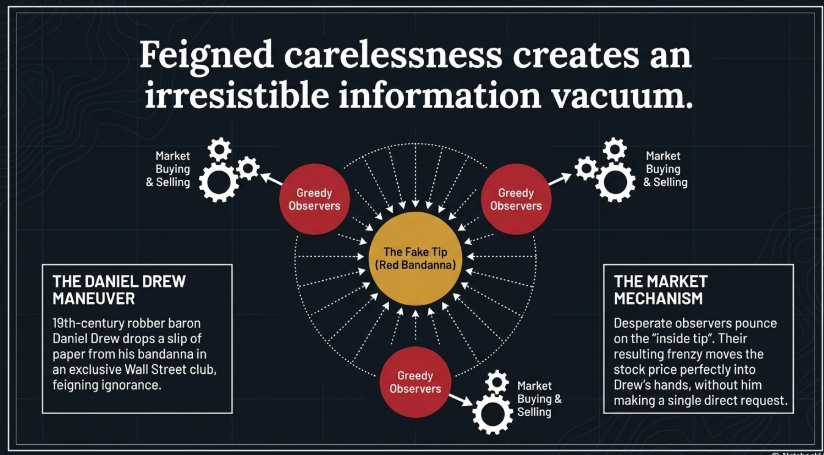
Similarly, the nineteenth-century robber baron Daniel Drew utilized the “sweet bait” of an inside tip to manipulate the market. He would hurry through exclusive clubs near Wall Street, appearing harried, and allow a slip of paper to fall from his red bandanna. Club members, blinded by the desire for “fabulous gains,” would pounce on the paper and buy or sell stocks exactly as Drew intended.
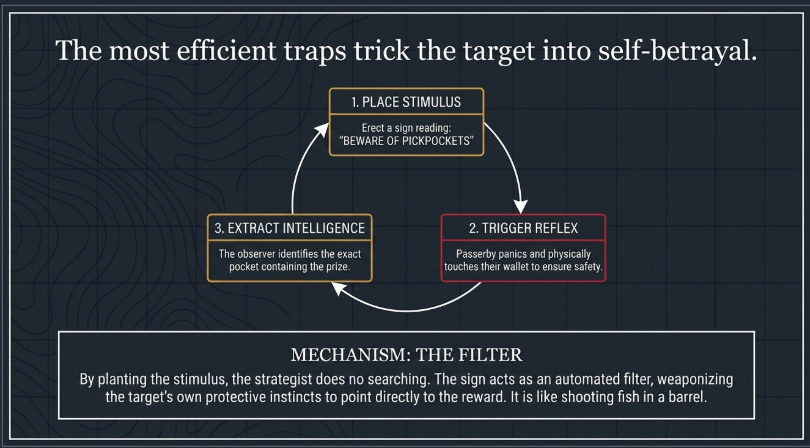
In both cases, the trap succeeds because the victim feels they are acting on their own initiative. They do not feel the strings being pulled because their focus is entirely consumed by the bait.
The Dignity of Absence: Using Indispensability as Bait
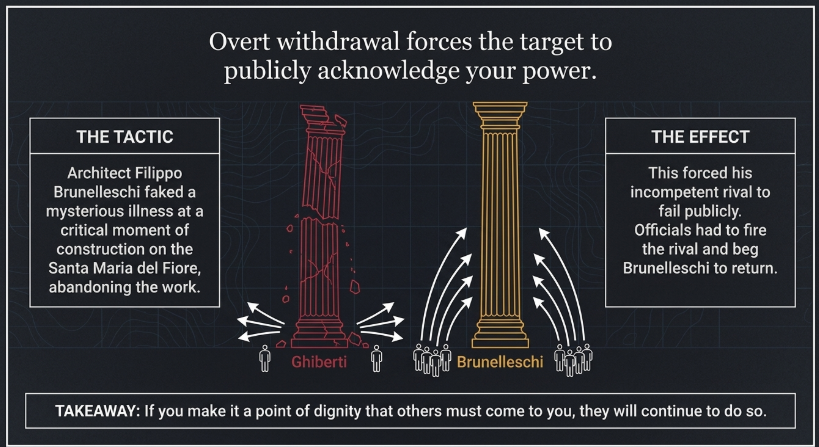
Making others come to you is not merely a tool of deception; it is a mechanism for establishing professional dignity. When the Renaissance architect Filippo Brunelleschi was forced to work with his incompetent but well-connected rival, Lorenzo Ghiberti, on the Santa Maria del Fiore dome, he chose strategic absence over direct confrontation.
At a critical juncture in the construction, Brunelleschi developed a “mysterious illness.” He stopped working and insisted that Ghiberti, as a co-commissioner, should be fully capable of finishing the project alone. Ghiberti’s inability to manage the complex engineering was quickly exposed. The city officials were forced to come to Brunelleschi, begging for his return and eventually firing Ghiberti. By making it a point of dignity that others must come to him, Brunelleschi proved his indispensability.
“If on one occasion you make it a point of dignity that others must come to you and you succeed, they will continue to do so even after you stop trying.”
The Strategic Reversal: When Waiting is Your Worst Enemy
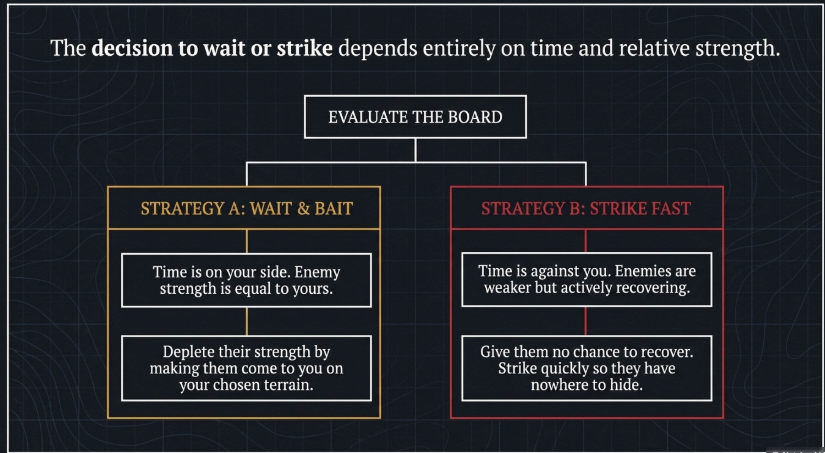
While making others exhaust themselves is the wiser policy for long-term power, a strategic analyst must recognize the rare necessity of the reversal. If time is your enemy—meaning your opponent is currently weak but has the potential to regroup—waiting provides them the chance to recover.
In such scenarios, a “fast attack” is required to demoralize the enemy and force them into errors of judgment. Leaders like Cesare Borgia used speed to intimidate and control, taking the lead to ensure the enemy had no time to plan.
- When to Wait: Use bait if time is on your side and you are at equal or greater strength than your opponent.
- When to Strike: Use speed if time is against you, the enemy is currently weaker, and a delay would allow them to regroup.
As the boxer Joe Louis famously observed regarding the demoralizing nature of the fast attack:
“He can run, but he can’t hide.”
Conclusion: From Reactor to Director
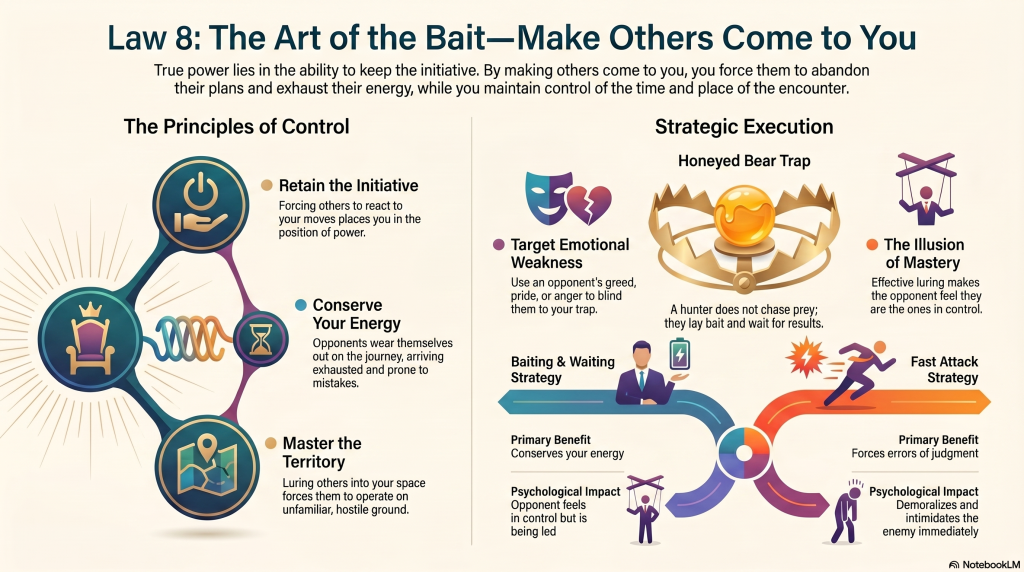
The ultimate image of this strategy is the Honeyed Bear Trap. The hunter does not pursue the bear through the wilderness; a cornered bear is a ferocious and unpredictable threat. Instead, the hunter lays a trap baited with honey and waits for the bear to exhaust itself in the pursuit of a perceived gain.
True power is the preservation of the initiative. By making others react to your moves, you keep them on the defensive and preserve your own energy while they waste theirs. You cease to be a reactor and become the director of the situation.

Perform a strategic audit of your current objectives: Which of your projects is a “chase” that is currently depleting your resources? How might you stop running and lay bait instead?

Image Summary
Reference


Related posts:
 Fifth Law of Power: The Invisible Shield: Why Your Reputation Is More Powerful Than Your Skills
 Sixth Law of Power: The Art of Being Seen: 5 Provocative Lessons from the Masters of Attention
 Seventh Law of Power: Why Doing All the Work is a Losing Game: 5 Ruthless Lessons on Credit and Power
 How to Win Friends and Influence People: Complete Chapter-by-Chapter Notes
 First Law of Power: Why Your Best Work Might Be Your Biggest Liability: Lessons from the Architecture of Power