1. The Dangerous Myth of Uniformity
The hallmark of the social amateur is “blind dealing.” Consider a common scenario: You make a witty remark at a high-level meeting; the room erupts in laughter, but one colleague goes quiet. You think nothing of it. Three months later, your long-awaited promotion is inexplicably blocked by a committee report you never saw coming. You treated a “serpent” like a “hare,” and now you’re paying the price in professional blood.
In the complex social terrain of power, the assumption that everyone reacts to strategy, insult, or deception in the same way is a fatal error. While your own objectives may remain consistent, your tactical calibration must change with every person you encounter. To ignore the specific psychological profile of your opponent is to invite a life of constant sorrow.
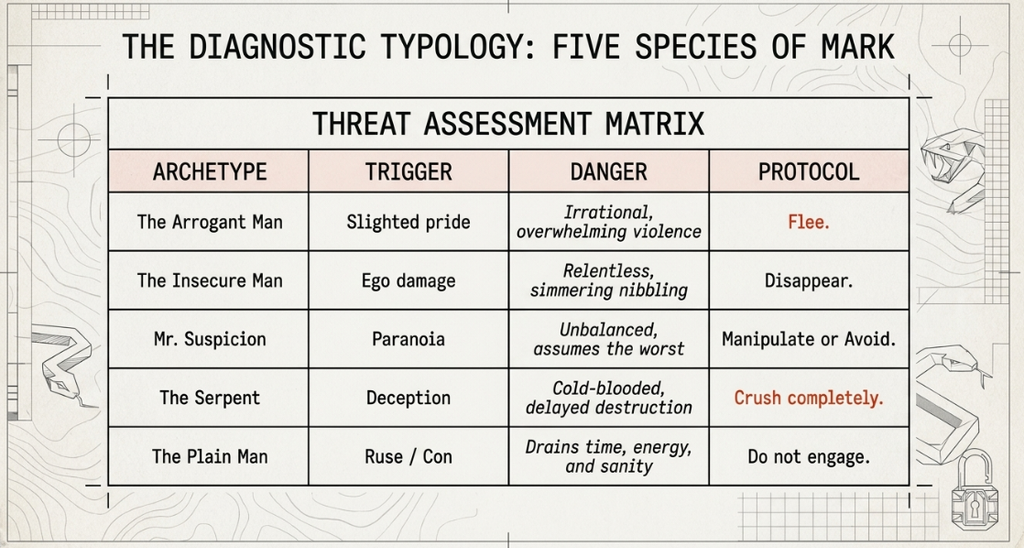
2. The Arrogant and Proud Man: A Vengeance Without Sanity
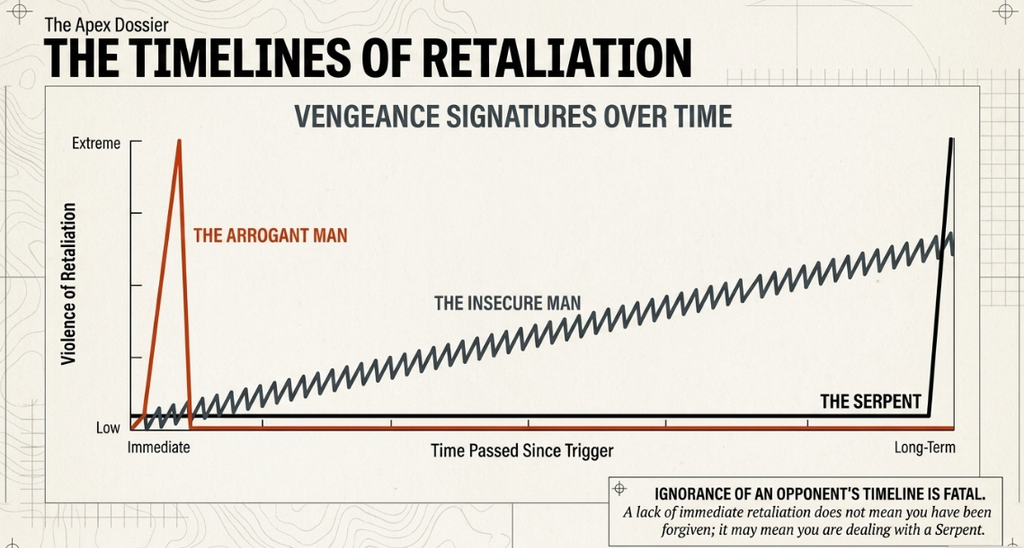
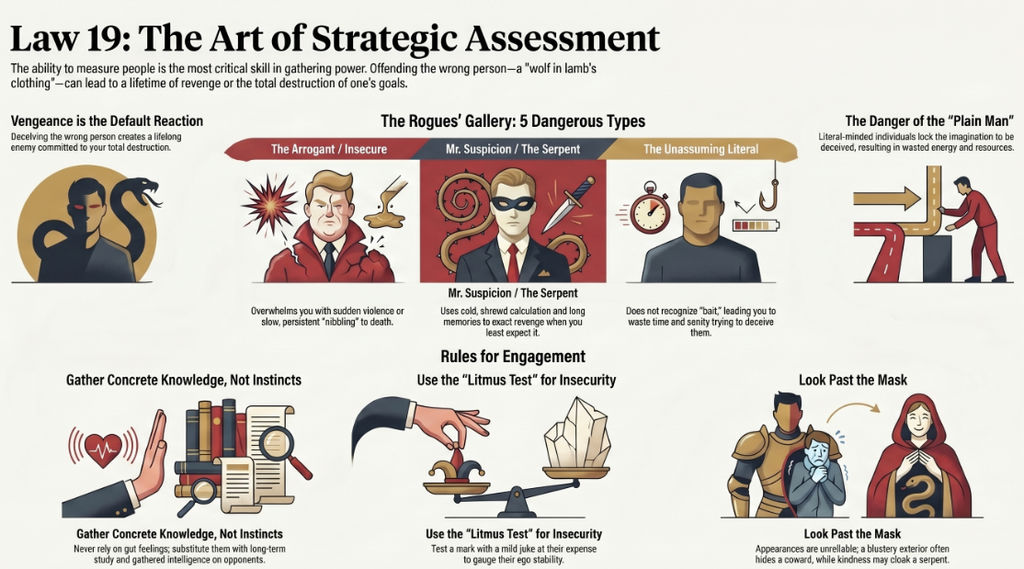
The “Arrogant and Proud” archetype is the most volatile element in the social jungle. Though he may initially mask his nature behind a veneer of authority, his pride is a hair-trigger mechanism. For this man, any perceived slight is met with an explosion of disproportionate violence. There is no logic or “sanity behind his over-reaction”; he will gladly burn down his own house just to ensure the smoke chokes you.
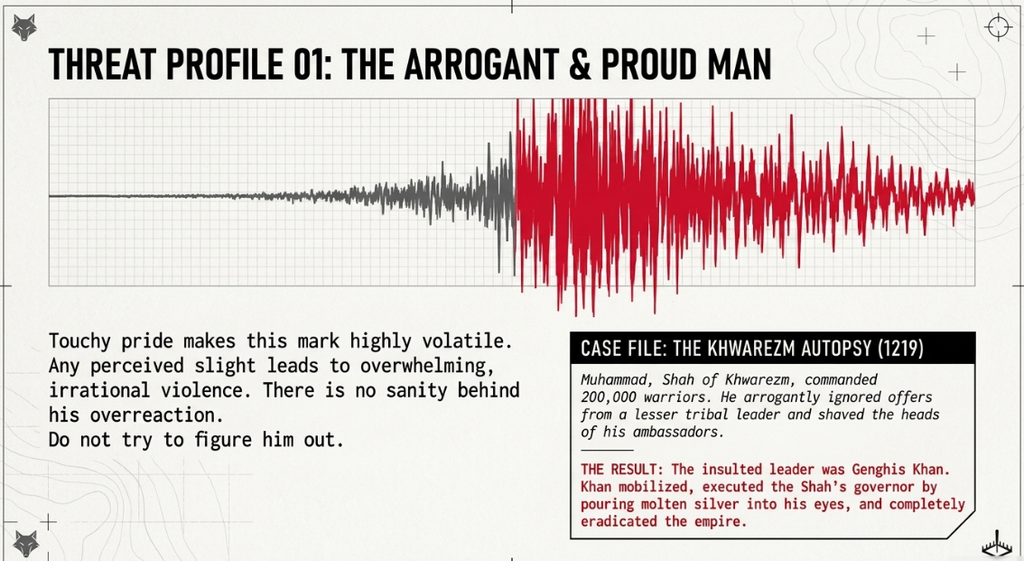
The historical ruin of Muhammad, the shah of Khwarezm, serves as a clinical case study in this pathology. In the thirteenth century, Muhammad ruled a vast empire centered in Samarkand. When Genghis Khan—then an emerging power—sent an embassy offering peaceful trade, the shah’s overactive pride perceived an equal’s greeting as an upstart’s insult. He eventually beheaded one of Khan’s ambassadors and shaved the heads of the others. This was not a strategic move; it was an irrational sacrifice of an entire empire for a moment of ego. Khan’s response was total annihilation, prefaced by a chillingly direct message:
> “You have chosen war. What will happen will happen, and what it is to be we know not; only God knows.”
If you detect a touchy, oversensitive pride in a mark, do not attempt to “manage” them. Flee. No potential gain is worth the risk of their senseless vengeance.
3. The Insecure Crusader: When the “Sucker” Fights Back
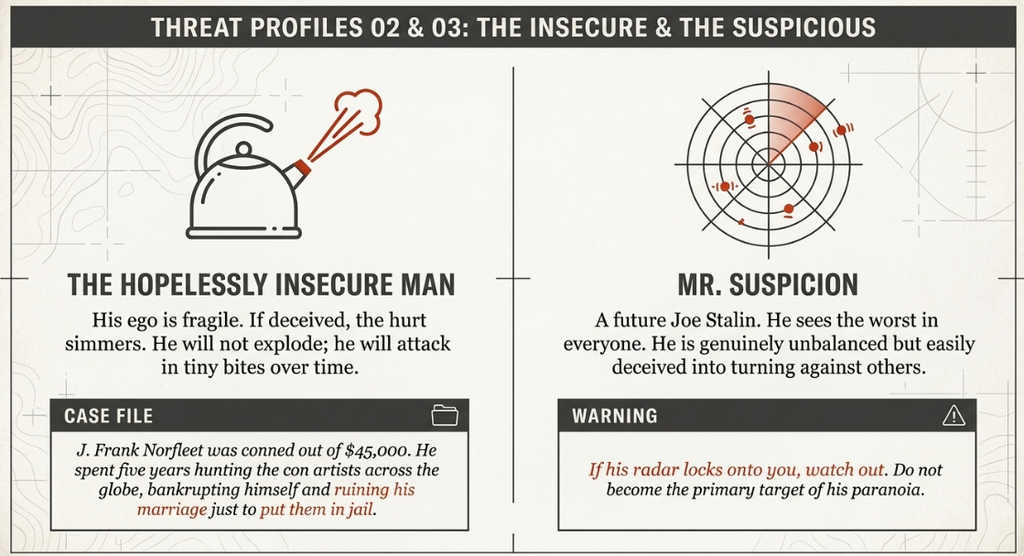
The “Hopelessly Insecure Man” is a variant of the proud man but far harder to diagnose. His ego is fragile, but his reaction is not an explosion; it is a slow-acting poison. Because he views himself as a “totally innocent victim,” he feels morally justified in a relentless pursuit of “justice.” While the Arrogant Man blows you up, the Insecure Crusader will “nibble you to death” over years.
Take J. Frank Norfleet, a Texas cattleman swindled out of $45,000 by Joe Furey’s con-artist ring. While most victims disappear in shame, Norfleet’s insecurity was so deeply activated that he spent five years on an international manhunt. He bankrupted himself, ruined his marriage, and scoured the globe from Canada to Mexico to catch Furey. To the Norfleets of the world, no price is too high to repair the damage to their self-doubt. If you harm an insecure man, do not stay around to watch him simmer; disappear, or he will make your destruction his life’s work.
4. The Literal Wall: Why You Can’t Deceive the Unintelligent
Deception is a sophisticated art that requires the target to have “intelligence and imagination.” To fall for a ruse, a person must be able to envision a grand future or a hidden gain. The “Plain, Unassuming, and Often Unintelligent Man” is immune to your traps because he simply does not recognize the bait.
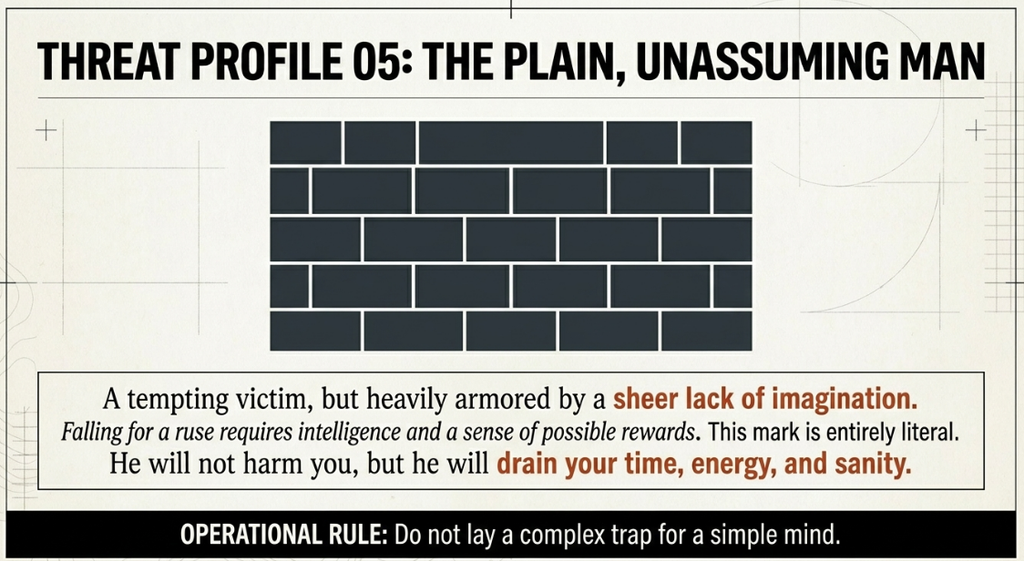
The legendary art dealer Joseph Duveen learned this when he tried to sell “The 100 Greatest Paintings in the World” to Henry Ford. Duveen produced a magnificent, expensive three-volume set of books to entice Ford into buying the originals. Ford’s reaction was devastatingly literal: he loved the books and saw no reason to buy the paintings since the color pictures in the book were already beautiful and sufficient. The danger here is not revenge, but the “waste of time, energy, and resources.”
The Diagnostic Tool: To identify this type, tell a joke or a story. If their reaction is utterly literal, do not proceed. Your sophisticated maneuvers will hit them like a wave hitting a stone wall, leaving you exhausted and empty-handed.
5. The Serpent with a Long Memory: The Art of the Cold Wait
The most dangerous strategist is the “Serpent”—the man who shows no anger on the surface but calculates his move for years. He understands that while wrongs are often forgiven, “contempt never is.”
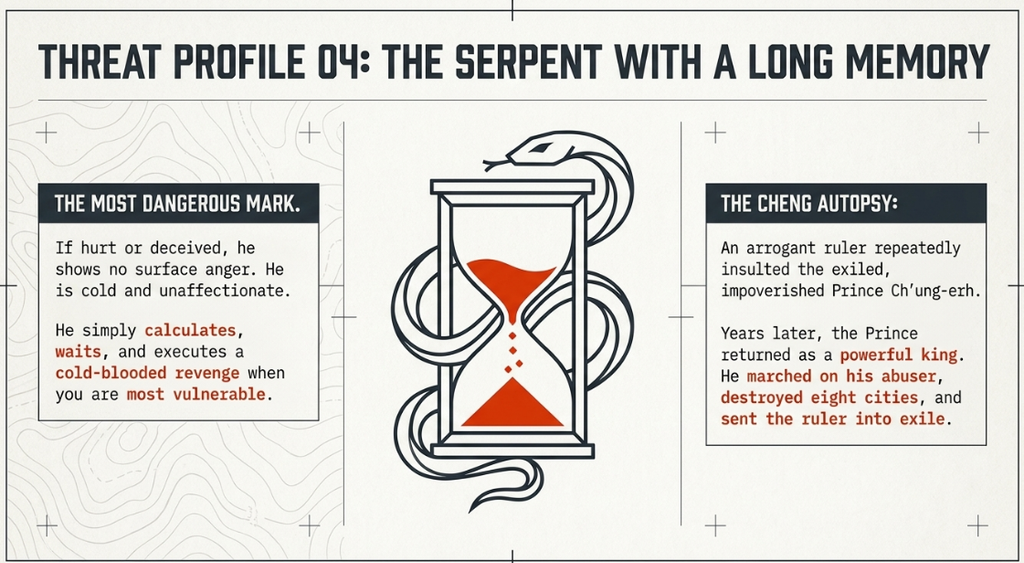
In the fifth century B.C., Prince Ch’ung-erh of Ch’in was an exile passing through the state of Cheng. The ruler of Cheng, seeing only the prince’s “lowly station,” treated him with overt rudeness despite warnings from his ministers. Years later, when Ch’ung-erh returned to power, he marched a vast army onto Cheng and destroyed the kingdom in a cold, calculated act of revenge. He waited until he was in a position of absolute power to settle the score.
To navigate the social terrain, you must categorize your targets:
- The Serpent: Cold, unaffectionate, and cunning. If you injure him, you must either crush him completely or remove him from your sight forever.
- Mr. Suspicion: A future Joe Stalin who imagines everyone is out to get him. He is actually the least dangerous because he is easy to deceive—simply play on his nature to make him turn against others.
- The Wolf in Lamb’s Clothing: The individual who hides a vengeful heart behind a polite or unremarkable facade.
6. The Golden Rules of Social Measurement
To move with power, you must adopt these three rules of engagement:
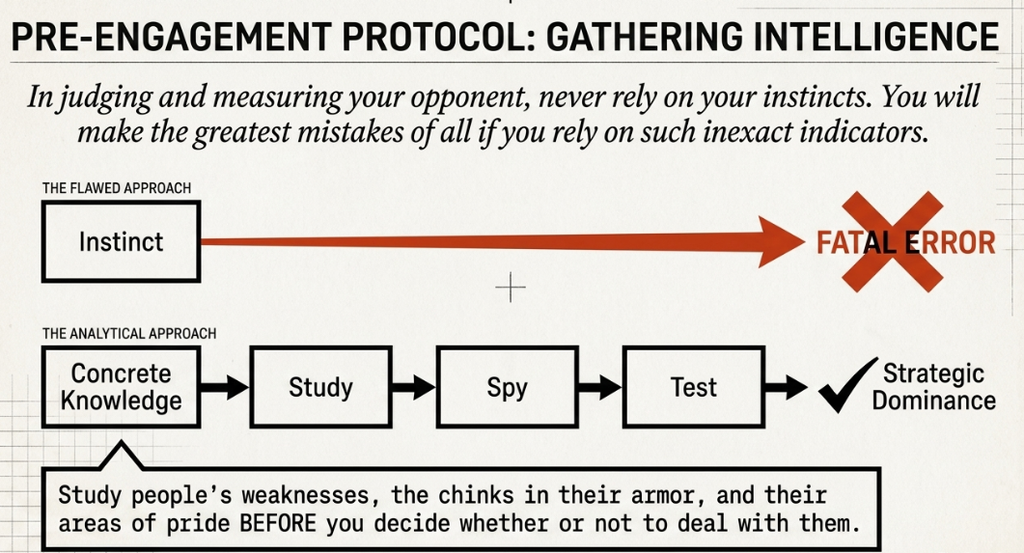
1. Never Rely on Instincts: Gut feelings are the currency of the gullible. Nothing substitutes for “concrete knowledge.” Spend the time to study and spy on your opponent until you understand the chinks in their armor.
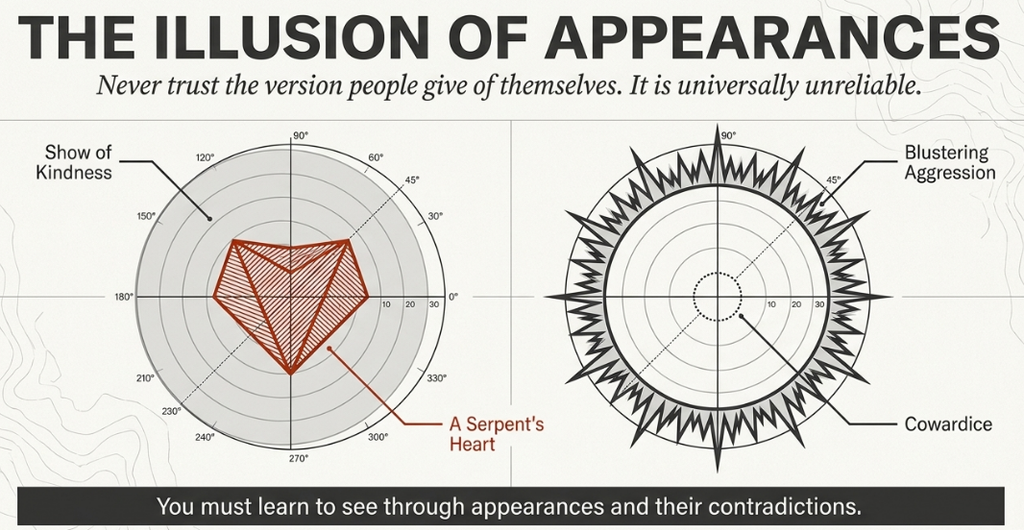
2. Look Past the Mask: People are not who they claim to be. A blustery exterior often cloaks a coward, while a “serpent’s heart” can easily hide behind a show of kindness. Look for the contradictions in their behavior.
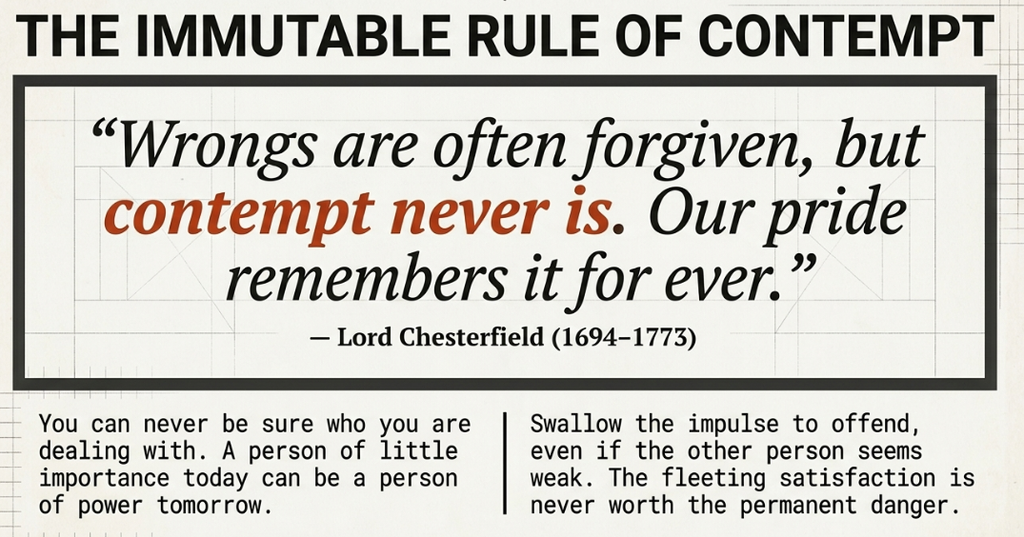
3. The Price of Contempt: An unnecessary insult offers a meager, fleeting satisfaction. It is never worth the long-term danger of creating a permanent enemy who will wait a decade to strike.
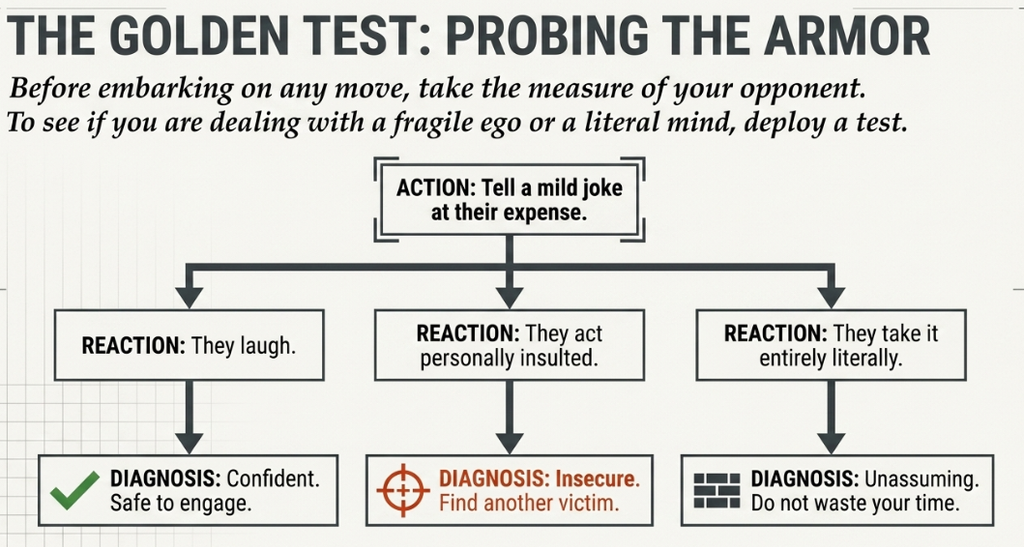
7. Conclusion: The Hunter’s Strategy
The master strategist is like the Hunter. He does not lay the same trap for a wolf as he does for a fox. He knows his prey’s habits, hideaways, and specific weaknesses, and he hunts accordingly. Before you make your next move, ask yourself: Have I measured the man across from me, or am I walking blindly into a trap of my own making?
As Lord Chesterfield observed: “Be convinced, that there are no persons so insignificant and inconsiderable, but may, some time or other, have it in their power to be of use to you; which they certainly will not, if you have once shown them contempt. Wrongs are often forgiven, but contempt never is. Our pride remembers it for ever.”
Reference


Related posts:
 First Law of Power: Why Your Best Work Might Be Your Biggest Liability: Lessons from the Architecture of Power
 The Fifteenth law: Why “Halfway” is the Most Dangerous Place to Stop: 5 Lessons in Total Victory
 The Sixteenth Law: The Scarcity of the Soul: Why Your Absence is Your Greatest Asset
 The Seventeenth Law: The Power of the Unseen Move: Why Unpredictability is Your Greatest Strategic Asset
 The Eighteenth Law: Why Your Best Defense is a Crowd: The Hidden Dangers of the “Fortress” Mentality