When the world turns hostile and the pressure of the “street” begins to mount, the siren song of the bunker becomes nearly irresistible. We crave a fortress—a sanctuary where we can shutter the windows, bolt the gates, and find safety away from the prying eyes and shifting loyalties of others. It is a primal instinct: when threatened, we withdraw to protect the “self.”
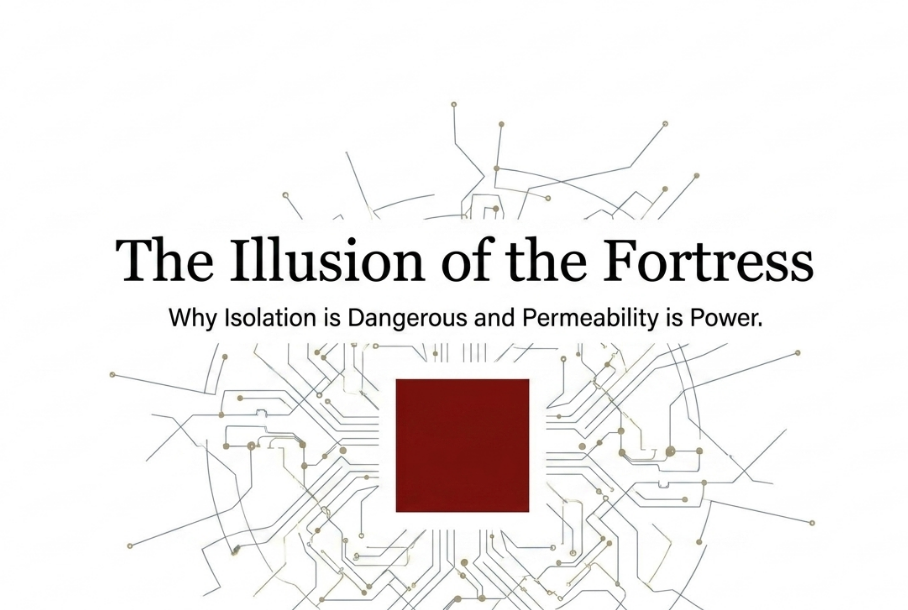
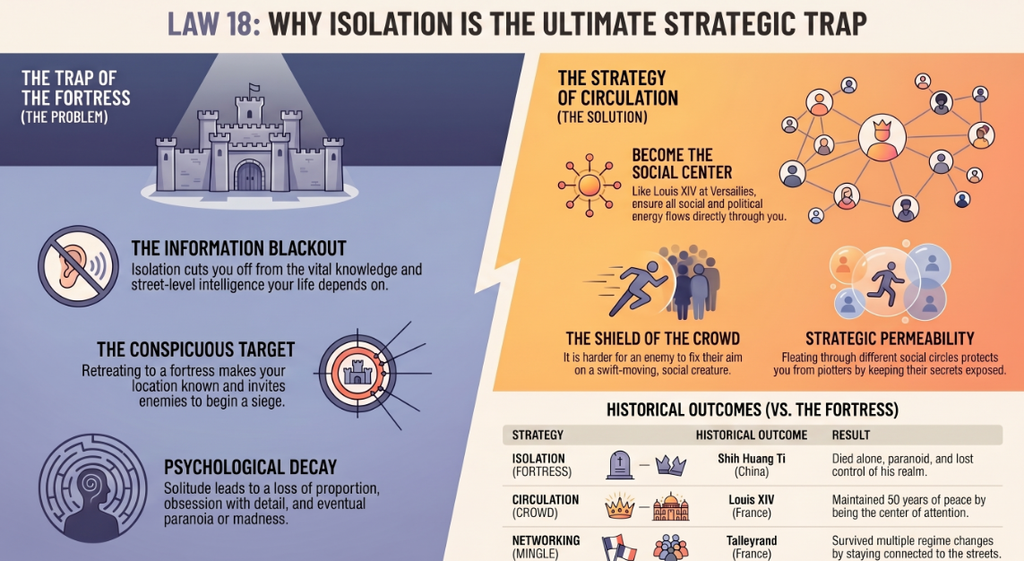
However, this withdrawal is the ultimate strategic blunder. In the realm of power, isolation is not a shield; it is a cage. By retreating, you trade the dynamic protection of a social circle for a static, visible target. The walls you build to keep enemies out serve only to trap you within, breeding a paralyzing paranoia that eventually replaces the very security you sought.
To remain powerful and safe, you must resist the urge to hide. True security is found not in solitude, but in the “thick of things.” To survive, you must stay permeable, using the crowd as your most effective camouflage.
Information is Your Most Valuable Shield
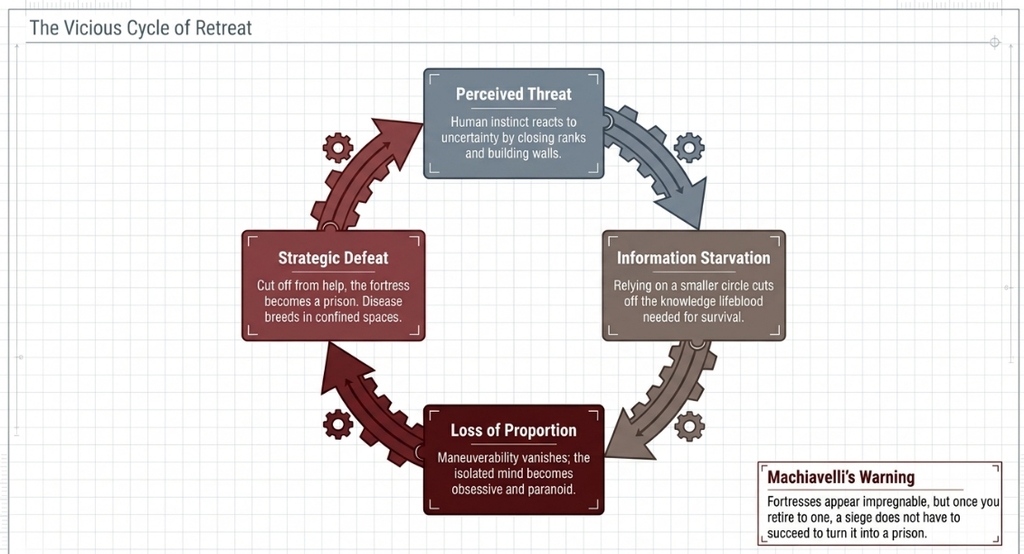
Safety depends entirely on intelligence. When you isolate yourself, you sever the arteries of vital information upon which your influence and survival depend. You lose your “ear” for the nuances of the street, becoming deaf to the plots being hatched in the shadows and blind to the shifting tides of the social landscape.
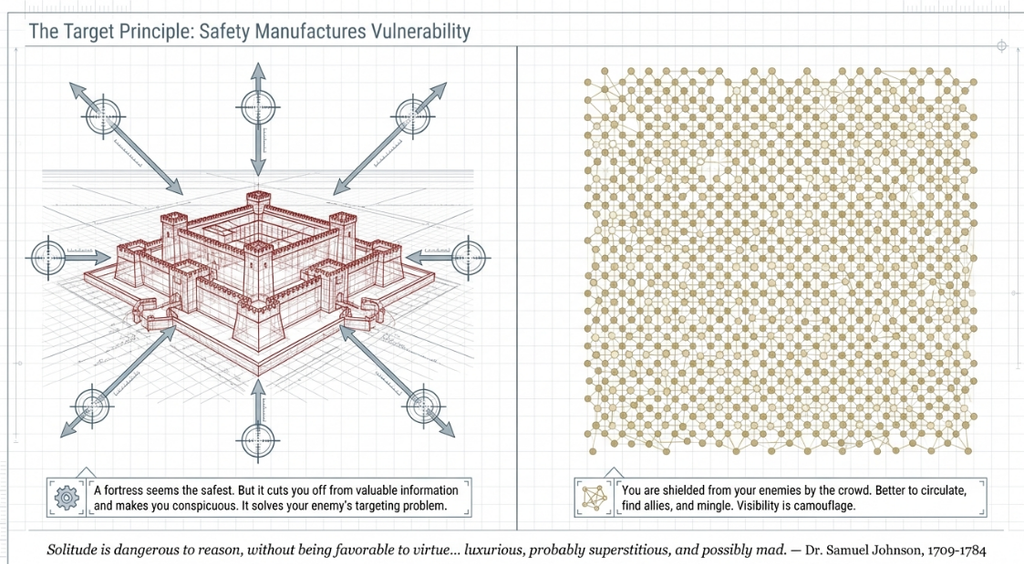
Instead of gaining safety, you become a conspicuous and easy target. In a crowd, you are one of many; in a fortress, you are the only point of focus. Circulating among people provides a form of “social camouflage,” a defensive barrier of connections and allies that makes it impossible for an enemy to isolate you from your base of support. As the source material warns:
> “The world is dangerous and enemies are everywhere—everyone has to protect themselves. A fortress seems the safest. But isolation exposes you to more dangers than it protects you from—it cuts you off from valuable information, it makes you conspicuous and an easy target. Better to circulate among people, find allies, mingle. You are shielded from your enemies by the crowd.“
The Salted Fish Factor: A Warning from the First Emperor
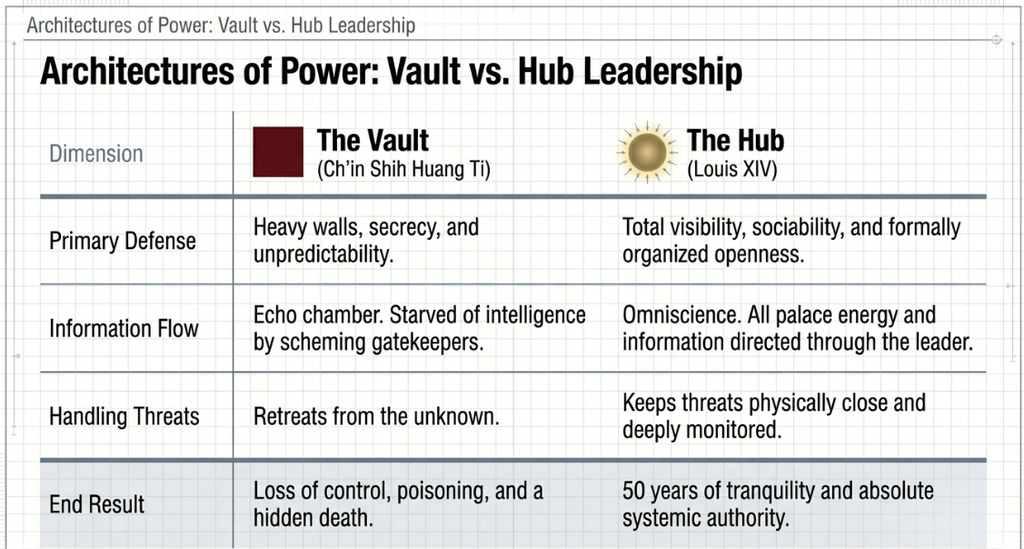
The tragic demise of Ch’in Shih Huang Ti, the first emperor of China, stands as history’s most potent warning against the “fortress” mentality. In his prime, he was a man of “unbridled ambition,” described by contemporaries as having a “waspish nose, eyes like slits, the voice of a jackal, and the heart of a tiger or wolf.” He unified a massive realm and built the Great Wall, yet his final years were defined by a pathetic, cowering terror of human contact.
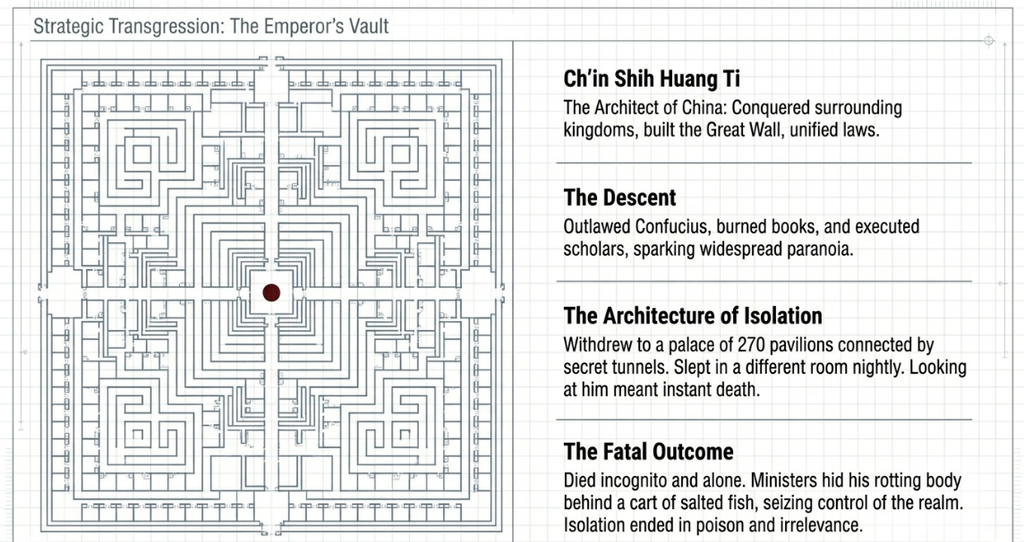
He moved through a magnificent palace of 270 pavilions via secret underground passageways, sleeping in a different room every night. Anyone who inadvertently laid eyes on him was instantly beheaded. He grew so paranoid that he traveled incognito, cutting himself off from his family, his court, and his own reality.
The irony was fatal. By the end, he was “emperor in name only,” having completely lost control of his realm to the scheming ministers who encouraged his isolation. On a trip through the provinces, he died suddenly. To maintain the illusion that he was still alive and to keep control of the state, his ministers trailed his carriage with a cart packed with salted fish to mask the stench of his rotting corpse. He was likely poisoned by the very men he thought were guarding his privacy. He died alone, his body a hidden, foul-smelling secret, proving that the fortress is often a tool used by your enemies to neutralize you.
Visibility as a Power Move: The Versailles Strategy
In stark contrast to the hidden emperor, Louis XIV of France recognized that power requires total visibility. He designed the Palace of Versailles not as a retreat, but as a “beehive” where privacy was strategically abolished.
The King’s bedroom sat at the literal center of the palace. Each morning began with the lever, a rigid ritual where over a hundred royal attendants, princes, and government officials watched the King wake and dress. This “forced sociability” was a masterstroke; by demanding the constant presence of the nobility, Louis ensured that no conspiracy could breathe without his knowledge.
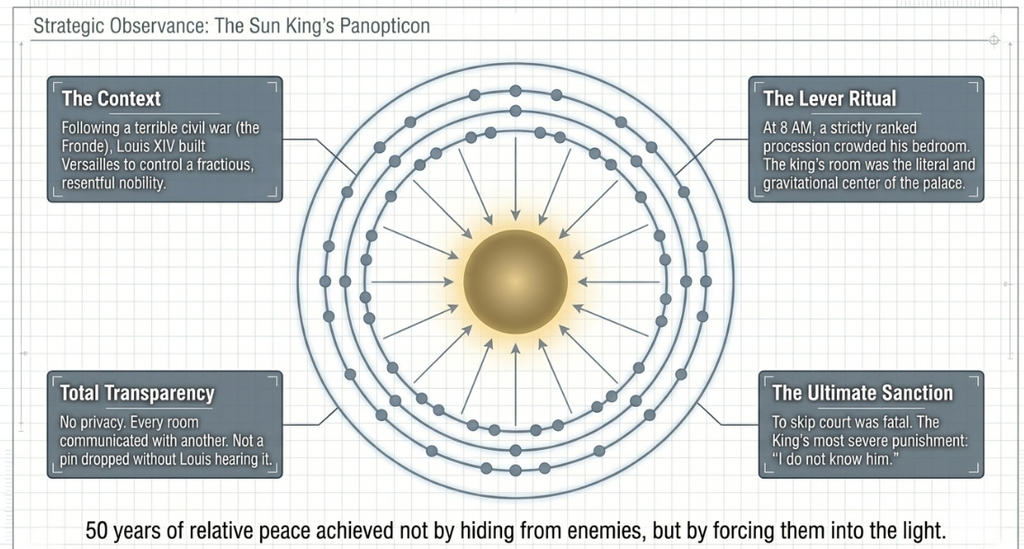
If someone dared to avoid the court, the King’s response was a social death sentence: “I do not know him.” When asked for advice or a favor, his standard, non-committal reply—”I shall see”—kept everyone in a state of precarious anticipation. As the court observer Saint-Simon noted, at his lever, his meals, and in his gardens, the King “always looked about him, noticing everything.” By staying visible, Louis remained the undisputed sun around which all other stars were forced to orbit.
The Creative Cost of the Fortress: The Case of Pontormo
Isolation is just as deadly to the creative mind as it is to the political one. In 1545, Duke Cosimo I de’ Medici commissioned the painter Jacopo da Pontormo to create frescoes for the church of San Lorenzo. Obsessed with protecting his ideas and outdoing Michelangelo, Pontormo sealed off the chapel with walls, partitions, and blinds. He worked in total solitude for eleven years.
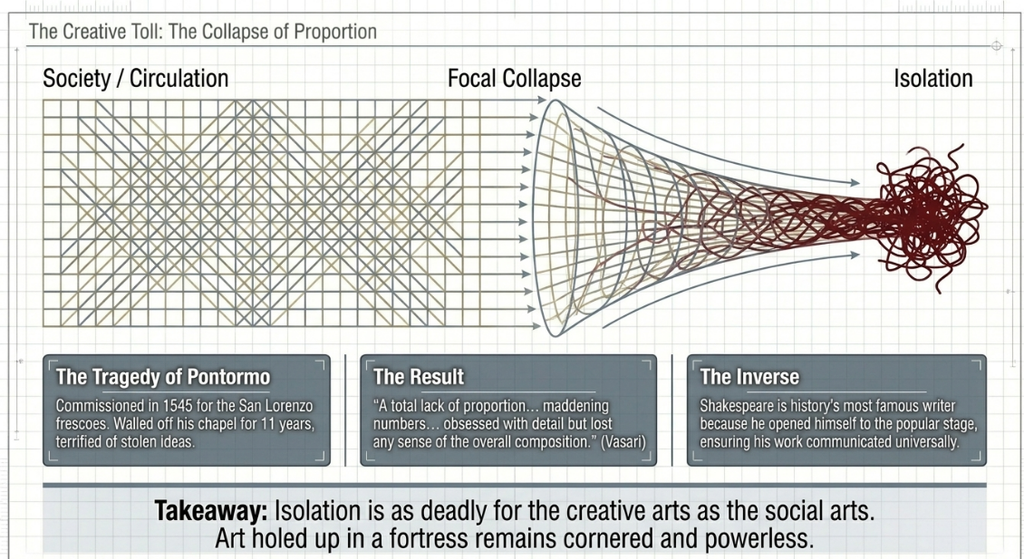
The results were a psychological horror. Without a “social reality check” to ground his vision, Pontormo lost all sense of proportion. His friend Vasari described the work as having an “extravagant ugliness,” with scenes and figures bumping into one another in “maddening numbers.” Pontormo had become so entangled in his own obsession with detail that he lost the overall composition.
The tragedy was absolute: none of the frescoes survived, and the work that should have been his legacy became his undoing. While a dramatist like Shakespeare thrived by opening his work to the masses, Pontormo’s isolation turned his mind into a prison. His art, like his spirit, remained cornered and powerless.
The Strategy of Fluidity: Mingle Like a Master
The most enduring strategists treat social interaction as a survival mechanism. They avoid the “quicksand” of a fixed, isolated position and prioritize mobility.
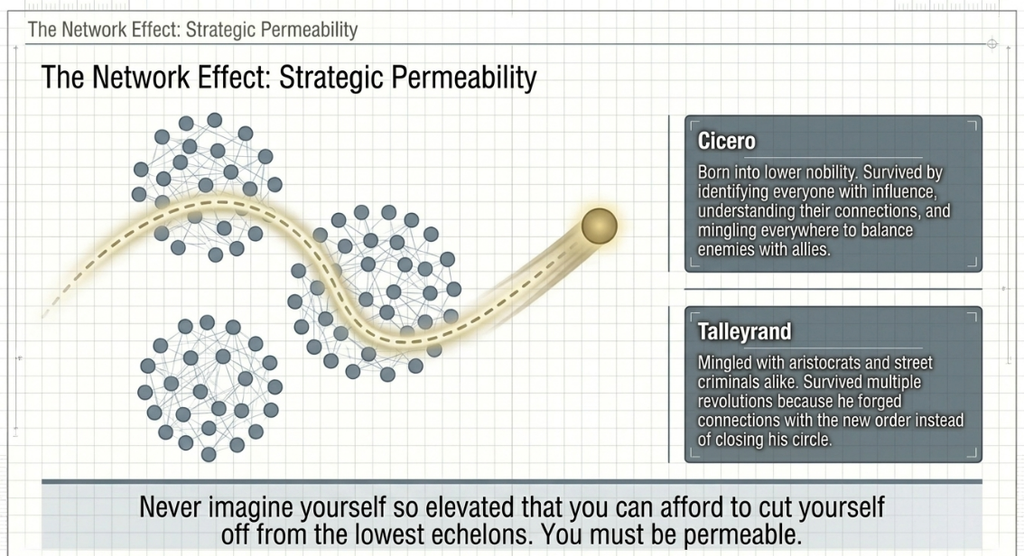
- Cicero’s Network: The Roman statesman overcame his lower-nobility status by mapping every person of influence and understanding their connections. By mingling everywhere, he built a web where any enemy could be counterbalanced by an ally.
- Talleyrand’s “Street” Intelligence: The French diplomat survived the most volatile regime changes in history—from the Directory to Napoleon, to the abdication of Louis XVIII—by staying in touch with the streets of Paris. He even mingled with criminal types to foresee trends before they reached the palace.
Tactics for Staying Accessible:
- Map Influence: Identify people of power and the invisible threads that connect them.
- Maintain “Street” Intelligence: Never imagine yourself so elevated that you can afford to cut off the lowest echelons.
- Stay Mobile: Float in and out of different circles. If you never settle in one place, no hunter can fix an aim on such a “swift-moving creature.”
The “Quicksand” of Solitude: A Word of Caution
It is almost never right to choose isolation. While the source acknowledges that solitude can be a “temporary recourse” for deep thought—Machiavelli, for instance, only wrote The Prince while in forced exile on a farm—it remains a dangerous drug.
Solitude is like quicksand; it sinks you deep without you noticing. While you may gain a certain perspective, you lose something more vital: a sense of your own smallness and limitations. Long-term isolation breeds “strange and perverted ideas” because it removes the friction of other people’s opinions. If you must seek solitude to think, do so in small doses and keep your way back into society wide open.
Conclusion: The Permeable Life
Power is not a physical object to be hoarded behind stone walls; it is a human creation sustained through social circulation. To retreat into a fortress is to choose irrelevance. In the modern world, safety does not come from the thickness of your walls, but from the breadth of your network.
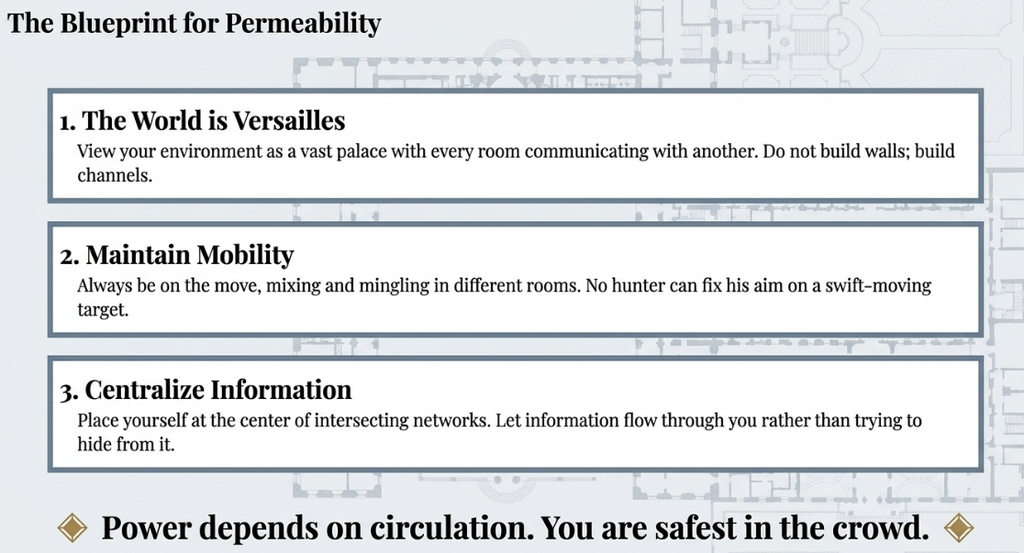
View the world as a vast Versailles—a place where every room communicates with another and success depends on your ability to be “permeable.” Are the boundaries you have set up protecting you, or are they slowly turning into the walls of your own prison?
To be truly powerful, you must remain permeable to the world, finding your greatest strength in the very crowd that surrounds you.
Reference


Related posts:
 First Law of Power: Why Your Best Work Might Be Your Biggest Liability: Lessons from the Architecture of Power
 The Fourteenth Law: The Art of the Invisible Inquisitor: Why Your Best “Friend” Might Be Your Best Spy
 The Fifteenth law: Why “Halfway” is the Most Dangerous Place to Stop: 5 Lessons in Total Victory
 The Sixteenth Law: The Scarcity of the Soul: Why Your Absence is Your Greatest Asset
 The Seventeenth Law: The Power of the Unseen Move: Why Unpredictability is Your Greatest Strategic Asset