1. Executive Context & Overview of the 1908 Laureates
The documentation of the 1908 Nobel Prizes captures a pivotal moment in early 20th-century intellectual history, highlighting foundational advancements across the physical sciences, life sciences, philosophy, and international diplomacy. In evaluating the strategic importance of these awards, the Nobel committees recognized contributions that addressed both the fundamental structure of physical matter and biological defense, as well as the imperative for human spiritual development and conflict resolution. Preserving a structured archival record of these achievements provides essential context for understanding how scientific rigor and humanitarian endeavors progressed alongside one another during a period of rapid global transformation.
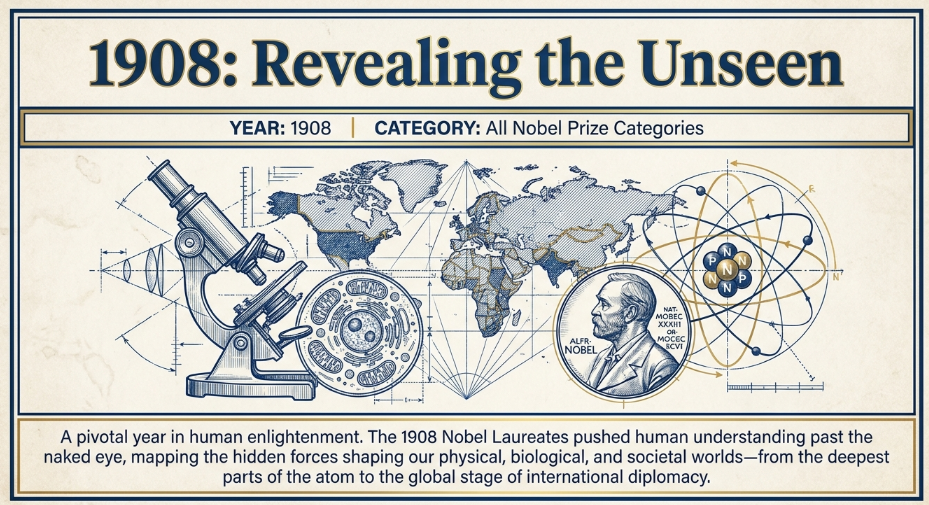
The 1908 awards were distributed among seven laureates across five prize categories. The composition of the awards included three full prizes (1/1 share) awarded to individual recipients in Physics, Chemistry, and Literature, alongside two split prizes (1/2 share each) awarded in Physiology or Medicine and Peace. Geographically and institutionally, the laureates represented prominent European academic centers and civic institutions, including Sorbonne University in France, Victoria University in the United Kingdom, the Institut Pasteur in France, Goettingen University and the Royal Institute for Experimental Therapy in Germany, as well as parliamentary and peace leaders in Sweden and Denmark.
| Category | Laureate Name(s) | Prize Share | Official Prize Motivation |
|---|---|---|---|
| Physics | Gabriel Lippmann | 1/1 | For his method of reproducing colours photographically based on the phenomenon of interference |
| Chemistry | Ernest Rutherford | 1/1 | For his investigations into the disintegration of the elements, and the chemistry of radioactive substances |
| Physiology or Medicine | Ilya Mechnikov and Paul Ehrlich | 1/2 each | In recognition of their work on immunity |
| Literature | Rudolf Christoph Eucken | 1/1 | In recognition of his earnest search for truth, his penetrating power of thought, his wide range of vision, and the warmth and strength in presentation with which in his numerous works he has vindicated and developed an idealistic philosophy of life |
| Peace | Klas Pontus Arnoldson and Fredrik Bajer | 1/2 each | For their long time work for the cause of peace as politicians, peace society leaders, orators and authors |
While these administrative divisions and geographic affiliations reflect the institutional landscape of the era, the true historical significance of the 1908 conferrals lies in the paradigm-shifting nature of the scientific discoveries themselves.
2. Scientific Breakthroughs: Physics, Chemistry, and Medicine
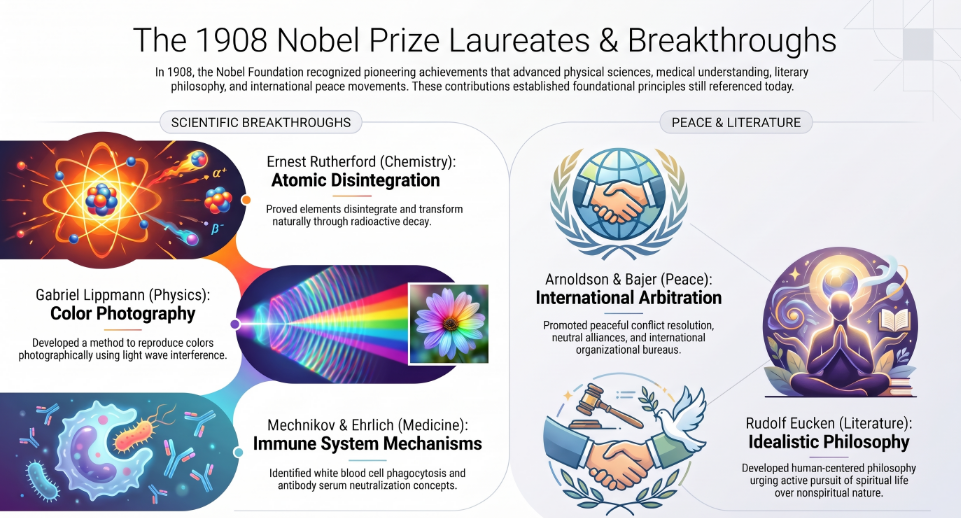
The natural science awards of 1908 reflect a period of profound paradigm shifts. Breakthroughs in wave optics, atomic decay, and cellular and humoral immunology altered the fundamental understanding of physical phenomena and biological defense mechanisms. By translating theoretical insights into experimental methodologies, the 1908 scientific laureates established new research trajectories that redefined early 20th-century scientific inquiry.
2.1 Physics: Gabriel Lippmann
Gabriel Lippmann was awarded the 1908 Nobel Prize in Physics for developing a groundbreaking method of reproducing colors photographically through wave interference. During the 19th century, photography relied primarily on light-sensitive silver halides, which were limited to capturing monochromatic (black-and-white) images. Lippmann overcame this limitation in the 1890s by exploiting the physical properties of light wave interaction.
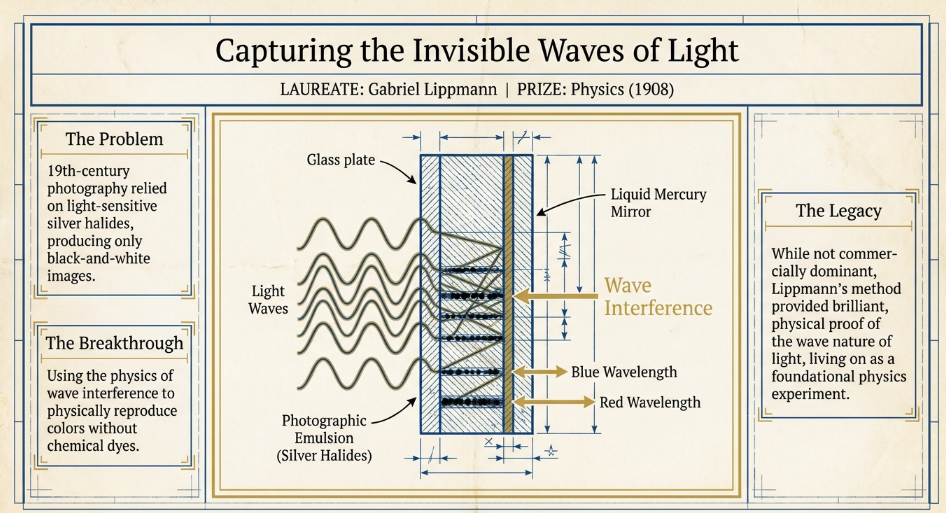
Lippmann’s technique utilized a mirror to reflect light back through a specialized photographic emulsion. This reflection established an interference phenomenon, forming a series of delicate, blackened layers within the emulsion. Because the precise distance between these layers corresponded directly to specific wavelengths of light, the structural pattern transmuted the reflected light into a natural color image upon viewing. Affiliated with Sorbonne University in Paris, France, Lippmann received a full (1/1) prize share. Although his elaborate color photography method never achieved widespread commercial usage due to practical constraints, it established a permanent legacy as a foundational experiment in wave physics.
2.2 Chemistry: Ernest Rutherford
Ernest Rutherford received the full (1/1) 1908 Nobel Prize in Chemistry for his investigations into the disintegration of elements and the chemical properties of radioactive materials. Affiliated with Victoria University in Manchester, United Kingdom, Rutherford conducted a series of landmark investigations following the initial 1896 discovery of radioactivity.
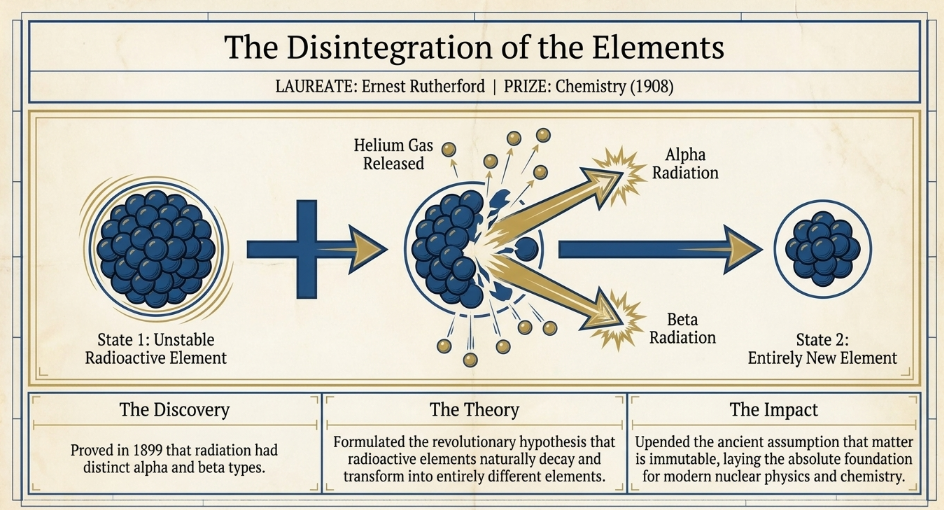
In 1899, Rutherford demonstrated that radioactive emissions were not uniform, identifying at least two distinct types of radiation: alpha radiation and beta radiation. He subsequently observed that radioactive preparations continuously generated gaseous substances. Collaborating with Frederick Soddy, Rutherford advanced the hypothesis that helium gas could be produced from radioactive elements. By 1902, Rutherford and Soddy formulated a revolutionary theory of elemental disintegration, establishing that unstable radioactive elements spontaneously transform into entirely different chemical elements over time.
2.3 Physiology or Medicine: Ilya Mechnikov and Paul Ehrlich
The 1908 Nobel Prize in Physiology or Medicine was shared equally (1/2 share each) between Ilya Ilyich Mechnikov and Paul Ehrlich for their work on immunity. Historically, their conferral represented the vital convergence of two opposing 19th-century immunological paradigms—cellular defense and humoral defense—which together laid the theoretical groundwork for modern 20th-century immunology.
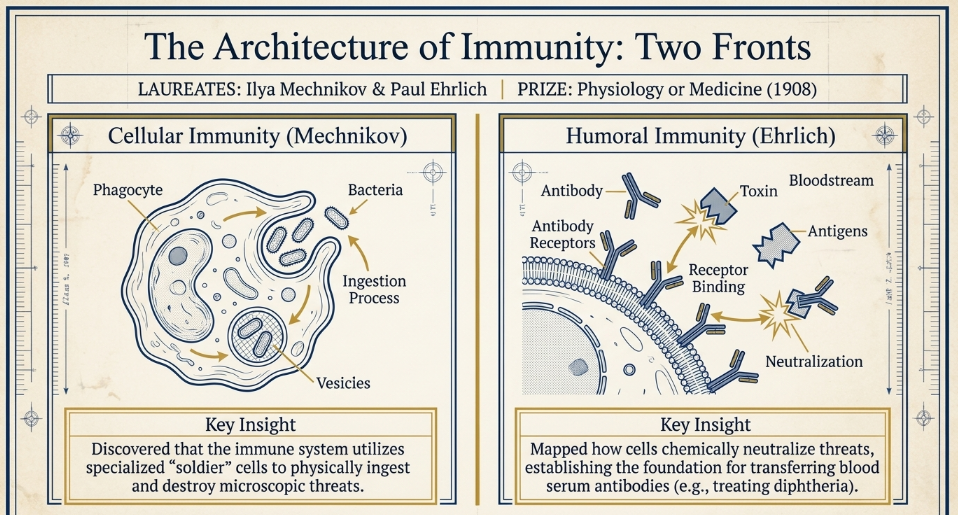
- Ilya Ilyich Mechnikov: Affiliated with the Institut Pasteur in Paris, France, Mechnikov pioneered the cellular theory of immunity. Through his 1882 studies of starfish larvae, Mechnikov identified the process of phagocytosis. He demonstrated that specialized white blood cells serve as active defenders within the body by physically encapsulating and destroying harmful bacteria and foreign microorganisms.
- Paul Ehrlich: Affiliated jointly with Goettingen University in Göttingen, Germany, and the Königliches Institut für experimentelle Therapie (Royal Institute for Experimental Therapy) in Frankfurt-on-the-Main, Germany, Ehrlich focused on humoral immunity and chemical defenses. Ehrlich advanced therapeutic immunology by working with Emil von Behring to transfer blood serum containing neutralizing substances to treat diphtheria. To explain this mechanism, Ehrlich formulated his receptor theory, postulating that body cells possess specific receiving elements (receptors) that bind to bacterial toxins. When these receptors are knocked off the cell during immune responses, they circulate in the bloodstream as functional antibodies.
Together, Mechnikov’s demonstration of active cellular ingestion and Ehrlich’s chemical model of circulating serum antibodies bridged the gap between cellular and molecular biology, providing a comprehensive dual framework for human biological defense.
Having demonstrated the transformative expansion of physical and biological understanding, the 1908 awards extended their scope to address humanistic philosophy and international conflict resolution.
3. Humanistic and Social Contributions: Literature and Peace
The humanistic and social awards of 1908 responded directly to the cultural and geopolitical tensions of the period. By recognizing idealistic philosophy and structured international arbitration, the Nobel committees highlighted intellectual frameworks designed to elevate human consciousness, protect civil sovereignty, and establish institutional mechanisms for world peace.
3.1 Literature: Rudolf Christoph Eucken
Rudolf Christoph Eucken was awarded the full (1/1) 1908 Nobel Prize in Literature in recognition of his idealistic philosophy, analytical depth, and extensive writings centered on human spiritual development. Born in Aurich, East Friesland (now Germany), Eucken built an academic career in classical philology, history, and philosophy, earning his PhD from Göttingen University in 1866 before holding professorships at the University of Basel in 1871 and the University of Jena in 1874. Residing in Germany and writing in the German language, his core philosophical work was articulated in major publications such as Main Currents of Modern Thoughts (1908) and Individual and Society (1923).
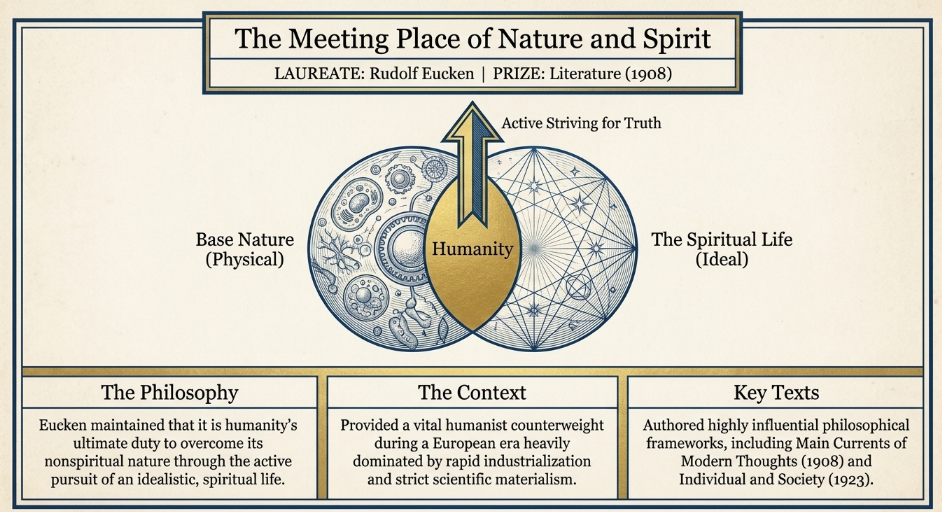
Eucken centered his intellectual system on human experience, advancing the thesis that man serves as the essential meeting point between physical nature and spirit. He argued that individuals bear an imperative ethical duty to overcome their nonspiritual, purely physical impulses by actively striving toward an elevated spiritual life. Explicitly framed as an intellectual reaction against 19th-century scientific positivism and reductive materialism, Eucken’s “idealistic philosophy of life” sought to reassert moral agency and spiritual purpose in an increasingly industrialized world.
3.2 Peace: Klas Pontus Arnoldson and Fredrik Bajer
The 1908 Nobel Peace Prize was divided equally (1/2 share each) between Klas Pontus Arnoldson of Sweden and Fredrik Bajer of Denmark, honoring their lifetime achievements as parliamentarians, authors, orators, and peace movement leaders. Their co-selection synthesized two contrasting yet complementary paths to peace activism: Bajer arrived at anti-militarism through his firsthand experiences as a military officer, whereas Arnoldson approached international diplomacy as a civilian parliamentarian and writer.
- Klas Pontus Arnoldson: A prominent Swedish writer, former member of the Swedish Parliament, and founder of the Swedish Peace and Arbitration League, Arnoldson dedicated his career to peaceful conflict resolution and international law. During the critical 1895 Swedish-Norwegian union crisis—when Sweden threatened force against Norway’s demands for union equality—Arnoldson published the influential handbill “Peace with Norway, whether the union sinks or swims.” This strategic intervention helped de-escalate military tension between the two “brother peoples,” laying key diplomatic groundwork prior to Norway’s eventual peaceful dissolution of the union in 1905. Arnoldson maintained that Nordic unity should form a union of autonomous republics with a shared foreign policy, later reflecting that “the idea of Europe’s United States may gradually prove stronger than the idea of Nordic unity.”
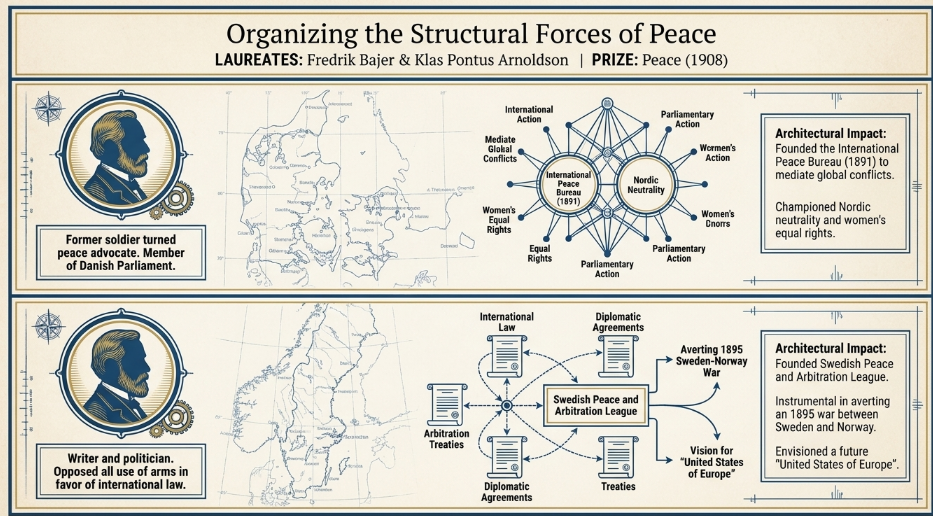
- Fredrik Bajer: A member of the Danish Parliament and former military officer, Bajer fought in the 1864 Dano-German war before resigning his commission in 1865 out of disillusionment with military life. Redirecting his career toward organized peace efforts, Bajer became a key architect of international arbitration frameworks and was credited with establishing the International Peace Bureau in 1891, serving as its Honorary President in Berne, Switzerland. A staunch republican, Bajer argued that Nordic nations must maintain strict neutrality and coordinate a unified foreign policy. Furthermore, collaborating with his wife, Mathilde Bajer, he co-founded the Danish Women’s Society, operating under the conviction that advancing equal societal rights was intrinsically linked to securing lasting international peace.
To formalize these historical contributions within the permanent archival index, the following section provides the standard, unedited year-wise summary listing for 1908.
4. Final Year-Wise Summary (1908 Standard Output Format)
This section provides an authoritative reference summary of the 1908 Nobel Laureates, strictly adhering to standard year-based summary requirements.
1908
- Gabriel Lippmann: For his method of reproducing colours photographically based on the phenomenon of interference.
- Ernest Rutherford: For his investigations into the disintegration of the elements, and the chemistry of radioactive substances.
- Ilya Mechnikov and Paul Ehrlich: In recognition of their work on immunity.
- Rudolf Christoph Eucken: In recognition of his earnest search for truth, his penetrating power of thought, his wide range of vision, and the warmth and strength in presentation with which in his numerous works he has vindicated and developed an idealistic philosophy of life.
- Klas Pontus Arnoldson and Fredrik Bajer: For their long-time work for the cause of peace as politicians, peace society leaders, orators and authors.
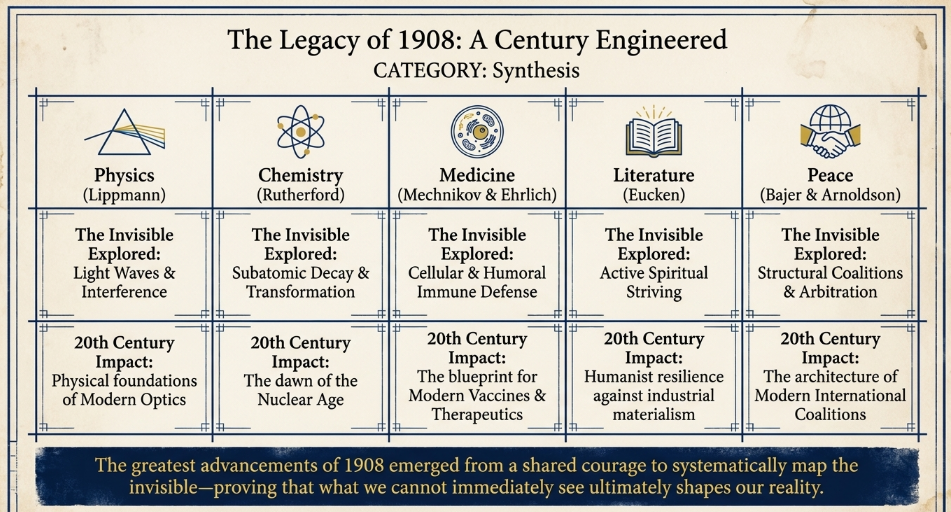
The decisions of the 1908 Nobel committees preserved an exceptional balance between theoretical science, practical medical applications, philosophical idealization, and the institutionalization of global peace.
Reference
https://www.nobelprize.org/prizes/lists/all-nobel-prizes/1909-1901