1. Historical Context: The Second Year of the Nobel Prize
The 1902 Nobel Prizes represented a pivotal strategic moment for the Nobel Foundation, serving as the critical first “follow-up” to the inaugural awards of 1901. By successfully identifying a second cohort of world-class laureates, the institution moved beyond the novelty of its inception to establish a permanent, global benchmark for intellectual and humanitarian achievement.
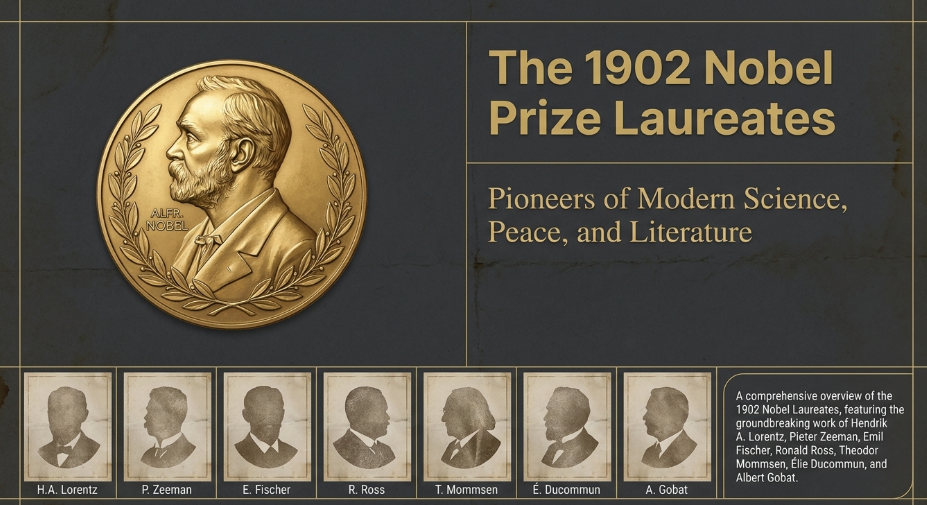
This continuity solidified the prestige of the prizes, confirming that the Nobel would serve as the ultimate arbiter of human excellence. The institutional framework for this mission remains anchored by the Nobel Foundation, which manages Alfred Nobel’s fortune and holds the ultimate responsibility for fulfilling the mandates of his will. Under its aegis, the independent prize-awarding institutions—academic bodies of unparalleled rigor—exercise their autonomy to select laureates based on professional merit. This established structure provided the stability necessary to recognize the groundbreaking work emerging in the physical sciences, beginning with a fundamental shift in our understanding of the relationship between magnetism and light.
2. Physics: Magnetism and the Foundation of Modern Radiation Theory
The 1902 Physics prize was of profound strategic importance, acting as a theoretical and experimental bridge that connected 19th-century electromagnetism to the burgeoning 20th-century paradigms of quantum mechanics and relativity. By honoring the “extraordinary service” of Hendrik A. Lorentz and Pieter Zeeman, the Nobel Committee highlighted a self-reinforcing ecosystem of excellence; Zeeman had been educated at Leiden University under the instruction of both Lorentz and the future 1913 laureate, Kamerlingh Heike Onnes.
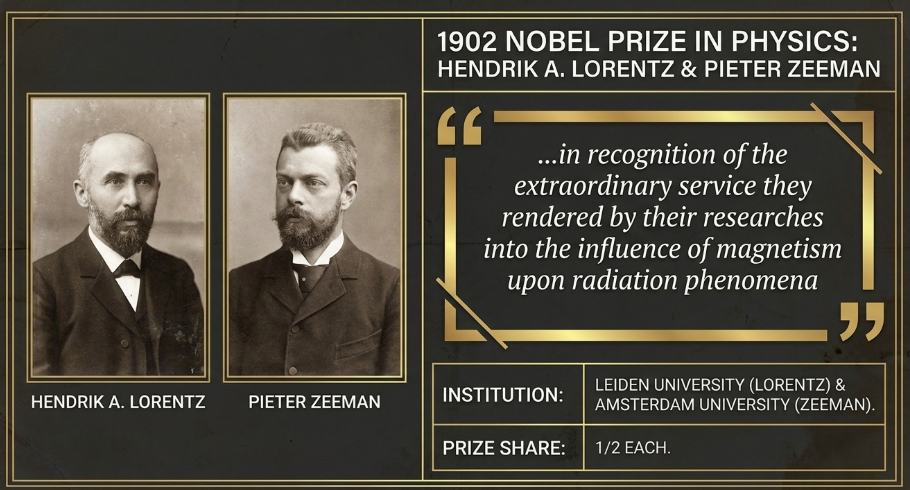
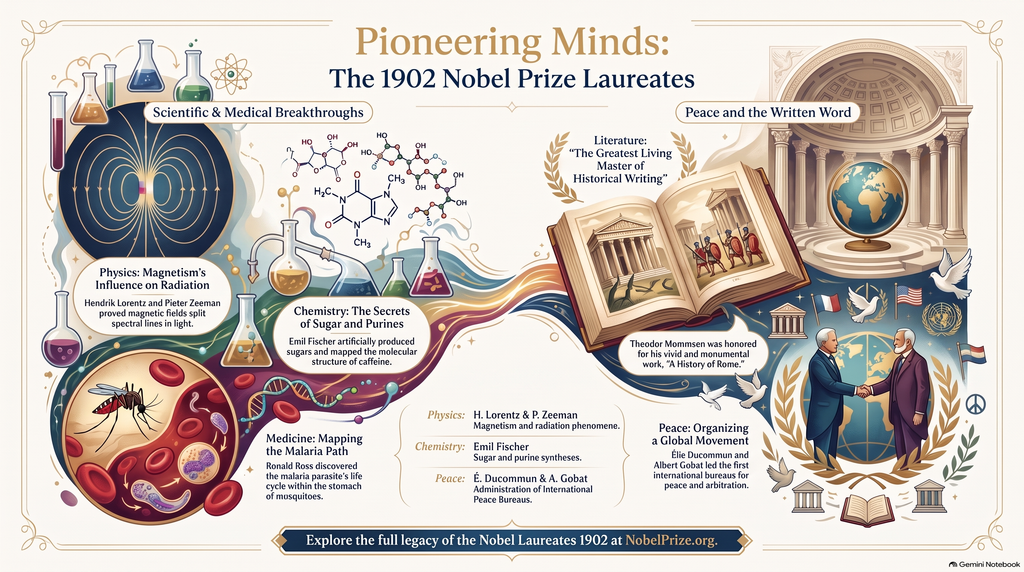
- Hendrik A. Lorentz: A professor of theoretical physics at Leiden, Lorentz clarified the vital connections between electricity, magnetism, and light. In 1892, he presented his “electron theory,” which posited that matter contains charged particles—electrons—whose oscillations produce light and whose movements conduct electric current.
- Pieter Zeeman: In 1896, Zeeman provided the experimental confirmation of his mentor’s theories. He discovered that when a substance is subjected to a magnetic field, its spectral lines—which typically correspond to fixed wavelengths—split into several distinct lines. This “Zeeman effect” provided the physical evidence required to validate the electron theory.
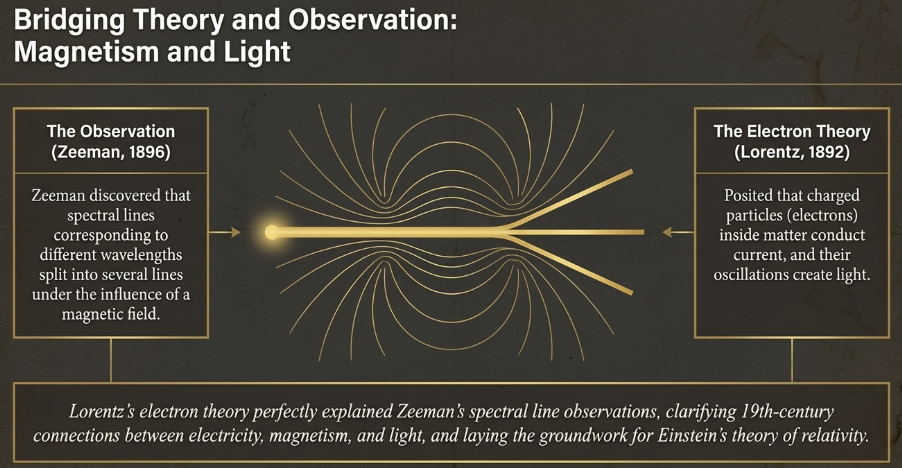
The Significance of the Discovery These researches provided the foundational data that anticipated the theory of relativity, a connection reinforced by Lorentz’s extensive intellectual exchange with Albert Einstein. Lorentz demonstrated that the most abstract theoretical knowledge could yield practical utility; he famously applied his equations for the movement of water to the improvement of dam systems. This mastery of physical radiation and its interactions with matter provided the conceptual tools for chemists to map the very synthesis of biological life.
3. Chemistry: Mapping the Building Blocks of Life
The 1902 Chemistry prize awarded to Emil Fischer underscored the strategic importance of chemical synthesis within both the burgeoning artificial materials industry and the foundational study of biological chemistry. Fischer, who earned his PhD under the 1905 laureate Adolf von Baeyer, exemplified the era’s trend toward collaboration between academic research and industrial production.
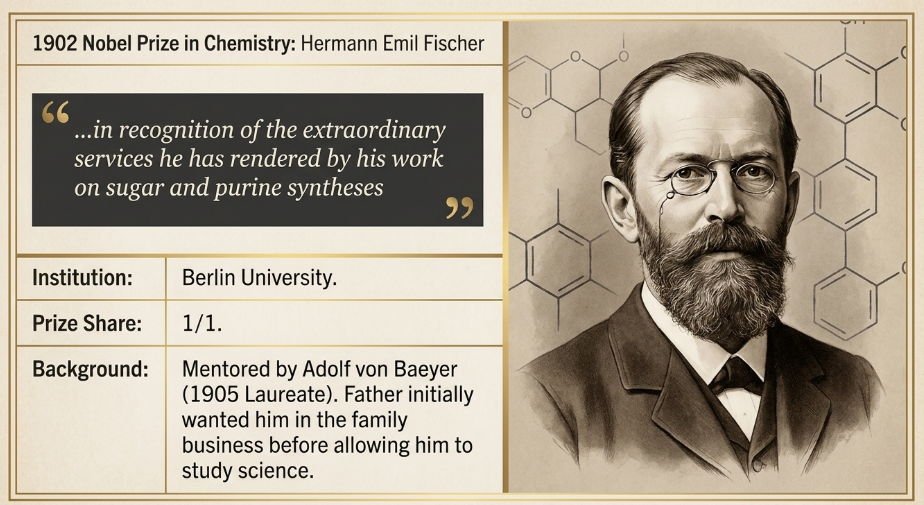
Emil Fischer: Recognized for his “extraordinary services” regarding sugar and purine syntheses, Fischer’s career was defined by an unparalleled ability to map complex molecular architectures.
- Sugar Syntheses: In 1877, Fischer produced phenylhydrazine, a base that became the essential chemical key for unlocking the structure of sugar molecules. This tool allowed him to map these structures and artificially produce several varieties of sugar in the laboratory.
- Purine Research: Fischer also identified and synthesized purines, a group of nitrogenous compounds. He demonstrated their biological ubiquity, showing that these substances form the caffeine found in coffee, as well as the related compounds in tea and cacao.
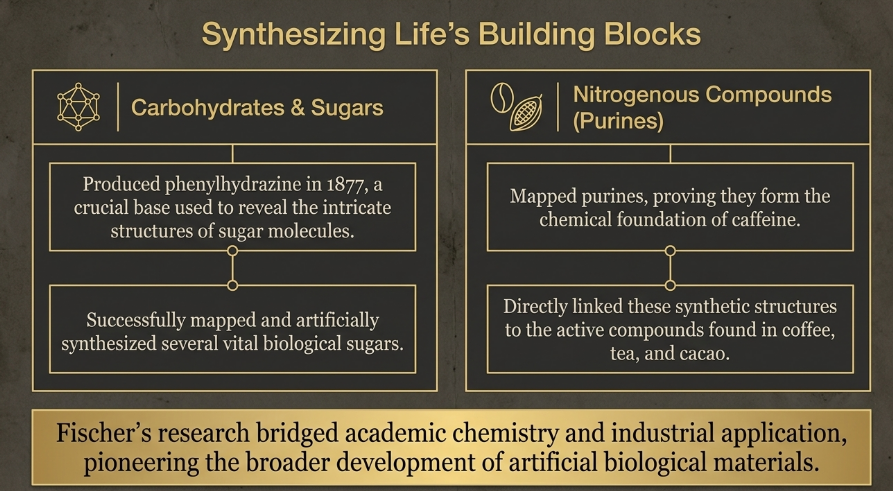
The Significance of the Discovery Fischer’s work transformed the understanding of biological processes by proving that the “building blocks of life” were not vitalistic mysteries, but chemical structures that could be mapped and recreated. His collaboration with industry helped move chemistry from a descriptive science to one of active creation, facilitating the development of artificial foods and materials. The mapping of these molecular structures facilitated a deeper understanding of life’s machinery, a clarity that became indispensable in the medical fight against tropical parasites.
4. Physiology or Medicine: The Breakthrough in Malaria Transmission
The awarding of the 1902 prize to Ronald Ross was a landmark event for global health and the then-emerging field of epidemiology. Malaria had long been an enigmatic scourge; Ross’s discovery provided the first actionable map of the disease’s transmission, moving the medical community from broad suspicion to precise containment.
Ronald Ross: A military medical officer born in India and educated in Great Britain, Ross was a multifaceted intellectual with deep interests in mathematics, poetry, and music.
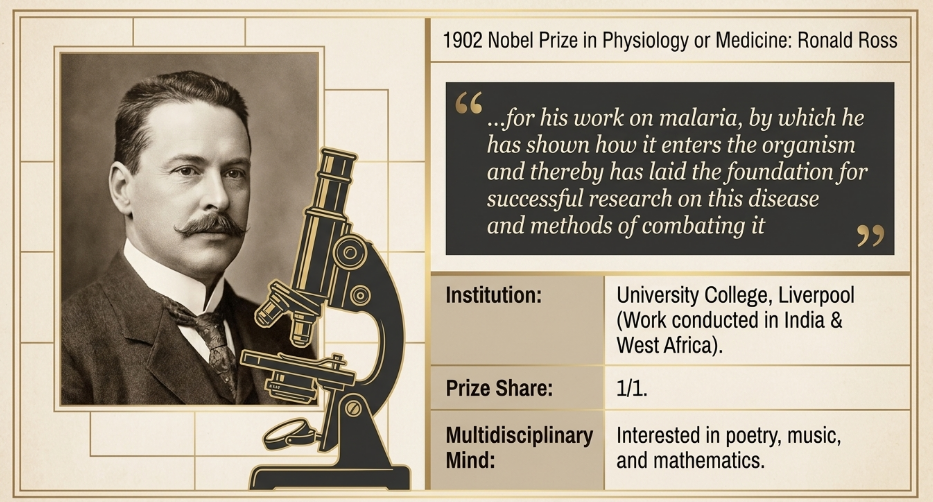
- Discovery of Transmission: Building on Alphonse Laveran’s earlier detection of the parasite in human blood, Ross sought the transmission vector. In 1897, while working in India, he identified the malaria parasite within the stomach of a specific species of mosquito that had fed on infected blood.
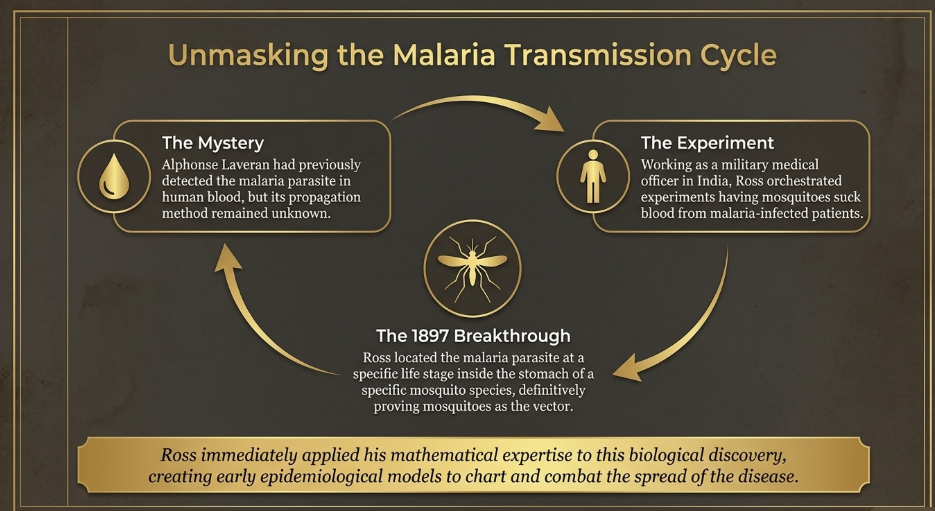
The Significance of the Discovery Ross’s contribution was as much mathematical as it was biological. He utilized his proficiency in mathematics to create the first rigorous models of how the disease spread through populations, a methodology that remains the foundation of modern epidemiological tools. This quantitative approach allowed for the development of scientific “methods of combating” malaria, fundamentally changing how global health crises are managed. The conquest of the microscopic parasite allowed for the security of human life, providing a stable foundation for the cultural and literary reconstructions of human civilization itself.
5. Literature: The Art of Historical Reconstruction
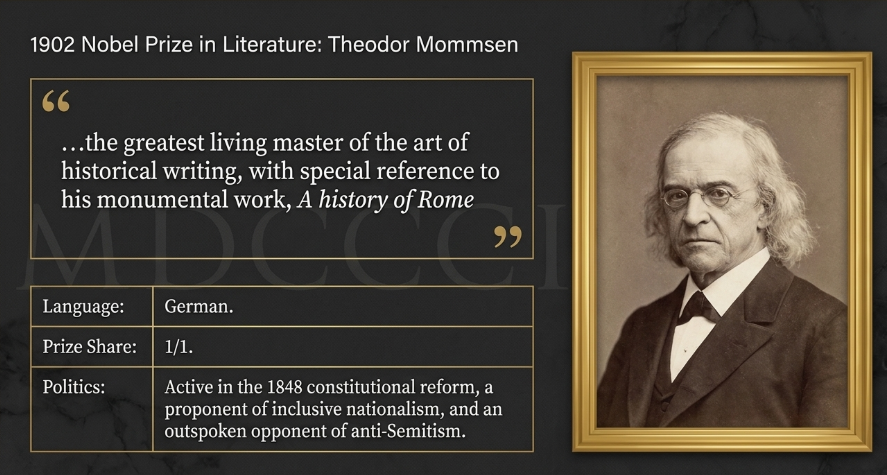
In a notable departure from traditional fiction, the 1902 Literature prize was awarded to the historian Theodor Mommsen. This selection highlighted the strategic importance of “literary quality” in the recording of human history, asserting that the mastery of prose is essential for the vivid reconstruction of the past.
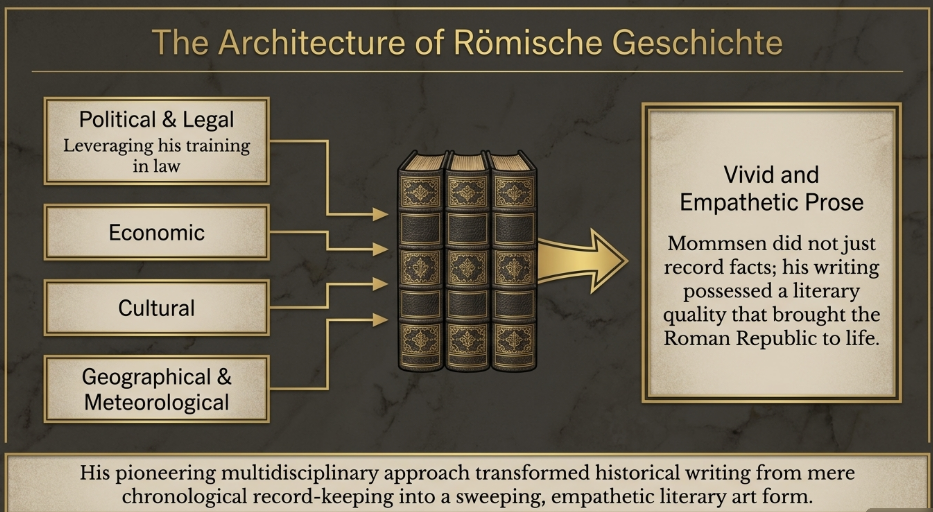
Theodor Mommsen: Honored as the “greatest living master of the art of historical writing,” Mommsen was recognized primarily for his monumental three-volume work, A History of Rome (Römische Geschichte).
- Multidisciplinary Mastery: Mommsen’s work synthesized his training in history and law with insights into geography, meteorology, and economics. His “vivid and empathetic” writing style transformed dry legal and political records into a holistic, resonant narrative of the Roman Republic.
The Significance of the Discovery Mommsen’s historical perspective was inextricably linked to his political life as a liberal nationalist and supporter of constitutional reform. While he was a staunch opponent of anti-Semitism and an advocate for “inclusive nationalism” within Germany, his worldview was tempered by the anxieties of his time, including his perception of Slavic countries to the east as a strategic threat. His ability to synthesize the legal and cultural foundations of an ancient civilization offered a roadmap for the modern pursuit of international stability through arbitration.
6. Peace: The Institutionalization of International Arbitration
The 1902 Peace Prize recognized the “administrative” and “bureaucratic” foundations of the global peace movement. By honoring Élie Ducommun and Albert Gobat, the Nobel Committee signaled that the pursuit of peace required professional organization and international legal frameworks rather than mere sentiment.
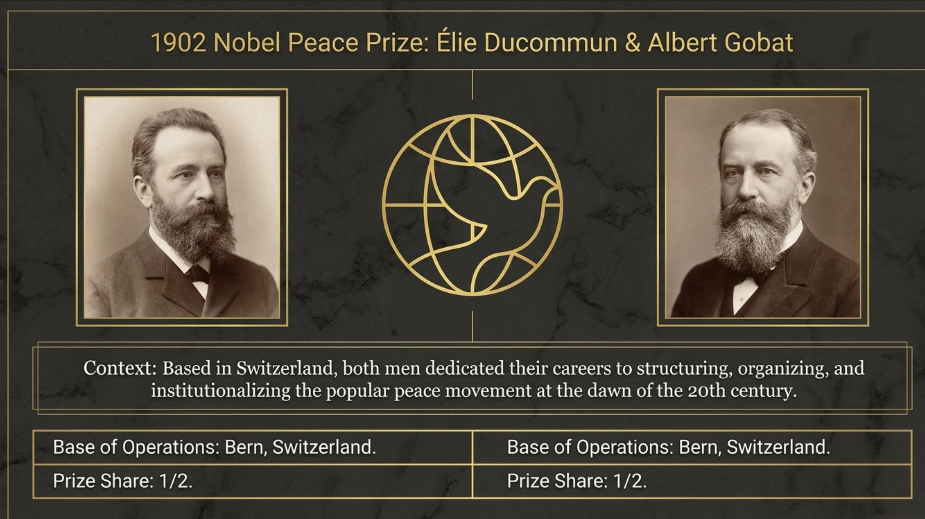
- Élie Ducommun: Serving as the honorary Secretary-General of the International Peace Bureau in Bern, Ducommun was a bridge-builder. A former teacher and liberal democrat politician, he also served as the director of the Jura-Simplon railway line. He believed that modern communications and international arbitration were the practical links required to bind peoples together in peace.
- Albert Gobat: As the Secretary-General of the Inter-Parliamentary Union, Gobat focused on the political machinery of peace. He brought together popularly elected representatives from various nations, planning annual conferences and drafting the resolutions that would eventually institutionalize peace through legislative channels.
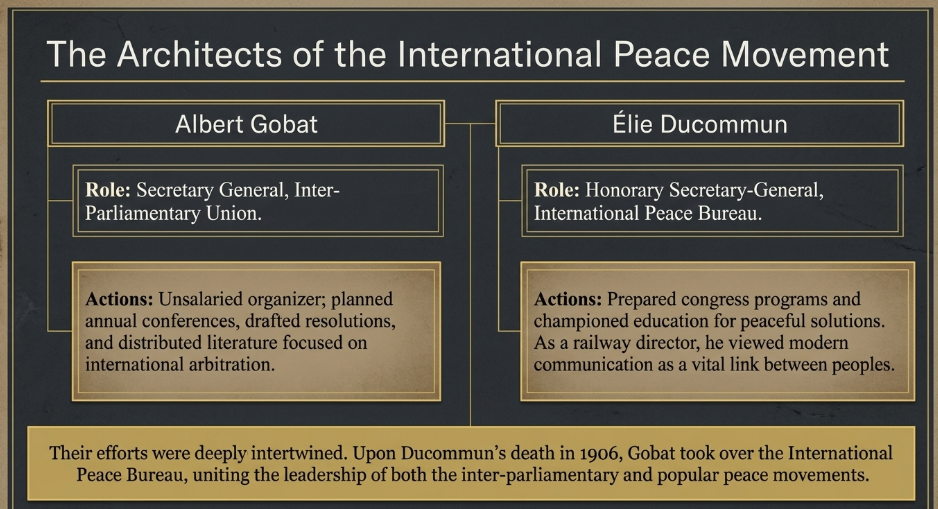
The Significance of the Discovery The joint award to Ducommun and Gobat marked the transformation of the peace movement from a scattered popular sentiment into a structured, professional, and inter-parliamentary network. Ducommun coordinated the popular movement through the Bern Bureau, while Gobat engaged the world’s parliaments. This dual-track approach professionalized the movement, turning the “practical administration” of peace into a viable alternative to conflict.
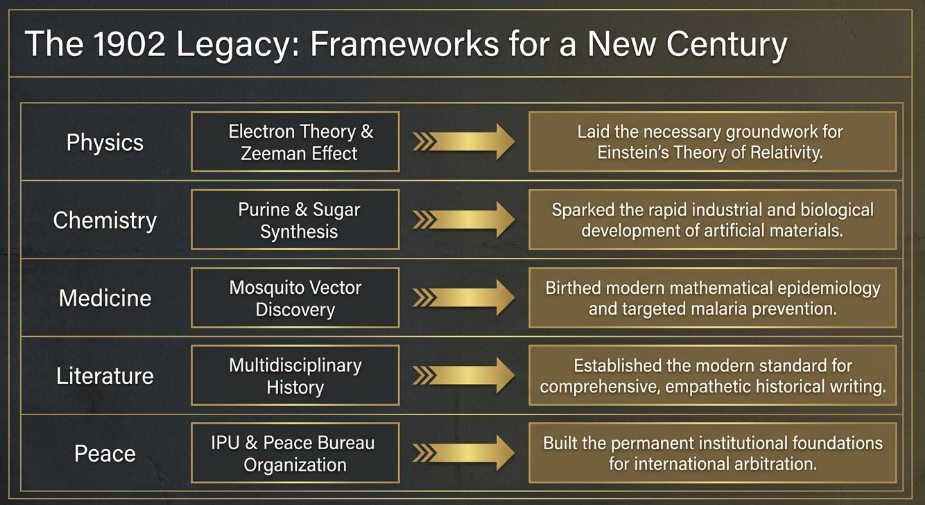
The collective legacy of the 1902 laureates is one of synthesis and structure. From the “electron theory” in physics to the administrative bureaus of the peace movement, these individuals provided the maps and frameworks that defined the modern era’s approach to science, health, and global society.
7. Summary Table of 1902 Laureates
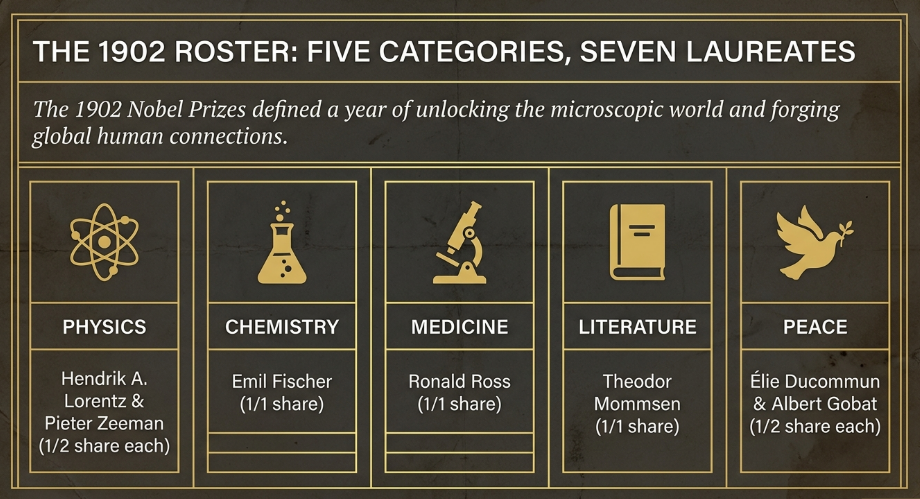
| Category | Laureate Name(s) | Primary Contribution/Motivation |
|---|---|---|
| Physics | Hendrik A. Lorentz and Pieter Zeeman | Researches into the influence of magnetism upon radiation phenomena. |
| Chemistry | Emil Fischer | Work on sugar and purine syntheses, moving chemistry toward artificial materials. |
| Physiology or Medicine | Ronald Ross | Discovery of the malaria parasite’s transmission via mosquitoes and the creation of epidemiological models. |
| Literature | Theodor Mommsen | Mastery of historical writing in the three-volume A History of Rome. |
| Peace | Élie Ducommun | Skilful directorship of the Bern Peace Bureau and advocacy for arbitration. |
| Peace | Albert Gobat | Practical administration of the Inter-Parliamentary Union to unite elected representatives. |
Reference:
https://www.nobelprize.org/prizes/lists/all-nobel-prizes/1909-1901


Related posts:
 Nobel Prize Laureates Series: The Inaugural 1901 Nobel Prize
 World Economic Forum: Top 10 Emerging Technologies of 2023
 The Giant Bacterium: Ca. Epulopiscium viviparus
 Thiomargarita magnifica: The Bacteria Big Enough to be Visible by the Naked Eye
 Integrated Pest Management (IPM): Fundamentals, Practice, and Professional Communication