

Introduction: The Secret Code Inside You

Have you ever wondered how a single set of instructions can build something as incredibly complex as a human being? From your eye color to the way your body fights off a cold, everything is directed by a secret code hidden deep within your cells. This code is stored in a remarkable molecule called DNA, the “master blueprint” of life. But a blueprint is just a plan; you need workers and materials to build the actual structure. In your cells, that work is done by proteins, the molecular machines that carry out nearly every task necessary for life.

This article will guide you through the Central Dogma of Molecular Biology, a term first coined by the brilliant scientist Francis Crick to describe the fundamental process that explains how the genetic information in your DNA is used to create these essential proteins. It’s a journey of information flowing from DNA to another molecule called RNA, and finally, to a functional protein. While scientists have discovered some fascinating exceptions to this rule (like viruses that can write their RNA code back into DNA), this core process is the foundation for almost all life on Earth.

To make this process easier to understand, we’ll use a simple analogy: imagine your DNA is a permanent file on a computer’s hard drive. To create a final document, the computer first makes a temporary copy of the file and sends it to a printer. The printer then reads the copy and translates it into a printed page. This two-step process—copying and printing—is a perfect way to think about the two major stages of protein synthesis: Transcription and Translation.

1. The Master Blueprint: Deoxyribonucleic Acid (DNA)
Think of DNA as the cell’s most valuable and protected information. It’s like the original, master blueprint for a skyscraper stored safely in the architect’s main office. Because this blueprint is irreplaceable, it doesn’t leave the safety of the cell’s “office”—the nucleus. DNA is the long-term storage molecule for all the genetic instructions an organism needs to develop, survive, and reproduce.
Here are the basic components of this master blueprint:
• A Double Helix: DNA is famously structured as two long strands of molecules twisted around each other, resembling a spiral staircase.
• The Genetic Alphabet: The instructions in DNA are written in a simple, four-letter alphabet. These “letters” are chemical bases: Adenine (A), Guanine (G), Cytosine (C), and Thymine (T). The specific sequence of these letters forms the genetic code.
• The Pairing Rule: The two strands of the double helix are held together by specific pairs of these bases. This rule is the key to how DNA is copied so accurately: Adenine (A) always pairs with Thymine (T) via two hydrogen bonds, and Cytosine (C) always pairs with Guanine (G) via three hydrogen bonds, ensuring the two strands fit together perfectly.
The cell faces a critical challenge: how does it get a specific instruction from the protected DNA blueprint out to the cell’s “construction sites” in the cytoplasm, where the proteins are actually built?
2. Making a Working Copy: The Process of Transcription
To solve this problem, the cell doesn’t send the original DNA blueprint out into the bustling, hazardous environment of the cytoplasm. Instead, it makes a temporary, disposable copy of a specific gene—the segment of DNA that holds the instructions for one protein. This process of creating a “working copy” is called transcription.
This temporary message is a molecule called Messenger RNA (mRNA). It’s a single-stranded transcript of the DNA’s code, designed to carry the instruction from the nucleus out to the protein-building machinery.
While they both carry genetic information, DNA and mRNA have a few key differences that are crucial for their different roles.
| Feature | DNA (The Blueprint) | mRNA (The Copy) |
| Structure | Double-stranded helix | Single strand |
| Sugar | Deoxyribose | Ribose |
| Key “Letter” | Thymine (T) | Uracil (U) |
| Location | Stays in the nucleus | Travels to the cytoplasm |
The process of transcription is carried out by a special enzyme called RNA polymerase. It works like this:
1. RNA polymerase binds to the DNA at the start of a gene.
2. It unwinds a small section of the DNA double helix, exposing the genetic letters on one of the strands.
3. It then moves along the DNA strand, reading the sequence and synthesizing a complementary strand of mRNA. According to the base-pairing rules, whenever a ‘G’ appears in DNA, it pairs with a ‘C’ in mRNA. Wherever there’s a ‘T’ in DNA, it adds an ‘A’. The only twist is that RNA doesn’t use Thymine (T); instead, when it reads an ‘A’ on the DNA, it places a Uracil (U) in the mRNA copy.
To return to our analogy, transcription is like the computer (the nucleus) copying information from a permanent file on the hard drive (DNA) into a temporary email or message (mRNA) that it can send to the printer. Since the message is still written in the same basic language of nucleotides, we call this process transcription.
Once the entire gene is copied, the newly made mRNA molecule detaches. It’s now ready to leave the nucleus and carry its instructions to the next stage of the process.
3. Building the Protein: The Process of Translation
After its creation in the nucleus, the mRNA travels out into the cytoplasm. This is where the cell’s protein-building factories are located. Here, the process of translation begins, where the genetic information carried by the mRNA is decoded and used to build a protein. This step requires three key players:
• The Message (mRNA): This is the single-stranded sequence of instructions, copied from a DNA gene, that dictates the order of the final product.
• The Factory (Ribosome): This is a molecular machine, made of ribosomal RNA (rRNA) and proteins, that acts as the site of protein synthesis. It clamps onto the mRNA and “reads” the message.
• The Delivery Trucks (tRNA): These are small molecules of transfer RNA. Their job is to read the message on the mRNA and fetch the correct building blocks—amino acids—delivering them to the ribosome.
Translation is an incredibly precise, step-by-step process:
1. The ribosome assembles and clamps onto the start of the mRNA strand.
2. The ribosome reads the mRNA’s sequence in groups of three letters. Each three-letter “word” is called a codon.
3. Each codon specifies one of the 20 different types of amino acids, which are the fundamental building blocks of proteins.
4. A tRNA molecule with a matching three-letter sequence, called an anticodon, recognizes the codon on the mRNA. This tRNA arrives at the ribosome carrying the specific amino acid that the codon calls for.
5. The ribosome takes the amino acid from the tRNA and links it to the previous one, forming a growing chain. It then moves down to the next codon on the mRNA to repeat the process. This long chain of linked amino acids is called a polypeptide.
To see this through our analogy, translation is where the printer (the ribosome) reads the message (mRNA). It translates the nucleotide language into the language of amino acids, arranging them in a specific order, just as a printer places ink letters on a page to form words. The tRNA molecules are like bilingual couriers; they read a specific three-letter word (codon) in the nucleotide language of the mRNA and deliver the one, and only one correct amino acid that corresponds to it. The growing chain of amino acids is like the sentences forming on your printed essay.
This process continues until the ribosome reaches a “stop” codon on the mRNA, which signals that the polypeptide chain is complete. But this chain isn’t a finished protein just yet.
4. From Chain to Machine: Protein Folding
The polypeptide chain created during translation is just a long, linear string of amino acids. To do its job, it must fold into a precise and complex three-dimensional shape. This folding process is critical—a protein’s shape determines its function.
Think of it like a key and a lock. A key only works if it has the exact right shape to fit the lock. Similarly, a protein that acts as an enzyme must have a specifically shaped “active site” to bind to other molecules. If the shape is wrong, the protein won’t work correctly. Another good analogy is a pile of Lego bricks; they are just building blocks until they are assembled into a specific model, like a car or a house. This folding is not random. The chain spontaneously organizes itself into stable structures, such as coils called alpha-helices and folded ribbons called beta-pleated sheets, which are held together by hydrogen bonds. This initial folding creates the framework for the protein’s final, complex 3D shape.
5. Summary: The Central Dogma at a Glance
The flow of information from DNA to a functional protein is a cornerstone of biology. This summary table provides a quick overview of the two main stages, serving as a helpful study guide.
| Process | Purpose | Location (in Eukaryotes) | Key Players |
| Transcription | Create a temporary RNA copy of a DNA gene. | Nucleus | DNA, RNA Polymerase |
| Translation | Synthesize a protein from the mRNA message. | Cytoplasm (at a Ribosome) | mRNA, Ribosome, tRNA |
This fundamental biological process is not just an abstract concept; it has profound, real-world consequences for our health and our traits.

6. Why It Matters: From Code to Consequences
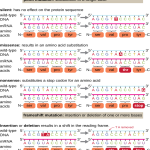
The central dogma is the link between your genes and your physical traits. The entire system is so precise that a single mistake in the original DNA code—a mutation—can have significant effects. If a DNA letter is changed, the corresponding mRNA codon will be different, which can cause the wrong amino acid to be added to the polypeptide chain during translation.
A classic and powerful example of this is sickle cell anemia.
• This inherited condition is caused by a mutation in just one letter of the DNA gene for hemoglobin, the protein in red blood cells that carries oxygen.
• This single change alters one codon in the mRNA, which in turn leads to a single incorrect amino acid (a valine instead of a glutamate) being placed in the hemoglobin protein chain.
• This seemingly tiny error is enough to change the final 3D shape of the hemoglobin protein. The altered proteins cause red blood cells to deform into a rigid, “sickle” shape instead of their normal flexible, disc-like form.
• These misshapen cells can get stuck in small blood vessels, blocking blood flow and leading to the pain, organ damage, and anemia characteristic of the disease.
This single example powerfully illustrates the direct line from DNA code to protein structure and, ultimately, to human health. The same fundamental process of transcription and translation is responsible for all of our inherited traits, from hair and eye color to the countless proteins that keep our bodies functioning every second of every day.
7. The Elegant Machinery of Life
From the silent, protected blueprint of DNA in the nucleus to the bustling protein factories in the cytoplasm, we have followed an incredible journey. The cell’s ability to transcribe a gene into a portable mRNA message, and then translate that message into a complex, functional protein, is a marvel of precision and efficiency. This elegant flow of information—DNA to RNA to protein—is the central principle that animates all living things. It is the constantly running machinery inside every one of your cells that turns a simple genetic code into the rich and complex reality of life.

8. The Expanded Central Dogma: Special Transfers
Crick’s formal restatement of the central dogma in 1970 accommodated certain “special transfers” of information, known to occur under specific conditions (often involving viruses or laboratory manipulation), which do not violate the core restriction that information cannot flow from protein back to nucleic acid.
The three major classes of information transfers include three general transfers (DNA → DNA, DNA → RNA, RNA → Protein), three special transfers, and three unknown transfers (believed never to occur).
Special Transfers of Sequential Biological Information
• Reverse Transcription (RNA→DNA): This is the transfer of information from RNA back to DNA, the inverse of transcription. This process is known in retroviruses, such as HIV, which use the enzyme reverse transcriptase (an RNA-dependent DNA polymerase) to synthesize a DNA strand from an RNA template. This process challenged the strict unidirectional flow of the classical model, leading to the necessary modification of the central dogma. In eukaryotes, the enzyme telomerase, which maintains the repetitive sequences at the ends of linear chromosomes (telomeres), also utilizes reverse transcriptase activity.

• RNA Replication (RNA→RNA): This involves the copying of one RNA molecule to another. This replication mechanism is used by many RNA-containing viruses and is catalyzed by enzymes called RNA-dependent RNA polymerases (RdRps). RdRps are also found in many eukaryotes, where they play a role in RNA silencing.

• Direct Translation from DNA to Protein (DNA→Protein): Direct synthesis of protein from a DNA template has been demonstrated in cell-free systems (in vitro).

9. Exceptions and Activities Unrelated to the Central Dogma
The fundamental tenet of the central dogma that sequential information cannot flow back from protein to nucleic acid (or protein to protein) has largely held true. However, the discovery of certain biological phenomena involving proteins transmitting information has led to discussions about exceptions.

Transfers Challenging the Dogma’s Original Scope
• Prions (Protein→Protein): Prions are misfolded, infectious proteins that propagate by changing the conformation or shape of normal variants of the same protein. This process represents an information transfer of Protein → Protein. Prions replicate without requiring DNA or RNA intermediates. Although some scientists argue this violates the central dogma, others maintain that it only involves the transfer of conformational information (the folding pattern), not the transfer of the primary sequence information (amino acid sequence) back to nucleic acid, thus leaving the core principle intact. Prions are responsible for devastating neurodegenerative diseases like Creutzfeldt-Jakob disease.

Activities Unrelated to Ribosomal Synthesis
• Nonribosomal Peptide Synthesis (NRPs): Some peptides, such as certain antibiotics, are synthesized by large enzyme complexes called nonribosomal peptide synthetases (NRPS). Critically, this synthesis process is independent of messenger RNA, meaning these protein complexes create peptides without the typical ribosomal translation pathway prescribed by the dogma.

• Post-translational Modification (PTMs): After a protein (polypeptide chain) is synthesized via translation, it often undergoes extensive PTMs, which are covalent changes that modify the amino acid side chains or termini. PTMs (e.g., phosphorylation, ubiquitination, glycosylation) are carried out by enzymes and are essential for the protein’s final functional structure. While this represents a protein modifying a protein structure/function, it is generally viewed as a subsequent editing process and not a transfer of sequence information back towards nucleic acids.

• Inteins: These are segments of protein precursors that are capable of excising themselves and ligating the remaining segments (exteins) together, a process called protein splicing. This self-catalytic removal and joining changes the protein’s primary structure after it has emerged from the ribosome. In some cases, inteins contain a homing endonuclease domain that initiates DNA repair mechanisms, causing the intein’s nucleotide sequence to be copied into an intein-free gene, thereby acting as an example of a protein indirectly editing the DNA sequence and increasing its heritable propagation.
| Information Transfer | Type (Crick’s Classification) | Mechanism/Example |
| DNA → DNA | General (Replication) | DNA is duplicated faithfully to pass on genetic information. |
| DNA → RNA | General (Transcription) | DNA sequence is copied into an mRNA molecule. |
| RNA → Protein | General (Translation) | mRNA sequence determines the amino acid sequence of a protein at the ribosome. |
| RNA → DNA | Special (Reverse Transcription) | RNA is used as a template to synthesize DNA, as seen in retroviruses (HIV) using reverse transcriptase. |
| RNA → RNA | Special (RNA Replication) | RNA is copied from an RNA template, typically seen in certain RNA viruses using RdRps. |
| DNA → Protein | Special (Direct Translation) | Protein synthesis from a DNA template observed in cell-free (in vitro) systems. |
| Protein → Protein | Unknown (Exception/Conformation Transfer) | Prions induce misfolding in other proteins of the same type, transmitting conformational information. |
| Protein → Nucleic Acid | Unknown (Forbidden by dogma) | Explicitly precluded by the dogma; no biological evidence for a “back-translation” mechanism exists. |

The fluidity of information transfer mechanisms, especially those involving RNA (such as reverse transcription and non-coding RNAs), highlights that the genetic message is complex, but the original core concept—that nucleic acids hold the blueprint for protein synthesis, and proteins cannot rewrite the fundamental genetic code—remains a central organizing principle of molecular biology. This framework provides structure to how information is generally handled, even as exceptions, like prions transferring conformational information, are identified.


Image Summary


Reference
CRICK, F. Central Dogma of Molecular Biology. Nature 227, 561–563 (1970). https://doi.org/10.1038/227561a0
Cobb M. 60 years ago, Francis Crick changed the logic of biology. PLoS Biol. 2017 Sep 18;15(9):e2003243. doi: 10.1371/journal.pbio.2003243. PMID: 28922352; PMCID: PMC5602739.
https://thebiologyprimer.com/the-central-dogma-echapter
https://www.yourgenome.org/theme/how-is-dna-turned-into-protein-the-central-dogma-of-molecular-biology/
https://bio.libretexts.org/Bookshelves/Introductory_and_General_Biology/Introductory_Biology_(CK-12)/04%3A_Molecular_Biology/4.01%3A_Central_Dogma_of_Molecular_Biology
https://en.wikipedia.org/wiki/Protein_splicing#Intein
https://en.wikipedia.org/wiki/Post-translational_modification
https://en.wikipedia.org/wiki/RNA-dependent_RNA_polymerase
https://ncert.nic.in/textbook/pdf/lebo105.pdf
https://www.ebsco.com/research-starters/health-and-medicine/central-dogma-molecular-biology


Related posts:
 The Blueprint of Life: An Introduction to DNA’s Structure
 The Amazing World of RNA: Life’s Versatile Molecule
 Mutation: Characteristics, Types and Applications
 Bacterial Cellulose: A Game-Changer for Plant Wound Healing and Regeneration
 Quantitative Essentiality Mapping in Reduced Genomes: New Insights into Gene Function and Fitness


