1. Introduction: DNA’s Indispensable Partner
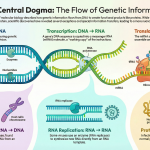
In the world of molecular biology, the flow of genetic information is often described by a principle known as the “Central Dogma”: DNA makes RNA, and RNA makes protein. While DNA holds the master blueprint for all life, it cannot build anything on its own. It relies on its indispensable partner, Ribonucleic Acid (RNA), to put its genetic plans into action.
A simple way to understand this relationship is to think of a cell as a large city with a central library and many construction sites.
• DNA is the master blueprint, stored safely in the library’s reference section (the cell’s nucleus). It’s too valuable to ever leave.

• Messenger RNA (mRNA) acts like a photocopy of a single page from the blueprint. It carries the specific instructions for one building project out of the library and into the city.
• The Ribosome (made of rRNA) is the construction workshop where the photocopy is read.
• Transfer RNA (tRNA) is like a fleet of specialized delivery trucks, each bringing the correct building material (an amino acid) to the workshop as specified by the instructions on the photocopy.
Together, these molecules work in concert to build the proteins that form our cellular structures and carry out countless chemical reactions. This document will explore what RNA is, how its unique structure gives rise to its many shapes, and the vital jobs it performs to sustain life.
2. The Building Blocks of RNA
Like its famous cousin DNA, RNA is a polymer—a long chain made of repeating chemical units. These individual units are called ribonucleotides.
2.1 The Three-Part Structure of a Ribonucleotide
Each ribonucleotide consists of three distinct components linked together:
• Ribose Sugar: This five-carbon sugar forms the structural “backbone” of the RNA molecule. Its full name is the reason RNA is called Ribonucleic acid.
• Phosphate Group: This group acts as the connector, linking the ribose sugars of adjacent nucleotides together via strong 3′-5′ phosphodiester bonds to form the long, continuous sugar-phosphate backbone of the RNA strand.
• Nitrogenous Base: These are the “letters” of the RNA code. In RNA, there are four different bases: Adenine (A), Guanine (G), Cytosine (C), and Uracil (U).
2.2 The RNA Alphabet: A Key Difference
The genetic alphabet used by RNA is nearly identical to that of DNA, with one crucial substitution: RNA uses the base Uracil (U) in place of Thymine (T). This small change has significant implications for the molecule’s function.
The rules for base pairing, which are essential for forming structures, are as follows in RNA:
• Adenine (A) pairs with Uracil (U).
• Cytosine (C) pairs with Guanine (G).
Now that we understand RNA’s basic components, let’s see how they compare to the more familiar DNA molecule.
3. RNA vs. DNA: A Tale of Two Molecules
While both are nucleic acids that carry genetic information, DNA and RNA are tailored for very different jobs. Their structural differences are the key to their distinct roles in the cell.

| Feature | Deoxyribonucleic Acid (DNA) | Ribonucleic Acid (RNA) |
| Primary Function | Stores genetic information. Implication: Its exceptional stability makes it a perfect, safe, long-term blueprint for all of an organism’s genetic information. | Transfers and expresses genetic information. Implication: It serves many short-term, active roles, including acting as a temporary message to build proteins. Its relative instability is a feature, not a bug, for a molecule with a temporary job. |
| Sugar Type | Deoxyribose. Implication: The missing hydroxyl group at the 2′ position makes DNA much more chemically stable and less prone to breaking down—essential for the long-term, safe storage of the genetic code. | Ribose. Implication: The extra 2′-hydroxyl group makes RNA more reactive and less stable. This chemical feature also forces its double-helical regions into an A-type helix, which is wider and shorter than DNA’s typical B-form helix. This instability is ideal for a molecule with temporary functions. |
| Nitrogenous Bases | Adenine (A), Guanine (G), Cytosine (C), Thymine (T). | Adenine (A), Guanine (G), Cytosine (C), Uracil (U). Implication: Using thymine (a methylated uracil) in DNA provides a critical advantage for long-term stability. It allows repair machinery to easily recognize and fix accidental deamination of cytosine (which turns it into uracil), a common form of DNA damage. For RNA’s short-term tasks, the less energetically costly uracil is sufficient. |
| Structure | Double helix (two strands). Implication: This “twisted ladder” is a highly stable structure that protects the genetic code on the inside rungs, shielding it from chemical attack and ensuring faithful replication. | Typically single-stranded. Implication: This is RNA’s superpower. The single strand is free to fold back on itself, allowing RNA to form a huge variety of complex 3D shapes that are essential for its many functions. |
| Length | Very long. Implication: A single DNA molecule can contain the code for thousands of genes and, when condensed, forms an entire chromosome, sometimes measuring centimeters in length. | Much shorter. Implication: RNA molecules are typically the length of just one gene, making them small, mobile messengers that are easily transported and read within the cell. |
This single-stranded nature is the foundation of RNA’s structural and functional diversity. Let’s explore how this simple chain folds into complex, functional machines.

4. The Shape of Function: How RNA Folds into 3D Structures
A core principle in biology is that structure dictates function. For RNA, the ability to fold into specific, intricate three-dimensional shapes is what allows it to perform so many different and specialized jobs in the cell.
4.1 Secondary Structure: The First Folds
Although RNA is a single strand, it doesn’t remain a simple, linear molecule. It frequently folds back on itself, allowing complementary bases within the same strand (A with U, G with C) to pair up and form short, double-stranded regions. This initial folding creates common patterns, or motifs, known as secondary structures.
• Stems (Helices): These are regions where the RNA strand forms a short, double-stranded A-type double helix with itself through complementary base pairing.
• Hairpin Loops: These form when the RNA strand folds back sharply on itself. The structure consists of a base-paired “stem” leading into an unpaired “loop” of bases at the end of the fold.
• Bulges and Internal Loops: These are small, unpaired regions that disrupt a stem. A bulge occurs when bases on one side of the strand have no partner on the other. An internal loop occurs when bases on both sides of the stem are unpaired.
4.2 Tertiary Structure: Building Complex Machines
Just as a protein folds into a functional shape, the secondary structures of an RNA molecule fold and interact with each other to create a stable, complex, three-dimensional tertiary structure. Distant parts of the RNA chain are brought together, stabilized by hydrogen bonds and other interactions.

These final, precise shapes are essential for RNA’s function. For example, some RNAs form intricate motifs like a pseudoknot, where a hairpin loop base-pairs with a region outside the loop to form an intricate network of interactions that can create a triple helix structure stabilized by base triples. Others form a kink-turn, which creates a sharp bend in the RNA backbone. These complex shapes create active sites and binding surfaces, turning a simple strand of nucleotides into a functional molecular machine.
These complex shapes are precisely what enable different types of RNA to perform their highly specialized jobs.
5. A Team of Specialists: The Many Jobs of RNA
Cells employ a team of different RNA types to carry out the process of building proteins from the DNA code, a process known as protein synthesis. The three main specialists involved are messenger RNA (mRNA), ribosomal RNA (rRNA), and transfer RNA (tRNA).
5.1 The Three Key Players in Building Proteins

Messenger RNA (mRNA): The Blueprint Copy Serving as the blueprint copy, mRNA acts as the intermediary that carries the genetic “message” from the DNA in the nucleus to the ribosomes in the cytoplasm. Its key feature is its relative instability and short lifespan, which ensures that proteins are only synthesized when and for as long as they are needed by the cell.
Transfer RNA (tRNA): The Amino Acid Taxi As the smallest of the three main types, typically only 70-95 nucleotides long, tRNA is responsible for reading the message on the mRNA and carrying the correct amino acid to the ribosome. It folds into a characteristic “L-shape” in three dimensions (or a “cloverleaf” in two). One end of the tRNA carries a specific amino acid, while the other end has an anticodon, a three-base sequence that pairs with a complementary codon on the mRNA, ensuring the correct amino acid is added to the growing protein chain.
Ribosomal RNA (rRNA): The Factory Foreman As the most abundant type of RNA, accounting for about 80% of all RNA in a cell, rRNA is the main structural and, crucially, the catalytic component of the ribosome. It is the rRNA that acts as the enzyme to form the peptide bonds that link amino acids together. This catalytic power means the ribosome is actually a giant ribozyme, a powerful reminder of RNA’s functional role in building life’s machinery.

5.2 RNA’s Other Hats: More Than a Messenger
The versatility of RNA extends far beyond its roles in protein synthesis. This remarkable molecule wears many other hats in the biological world.


• For many viruses, including Rhinoviruses (which cause the common cold), influenza viruses, and the Ebola virus, RNA—not DNA—serves as the primary genetic material, storing all the information the virus needs to replicate.

• Some RNA molecules, known as ribozymes, can function as biological catalysts, much like protein enzymes. They can drive biochemical reactions, such as cutting and splicing other RNA molecules, demonstrating that RNA is not just an information carrier but also a functional, active molecule.

6. Conclusion: The Versatile Heart of the Cell
RNA is a molecule of incredible structural and functional diversity. As we’ve seen, it is far more than just a simple copy of DNA; it is a dynamic and essential player in virtually all aspects of cellular life.
Here are the most important takeaways for a new learner:
1. RNA is the essential link between DNA’s genetic code and the creation of proteins. It acts as the cell’s messenger (mRNA), translator (tRNA), and even a key part of the manufacturing machinery (rRNA).
2. RNA’s single-stranded structure is its superpower. Unlike the stable DNA double helix, this flexibility allows RNA to fold into a huge variety of complex 3D shapes.
3. In biology, shape determines function. The diverse shapes of RNA molecules allow them to perform a wide array of specialized jobs, from carrying messages to catalyzing the very chemical reactions that build the machinery of life.


Image Summary


References
https://www.geeksforgeeks.org/biology/rna-definition-structure-types-and-functions
https://elearning.raghunathpurcollege.ac.in/files/2BD2BC4915966180050.pdf
https://www.jsscacs.edu.in/sites/default/files/Department%20Files/RNA%20notes.pdf
https://www.genome.gov/genetics-glossary/Ribonucleic-Acid-RNA
https://en.wikipedia.org/wiki/RNA
https://www.ncbi.nlm.nih.gov/books/NBK558999