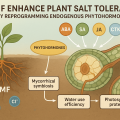
Microbe–plant communication is more dynamic than previously believed. A new peer-reviewed study reports that volatile organic compounds (VOCs) emitted by the beneficial bacterium Enterobacter hormaechei WU-15 significantly enhance salt tolerance in pepper seedlings—while pepper plants simultaneously reshape bacterial metabolism through root exudates.
Salt stress is one of the most destructive abiotic factors limiting crop productivity worldwide. In this study, researchers constructed a co-culture system where pepper seedlings were grown in sealed containers exposed only to VOCs released by WU-15. These VOCs significantly boosted plant growth under salt stress by improving osmoprotective responses, restoring photosynthetic pigment levels, and enhancing the plant’s antioxidant enzyme activity.
The team identified key growth-promoting VOCs including isoamyl alcohol, n-pentanol, phenethyl alcohol, and 2-nonanone. At appropriate concentrations, these compounds increased fresh weight, plant height, root length, and leaf area even under high salinity. They also sharply reduced stress markers such as proline and malondialdehyde while elevating soluble sugars, soluble proteins, POD, and CAT enzyme activity.
In a surprising reciprocal interaction, pepper root exudates (REs) also regulated the bacterium. The study identified 17 RE-derived compounds, several of which significantly enhanced WU-15 growth, chemotaxis, biofilm formation, phosphate solubilization, and IAA production. These REs also altered the bacterium’s VOC profile—either stimulating or inhibiting the release of specific VOCs—indicating a dual regulatory system.
The study highlights a two-way chemical communication mechanism: bacterial VOCs activate plant salt-tolerance pathways, while plant REs enhance bacterial metabolism and growth-promoting traits. Together, these interactions form a synergistic PGPR–plant system that improves resilience to salinity stress.
This work provides new insights into microbe-mediated stress alleviation and opens opportunities for developing VOC-based or microbe-assisted strategies for sustainable crop production in saline environments.
Reference
Wen, Z., Chu, J., Fu, Q., Wang, X., & Xu, X. (2025). Microbe-plant synergistic interactions: Mechanism of VOCs promotion on salt tolerance in pepper seedlings and the feedback of root exudates on Enterobacter hormaechei WU-15. Plant and Soil. https://doi.org/10.1007/s11104-025-08004-2


Related posts:
 Maize Fights Back: How a Fungal Infection Recruits Friendly Bacteria for Natural Disease Resistance
 Beneficial Bacillus Bacteria Boost Cotton Growth and Sustainability in Brazil
 Zinc Ferrite Nanoparticles and Beneficial Rhizobacteria Team Up to Protect Mung Beans from Lead Toxicity
 Scientists Develop First Dual Microbial Consortium to Enhance Iron and Zinc Uptake in Wheat
 New Bacillus Consortium Offers Eco-Friendly Defense Against Devastating Apple Valsa Canker