1. Introduction: The Lingering Threat
The amateur mistakes a pause in hostilities for a permanent peace. In the brutal arithmetic of power, mercy is often a high-interest loan that must be paid back in blood. All great leaders since Moses have understood a single, uncomfortable truth: a feared enemy must be crushed completely. If one ember is left alight, no matter how dimly it smolders, a fire will eventually break out. To stop halfway is to invite catastrophe. You provide your adversary with the one thing they need most: the time to recover and the motive to seek revenge.
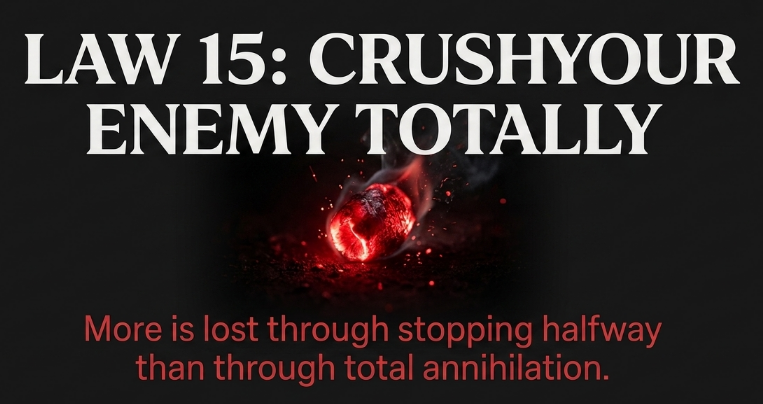
2. The Ember and the Fire: Why Remnants are Fatal
Pity, laziness, and a false sense of security are the three pillars of tactical suicide. When you leave an enemy alive—no matter how weakened they appear—you are not being “noble”; you are being negligent. A surviving enemy is a mutating disease. Total annihilation is not a matter of cruelty; it is a matter of political hygiene. The source of this wisdom is ancient, emphasizing that the remnants of an opposition act as a ticking clock.
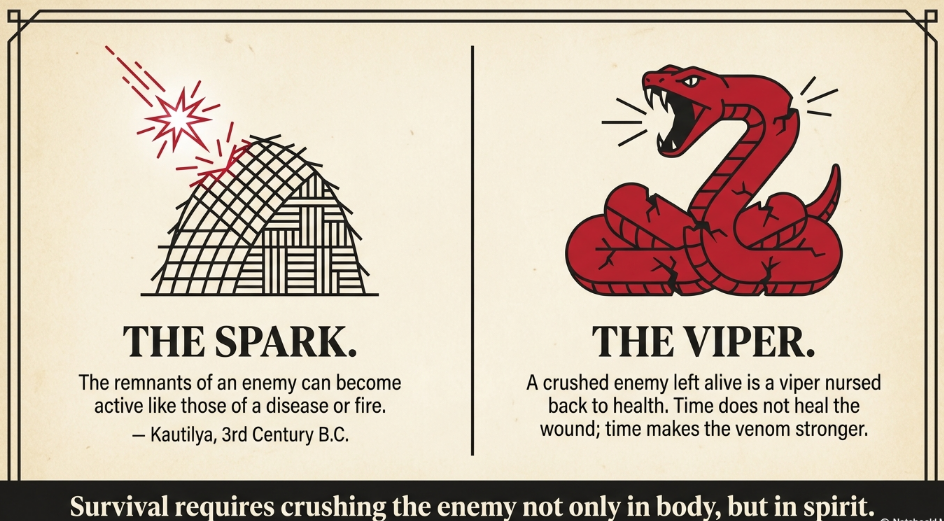
> The remnants of an enemy can become active like those of a disease or fire. Hence, these should be exterminated completely. . . . One should never ignore an enemy, knowing him to be weak. He becomes dangerous in due course, like the spark of fire in a haystack. — Kautilya, Indian Philosopher, Third Century B.C.
3. The Myth of Reconciliation: Why “Vipers” Don’t Forget
The strategist recognizes that in fatal antagonisms, reconciliation is a fantasy. You have defeated your enemy, and in doing so, you have humiliated them. Humiliation does not breed gratitude; it nurtures a cold, calculating desire for retribution. By sparing them, you do not earn their love; you merely strengthen their hatred while giving them the space to sharpen their fangs.
> Image: A Viper crushed beneath your foot but left alive, will rear up and bite you with a double dose of venom. An enemy that is left around is like a half-dead viper that you nurse back to health. Time makes the venom grow stronger.
4. The Price of Hesitation: The Tragedy of Hsiang Yu
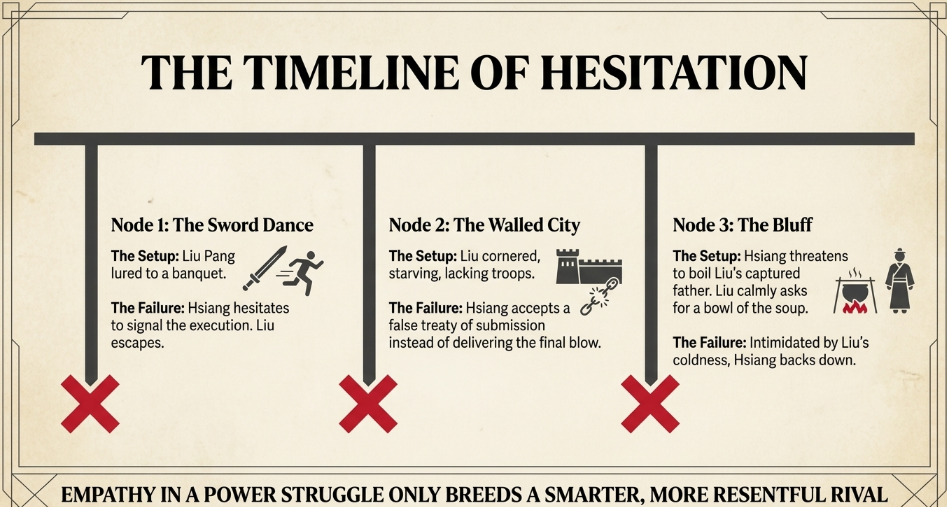
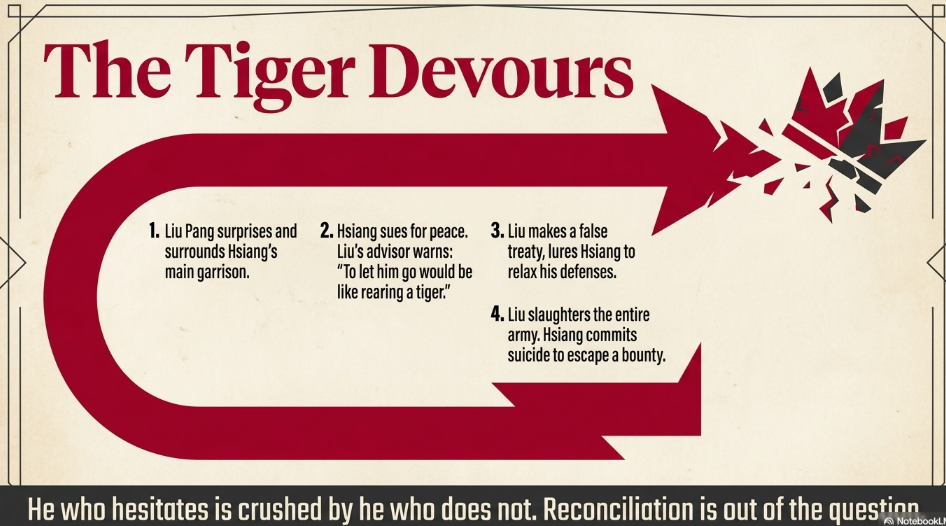
History offers no clearer warning than the struggle between Hsiang Yu and Liu Pang. Hsiang Yu was a noble-born warrior, but he was plagued by a “fatal sympathy.” Because he and Liu Pang had been former friends and comrades in arms, Hsiang hesitated at every critical juncture. At the Feast of Hsien-yang, he ignored his adviser’s command to execute Liu Pang during a sword dance. Later, when he held Liu Pang’s father captive and threatened to boil the old man alive, the wily Liu Pang revealed the chilling detachment required for total victory. He simply replied: “We are sworn brothers… If you insist on boiling your own father, send me a bowl of the soup!”
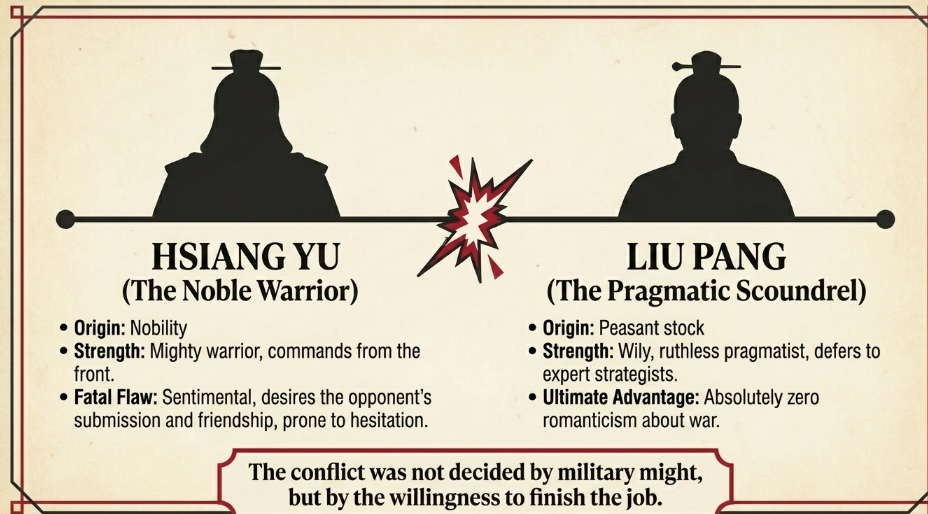
Hsiang Yu backed down, his nobility serving as his noose. When the tables finally turned, Liu Pang showed no such hesitation. He lured Hsiang Yu into a trap with a false treaty and slaughtered his entire army. Hsiang Yu’s adviser had warned that letting a rival go was like “rearing a tiger—it will devour you later.” In the end, cornered and broken, Hsiang Yu was forced to slit his own throat, a victim of the mercy he once extended.
5. Beyond the Battlefield: The Ruthless Efficiency of Empress Wu
Total victory requires a clinical lack of sentimentality, a trait embodied by Empress Wu. Her rise from a low-ranking concubine to the only woman to rule China as Emperor was paved with the bodies of any who could challenge her. She secured her initial access to the throne by seducing the crown prince, Kao Tsung, at the royal urinal—a moment of predatory opportunism that defined her career.
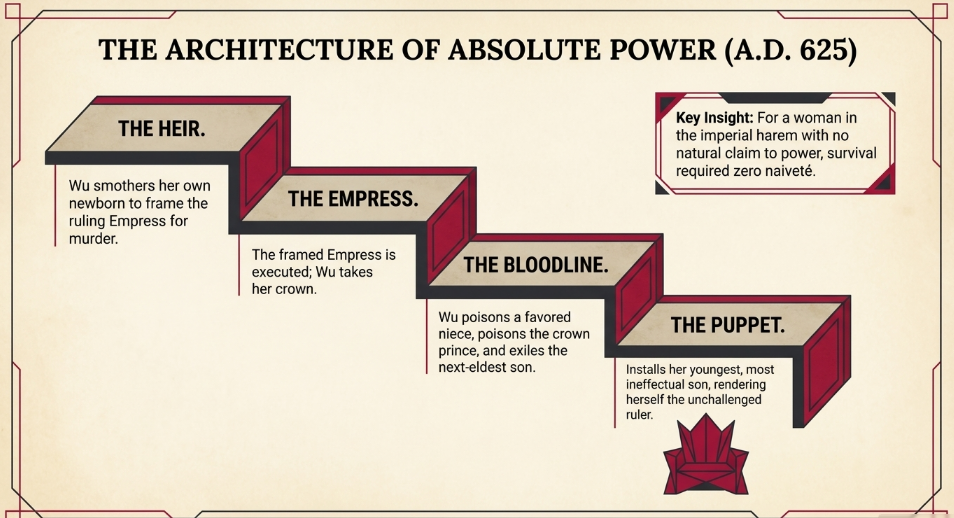
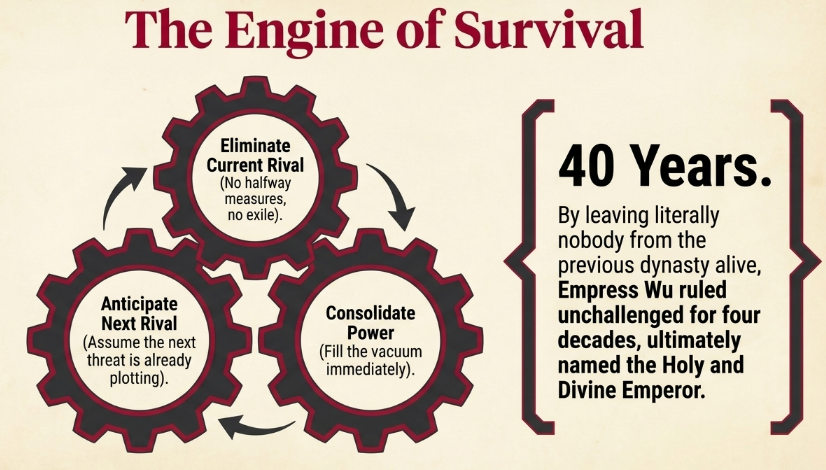
Wu understood that to survive as a woman in a traditional society, she had to be more ruthless still than any man. She smothered her own newborn child to frame the reigning empress, poisoned her niece, and murdered or exiled her own sons. She pursued the lineage of total victors, eventually reaching the same immortal status as Han Kao-tsu (Liu Pang) by ensuring there was literally nobody left from the previous dynasty to challenge her. Her forty-year reign was one of the most effective in history because her opposition didn’t just lose; they ceased to exist.
> A priest asked the dying Spanish statesman and general Ramon Maria Narváez (1800–1868), “Does your Excellency forgive all your enemies?” “I do not have to forgive my enemies,” answered Narváez, “I have had them all shot.”
6. The Axiom of Modern Power: No Room to Maneuver
The strategic necessity of the “total kill” was codified by Carl von Clausewitz, the premier philosopher of war. Clausewitz argued that the direct annihilation of the enemy’s forces must always be the dominant consideration. This means seizing his capital, attacking his reserves, and allowing no talk of rest or breathing space.
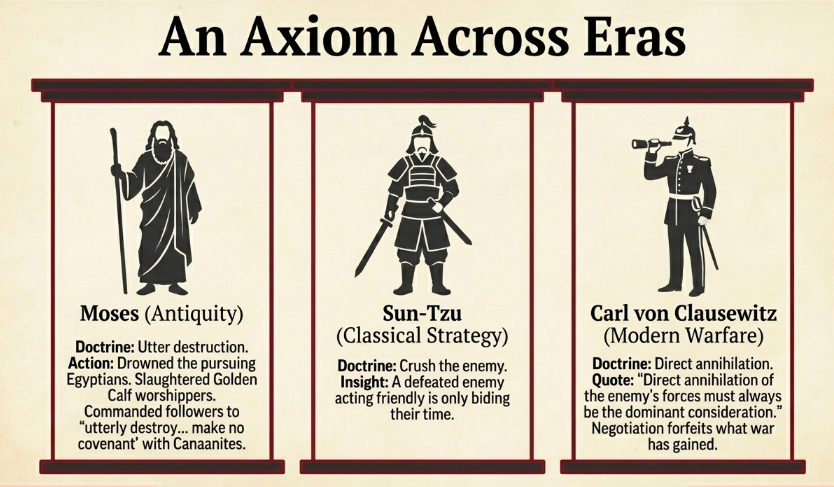
Victory is not a destination but a continuous pursuit. The most insidious threat to a win is negotiation. Negotiation is the “insidious viper” that will eat away at your victory, offering the enemy a chance to regain through diplomacy what they lost through force. To secure power, you must leave your adversary with no options. When they have no hope, they are forced to obey.
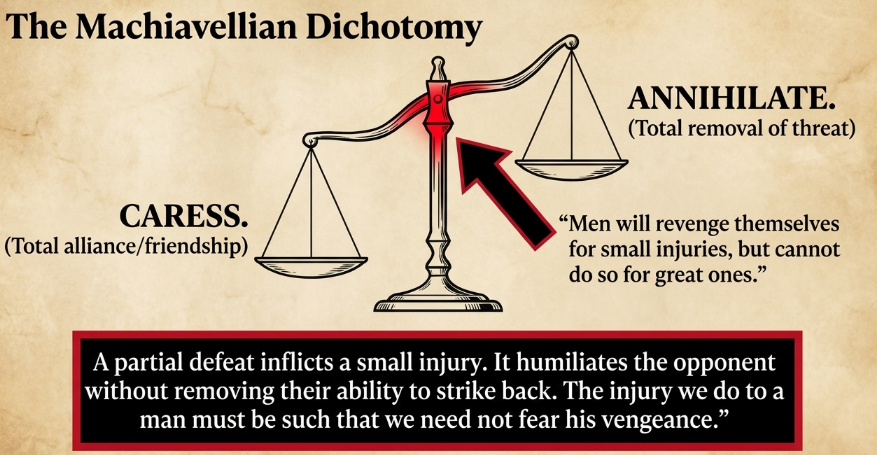
> For it must be noted, that men must either be caressed or else annihilated; they will revenge themselves for small injuries, but cannot do so for great ones; the injury therefore that we do to a man must be such that we need not fear his vengeance. — Niccolò Machiavelli
7. Conclusion: The Burden of Total Victory
Safety is not found in the middle ground. From Moses—the first practitioner who ensured “not so much as one” of his pursuers remained—to the modern era, history confirms that peace is only found in the total disappearance of the opposition. There is, however, a subtle nuance: the “Reversal.” Occasionally, a master may allow an enemy to destroy themselves, providing an escape route only to watch them wear themselves out in retreat. But this is a controlled burn, used only when you are certain they have no chance of recovery.
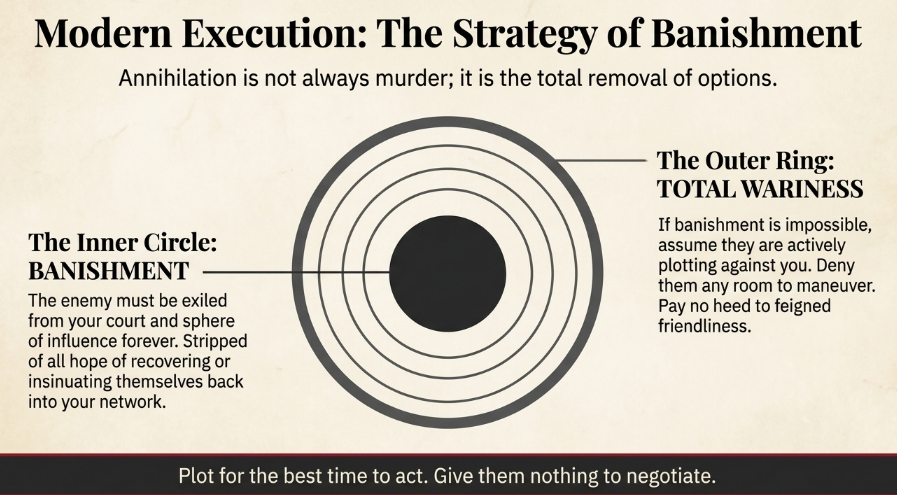
If they have even a spark of life, they remain a threat. Real security is found only when the fire is out and the ashes are scattered. If the cost of safety is the total destruction of your rival, are you prepared to pay the price, or will you let the embers smolder?
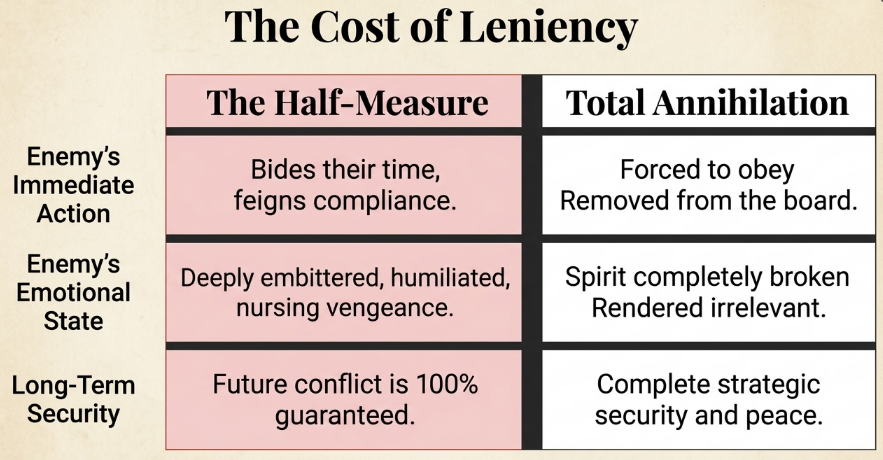
Image Summary
Reference


Related posts:
 First Law of Power: Why Your Best Work Might Be Your Biggest Liability: Lessons from the Architecture of Power
 Second Law of Power: Why Your Best Friend Might Be Your Worst Business Partner: The Strategic Case for Using Enemies
 Third Law of Power: The Hidden Hand: Why Your Total Honesty is a Strategic Liability
 Fourth Law of Power: Why Your Biggest Career Move Might Be Saying Nothing at All: Lessons in Strategic Silence
 Fifth Law of Power: The Invisible Shield: Why Your Reputation Is More Powerful Than Your Skills