1. Introduction: The Replaceability Paradox
In the high-stakes theater of global business, most professionals operate under a dangerous delusion: that working harder and being “better” than the competition is a guarantee of security. This is the Replaceability Paradox. You exhaust yourself to become an asset, only to realize that as an asset, you are a line item on a balance sheet—one that can be optimized, outsourced, or deleted.
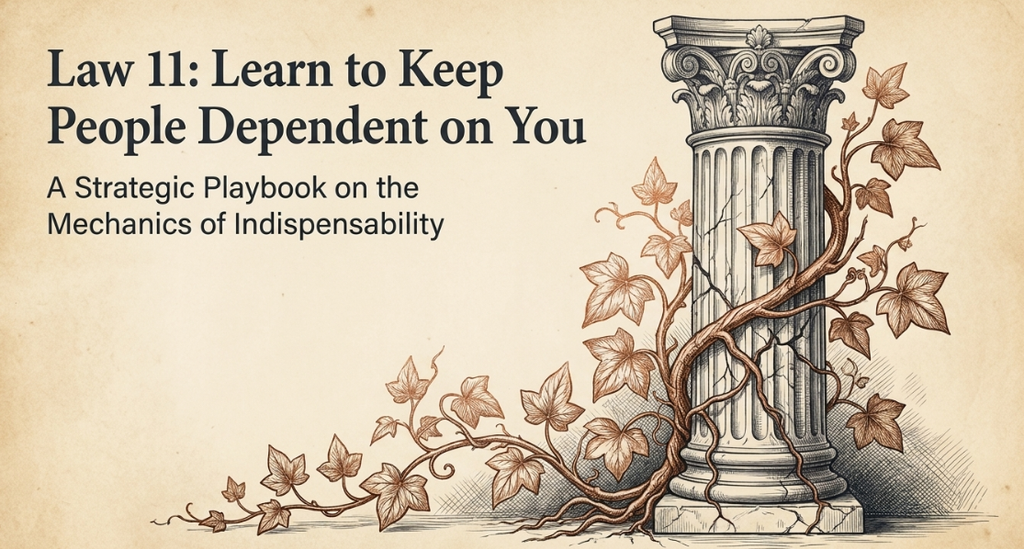
True professional sovereignty is not found in total independence, which is a fragile and often fatal state. Real leverage comes from The Eleventh Law: making others so dependent on you for their prosperity that removing you would trigger their own collapse. Freedom is not the absence of masters; it is the mastery of mutual dependence.
2. The Danger of Excellence Without Dependency
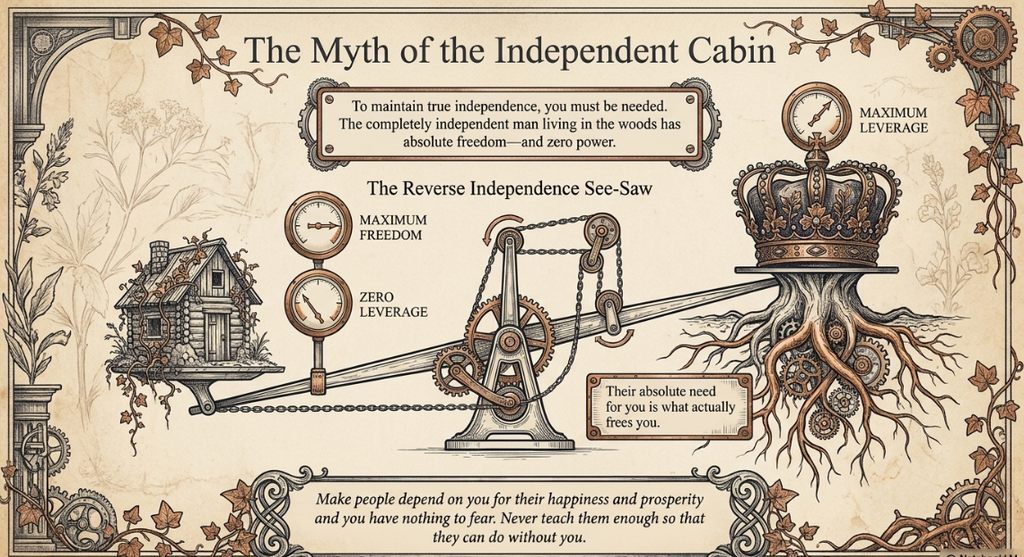
From a strategic standpoint, excellence without enmeshment is a liability. If you are merely “great” at your job, you are a commodity with a high price tag. Eventually, a younger, cheaper, and less threatening version of you will appear, and your “Bridge of Sighs”—the transition from a place of honor to a dungeon of obsolescence—will be inevitable.
Consider the mercenary of Siena who saved his city from a foreign aggressor. The citizens were faced with a strategic dilemma: no amount of money or honor could adequately repay the preservation of the city’s liberty. To keep the hero was too expensive and potentially threatening to their own power. Their solution was chillingly pragmatic:
“Let us kill him and then worship him as our patron saint.”
By executing him, they preserved their wealth and neutralized a threat while “owning” his legacy forever. Similarly, the Count of Carmagnola, a brilliant military mind for Venice, was executed on trumped-up charges because he grew impudent. He failed to realize that his success made him a target, and because he hadn’t made himself structurally indispensable, he was easily replaced by the next ambitious soldier.
Architect’s Note: Value Entrenchment Being “the best” is a weak position because the best can be surpassed. To survive, you must move from being a “hero” to becoming an “infrastructure.” Heroes are sacrificed; infrastructure is maintained.
3. The “Weak Master” Strategy: Why You Should Seek Insecurity
Most ambitious consultants and executives reflexively seek out the most powerful leaders to serve. This is a tactical error. The powerful are already established; they will “swallow you up” to fuel their own momentum, just as the Doge of Venice did to Carmagnola. Instead, the Strategic Career Architect seeks out “Strategic Fragility”—a master who is insecure or lacks a specific, vital capacity.
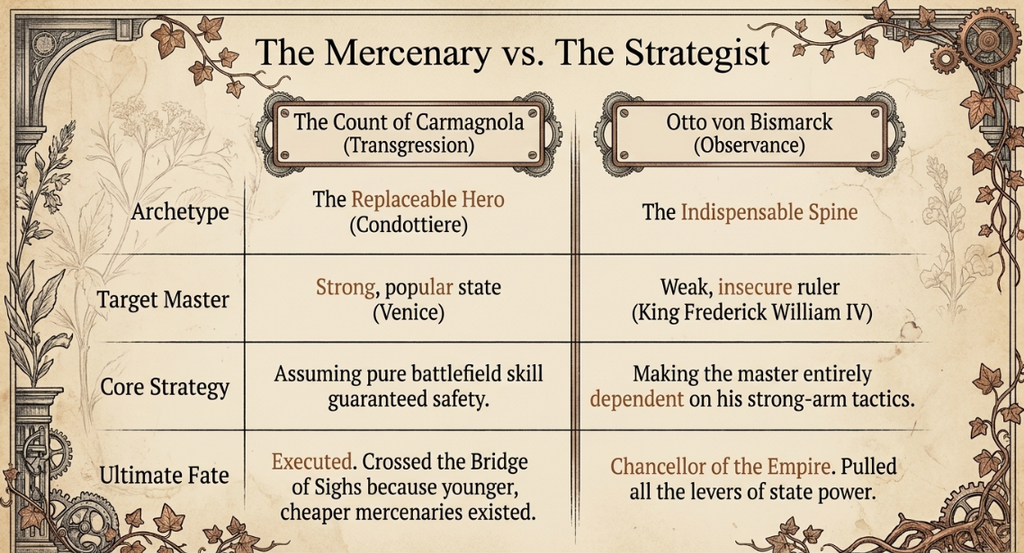
Otto von Bismarck understood this perfectly. He bypassed the strong and allied himself with King Frederick William IV of Prussia, a man so spineless he was routinely bullied by parliament. Bismarck didn’t just serve the King; he became his “spine.” He deliberately worked on the King’s insecurity about his own manliness, challenging him to rule with “iron and blood.” By restoring the monarchy’s power, Bismarck ensured that the King’s survival was synonymous with his own.
The Benefits of Reverse Independence:
- Monopolized Intelligence: You become the only source of clarity for a confused leader.
- Operational Redundancy Elimination: You perform tasks that the master is fundamentally incapable of doing, making you unfireable.
- Hidden Sovereignty: You hold the levers of state policy while the master takes the “thorns” and public scrutiny that come with leadership.
Architect’s Note: The Power Base If your master is already strong, you are a luxury. If your master is weak, you are a necessity. Necessity is the only currency that never devalues.
4. Intensive vs. Extensive: Two Paths to Being Unfireable
To entrench yourself, you must choose your mode of power: the Intensive or the Extensive.
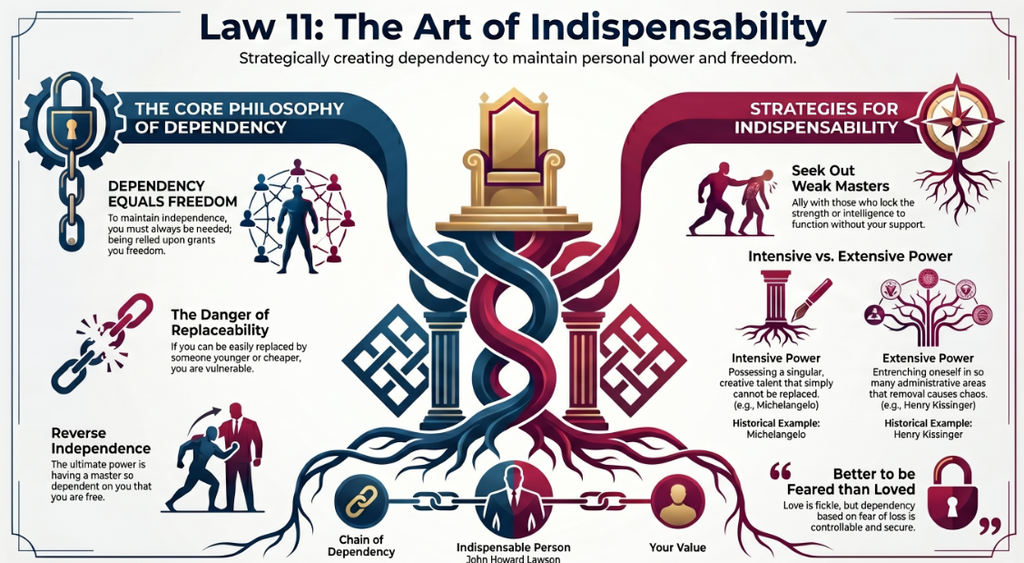
The Michelangelo Model (Intensive Power) Michelangelo relied on a singular, irreplaceable creative talent. When he quarreled with Pope Julius II and fled, the Pope—the most powerful man in Christendom—was forced to beg for his return. Michelangelo’s power was intensive: his skill was so unique that he depended on no particular master. He could find another patron, but the Pope could never find another Michelangelo. This path offers the highest degree of personal freedom.
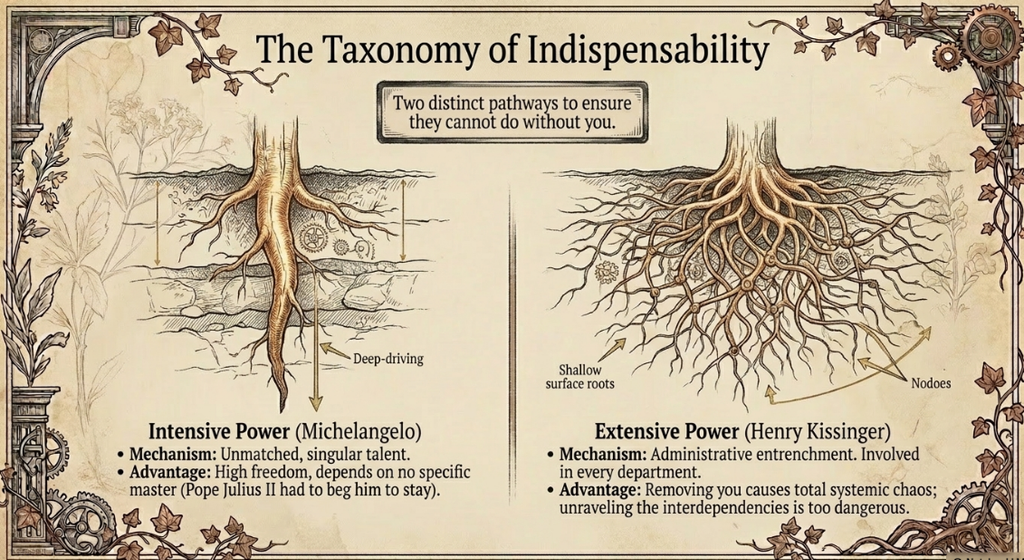
The Kissinger Model (Extensive Power) Henry Kissinger survived the purges of the Nixon administration not through a single skill, but by embedding himself in so many political structures that his removal would have unraveled the entire American diplomatic fabric. His power was extensive: he created a web of interdependencies that made his involvement “a card in his hand.”
Architect’s Note: Structural Leverage While Intensive power (talent) provides more mobility, Extensive power (entrenchment) provides more systemic control. The former makes you a legend; the latter makes you the system itself.
5. The Astrologer’s Gambit: Intertwining Fates
The ultimate form of dependency is the “Intertwining of Fates.” You must make the person above you believe that their health, success, or very life is tied to yours.
King Louis XI of France, the “Spider King,” once planned to execute his court astrologer. Before the execution, the King asked the man to predict the date of his own death, hoping to prove him a fraud. The astrologer, sensing the trap, replied:
“I shall die just three days before Your Majesty.”
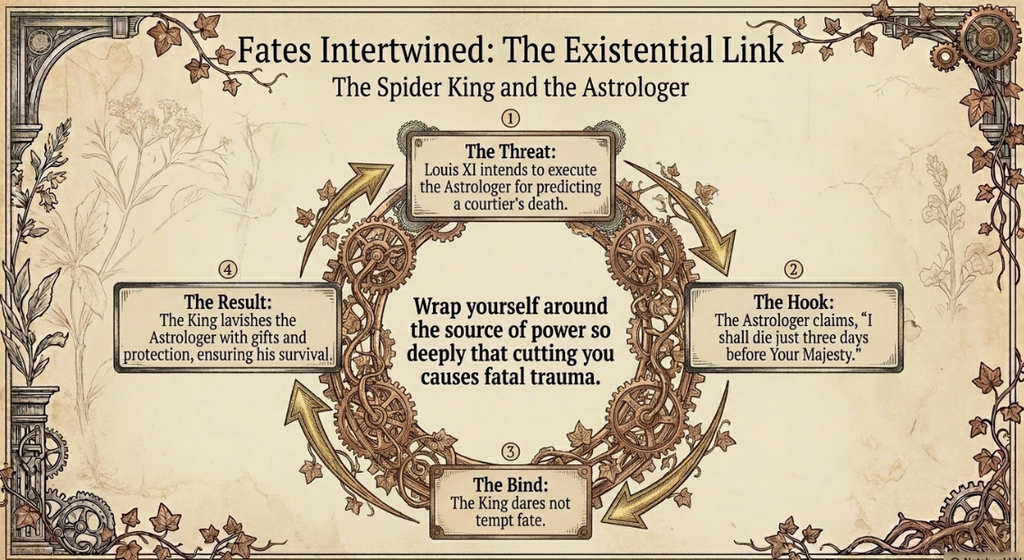
Terrified by this “prophecy,” Louis XI didn’t just spare the man; he spent the rest of his life protecting him, providing him with the best doctors and a life of luxury. By making his own death a death sentence for the King, the astrologer became the most protected asset in France.
Architect’s Note: Strategic Symbiosis Like creeping ivy, you must wrap yourself around the source of power so tightly that “cutting you away” would cause fatal trauma to the host.
6. The Machiavellian Pivot: Why Fear Trumps Love
A common mistake among high-performers is trying to make their superiors “love” them. Love is an unstable, uncontrollable emotion. As Machiavelli famously noted, “Fear you can control; love, never.” In a professional context, this means relying on the fear of loss rather than the warmth of affection.
Consider the “chain of dependence” at Columbia Pictures. President Harry Cohn, a man who kept a photo of Mussolini on his wall and hated “Communist bastards,” was urged to fire screenwriter John Howard Lawson during the 1951 blacklists. Cohn refused. He didn’t love Lawson; he actually despised him. But Lawson was the exclusive writer for Humphrey Bogart—the studio’s most profitable star. To fire Lawson was to lose Bogart. Lawson was an anchor in a chain of dependence that Cohn could not afford to break.
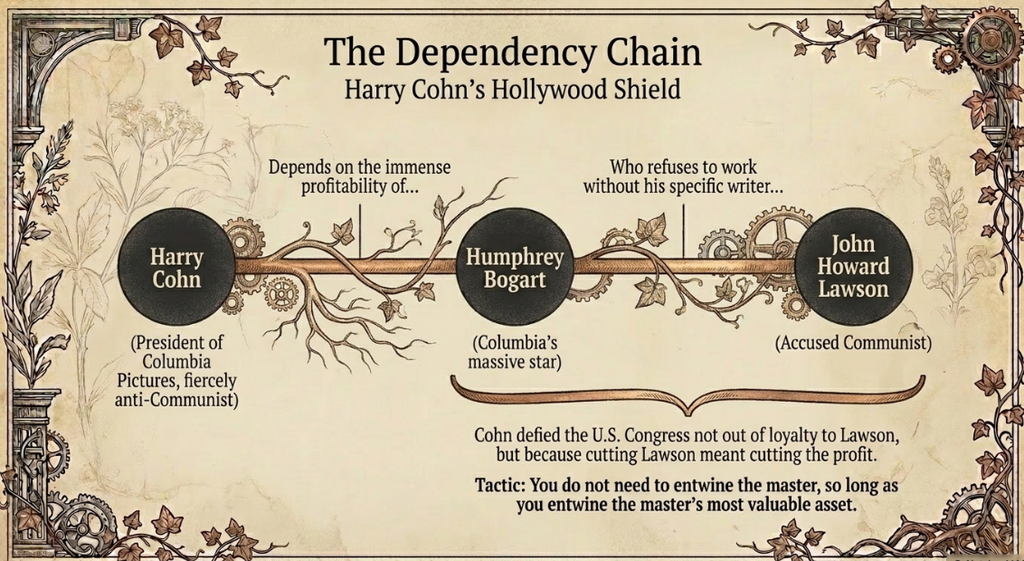
Architect’s Note: The Functional Moat Do not strive to be liked. Strive to be the person who holds the keys to what the master loves most. Your security should be built on their self-interest, not their heart.
7. Conclusion: The Law of Mutual Dependence
Total independence is a “rare and often fatal exception.” The drive for complete control—the monopolistic urge of a J.P. Morgan or a John D. Rockefeller—is often ruinous and fruitless, as it invites a united front of enemies and internal rot.
As the philosopher Baltasar Gracián observed: “He who has slaked his thirst, immediately turns his back on the well, no longer needing it.” The first lesson of high-performance strategy is to keep your patron ever in need of you—keep hope alive but never fully satisfied. To be the “servant” who pulls the levers is to have all the benefits of power without the target on your back.
Final Thought: Look at the architecture of your career. Are you the well that slakes the thirst, or are you merely a hero waiting for your own “Bridge of Sighs”? Have you made it so that getting rid of you would cost your master “toil and blood,” or are you simply waiting for someone younger and cheaper to take your place?
Image Summary
Reference


Related posts:
 Fifth Law of Power: The Invisible Shield: Why Your Reputation Is More Powerful Than Your Skills
 Sixth Law of Power: The Art of Being Seen: 5 Provocative Lessons from the Masters of Attention
 Seventh Law of Power: Why Doing All the Work is a Losing Game: 5 Ruthless Lessons on Credit and Power
 Eighth Law of Power: The Strategy of the Lure: Mastering the Initiative
 How to Win Friends and Influence People: Complete Chapter-by-Chapter Notes