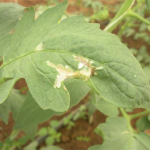
Tuta absoluta is a highly invasive moth native to South America that feeds primarily on tomato plants. It is now a global threat, spreading across Africa, Asia, Europe, and the Mediterranean, attacking not just tomatoes but also potatoes and eggplants.
The larvae mine into tomato leaves, stems, buds, and fruits, causing extensive damage that leads to crop loss up to 80–100% if not properly managed.
Symptoms of Infestation
- Tiny leaf mines or tunnels with dark frass (insect waste)
- Rolled or folded leaves with larvae inside
- Damaged apical buds leading to plant stunting
- Fruits with small entry holes and internal feeding tunnels
- Early fruit drop and poor yield quality


Life Cycle & Behavior
- Female lays ~250–300 eggs on the underside of leaves
- Larvae hatch and mine plant tissues
- Pupa develops in soil or plant debris
- Entire cycle completes in 24–38 days, with 10–12 generations/year under warm conditions
Management Strategies
| Method | Description |
|---|---|
| Monitoring | Use pheromone traps to detect early infestation |
| Cultural Control | Remove crop residues, deep plowing, and crop rotation |
| Biological Control | Release parasitoids like Trichogramma pretiosum, predators like Nesidiocoris tenuis |
| Botanical Insecticides | Neem-based products, Beauveria bassiana, or Metarhizium anisopliae |
| Chemical Control | Use insecticides like Spinosad or Emamectin benzoate with rotation to avoid resistance |
| IPM Approach | Combine all the above with farmer training and field surveillance |
Global Concern
Due to its rapid spread and resistance to many chemicals, Tuta absoluta is considered a quarantine pest in many countries. Integrated Pest Management (IPM) and early detection are key to controlling outbreaks and minimizing damage to the tomato industry.
References
- Desneux, N. et al. (2010). Biological invasion of European tomato crops by Tuta absoluta: Ecology, history of invasion, and prospects for biological control. Journal of Pest Science. https://doi.org/10.1007/s10340-010-0321-6
- Kurmi, B. N., Tiwari, K. H., Roy, N. K., Sigdel, B., & Pokharel, P. (2022). Effective Management Practices Of Tomato Leafminer-Tuta Absoluta (Lepidoptera: Gelechiidae): A Review. DOI: http://doi.org/10.26480/sfna.02.2022.58.61
- Pandey, M., Bhattarai, N., Pandey, P., Chaudhary, P., Katuwal, D. R., & Khanal, D. (2023). A review on biology and possible management strategies of tomato leaf miner, Tuta absoluta (Meyrick), Lepidoptera: Gelechiidae in Nepal. Heliyon, 9(6). https://doi.org/10.1016/j.heliyon.2023.e16474
- EPPO (2024). Tuta absoluta – Pest Fact Sheet.
- https://www.tutaabsoluta.com/tuta-absoluta
Related
Share


Related posts:
 Unlocking Nature’s Toolkit: How Plants Use Hormones to Build Organs for Symbiosis and Survival
 Nature’s Double Punch: How Nematodes and Yarrow Extracts Team Up to Fight Potato Pests
 Cadmium Contamination in Asian Rice: Hidden Health Risks and Sustainable Solutions
 Bioponics Boosts Tomato Farming with Circular Aquaponics and Insect-Based Systems
 Boosting Rice Yield and Stress Tolerance with PGR-Based Seed Priming