
1. Introduction: The Quiet Crisis in Our Greenhouses
The modern agricultural landscape stands at a critical juncture. For decades, the global food system has leaned heavily on synthetic chemical insecticides to safeguard our produce, but this “chemical-first” strategy is reaching a point of diminishing returns. As pests develop rapid resistance, farmers find themselves trapped on a treadmill—applying higher dosages of toxic compounds only to see smaller harvests. This reality has created a strategic global imperative to transition toward Integrated Pest Management (IPM), a holistic approach that prioritizes biological controls over chemical dependency.
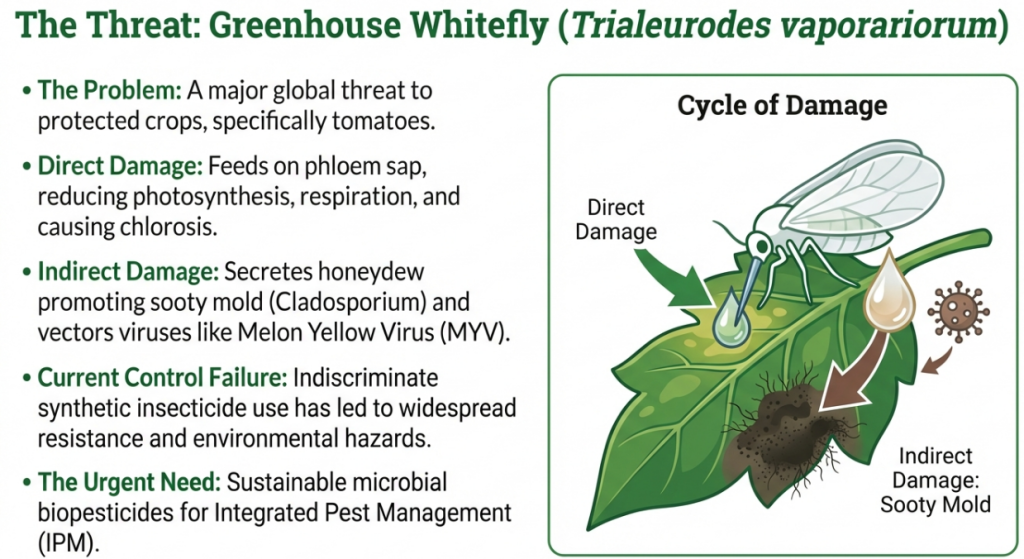
At the center of this struggle is the “Whitefly Menace,” scientifically known as Trialeurodes vaporariorum. These tiny insects are a global scourge, causing annual economic losses estimated at USD 100 million worldwide. As phloem-feeders, they pierce plant tissues to drain life-sustaining sap, leading to severe physiological stress including dehydration, chlorosis (the yellowing of leaves), and a catastrophic decline in photosynthetic capacity. The threat is twofold: not only do they weaken the plant directly, but they also act as dangerous vectors for plant viruses like the Beet Pseudo Yellow Virus (BPYV). Furthermore, they secrete a sticky substance called “honeydew” that facilitates the growth of Cladosporium—a dark sooty mold that further suffocates the plant’s ability to breathe and capture sunlight.
The “so what” of this crisis is clear: as whiteflies become impervious to traditional sprays, the discovery of “indigenous” biological solutions is a paradigm shift. Rather than relying on imported, broad-spectrum chemicals that threaten biodiversity and non-target organisms like bees, we are looking to the soil beneath our feet for answers. This search has led us to a remarkable hero: a native bacterium named Bacillus paramycoides EU-SIRCK1266.
2. The Discovery: Hunting for “Super-Bugs” in Himachal Pradesh
In the world of sustainable agriculture, local is almost always better. Indigenous bacteria possess a natural “ecological adaptability” that imported commercial strains lack. They are evolutionarily tuned to the specific climate, soil chemistry, and native plant species of their region, making them far more resilient when deployed in the field.
To find a suitable ally, researchers Kaur, Thakur, and Yadav embarked on a meticulous journey across six diverse districts of Himachal Pradesh, India. They collected rhizospheric soil—the nutrient-dense zone immediately surrounding plant roots—from a variety of environments, including:
• Fruit Orchards: Pear, apple, kiwi, lemon, wild fig, guava, litchi, and cherry.
• Floral and Traditional Crops: Marigold, date palm, and wild fig.
The search was rigorous. The team isolated a total of 78 bacterial candidates from these soil samples. To find the “best of the best,” they conducted a high-stakes screening process. Of the 78 isolates, 40 showed the ability to produce ammonia or hydrolytic enzymes, but the researchers were looking for a “Triple Threat.” They screened for three specific biological tools: Ammonia, Amylase, and Protease.
These aren’t just laboratory markers; they are the bacterium’s “biological toolkit.” Protease and amylase act like microscopic scissors, capable of dissolving the tough outer cuticles and internal proteins of pests like the whitefly. Meanwhile, ammonia serves a dual purpose: it inhibits the growth of competing pathogens and acts as a direct nitrogen source for the plant. Out of 78 isolates, only one strain—EU-SIRCK1266—tested positive for all three attributes. Molecular characterization using a “genetic fingerprinting” technique known as 16S rRNA gene sequencing confirmed its identity as Bacillus paramycoides.
3. The Greenhouse Trials: Putting the Bio-Pesticide to the Test
In the crucible of the greenhouse, the theoretical becomes the tactical. To validate the power of EU-SIRCK1266, researchers conducted a two-year study (2022–2023) on “Heem Sohna” hybrid tomatoes at an experimental farm in Baru Sahib. The setup was a rigorous randomized block design, pitting the treated crops against a “control” group that received no protection.
The data revealed that B. paramycoides is a formidable defender. The following table summarizes the “Percent Reduction” of the whitefly population compared to the untreated control:

While these numbers are impressive, the math behind the muscle is even more compelling. Statistical analysis (specifically P-values less than 0.05) confirmed that these results weren’t just a stroke of luck—they were scientifically significant. A consistent reduction of approximately 56% to 58% represents a fundamental shift in crop security. By decimating the ranks of both adults and nymphs, the bacterium prevents the exponential population explosions that typically lead to total crop failure. This level of control, achieved without a single drop of synthetic insecticide, offers a viable blueprint for the future of pesticide-free farming.
4. Beyond Protection: A Natural Growth Engine
One of the most profound insights from this study is that Bacillus paramycoides EU-SIRCK1266 is a biological “double agent.” Beyond its role as a shield, it facilitates “Phytostimulation”—a process where the bacterium acts as a natural fertilizer to boost plant health from the inside out.
The synthesis of ammonia by the bacterium is particularly crucial here; by converting nitrogen into a form the tomato plant can easily absorb, the bacterium directly fuels growth. The results across both years were exceptional:
• Enhanced Structural Integrity: In 2023, shoot and root lengths increased by 1.6-fold and 1.32-fold respectively.
• Robust Biomass: Treated plants showed a significant boost in both fresh and dry weight, creating hardier plants capable of withstanding environmental stress.
• Photosynthetic Capacity: While chlorophyll content saw a modest 1.09-fold improvement in 2022, it reached a peak 1.92-fold increase in 2023. This nearly doubling of chlorophyll means the plants were vastly more efficient at converting sunlight into energy.

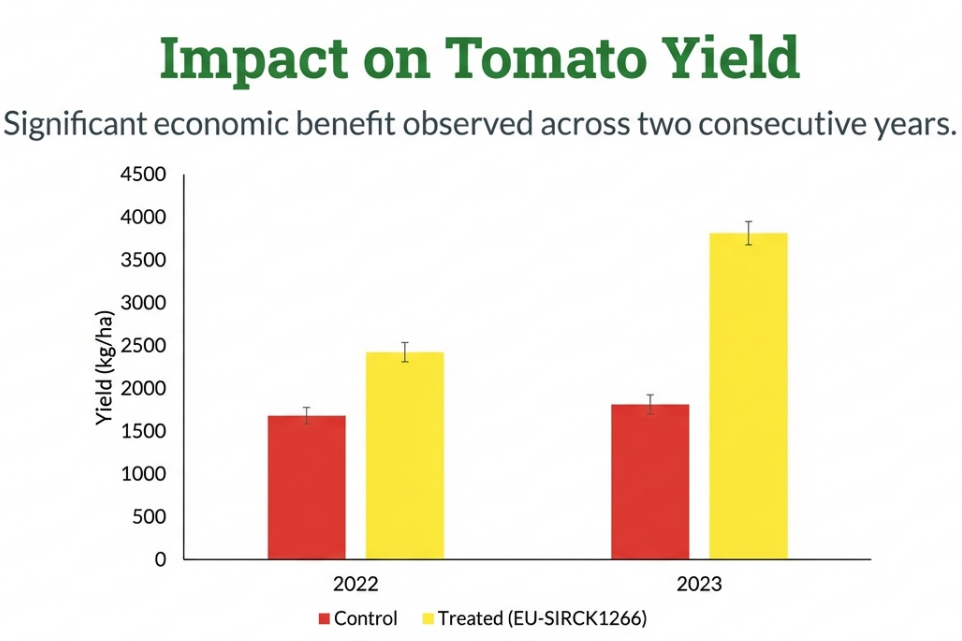
The economic narrative is perhaps the most persuasive argument for the agricultural strategist. In 2023, the yield for treated plants reached 3,817.62 kg/ha, while the unprotected control group languished at 1,810 kg/ha. This represents a staggering 110% increase in yield. For a farmer, this “tiny ally” doesn’t just protect the crop; it doubles the potential income while slashing the costs associated with expensive chemical inputs.
5. The Big Picture: Why This Matters for Your Table
This research is a vital contribution to the global movement for organic and eco-safe food production. The implications extend far beyond the greenhouse walls. For the consumer, the successful use of microbial biopesticides like EU-SIRCK1266 means a significant reduction in chemical residues on the vegetables we eat. For the environment, it means protecting “non-target organisms”—the bees, ladybugs, and local wildlife that are often the silent victims of industrial chemical farming.
6. Conclusion: The Future is Microbial
The study of Bacillus paramycoides EU-SIRCK1266 is a landmark in the transition toward a sustainable food system. By identifying a native bacterium that can simultaneously decimate the “Whitefly Menace” and act as a potent growth stimulant, researchers have provided a powerful alternative to the chemical status quo.

This tiny ally from the soil of Himachal Pradesh proves that the future of farming isn’t found in a laboratory-synthesized poison, but in the complex, beautiful world of microbial biology. Indigenous science is leading the way toward a more sustainable, green, and productive agricultural revolution.

Reference
Kaur, S., Thakur, N. & Yadav, A.N. Exploring the Biopesticidal Potential of Indigenous Bacillus paramycoides EU-SIRCK1266 for Sustainable Management of Greenhouse Whiteflies Trialeurodes vaporariorum. Journal of Crop Health 78, 23 (2026). https://doi.org/10.1007/s10343-025-01283-w


Related posts:
 Coral-Derived Bacterium Shows Powerful Potential to Reclaim Phosphorus and Boost Crop Growth in Saline Soils
 Native Fungus Beauveria bassiana Offers Dual Pest Control and Plant Growth Boost Against Cabbage Aphids
 Bacillus velezensis Effectively Controls Fusarium Wilt in Strawberry Through Enzyme Activation and Defense Gene Upregulation
 Brazilian Bacillus thuringiensis CNPMS B116 Genome Decoded for Biocontrol and Plant Growth Potential
 Powerful Bacterial Biocontrol Agents Against Citrus Rust Mite


