Introduction
What connects long-distance radio communication, life-saving thyroid surgery, chemical catalysis, rich Scandinavian storytelling, and the establishment of international peace courts? The year 1909 stands out in intellectual history as the moment the Nobel Foundation honored a remarkably diverse group of pioneers whose innovations reshaped technology, medicine, literature, and diplomacy.
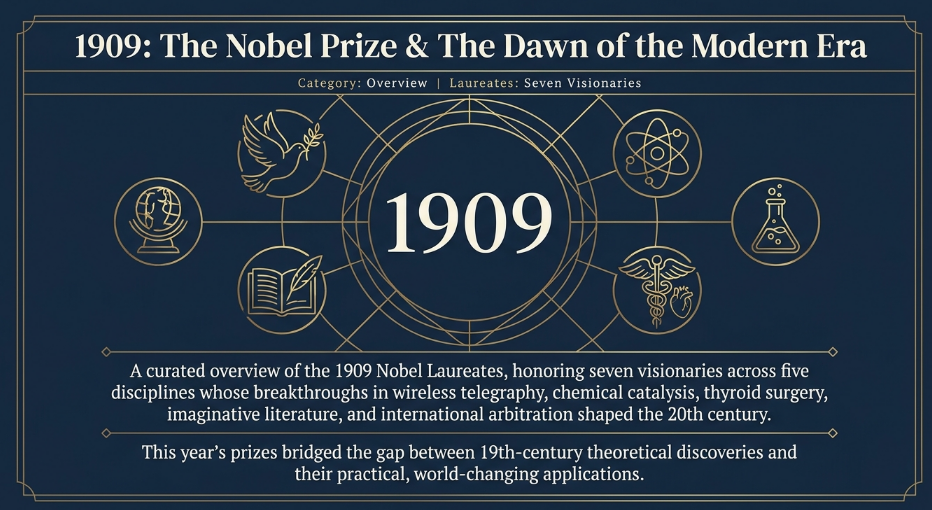
In this lesson, you will explore the breakthroughs of the 1909 Nobel laureates and see how their work laid the groundwork for modern science and international cooperation.
- Analyze how Guglielmo Marconi and Ferdinand Braun established wireless telegraphy.
- Understand Wilhelm Ostwald’s foundational principles of chemical catalysis.
- Examine Theodor Kocher’s surgical techniques and thyroid research.
- Explore Selma Lagerlöf’s literary style and the peace arbitration efforts of Auguste Beernaert and Paul Henri d’Estournelles de Constant.
Harnessing the Invisible: Waves of Communication in Physics
In the late 1880s, scientists discovered radio waves—a form of electromagnetic radiation sharing the same basic nature as visible light, but possessing a far longer wavelength. This discovery sparked a global race to determine whether these invisible waves could transmit signals across great distances without wires.
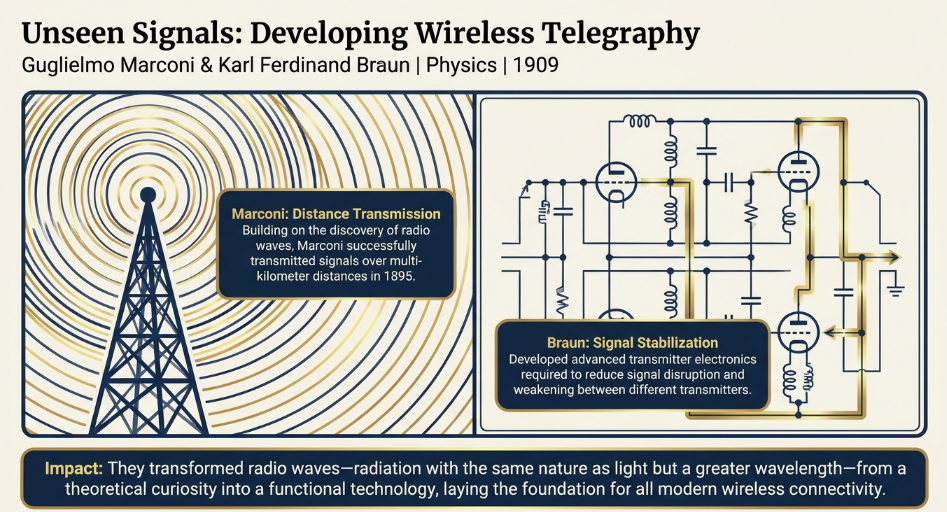
Two key figures shared the 1909 Nobel Prize in Physics for turning this theoretical concept into a world-changing technology:
- Guglielmo Marconi: In 1895, Marconi successfully transmitted radio signals over a distance of several kilometers. Representing the Marconi Wireless Telegraph Co. Ltd. in London, he continually refined equipment to push signals across vast distances, laying the cornerstone for both radio and wireless telegraphy.
- Ferdinand Braun: While Marconi focused on expanding range, Braun—a professor at Strasbourg University—focused on signal stability and efficiency. In the late 1890s, he developed specialized transmitter electronics that reduced signal weakening and prevented mutual interference between competing transmitters.
Think of early radio like shouting across a crowded, noisy room: Marconi built the powerful megaphone to make the voice travel miles away, while Braun created the acoustic filters so multiple speakers could talk simultaneously without drowning each other out.
Notably, Braun chose not to patent his inventions, maintaining that researchers should share their findings freely to advance human knowledge.
Catalysts of Life and Health: Advances in Chemistry and Medicine
The 1909 Nobel Prizes in Chemistry and Medicine highlighted fundamental discoveries in how chemical reactions operate inside industrial reactors and the human body.
Wilhelm Ostwald and the Magic of Catalysis During the 19th century, chemists observed that certain chemical reactions accelerated in the presence of specific elements that remained untouched at the end of the process. In 1894, Wilhelm Ostwald of Leipzig University clarified this phenomenon: a catalyst alters the speed of a chemical reaction without appearing in the final end-products.
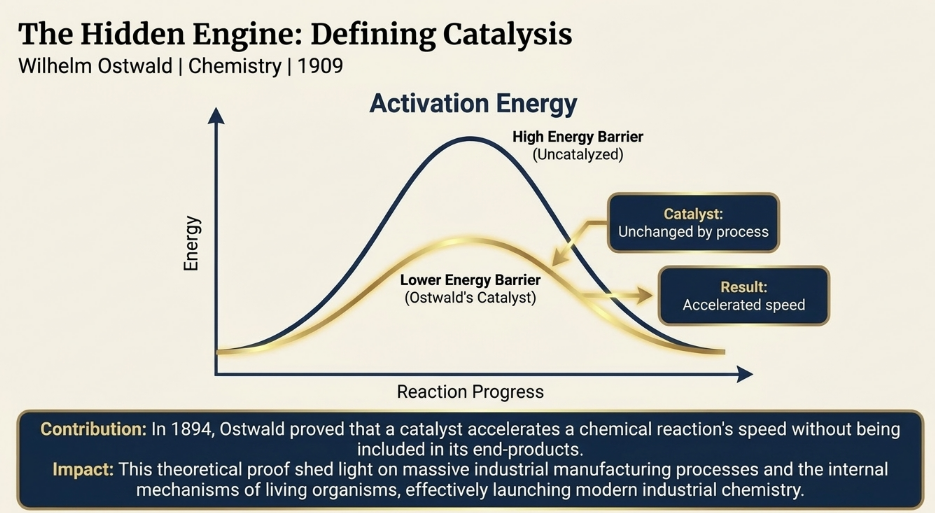
Imagine a matchmaker introducing two people at a social gathering: the matchmaker facilitates a connection between others while remaining entirely separate from the resulting partnership. Ostwald’s insight into reaction rates and chemical equilibria transformed both industrial chemical manufacturing and our understanding of biological enzymes.
Theodor Kocher and Thyroid Surgery The thyroid gland, located in the neck, plays a vital role in human metabolism. In the 19th century, severe swelling known as a goiter frequently obstructed patient breathing, prompting dangerous surgical attempts at removal that often resulted in fatal complications or severe illness.
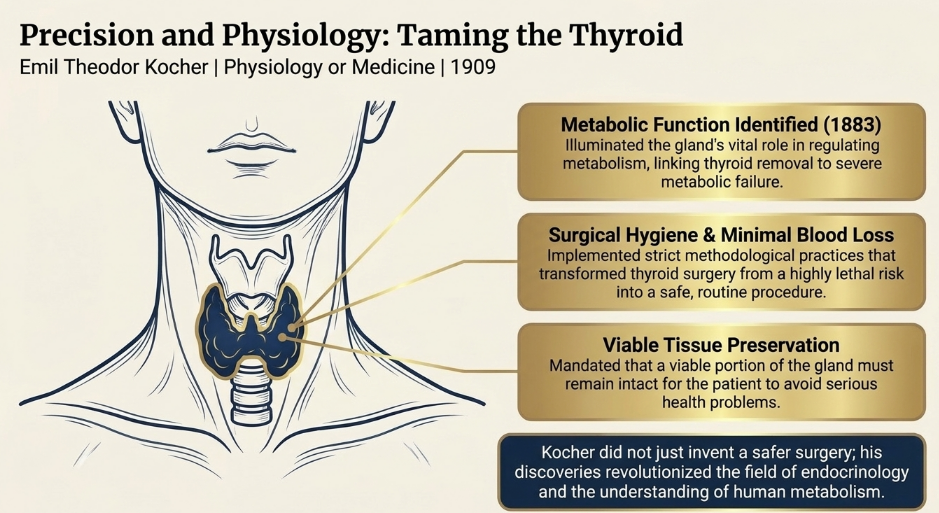
In 1883, Emil Theodor Kocher of Berne University transformed thyroid treatment by proving how surgery could be performed safely:
- Implementing strict surgical hygiene protocols to prevent infection.
- Precision techniques to ensure minimal blood loss during procedures.
- Demonstrating that surgeons must leave a viable fragment of the gland intact so the patient retains essential metabolic functions.
Storytelling and Universal Peace: Literature and Diplomacy
The remaining 1909 awards honored human creativity in literature and dedicated public service aimed at preventing global conflict.
Selma Lagerlöf: Master of Narrative Idealism Swedish author Selma Lagerlöf began her career as a schoolteacher before devoting herself entirely to writing in 1895. Her début novel, Gösta Berling’s Saga, broke away from the rigid realism and naturalism of the era by incorporating folk tales, local legends, and rich imagination from her home district in Värmland County.
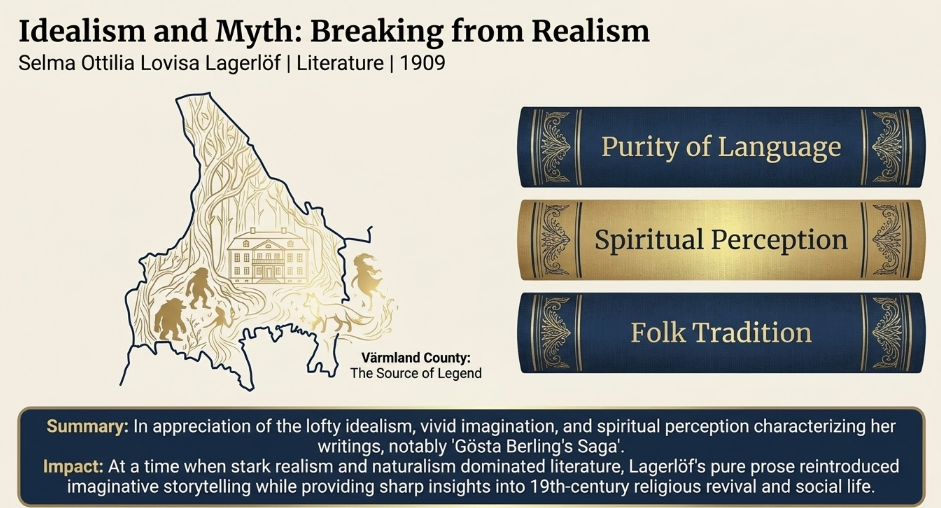
Awarded the Nobel Prize in Literature for her lofty idealism, vivid imagination, and spiritual perception, Lagerlöf used her prize money to repurchase Mårbacka, her ancestral family estate that had been lost following her father’s financial insolvency.
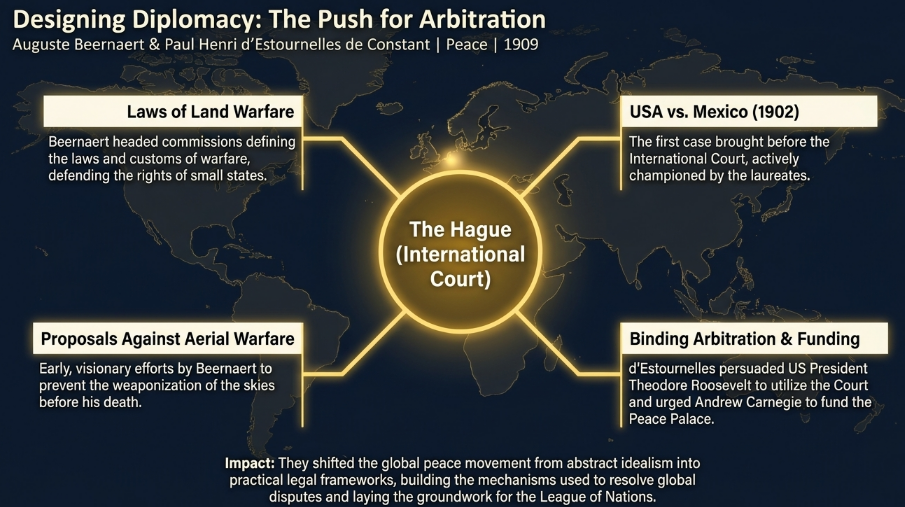
Auguste Beernaert & Paul Henri d’Estournelles de Constant: Architects of Peace The 1909 Nobel Peace Prize was shared between two statesmen dedicated to international arbitration:
- Auguste Beernaert (Belgium): A former Prime Minister who broke with King Leopold II over brutal colonial policies in the Congo. At the Hague Peace Conferences of 1899 and 1907, Beernaert advocated for small neutral states and headed the commission on land warfare customs. In 1902, he represented Mexico against the United States in the first case brought before the International Court at the Hague, and spent his final days campaigning against aerial warfare.
- Paul Henri d’Estournelles de Constant (France): A French diplomat and Senator who envisioned a “united states of Europe.” He persuaded U.S. President Theodore Roosevelt to submit disputes to the Hague Court and urged philanthropist Andrew Carnegie to fund the construction of the Peace Palace. Following World War I, he advocated for fair peace terms and warned against the excessive severity of the Versailles Treaty.
Summary
The 1909 Nobel Laureates demonstrated how distinct disciplines—physics, chemistry, medicine, literature, and diplomacy—share a common goal: improving the human condition through rigorous investigation, creative expression, and international cooperation.
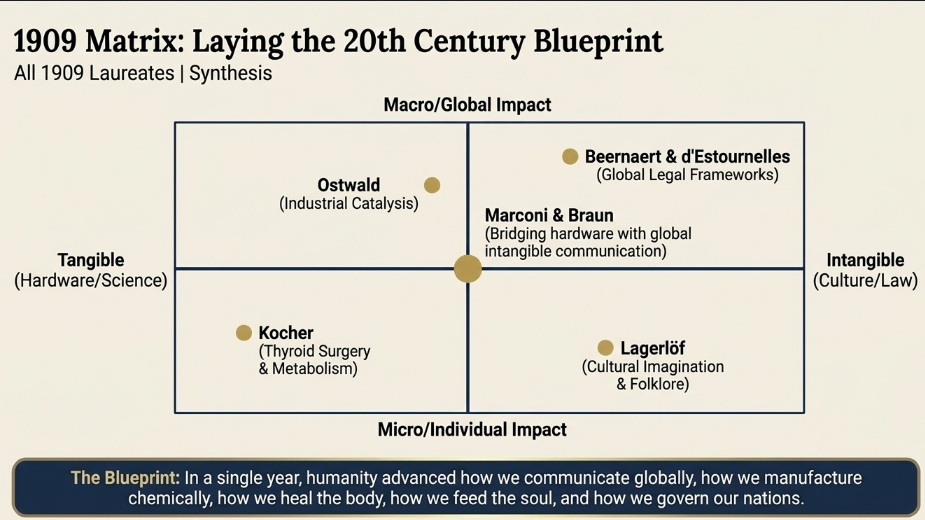
Key Takeaways:
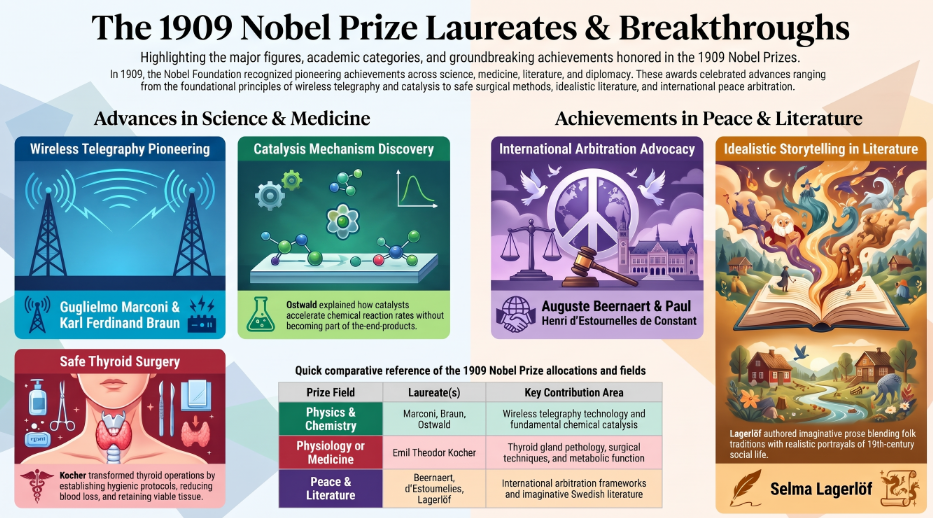
- Physics: Guglielmo Marconi and Ferdinand Braun developed practical wireless telegraphy by combining long-distance radio signaling with interference-reducing circuit design.
- Chemistry: Wilhelm Ostwald identified the mechanism of catalysis, proving catalysts alter reaction rates without being consumed.
- Medicine: Theodor Kocher reduced mortality in thyroid surgery through hygienic practices, blood loss control, and preserving partial gland function.
- Literature: Selma Lagerlöf infused Swedish literature with vivid imagination and folk traditions, using her award to buy back her family home at Mårbacka.
- Peace: Auguste Beernaert and Paul Henri d’Estournelles de Constant championed binding international arbitration, small-state protection, and the work of the Hague International Court.
Reference
https://www.nobelprize.org/prizes/lists/all-nobel-prizes/1909-1901