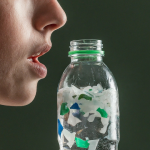
Plastics, previously hailed for their strength and multiple uses, have now become a scourge for the entire ecosystem. It has been observed that these polymers can continue their fragmentation to the nano level. As they continue to miniaturize, they not only increase in quantity but could also cross biological barriers and reside in biological systems.

Researchers from Columbia University developed a hyperspectral-stimulated Raman scattering (SRS) imaging platform with an automated plastic identification algorithm capable of analyzing micro-nano plastics at the single particle level with high chemical specificity and throughput.

They detected the micro-nano plastics at approximate concentrations of 2.4 ± 1.3 X 10⁵ particles per liter of bottled water, about 90 % of which were nanoplastics. The estimated mass of micro-nano plastics was found to be about 10 ng/L.
As plastic use continues to rise, the time is long past due to think about its consequences. If the right measures are not taken at the right time, there might come a time when the plastics inside the drinking water bottle outweigh the plastic used to make the bottle.
Reference:
Qian, Naixin, Xin Gao, Xiaoqi Lang, Huiping Deng, Teodora Maria Bratu, Qixuan Chen, Phoebe Stapleton, Beizhan Yan, and Wei Min. “Rapid single-particle chemical imaging of nanoplastics by SRS microscopy.” Proceedings of the National Academy of Sciences 121, no. 3 (2024): e2300582121.


Related posts:
 World Economic Forum: Top 10 Emerging Technologies of 2023
 The Giant Bacterium: Ca. Epulopiscium viviparus
 Thiomargarita magnifica: The Bacteria Big Enough to be Visible by the Naked Eye
 Panama Wilt: Understanding and Managing the Banana Killer
 New Class of Antibiotics with a Novel Mode of Inhibition against World Health Organization’s Critical Listed Bacteria, Carbapenem-Resistant Acinetobacter baumannii