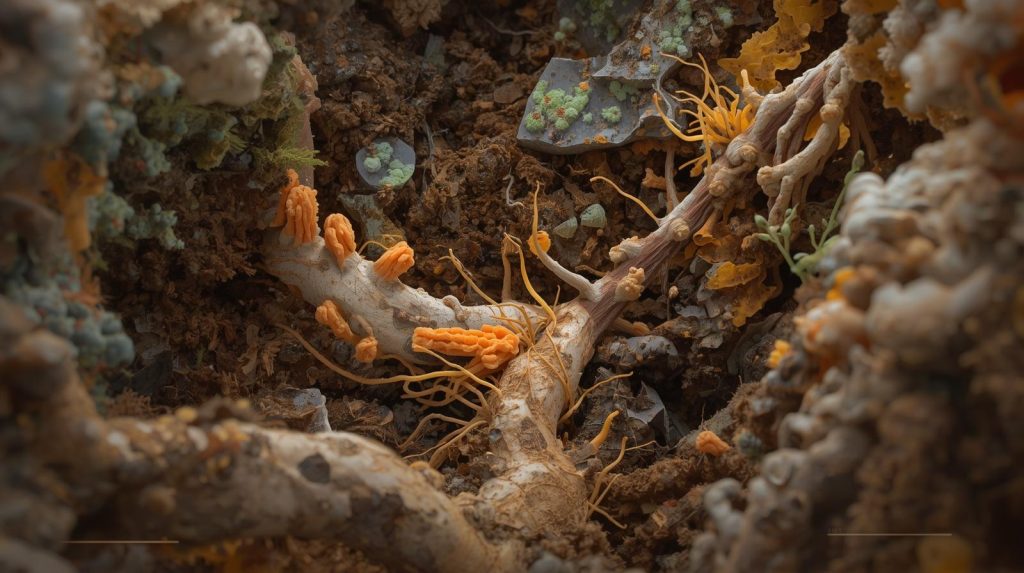

Soil Microbial Interactions: AMF vs. SOB in Soybean Rhizosphere
Soil health and crop productivity often depend on complex interactions between plants and soil microorganisms. Two important microbial groups—arbuscular mycorrhizal fungi (AMF) and sulfur-oxidizing bacteria (SOB)—play key roles in nutrient cycling and soil fertility.
Traditionally, AMF and SOB are believed to act synergistically, enhancing nutrient uptake and plant growth. However, a new study investigating their combined effects in sulfur-deficient, acidified soybean soils revealed a surprising antagonistic relationship that challenges previous assumptions.
Key Findings: When Allies Turn into Adversaries
The research explored interactions between Funneliformis mosseae (AMF) and Acidithiobacillus thiooxidans (SOB) in soybean rhizosphere soils under continuous cropping.
1. Reduced Soybean Growth Under Co-Inoculation
- Inoculating AMF alone improved soybean height, dry weight, and available soil sulfur.
- SOB alone or combined with AMF inhibited plant growth, suggesting antagonistic interactions under acidic, sulfur-deficient conditions.
2. Decline in Sulfur Cycling Genes
- AMF alone increased the abundance of sulfur-related genes (dsrA, soxY, yedZ, apsA).
- SOB alone or co-inoculation reduced these genes, limiting sulfur oxidation efficiency in soils.
3. Impact of Soil pH and Microbial Secretions
- High fructose and glucose levels secreted by AMF roots inhibited SOB growth.
- Acidic conditions and excess carbon sources disrupted SOB’s autotrophic metabolism, lowering sulfur oxidation capacity.
Why This Matters for Agriculture
Continuous soybean cropping often leads to:
- Sulfur depletion in soils
- Soil acidification due to fertilizer overuse
- Reduced crop yields and soil fertility
This study suggests that microbial interactions are context-dependent. While AMF can boost nutrient uptake and soil fertility, their combined use with SOB may not always be beneficial, especially in acidic, sulfur-deficient soils.
Towards Sustainable Soil Management
The findings highlight the need to:
- Tailor microbial inoculant strategies to soil pH, nutrient status, and crop requirements
- Study carbon exudation effects on soil microbial communities
- Develop integrated soil fertility approaches for sustainable farming
Conclusion: Rethinking Microbial Fertilizers
The research provides new insights into plant-microbe-soil interactions, showing that AMF and SOB may compete rather than cooperate under certain conditions.
Future studies should explore:
- How to balance microbial interactions for better nutrient cycling
- The role of carbon exudates in shaping soil microbial networks
- Field-scale validation of microbial inoculant performance
These findings could help farmers and soil scientists design eco-friendly, site-specific soil fertility management practices for sustainable agriculture.
Reference
Pan, L., Chen, J., Wang, L., & Cai, B. (2025). New insights into the antagonistic effect of AMF and SOB: A preliminary study on the ability of Funneliformis mosseae to inhibit sulfur oxidation by Acidithiobacillus thiooxidans. Plant and Soil. https://doi.org/10.1007/s11104-025-07885-7


Related posts:
 Planting Nitrogen-Fixing Species Can Boost Soil Carbon and Fight Climate Change
 Sugarcane-Legume Intercropping Boosts Yield, Soil Health, and Sustainability with Less Nitrogen
 Soil Microbes Shape Crop Growth — But Only When Unlocking Hidden Nutrients
 Wastewater Sludge Compost and Mycorrhizal Fungi Boost Soil Fertility and Microbial Activity in Giant Reed
 Brewer’s Yeast Residue: A Sustainable Biofertilizer for Horticultural Seedlings


