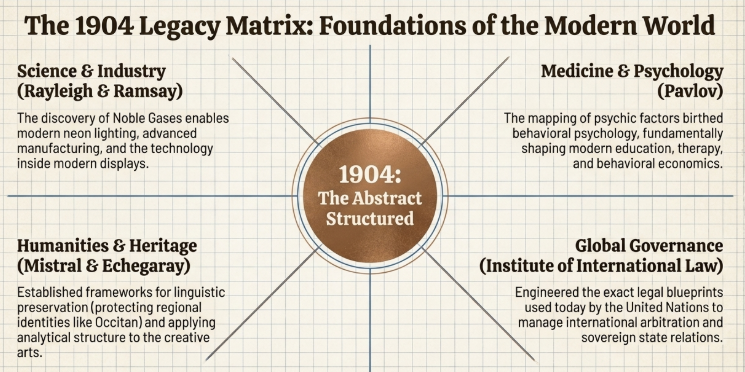
At the turn of the twentieth century, the 1904 Nobel Prize conferrals represented a monumental moment in the systematic recognition of human achievement across physical science, physiological analysis, cultural expression, and international governance. Awarded during an era defined by rapid industrialization, scientific professionalization, and complex geopolitical shifts, the 1904 prizes recognized groundbreaking discoveries that reconfigured physical chemistry and biological science, alongside profound efforts to preserve regional linguistic identity, revitalize national theatrical traditions, and establish enduring legal mechanisms for peaceful dispute resolution.
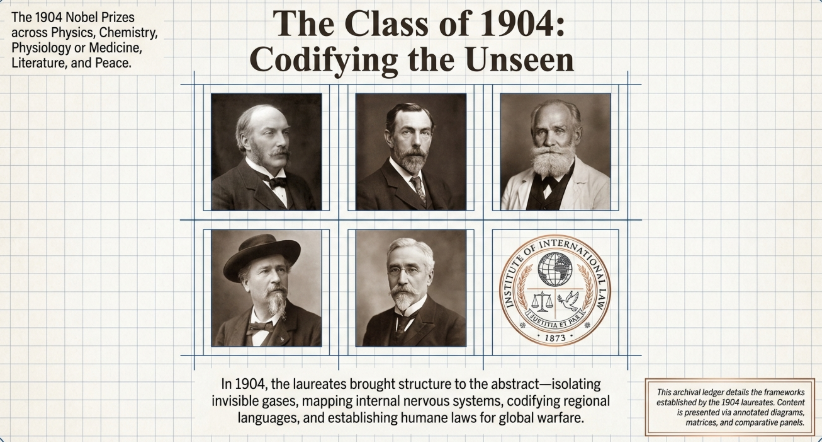
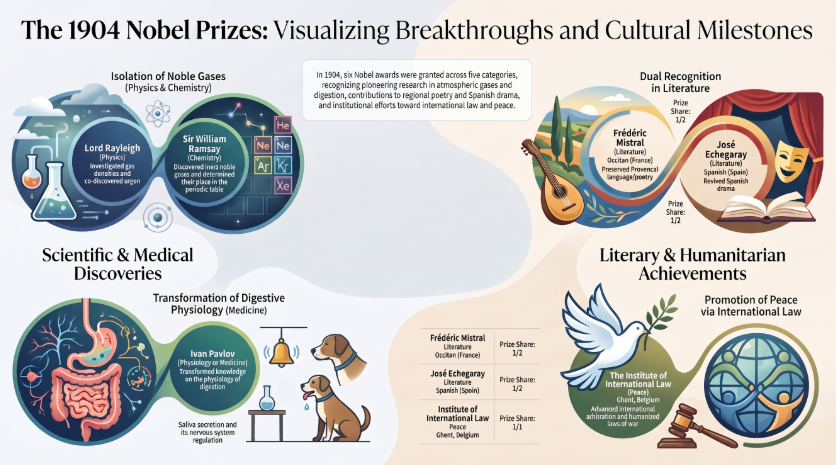
The 1904 cohort comprised exceptional individual scholars and a pioneering institutional body distributed across five distinct prize disciplines:
- Physics: Lord Rayleigh (John William Strutt) was awarded a 1/1 full share for his physical investigations into atmospheric gas densities and his isolation of argon. At the time of the award, he was affiliated with the Royal Institution of Great Britain in London, United Kingdom.
- Chemistry: Sir William Ramsay received a 1/1 full share for his discovery and systematic placement of the inert gaseous elements in the periodic table. He was affiliated with University College in London, United Kingdom.
- Physiology or Medicine: Ivan Petrovich Pavlov was granted a 1/1 full share for his revolutionary experimental work on the physiology of digestion. He was affiliated with the Military Medical Academy in St. Petersburg, Russia.
- Literature: The prize was divided equally between two co-laureates: Frédéric Mistral (1/2 share), residing in France, recognized for his poetic genius and Provençal philology; and José Echegaray y Eizaguirre (1/2 share), residing in Spain, honored for his revival of Spanish dramatic traditions.
- Peace: The Institute of International Law (Institut de droit international) was awarded a 1/1 full share as an institutional laureate, recognizing its scientific contributions to public international law, arbitration, and humanitarian wartime regulations. Founded in Ghent, Belgium, its administrative seat is tied to the residence of its active Secretary-General.
An analysis of award allocation structures reveals distinct institutional strategies across the Nobel committees. In the scientific disciplines—Physics, Chemistry, and Physiology or Medicine—the awarding bodies conferred single, undivided full shares (1/1), emphasizing individual authority and singular empirical milestones. In contrast, the Literature Committee utilized a split allocation (1/2 shares) to celebrate two contrasting cultural frameworks within Southern Europe: regional linguistic preservation in France and formal dramatic revival in Spain. Furthermore, the Peace Prize committee prioritized collective legal framework development over individual activism by recognizing a non-governmental scientific organization, reinforcing the institutionalization and codification of international law.
Having established this broad structural overview, a detailed examination of the physical and physiological breakthroughs demonstrates the scientific rigor and interdisciplinary resonance of the 1904 scientific laureates.
Analysis of Scientific Breakthroughs: Physics, Chemistry, and Medicine
The 1904 scientific awards highlighted the supreme value of precise empirical physical measurements and meticulous surgical experimentation. Together, these scientific contributions fundamentally altered contemporary understanding of the Earth’s atmospheric constituents and the intricate nervous control mechanisms governing animal digestive physiology.
Physics: Lord Rayleigh (John William Strutt)
Operating at the Royal Institution of Great Britain, Lord Rayleigh focused on developing extraordinarily precise physical methods to evaluate the properties and densities of atmospheric gases. During his comparative studies of nitrogen, Rayleigh observed a persistent empirical anomaly: atmospheric nitrogen extracted from air consistently weighed more per unit volume than chemically synthesized nitrogen derived from nitrogen compounds. He correctly deduced that atmospheric air contained a hitherto unidentified, heavier gaseous constituent. In 1894, collaborating with chemist Sir William Ramsay, Rayleigh successfully isolated this non-reactive element in pure form and analyzed its physical characteristics, naming it argon.
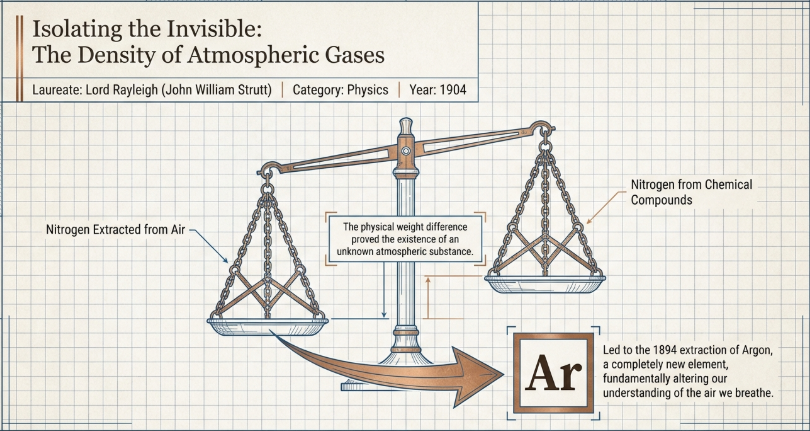
His official Nobel citation recognizes him “for his investigations of the densities of the most important gases and for his discovery of argon in connection with these studies.”
Chemistry: Sir William Ramsay
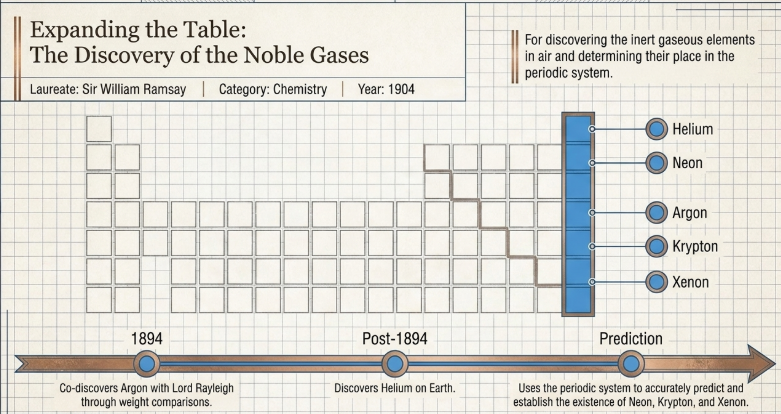
Sir William Ramsay, a professor at University College, London, who had earned his doctorate in organic chemistry in Germany, was inspired to investigate gaseous elements after attending a lecture by Lord Rayleigh. Following their joint 1894 discovery of argon, Ramsay isolated another non-reactive gas, helium. Recognizing that these elements did not fit into the existing periodic architecture, Ramsay utilized the periodic table as a predictive framework to postulate an entire unmapped family of noble gases. Through methodical fractional distillation and chemical isolation, he subsequently established the empirical existence of neon, krypton, and xenon, systematically placing them into the periodic system.
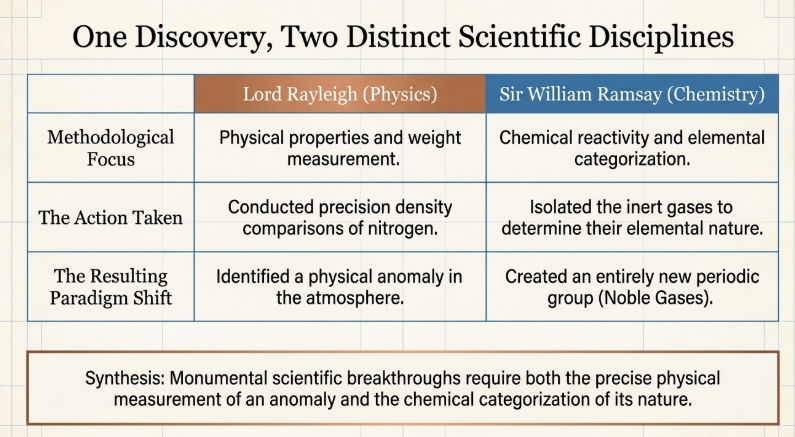
The simultaneous conferral of the 1904 Nobel Prizes in Physics and Chemistry to Rayleigh and Ramsay represented a landmark moment of cross-disciplinary validation by the Royal Swedish Academy of Sciences. While Rayleigh applied physical methods to measure gas densities with unprecedented precision, Ramsay brought chemical isolation techniques and theoretical systematization to the endeavor. Their operational synergy bridged physical measurement and chemical classification, expanding the periodic table and fundamentally transforming atomic chemistry.
Physiology or Medicine: Ivan Petrovich Pavlov
At the Military Medical Academy and the Physiology Department of the Institute of Experimental Medicine in St. Petersburg, Ivan Petrovich Pavlov transformed the scientific understanding of digestive physiology. Pavlov devised innovative surgical techniques on canine subjects, exposing sections of their intestinal canals to observe organ function directly in living organisms without disrupting normal physiological processes.
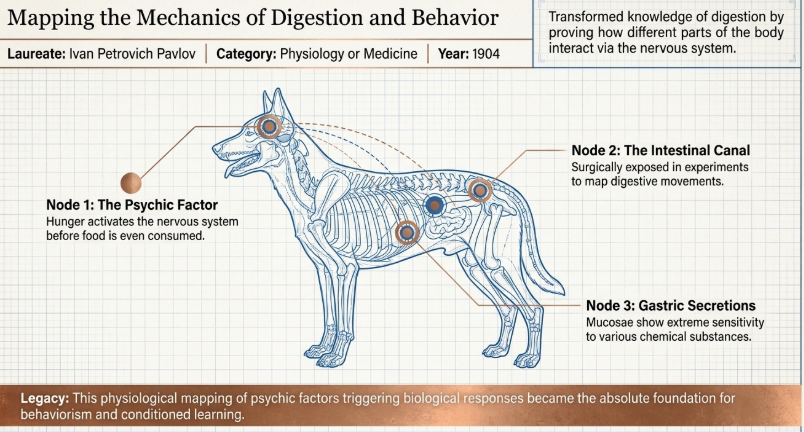
Throughout the 1890s, Pavlov’s experimental investigations established that the central nervous system exerts direct control over intestinal movements and the secretion of digestive fluids, such as gastric juice. He proved that the gastric mucosae exhibit precise sensitivity to specific chemical substances and demonstrated the paramount role of psychic factors—such as the anticipation of food and the sensation of hunger—in stimulating physiological gastric secretions. Pavlov’s work revolutionized physiological medicine and provided the primary conceptual foundation for the emergence of modern behaviorism.
Comparative Matrix of Scientific Laureates
| Laureate | Discipline | Institutional Affiliation | Core Empirical Breakthrough |
|---|---|---|---|
| Lord Rayleigh (John William Strutt) | Physics | Royal Institution of Great Britain (London, United Kingdom) | Identified density discrepancies between atmospheric and chemical nitrogen, isolating the noble gas argon in 1894 through physical analysis. |
| Sir William Ramsay | Chemistry | University College (London, United Kingdom) | Isolated argon and helium, predicted and discovered neon, krypton, and xenon, systematically placing noble gases in the periodic table. |
| Ivan Petrovich Pavlov | Physiology or Medicine | Military Medical Academy (St. Petersburg, Russia) | Demonstrated nervous system control over digestive secretions and intestinal movements, proving chemical and psychic influences on digestion. |
Beyond these profound advancements in physical chemistry and medical physiology, the 1904 Nobel Committees extended their recognition to achievements in regional literature, national drama, and global legal governance.
Cultural Preservation and Governance: Literature and International Peace
The 1904 conferrals for Literature and Peace recognized achievements that preserved regional linguistic heritage, invigorated national theatrical arts, and structured the legal parameters of global conflict resolution. Historiographically, these awards reflect the profound tension in turn-of-the-century Europe between centralized nation-state homogenization and regional cultural preservation, as well as the growing pre-World War I momentum toward codifying international humanitarian law.
Literature: Co-Laureates
Frédéric Mistral
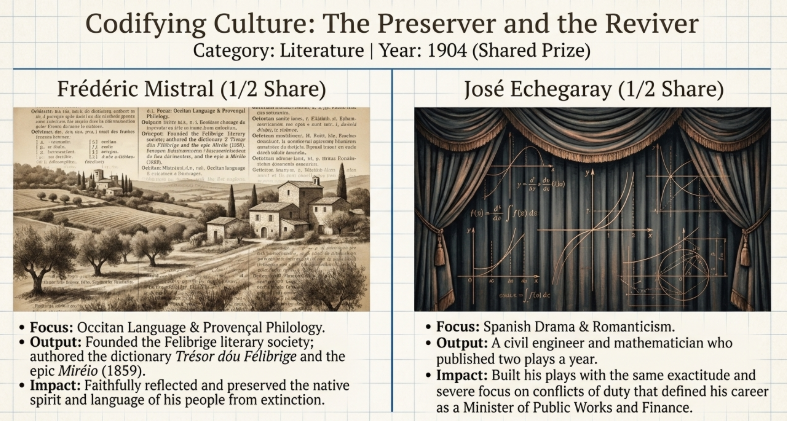
Born to an affluent landowning family in Maillane, France, Frédéric Mistral studied law before devoting his life to writing poetry in Provençal (Occitan), a Southern French literary language dating back to the 12th century. Inspired by his teacher, the Provençal poet Joseph Roumanille, Mistral made the scenery, culture, and native spirit of Provence the focal point of his literary career.
In 1854, Mistral co-founded the Felibrige literary society to safeguard and promote Provençal culture and language against the centralizing cultural pressures of the French state. Over several decades, he compiled Trésor dóu Félibrige, a monumental dictionary of the Provençal language published by the society. His epic poetic masterpiece, Miréio, published in 1859 after eight years of composition, achieved major international renown. Demonstrating his lifelong commitment to cultural preservation, Mistral donated his entire Nobel prize share to establish a museum dedicated to Provençal folk art.
His award citation reflects his achievements: “in recognition of the fresh originality and true inspiration of his poetic production, which faithfully reflects the natural scenery and native spirit of his people, and, in addition, his significant work as a Provençal philologist.”
José Echegaray y Eizaguirre
José Echegaray y Eizaguirre pursued a remarkably multifaceted career in Madrid, Spain. Earning a civil engineering degree at age 20, he worked as a professor teaching mathematics, geometry, and physical calculus, publishing several scholarly scientific works. Simultaneously, he attained high public office, serving as Spain’s Minister of Public Works and Minister of Finance.
Echegaray entered dramatic writing relatively late, making his debut in 1874 at age 42. For the remainder of his life, he maintained an extraordinary artistic output, publishing an average of two plays per year. Echegaray brought his background in engineering, mathematics, and public administration to playwriting, constructing dramatic plots with mathematical exactitude. His works featured moral conflicts centered on uncompromising duty and exalted romanticism, reviving classical Spanish theatrical traditions for the modern stage.
His citation reads: “in recognition of the numerous and brilliant compositions which, in an individual and original manner, have revived the great traditions of the Spanish drama.”
Comparative Differentiators
The literature co-laureates represented two distinct responses to nineteenth-century European cultural trends. Mistral operated within the realm of regional linguistic preservation, utilizing the Occitan/Provençal vernacular, epic folk poetry, and lexicographical compilation (Trésor dóu Félibrige) to resist state-driven cultural assimilation. Conversely, Echegaray operated within Spanish state institutions and formal national theater, employing mathematical plot architecture, severe moral dilemmas of duty, and romantic stage drama to modernize and celebrate the Spanish dramatic tradition.
Peace: Institute of International Law (Institut de droit international)
Organizational Mandate
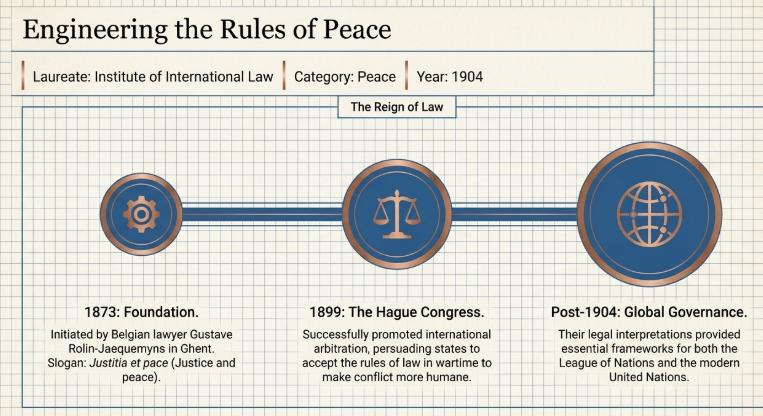
Founded in 1873 in Ghent, Belgium, through the initiative of Belgian lawyer Gustave Rolin-Jaequemyns, the Institute of International Law (Institut de droit international) was established as an independent, non-governmental scientific society of legal scholars. Operating under the official motto “Justitia et pace” (Justice and Peace), the Institute was designed to serve as an authoritative, objective body in formulating, clarifying, and promoting the principles of international law across sovereign states. Its administrative seat is maintained at the place of residence of its active Secretary-General.
Legal and Humanitarian Impact
In 1904, the Nobel Committee honored the Institute for its pivotal role in advancing international arbitration and advocating state adherence to legal norms during armed conflicts. The award underscored the pre-World War I movement to construct a codified international legal framework capable of mitigating geopolitical conflict. The Institute contributed directly to the arbitration provisions adopted during the landmark Hague Congress of 1899. Following its 1904 award, the Institute’s legal analyses proved vital to the League of Nations during the inter-war period, and its authoritative legal reports continue to assist the United Nations.
The official motivation praises the organization: “for its striving in public law to develop peaceful ties between nations and to make the laws of war more humane.”
These cultural and institutional contributions complete the historical record of the 1904 Nobel cohort, summarized in the master reference entry below.
Standardized 1904 Nobel Prize Master Summary
This section compiles the strictly grounded year-wise entry for 1904, providing an accessible, standardized reference summary of all laureates and official award citations across every discipline.
- Lord Rayleigh (John William Strutt): Awarded the Nobel Prize in Physics for his investigations of the densities of the most important gases and for his discovery of argon in connection with these studies.
- Sir William Ramsay: Awarded the Nobel Prize in Chemistry in recognition of his services in the discovery of the inert gaseous elements in air, and his determination of their place in the periodic system.
- Ivan Petrovich Pavlov: Awarded the Nobel Prize in Physiology or Medicine in recognition of his work on the physiology of digestion, through which knowledge on vital aspects of the subject has been transformed and enlarged.
- Frédéric Mistral: Awarded one-half of the Nobel Prize in Literature in recognition of the fresh originality and true inspiration of his poetic production, which faithfully reflects the natural scenery and native spirit of his people, and, in addition, his significant work as a Provençal philologist.
- José Echegaray y Eizaguirre: Awarded one-half of the Nobel Prize in Literature in recognition of the numerous and brilliant compositions which, in an individual and original manner, have revived the great traditions of the Spanish drama.
- Institute of International Law (Institut de droit international): Awarded the Nobel Peace Prize for its striving in public law to develop peaceful ties between nations and to make the laws of war more humane.
The 1904 Nobel Prize cohort stands as an extraordinary historical testament to human achievement, bridging groundbreaking physical discoveries, revolutionary physiological insights, literary preservation, and the institutional promotion of world peace.
Reference
https://www.nobelprize.org/prizes/lists/all-nobel-prizes/1909-1901


Related posts:
 Nobel Prize Laureates Series: The Inaugural 1901 Nobel Prize
 Nobel Prize Laureates Series: 1902, A Comprehensive Review of Scientific and Humanitarian Advancements
 Nobel Prize Laureates Series: 1903
 World Economic Forum: Top 10 Emerging Technologies of 2023
 The Giant Bacterium: Ca. Epulopiscium viviparus