In a stunning leap forward for trauma care and emergency medicine, researchers in China have engineered a self-sealing hemostatic nanofabric that can stop severe bleeding in seconds—without the need for surgery or external pressure.
This new technology, published in Nature Communications, uses oppositely charged nanofibers that self-bond when exposed to blood, forming a compact, tissue-adherent barrier that seals wounds from the inside out.
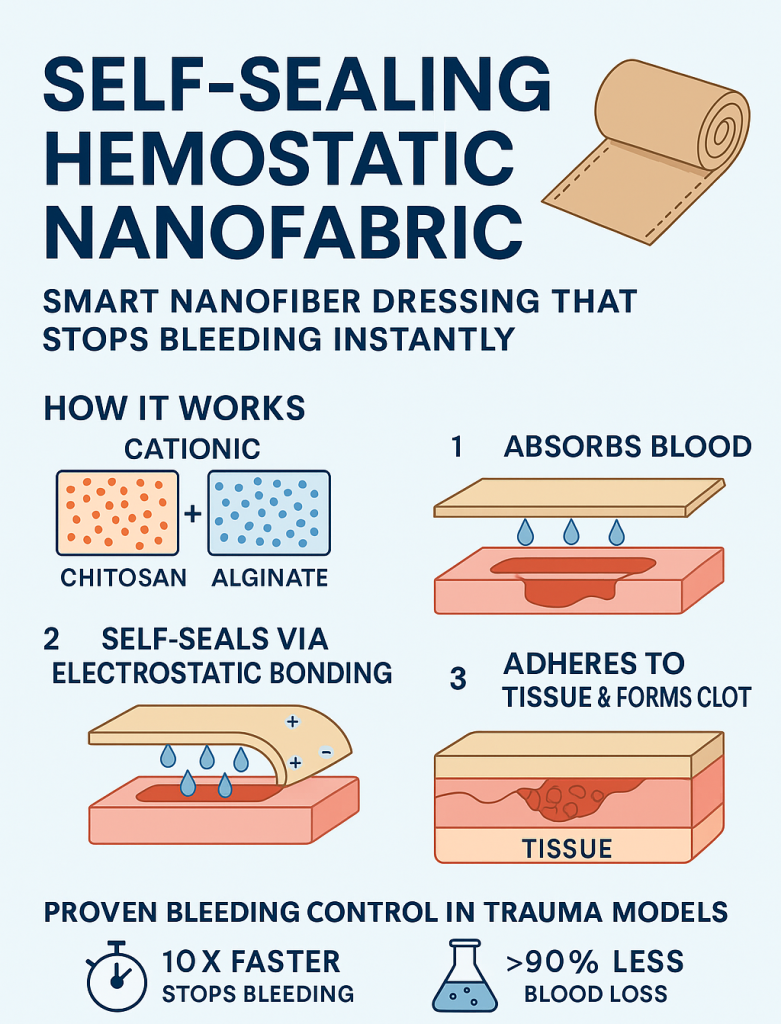
Unlike traditional gauze or even military-grade Combat Gauze™, this nanofabric stops blood flow nearly 10 times faster, reduces blood loss by over 90%, and biodegrades harmlessly in the body—eliminating the need for removal.
How It Works: Blood As the Trigger
The fabric is crafted from cationic and anionic nanofibers of chitosan and alginate, layered through coaxial electrospinning. When applied to a bleeding wound:
- It absorbs the blood plasma
- Electrostatic interactions cause the fibers to self-seal, transforming the fabric from porous to dense
- It adheres tightly to wet tissue, forming a watertight barrier even under arterial pressure
- Blood components are trapped and quickly form a strong thrombus (clot) inside the material
In essence, the fabric doesn’t just absorb blood—it uses blood to build a shield.
Proven in Real-Time Trauma Models
The nanofabric’s performance was tested in both rat and pig models simulating deep arterial wounds and liver lacerations. Compared to conventional gauze:
- Blood loss was reduced by 98.5%
- Bleeding time dropped from over 4 minutes to just 38 seconds
- In pig femoral artery injuries, only 2.9 g of blood loss occurred using the nanofabric, compared to 36.8 g with Combat Gauze™
This makes it potentially lifesaving for battlefield injuries, road accidents, or remote emergencies where professional medical care is delayed.
Bonus Benefits: Biodegradable, Antibacterial, and Non-Toxic
Made from natural polymers—chitosan, alginate, and PVA—the fabric breaks down safely in the body. It also:
- Prevents bacterial infections with over 90% antibacterial activity against E. coli and S. aureus
- Supports cell growth and wound healing
- Avoids the need for painful removal thanks to saline-triggered debonding
Even in long-term contact, it caused no skin irritation or toxicity, making it suitable for a wide range of civilian and military applications.
From Battlefield to ER—and Beyond
This self-sealing hemostatic nanofabric may soon replace outdated wound dressings in ambulances, operating rooms, and first aid kits worldwide. Its scalability, affordability, and simplicity make it a rare innovation that could drastically reduce preventable deaths from trauma and surgery.
“Every second counts in uncontrolled bleeding,” the authors wrote. “This nanofabric gives us back those seconds.”
Reference
Fang, Y., Wang, L., Zheng, X., Ni, P., Xu, Z., Wang, Z., … & Liu, H. (2025). Blood-triggered self-sealing and tissue adhesive hemostatic nanofabric. Nature Communications, 16(1), 1-19. https://doi.org/10.1038/s41467-025-60244-z


Related posts:
 World Economic Forum: Top 10 Emerging Technologies of 2023
 The Giant Bacterium: Ca. Epulopiscium viviparus
 Thiomargarita magnifica: The Bacteria Big Enough to be Visible by the Naked Eye
 Panama Wilt: Understanding and Managing the Banana Killer
 New Class of Antibiotics with a Novel Mode of Inhibition against World Health Organization’s Critical Listed Bacteria, Carbapenem-Resistant Acinetobacter baumannii