

Researchers have developed a next-generation fluorescence-based sensor system enhanced with deep learning algorithms that can detect trace amounts of nitro explosives such as TNT, RDX, and PETN. This hybrid approach allows for ultra-sensitive, rapid, and accurate identification of explosive materials in diverse environments.
Traditional explosive detection systems suffer from limited selectivity, high false positives, or the need for expensive, bulky equipment. This new method integrates machine learning-driven pattern recognition with optical emission data, creating a portable, real-time detection platform that works with unprecedented precision.
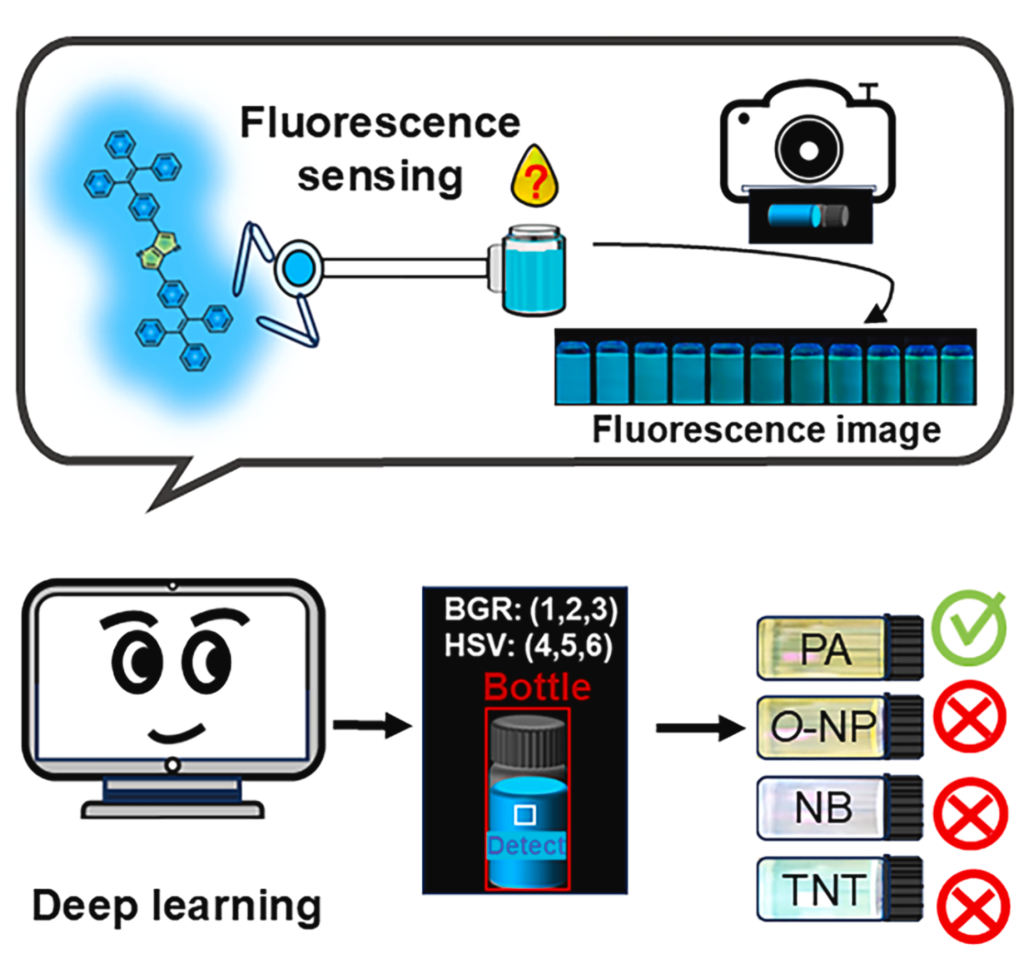
How It Works
- Sensor Array: A 2D fluorescent material array interacts with nitro explosive vapors.
- Optical Signatures: Different explosives alter fluorescence in unique ways.
- AI-Powered Analysis: A convolutional neural network (CNN) decodes subtle optical shifts to identify the explosive with 98%+ accuracy.
This sensor can distinguish among multiple types of explosives, even under environmental noise, dust, and humidity.
Key Benefits
- Detection time: Under 30 seconds
- Detection limit: As low as 10⁻⁹ g/mL
- Highly selective: Differentiates structurally similar explosives
- Low-cost, field-deployable device
- AI-enhanced performance: Adapts to new patterns and explosive types over time
Real-World Applications
- Airport and border security
- Forensic and crime scene analysis
- Military field operations
- Environmental remediation monitoring
Reference
Xiong, J., Zhang, J., Zheng, X., Hu, T., Xiang, H., Li, Y., … & Yang, R. (2025). Fluorescence sensing of nitro explosives based on deep learning. Cell Reports Physical Science. DOI: 10.1016/j.xcrp.2025.102690


Related posts:
 World Economic Forum: Top 10 Emerging Technologies of 2023
 The Giant Bacterium: Ca. Epulopiscium viviparus
 Thiomargarita magnifica: The Bacteria Big Enough to be Visible by the Naked Eye
 Panama Wilt: Understanding and Managing the Banana Killer
 New Class of Antibiotics with a Novel Mode of Inhibition against World Health Organization’s Critical Listed Bacteria, Carbapenem-Resistant Acinetobacter baumannii