
Imagine a world where woolly mammoths roam the Arctic again, their thick coats shielding them from the cold. While this might sound like science fiction, researchers have taken a major step toward making it a reality. In a groundbreaking study, scientists have successfully used CRISPR gene editing to modify mice, giving them woolly hair traits similar to those of the extinct woolly mammoth (Mammuthus primigenius).
This research, led by scientists from Colossal Biosciences, Harvard Medical School, and the Swedish Museum of Natural History, represents a milestone in de-extinction efforts—a process that aims to resurrect key traits of extinct species in their closest living relatives.
Why Mice? A Mammoth Problem with Elephant Biology
The closest living relative of the woolly mammoth is the Asian elephant (Elephas maximus), but conducting genetic experiments on elephants poses major challenges.
- Elephants have a long gestation period (22 months), making rapid testing impractical.
- They are endangered and highly intelligent, raising ethical concerns for experimentation.
Mice, on the other hand, have a short reproductive cycle and are well-established in genetic research, making them ideal for testing the effects of mammoth genes before moving to elephants.
The Science: Engineering Mice for Mammoth-Like Fur
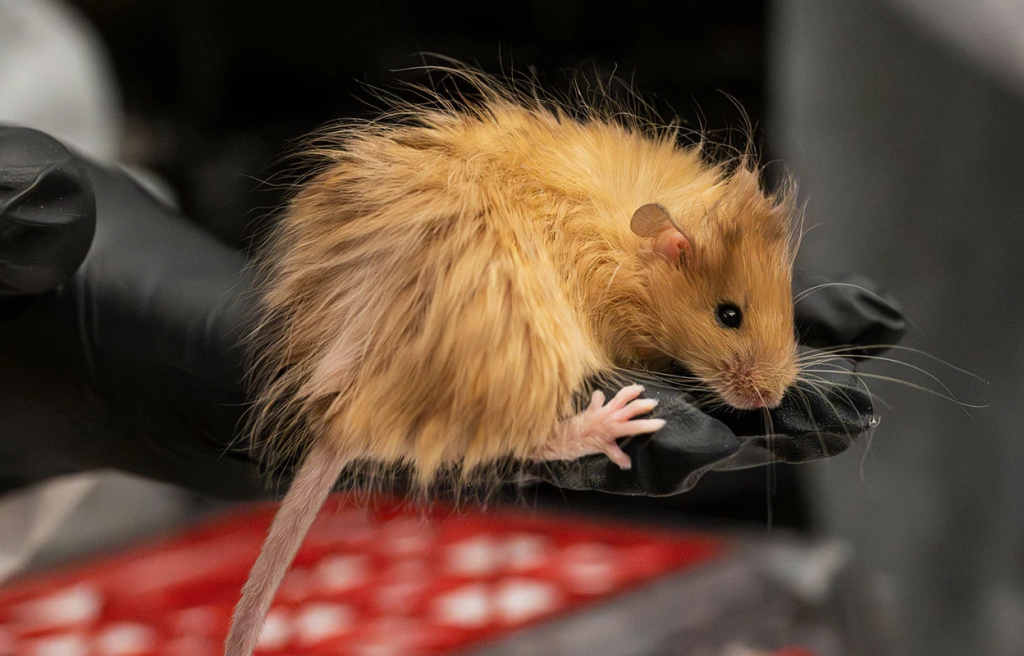
Using multiplex CRISPR gene editing, researchers simultaneously modified up to seven genes associated with hair growth, texture, and color in mammals. These genes were chosen based on comparisons between mammoth and elephant DNA, as well as studies on hair development in mice.
Key Genetic Modifications & Their Effects
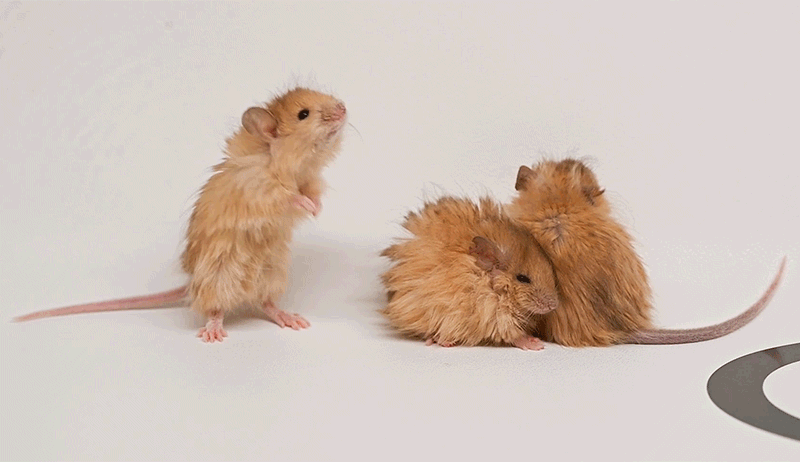
✅ Fgf5 Knockout → Led to longer hair, mimicking mammoth fur.
✅ Tgm3 Knockout → Created curly, textured hair, similar to the wavy undercoat of a mammoth.
✅ Fam83g Mutation → Produced a dense, woolly coat with a rough texture.
✅ Mc1r Mutation → Altered hair pigmentation, leading to a golden-brown coat—a color common in mammoth fossils.
✅ Fabp2 Mutation → A gene linked to fat metabolism, crucial for cold adaptation.
The resulting mice displayed thick, curly, and golden-brown coats, closely resembling the fur characteristics of woolly mammoths. This validates the role of these genes in mammoth hair development and provides insight into how these traits could be introduced into elephants.
What This Means for Mammoth De-Extinction
This study represents a crucial proof-of-concept for de-extinction efforts. If these genes successfully produced mammoth-like fur in mice, they could be introduced into Asian elephant embryos, bringing us one step closer to re-creating a cold-adapted elephant with mammoth traits.
However, hair isn’t the only challenge. To survive the Arctic, mammoths had thicker fat layers, different blood circulation patterns, and metabolic adaptations. Future research must test genes related to these traits before mammoth-like elephants can be engineered.
Beyond De-Extinction: Other Applications
While reviving mammoth traits is exciting, this research has broader implications:
🧬 Gene Therapy & Medicine: Understanding how hair genes work could help develop treatments for human hair loss and skin disorders.
🌍 Conservation & Climate Science: A woolly elephant could help restore Arctic ecosystems by preventing permafrost thawing—an idea known as the “Pleistocene Park” project.
🧪 Advanced Gene Editing: The ability to edit multiple genes at once in mammals could revolutionize genetic engineering for other species.
Final Thoughts: A Step Closer to a Woolly Future?
This study doesn’t mean mammoths will walk the Earth tomorrow, but it is a major leap forward in understanding how to engineer cold-adapted elephants. As gene editing technology advances, the dream of seeing mammoth-like creatures in Arctic landscapes may not be far from reality.
Would you visit a real-life Jurassic Park for mammoths? The science is getting closer every day.
References
Chen, R., Srirattana, K., Coquelin, M. L., Vilar Sampaio, R., Wilson, R., Ganji, R., … & Abrams, M. E. (2025). Multiplex-edited mice recapitulate woolly mammoth hair phenotypes. bioRxiv, 2025-03.


Related posts:
 New Class of Antibiotics with a Novel Mode of Inhibition against World Health Organization’s Critical Listed Bacteria, Carbapenem-Resistant Acinetobacter baumannii
 The Future of Meat Might Be Mold: Scientists Reprogram Edible Fungi to Taste Like Steak
 Plant Virus Turned Cancer Vaccine Could Revolutionize Ovarian Cancer Treatment
 Genetic Breakthrough: CRISPR-Cas9 Corrects Down Syndrome Cells with Precision DNA Cuts
 Turning Trash into Treatment: Engineered E. coli Converts Plastic Waste into Paracetamol Using a New Biocompatible Reaction


