A cell cycle is a sequence of events that results in the production of two new daughter cells through the process of cell growth and division. It can also be understood as the events that occur between the end of one nuclear division and the beginning of the next. New cells are produced in the body every day for growth and to replace damaged and worn-out ones. Some cells, such as blood, and skin cells, are continuously dividing, whereas other cells, like specialized muscle cells and certain nerve cells, may never divide at all. For cell division, a cell has to go through a series of precisely timed and carefully regulated stages of growth, DNA replication, and nuclear and cytoplasmic division that ultimately produce two identical cells.
1.1 Phases of Cell Cycle:
The entire cell cycle is divided into 4 phases or stages: G1, S, G2, and M phase . The G1 phase, S phase, and G2 phase together form an interphase. M stands for mitotic phase.

Figure 1: Different phases of Cell Cycle (Credit: https://theory.labster.com/cell-cycle)
- G1 phase: After completion of M phase of previous cell cycle, the daughter cell begins G1 phase of interphase of new cell cycle. This phase is also known as the resting phase since DNA synthesis does not occur during this phase. Here, synthesis of RNA proteins and membranes occur which leads to growth of nucleus and cytoplasm towards their mature size. Hence, this phase is also called the first growth phase.
The duration of the G1 phase is variable. It occupies 30 to 50 percent of the total time of the cell cycle.
- S phase: During the S phase or synthetic phase of interphase, DNA replication and histone protein synthesis occur. Identical pairs of DNA molecules are formed that are firmly attached to the centromeric region. Duplication of the centrosome also occurs during the S phase. The two centrosomes of homologous chromosomes give rise to the mitotic spindle, which directs the movement of chromosomes during mitosis. The S phase usually occupies roughly 35 to 45 percent of the cell cycle.
- G2 phase: This phase is called the second gap phase. In this phase, the synthesis of RNA and proteins continues. Some cell organelles are duplicated and the cytoskeleton is dismantled to provide resources for the mitotic phase. It may occupy about 10 to 20 percent of the cell cycle. The final preparations for the mitotic phase must be completed before the cell can enter the first stage of mitosis.
- M phase(Mitotic): The mitotic phase occurs in somatic cells. Its main function is to multiply the cell number when an individual grows from a zygote to an adult. It is essential for wound healing, and repairing wear and tear in cells.
During mitosis, the duplicated chromosomes are aligned, separated, and moved into two new identical daughter cells. The first portion of mitosis is karyokinesis (nuclear division) which is followed by cytokinesis (cytoplasmic division).1
Karyokinesis is divided into the following stages:
- Prophase: The nuclear envelope starts to dissociate into a small vesicle. Golgi complex, Endoplasmic reticulum fragments and disperses around the cytoplasm. Nucleolus disappears. Centrosomes begin to move towards the opposite poles of the cell. Microtubules extend between the centrosomes, pushing them far apart as the microtubule fiber lengthens. Sister chromatids coil around more tightly.
- Prometaphase: Processes of prophase continues forward. The nuclear envelope breaks down further. The mitotic spindle contains and begins to align the chromosomes at the metaphase plate. Each sister chromatid develops a protein structure called a kinetochore in its centromeric region. Kinetochores act as a cap that prevents the plus end of microtubules from depolymerizing. Sister chromatids become attached by their kinetochores to the opposite poles. Balanced bipolar forces hold the chromosomes on the metaphase plate.2
- Metaphase: All the chromosomes are aligned in a plane called the metaphase plate. It lies roughly midway between the two poles of the cell. The sister chromatids are still tightly attached by cohesion proteins. Chromosomes are highly condensed.
- Anaphase: Cohesion proteins degrade the sister chromatids and separate them at the centromere. Each chromatid is rapidly pulled toward the centrosome around which its microtubule is attached. The cell becomes visibly elongated during this stage.
- Telophase: Chromosomes reach the opposite poles and begin to decondense creating a stretched-out chromatin configuration. The mitotic spindles are depolymerized into tubulin monomers that will be used to assemble cytoskeletal components for each daughter cell. A nuclear envelope appears around the chromosomes.
Cytokinesis: The cell divides forming two daughter cells by complete physical division of cytoplasmic components between them. Initially, a cleavage or furrow appears at the site of separation which eventually enlarges and cleaves the cell into two. The mitotic spindle determines where and when the cleavage occurs.
In animal cells, cytokinesis initiates in late anaphase. A contractile ring composed of actin filament forms inside the plasma membrane. The filaments pull the equator of the cell inwards creating a fissure. The fissure deepens as the actin ring contacts and eventually the membrane is cleaved into two.
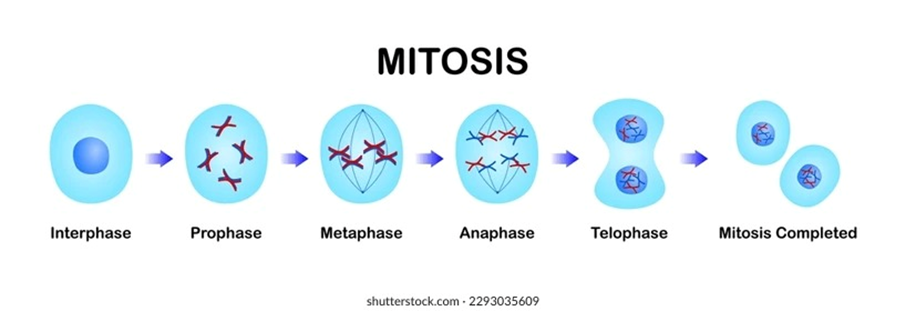
Figure 2: Different Stages of Mitosis cell division (Credit: https://www.shutterstock.com/search/mitotic-cell-cycle)
1.2 Regulation of Cell Cycle:
The cell cycle is controlled by mechanisms that are both internal and external to the cell.
- External Factor: Certain external factors may cause inhibition or the initiation of the cell cycle. Some of them may be the death of nearby cells, or release of hormones, or overcrowding of the cells. The size of the cell may also enhance cell division. For instance, if the cell grows, it becomes less efficient due to decreasing surface-to-volume ratio. Hence, cell division initiates.
- Internal checkpoints: To prevent compromised cells from continuing to divide certain internal control mechanisms come into action. There are 3 main cell cycle checkpoints. The checkpoints ensure that the cell cycle is halted until conditions are favorable. They occur near the end of G1, at the G2/M transition, and during metaphase.
Proteins like cyclins and cyclin-dependant kinases(Cdks) are responsible for the progress of the cell through various checkpoints. Cyclins regulate the cell cycle only when they are bound to Cdks. Cdks phosphorylate other proteins and activate them by changing their shape. Different cyclins and Cdks bind at specific points in the cell cycle and regulate different checkpoints since without a specific concentration of fully activated cyclin, and Cdk complexes, the cell cycle cannot proceed.2
1.3. Significance of Cell cycle:
- Dividing cells helps in the reproduction, growth, and replacement of dead cells. It also helps in wound healing.
- Normal and proportionate growth of organisms can only be achieved by properly controlled and regulated cell cycle.
- Interphase acts as a preparatory phase, allowing time for the synthesis and growth of dividing cells.
- It is essential for maintaining genetic stability during cell division.
- Uncontrolled cell growth may cause various forms of cancer.
1.4. Role in Cancer Biology:
Despite the redundancy and overlapping levels of cell cycle control, errors do occur. A small percentage of replication errors will be passed on to the next cells. When changes to DNA nucleotide sequence occur within a coding portion of a gene and are not corrected, gene mutation occurs. Cancer generally starts when a gene mutation gives rise to a faulty protein that plays a key role in cell reproduction. Negative protein repressors like Rb, P53, and P21 halt the cell cycle until certain events are completed. If a mutation occurs in those negative regulators, it might not be able to halt the cell cycle where certain errors occur. Mutated P53 genes are identified in more than 50% of human tumor cells.2 Hence, proper regulation and functioning of the cell cycle is of fundamental biological importance.
References:
- Dr. P.S. Verma, Dr. C.K. Agrawal. Cell Biology, Genetics, Molecular Biology, Evolution and Ecology. fourteenth. (Bharatnagar S, Pradhan S, eds.). S.CHAND & COMPANY PVT.LTD.; 2016.
- Clark MA, Choi J, Douglas M. Biology 2e. Second. The Rice University Press; 2020.
Related Articles: