Genes that are responsible for different characters may either be situated in the same chromosome or in a different one. When the genes are situated in different chromosomes, they assort independently according to Mendel’s law of independent assortment. The characters controlled by those genes appear together or apart in the next generation. It depends upon the chance alone. However, if the genes are situated in the same chromosome and are present fairly close, they tend to be inherited together. Thus, linkage is defined as the tendency of two or more genes to stay together during inheritance.1 Linkage is an exception to Mendel’s law of independent assortment.
1.1. History
Hypothesis of linked gene was advanced by T.H. Morgan in 1911. Some other scientists such as Morgan, W. Sutton and T. Boveri (1902), Sutton (1903) and Bateson and Punnet (1906) had given certain hints regarding the phenomena of linkage. However, Mendel himself could not detect the linkage phenomenon in his pea plant experiments
In 1910, Morgan demonstrated that the peculiar inheritance pattern of white- eye (w) gene of Drosophila can be easily explained by assuming that w is located in X chromosome (Sex-linkage). He proposed the following additional conclusions through his study:
- Genes are arranged in linear fashion in the chromosomes
- Intensity of linkage between the two genes is inversely related to the distance between them in the chromosomes.
- Coupling and repulsion phases are two aspects of the same phenomenon i.e. linkage.2
Later, Morgan along with Castle formulated the widely popular ‘chromosome theory of linkage’ which is summarized below:
- Those genes which show the phenomenon of linkage are situated in the same chromosome. These linked genes remain bounded together by the chromosomal material due to which they cannot be separated during the process of inheritance.
- The strength of linkage is determined by the distance between the linked genes.
1.2. Types of linkage

By their study on Drosophila, T.H. Morgan and his co-workers have discovered two types of linkage i.e. complete linkage and incomplete linkage. The phenomenon in which parental combinations of characters appear together for two or more generations in a continuous and regular pattern is known as complete linkage. Here, the genes remain closely associated together and they generally transmit together. For instance, the genes responsible for bent wings (bt) and shaven bristles (svn) of the fourth chromosome mutant of the drosophila show complete linkage.
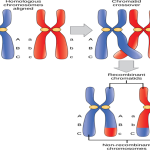
However, the linked genes do not always stay together. It is because homologous pair of non-sister chromatid may exchange segment of varying lengths with one another during meiotic prophase i.e. crossing over. The linked genes which are widely located on the chromosomes (i.e. greater distance between two genes) and contain chances of separation by crossing over are called incompletely linked genes. “Crossing over is a process that produces new combinations of genes by interchanging of corresponding segments between non-sister chromatids of homologous chromosome.” 1The phenomenon of inheritance of incompletely linked gene is called incomplete linkage. Incomplete linkage can be observed more prominently in female Drosophila.
Depending on whether all dominant or some dominant and some recessive genes are linked together, linkage can be divided into two types i.e. Coupling phase linkage and Repulsion phase linkage. Dominant alleles of the linked genes are present on the same chromosome in coupling phase linkage. The dominant alleles of some genes are present with recessive alleles of other genes in the same chromosome in repulsion phase linkage.1
1.3. Representation of linked genes
Linkage between two or more genes is denoted by adopting the following system: the genes present in one chromosome are written together and are separated from those present in the homologous chromosome by an oblique line (/). For example, C Sh/c sh or C sh/c Sh. (Here, genotype C represents colour of seed and Sh represents fullness or shrunken type of seed.)
1.4. Linkage groups and linkage maps
Genes which are linked together form a linkage group. Genes of a linkage group are generally represented on a single straight line in the same order in which they are present in the chromosome. In such representations, the distance between two neighbouring genes is directly proportional to the frequency of recombination (%) between them. Such a line which represents the linked genes and the recombination frequencies between them are called linkage map. It may also be referred to as the genetic map or chromosome map.2 Thus, linkage maps provide information about the genes that are linked together and the frequencies of the recombination which may be present between them.

1.5. Significance of linkage
- The possibility of variability in gametes is reduced unless crossing over occurs.
- Linkage is useful for preserving desirable traits in plants and animal livestock.
- It helps to keep parental, racial and specific traits together.
- It plays an important role in determining the nature and scope of hybridization.
- It helps to predict and understand inheritance pattern.
- It helps in the creation of genetic maps and identification of disease- causing genes.
1.6. Linked genes in human
There are several well-known examples of linked genes present in human. For instance, genes responsible for colour blindness and haemophilia lie close together on the X chromosome, so males (who inherit only X chromosome) often inherit both of these traits together. Similar case scenario can be observed in genes for Duchenne Muscular Dystrophy and Colour blindness. BRCA1 (breast cancer susceptibility gene 1) is also often linked with NBR1 gene. Their close association is used to better understand cancer susceptibility.
REFERENCES:
- Dr. P.S. Verma, Dr. C.K. Agrawal. Cell Biology, Genetics, Molecular Biology, Evolution and Ecology. fourteenth. (Bharatnagar S, Pradhan S, eds.). S.CHAND & COMPANY PVT.LTD.; 2016.
- B.D. Singh. Genetics. Second. Kalyani Publishers; 2018.