The 1906 Nobel Prize cohort marks a pivotal moment in modern scientific and political history. At the turn of the twentieth century, the Nobel Foundation’s recognitions captured a pivotal moment of institutional and conceptual transformation across the physical sciences, neurobiology, classical scholarship, and statecraft. By honoring achievements that dismantled long-standing scientific paradigms and redefined global diplomacy, the 1906 awards illustrated the increasingly complex institutional infrastructure required to advance human knowledge and international order.
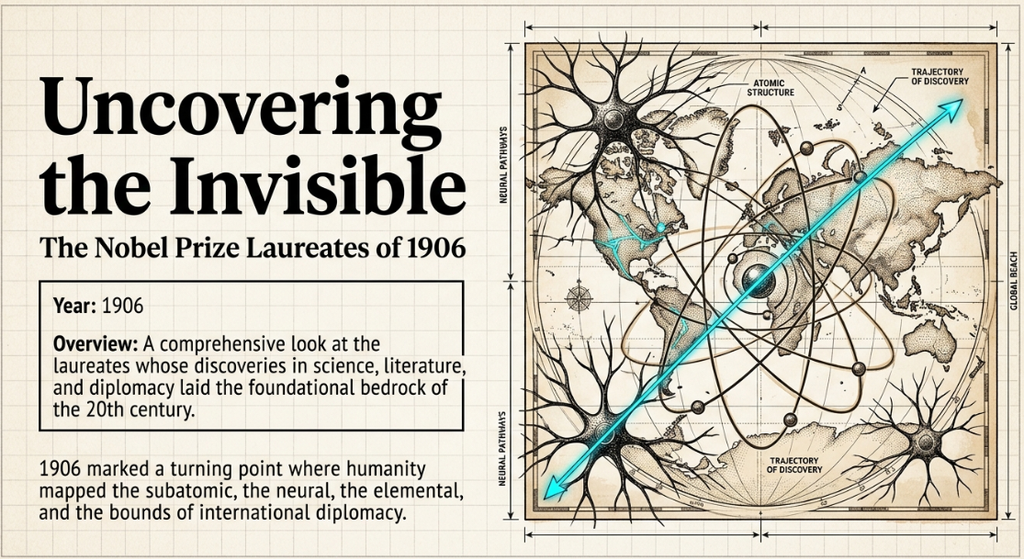
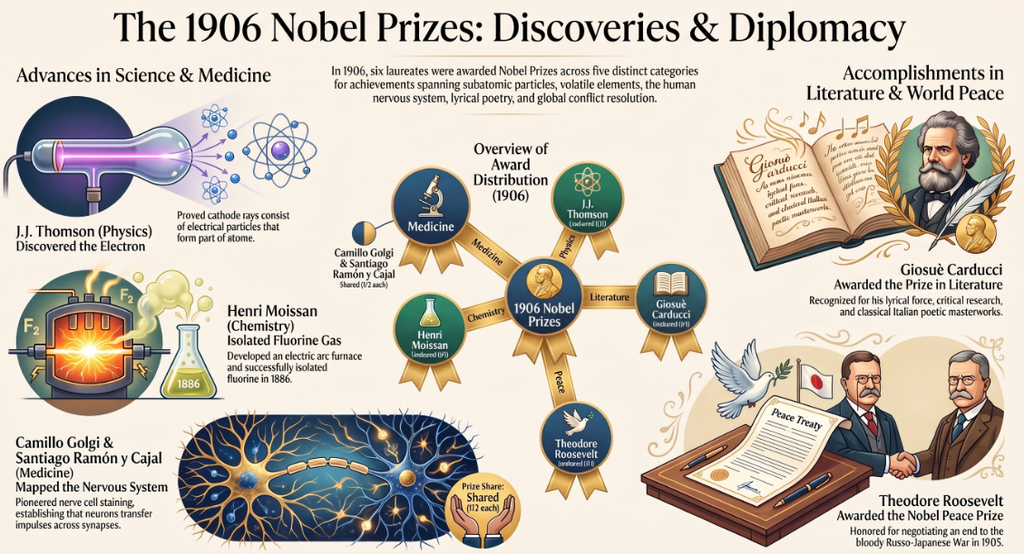
1906 Nobel Prize Summary
- 1906
- Joseph John Thomson (Physics): For his theoretical and experimental investigations on the conduction of electricity by gases, leading to the discovery that cathode rays consist of electrons which form part of atoms.
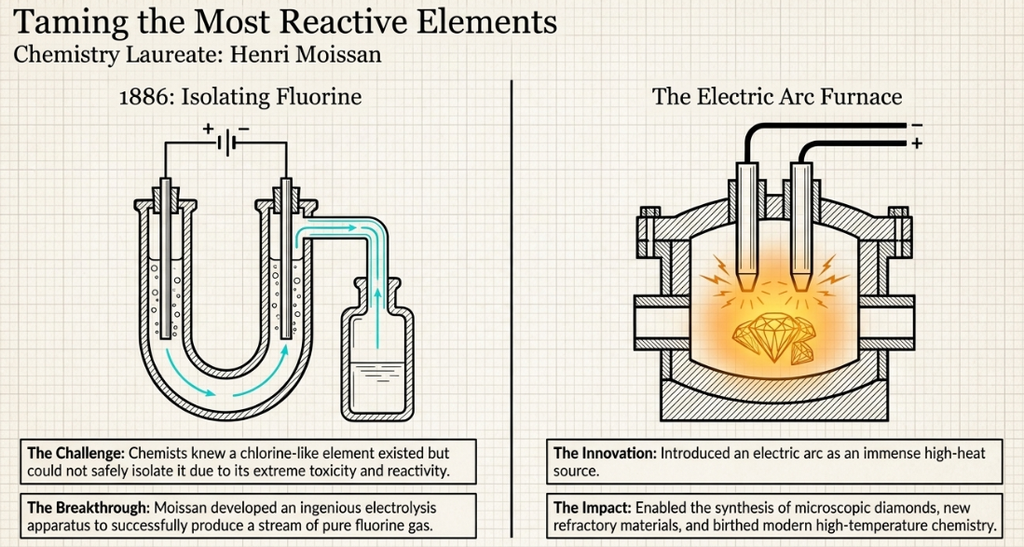
- Henri Moissan (Chemistry): For his investigation and isolation of the element fluorine, and for the development and application of the electric arc furnace in scientific research.
- Camillo Golgi and Santiago Ramón y Cajal (Physiology or Medicine): For their joint, foundational work on the structural organization of the nervous system.
- Giosuè Carducci (Literature): For his deep learning, critical research, creative energy, freshness of style, and lyrical force in his poetic masterpieces.
- Theodore Roosevelt (Peace): For his role as a peace arbitrator in negotiating an end to the Russo-Japanese War and resolving disputes with Mexico through international arbitration.
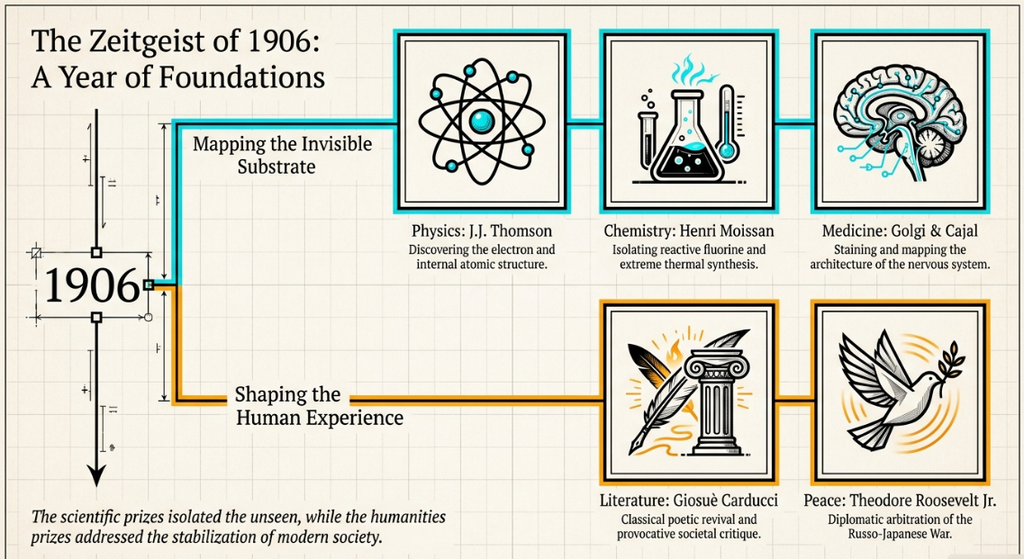
Having established this structural baseline, a domain-specific evaluation demonstrates how empirical discoveries in physics, chemistry, and physiology fundamentally reconfigured early twentieth-century scientific paradigms at the subatomic, molecular, and cellular levels.
2. Physical and Life Sciences: Discoveries and Scientific Debates
The 1906 scientific awards celebrated major breakthroughs that forced a total re-examination of physical matter and biological organization. These laureates provided the empirical methodologies necessary to probe subatomic particles, manipulate extreme chemical environments, and map the cellular architecture of the central nervous system.
Physics and Chemistry Innovations
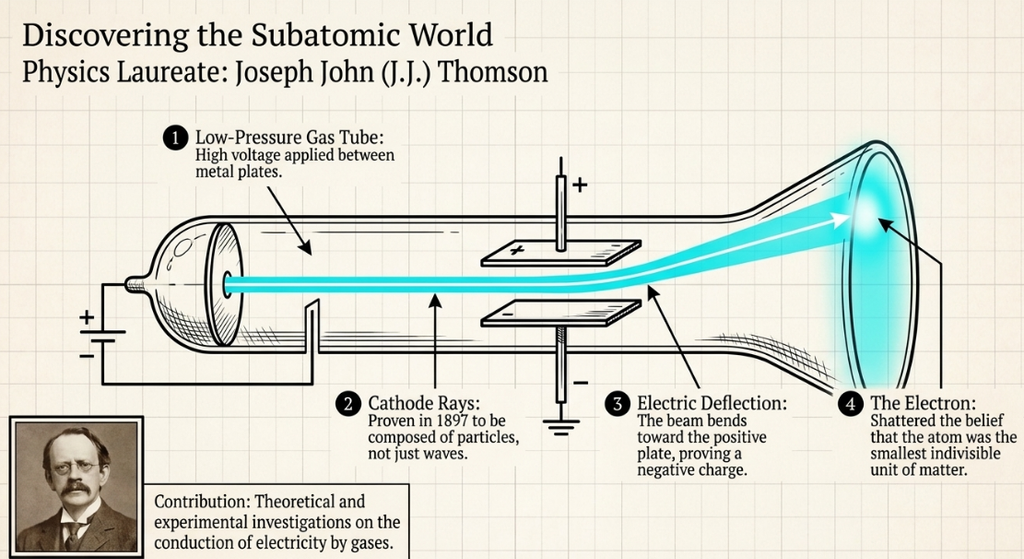
In Physics, Joseph John Thomson was awarded the un-split Nobel Prize for his seminal theoretical and experimental investigations into the conduction of electricity through gases. The conceptual origin of an elementary unit of electric charge bound to matter traces back to the 1830s. However, during the 1890s, Thomson executed a sequence of experiments measuring charged particle deflection within low-pressure gases to estimate the physical magnitude of these charge carriers. In 1897, Thomson decisively demonstrated that cathode rays—the radiation generated when high voltage is applied across metal plates inside an evacuated glass tube—consisted of discrete, negatively charged subatomic particles, termed electrons. By establishing that electrons are universal constituents of all elements, Thomson breached the boundary of atomic indivisibility and laid the experimental bedrock for subatomic physics.
In Chemistry, Henri Moissan received sole recognition for twin achievements in elemental isolation and high-temperature research methodology. Throughout the nineteenth century, analytical investigations of various mineral salts led chemists to hypothesize the existence of a highly reactive halogen element structurally analogous to chlorine and iodine. However, its extreme reactivity prevented its isolation until 1886, when Moissan designed a specialized platinum-based apparatus that isolated a continuous stream of pure fluorine gas. Complementing this synthetic breakthrough, Moissan engineered an innovative electric furnace powered by an electric arc heat source. This technical innovation enabled researchers to achieve previously unattainable thermal states, allowing Moissan to synthesize microscopic diamonds and produce novel inorganic compounds that expanded the horizons of synthetic chemistry.
Physiology or Medicine: The Structural Paradox of the Nervous System
The joint award of the 1906 Nobel Prize in Physiology or Medicine to Italian pathologist Camillo Golgi and Spanish histologist Santiago Ramón y Cajal represents a classic case study in the history of science: a foundational empirical methodology turned directly against its creator’s theoretical paradigm by a rival utilizing the exact same physical evidence.
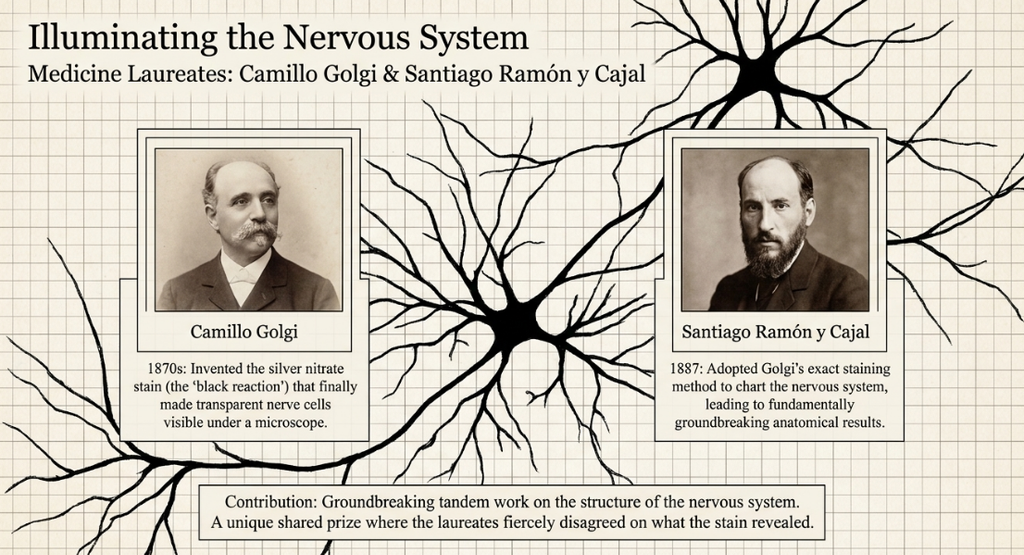
Both investigators depended on the revolutionary histological technique developed by Golgi in the 1870s, which utilized silver nitrate to stain neural tissue, rendering intricate cell structures visible under optical microscopy for the first time. Ramón y Cajal adopted Golgi’s silver nitrate staining methodology in 1887, initiating years of systematic comparative investigations across embryological and adult neural tissues. However, their empirical findings produced irreconcilable interpretations of neural architecture:
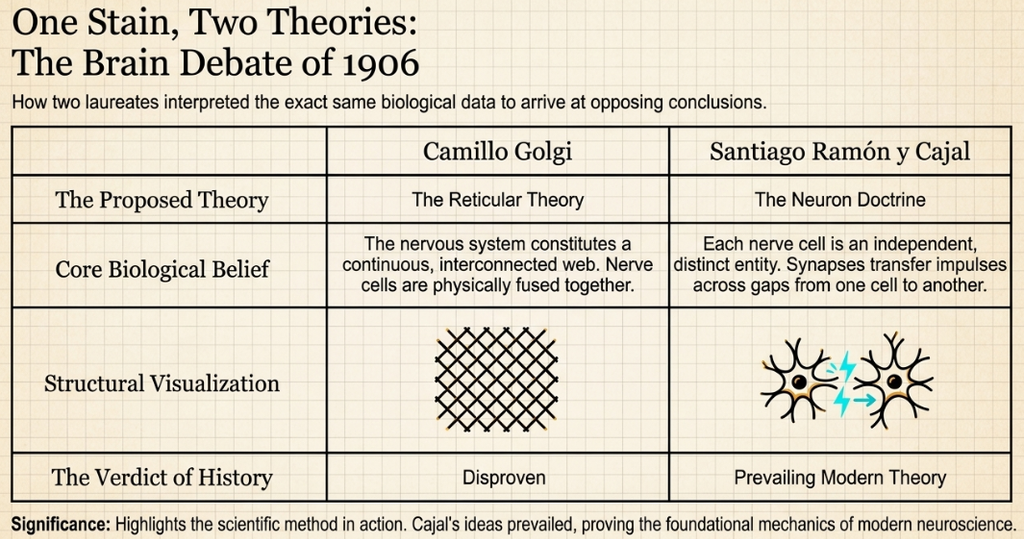
- Golgi’s Reticular Theory: Golgi argued that the central nervous system formed a continuous, interconnected reticular network—a diffuse syncytium of continuous pathways functioning as a holistic meshwork.
- Ramón y Cajal’s Neuron Doctrine: Ramón y Cajal demonstrated that nerve cells are structurally independent cellular units. He established that neurons communicate across specialized functional junctions termed synapses, transferring impulses from one autonomous cell to another without physical protoplasmic continuity.
Because rigorous histological verification consistently confirmed cellular individuality rather than continuous syncytial fusion, Ramón y Cajal’s neuron doctrine prevailed over Golgi’s reticular model, establishing the foundational paradigm of modern neuroscience.
Transitioning from empirical laboratory discoveries to broader socio-political spheres, the remaining 1906 awards recognized major contributions to classical literature and international executive diplomacy.
3. Cultural and Political Impact: Literature and Global Peace
The 1906 Nobel Prizes for Literature and Peace reflected the complex geopolitical dynamics, academic classicism, and ideological polarization of the early twentieth century. These selections illustrated how the Nobel institutional framework evaluated literary scholarship, anti-clerical commentary, and international realpolitik during an era of global diplomatic realignment.
Literature: Academic Rigor and Lyrical Force
Giosuè Carducci, selected as the sole Literature laureate for 1906, established his career at the intersection of rigorous classical philology and active public life. Born in Valdicastello, Tuscany, Carducci completed his higher education at the prestigious Scuola Normale Superiore di Pisa before entering academia. In 1860, he was appointed Chair of Italian Literature at the University of Bologna, an influential academic position he held for over four decades. A popular lecturer, literary critic, and public intellectual, Carducci was appointed to the Italian Senate in 1890 in recognition of his civic and cultural standing.
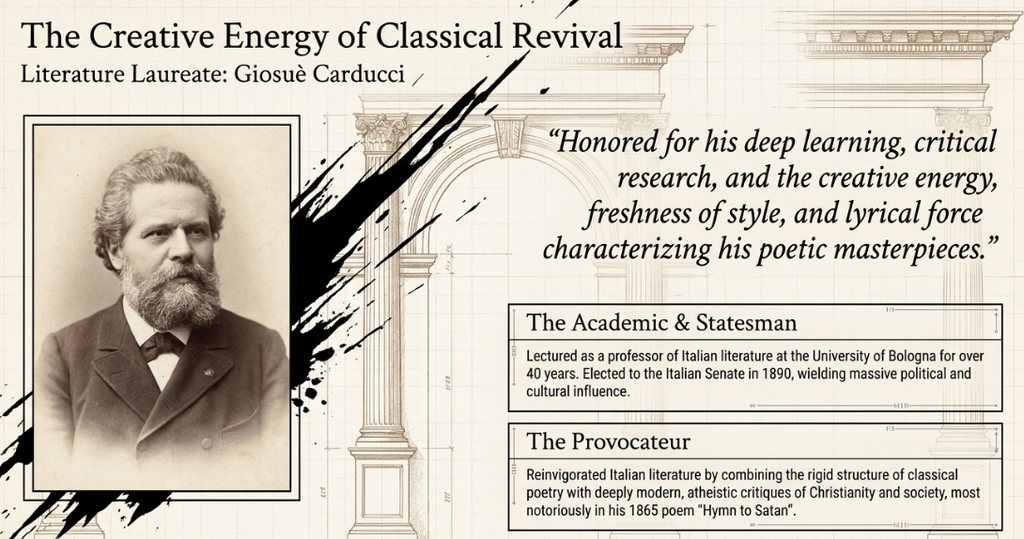
The Nobel Committee praised Carducci “not only in consideration of his deep learning and critical research, but above all as a tribute to the creative energy, freshness of style, and lyrical force which characterize his poetic masterpieces.” Drawing inspiration from classical Latin and Italian poetic forms as well as contemporary sociopolitical developments, Carducci published his debut collection, Rime, in 1857. An unyielding atheist, Carducci directed sharp polemics against religious orthodoxy, an intellectual stance epitomized by his provocative 1865 poem “Hymn to Satan” (Inno a Satana). Carducci’s synthesis of classical erudition and rebellious lyrical force established him as the preeminent national poet of post-Risorgimento Italy.
Global Peace: Diplomacy, Arbitration, and Public Controversy
The award of the 1906 Nobel Peace Prize to Theodore Roosevelt, President of the United States, marked the first time a sitting head of state received the honor, generating political debates over the geopolitical function of the award. Roosevelt was commended for his diplomatic intervention in mediating the Treaty of Portsmouth, which concluded the Russo-Japanese War (1904–1905). Furthermore, Roosevelt applied international arbitration mechanisms—long advocated by the 19th-century peace movement—to resolve a longstanding diplomatic dispute between the United States and Mexico.
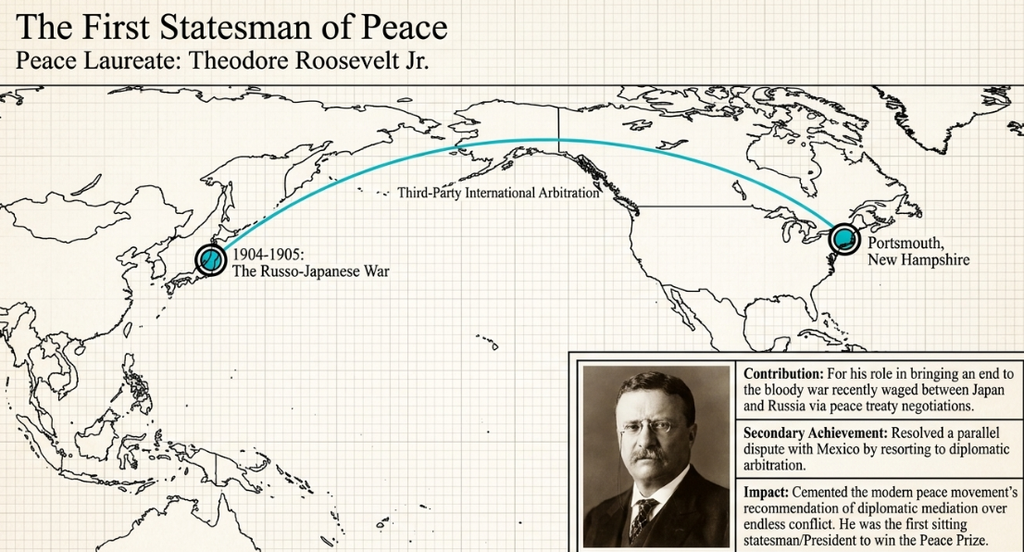
Roosevelt’s selection as a military leader and executive statesman triggered intense controversy, splitting along distinct regional and ideological fault lines:
- Critique from the Norwegian Left: Domestic political factions in Norway denounced Roosevelt as a “military mad” imperialist, pointing to his command role in the Spanish-American War and the subsequent American conquest and pacification of the Philippines.
- Swedish Press Reactions: Major Swedish publications asserted that Alfred Nobel was “turning in his grave.” Commentators framed the decision by the Norwegian Nobel Committee as political pandering designed to court powerful foreign allies immediately following Norway’s unilateral dissolution of its union with Sweden in 1905.
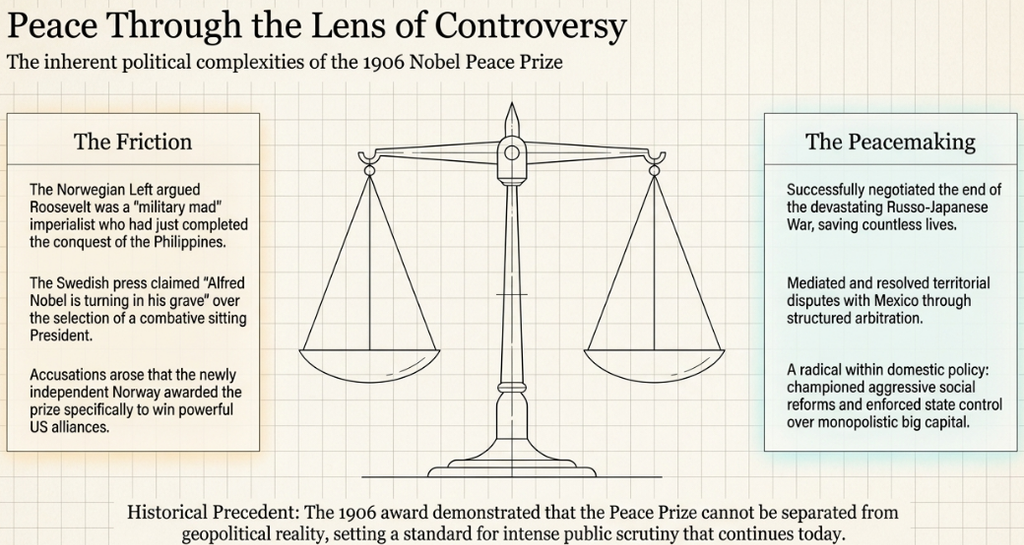
In American domestic politics, Roosevelt positioned himself as a progressive reformer within the Republican Party, advocating state control over corporate capital and social policy reform. Following the conclusion of his presidency in 1908, Roosevelt pursued active military service during World War I—a request rejected by the Wilson administration—and ultimately opposed United States entry into the League of Nations in 1919.
To evaluate these scientific, literary, and diplomatic achievements within a unified structural framework, the following section synthesizes institutional, geographic, and award metrics across the entire 1906 cohort.
4. Comparative Framework and Institutional Analysis
A comparative synthesis of the 1906 laureates exposes key patterns regarding the institutional geography of knowledge production and state administration at the start of the twentieth century. The dataset highlights the central role of state-funded European universities and executive offices in supporting groundbreaking research and international mediation.
Comparative Framework: 1906 Nobel Laureates
| Laureate Name | Prize Category | Affiliation / Location | Prize Share | Core Scientific/Cultural Breakthrough |
|---|---|---|---|---|
| Joseph John Thomson | Physics | University of Cambridge, Cambridge, United Kingdom | 1/1 | Demonstrated that cathode rays consist of subatomic particles (electrons) through gas conduction experiments, establishing the subatomic structure of atoms. |
| Henri Moissan | Chemistry | Sorbonne University, Paris, France | 1/1 | Isolated pure fluorine gas via a specialized platinum apparatus; engineered the electric arc furnace to synthesize microscopic diamonds and novel materials. |
| Camillo Golgi | Physiology or Medicine | Pavia University, Pavia, Italy | 1/2 | Discovered the silver nitrate staining methodology for neural tissue; formulated the reticular theory of a continuous syncytial neural network. |
| Santiago Ramón y Cajal | Physiology or Medicine | Madrid University, Madrid, Spain | 1/2 | Employed silver nitrate staining to demonstrate cellular individuality in the nervous system, establishing the neuron doctrine and synaptic transmission. |
| Giosuè Carducci | Literature | University of Bologna / Residence: Italy | 1/1 | Produced scholarly and poetic masterpieces (Rime, “Hymn to Satan”) marked by classical erudition, anti-clerical critique, and lyrical force. |
| Theodore Roosevelt | Peace | President of the United States / Residence: USA | 1/1 | Arbitrated the end of the Russo-Japanese War (1904–1905) and resolved international diplomatic disputes with Mexico using legal arbitration. |
Historiographical Synthesis and Institutional Allocation
Analyzing the allocation patterns and institutional bases of the 1906 cohort reveals significant structural characteristics regarding early twentieth-century intellectual infrastructure:
- Distribution of Award Shares: Four of the five Nobel categories—Physics, Chemistry, Literature, and Peace—were conferred as un-split, full prizes (1/1 share) to individual figures. Physiology or Medicine stood as the sole split award (1/2 share each), reflecting a shared histological methodology (silver nitrate staining) leveraged to construct two diametrically opposed structural models of the central nervous system.
- Institutional Base: The scientific and literary prizes were dominated by historic European academic institutions, including the University of Cambridge, Sorbonne University, Pavia University, Madrid University, and the University of Bologna. In contrast, the Peace Prize represented an institutional departure, bestowing recognition upon the executive head of state of an emerging non-European power.
Paradigm Transformations Across Disciplines: Historiographically, the 1906 Nobel Prize roster captures a simultaneous paradigm shift across human knowledge:
- Physics breached the indivisible atom, entering the subatomic realm through Thomson’s discovery of the electron.
- Chemistry mastered extreme thermal states and isolated previously uncapturable elemental substances through Moissan’s electric arc furnace and custom apparatus.
- Biology settled the debate over the structural basis of life’s complex command systems, establishing the cellular individuality of the neuron through Ramón y Cajal’s empirical validation over Golgi’s reticular model.
- Diplomacy marked a transition toward executive state-led legal arbitration and diplomatic mediation in international conflicts through Roosevelt’s intervention in the Russo-Japanese War.
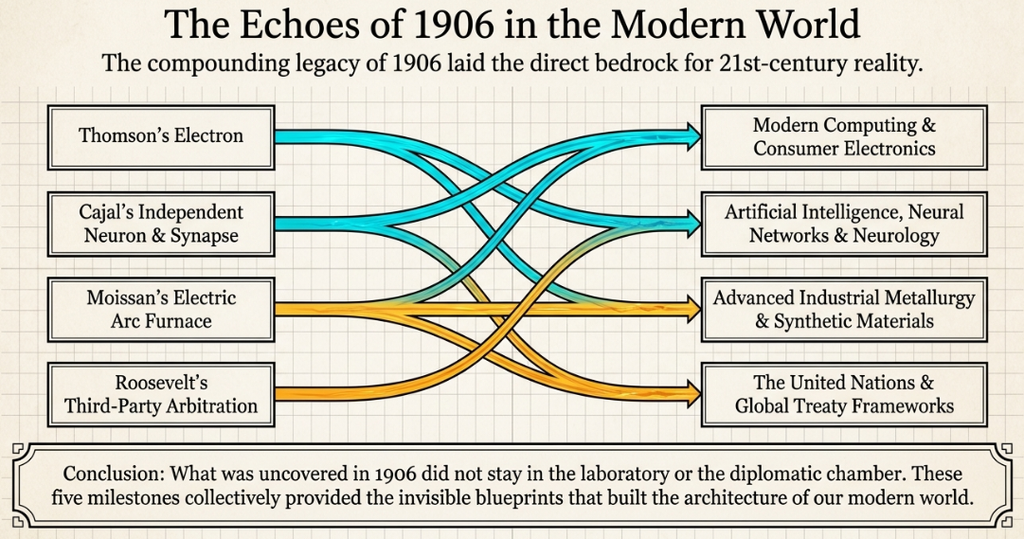
Collectively, the 1906 Nobel laureates personified an era wherein empirical precision, institutional rigor, and international statecraft coalesced to define the trajectories of modern science, literature, and global governance.
Reference
https://www.nobelprize.org/prizes/lists/all-nobel-prizes/1909-1901