1. Strategic Overview of the Early Nobel Era
The dawn of the twentieth century necessitated a rigorous codification of intellectual achievement to foster international standards in science, literature, and diplomacy. The establishment of the Nobel Prizes provided this essential framework, transforming individual breakthroughs into universal benchmarks for the “greatest benefit to mankind.” Central to this infrastructure is the Nobel Foundation, a body strictly tasked with the managerial stewardship of Alfred Nobel’s fortune and the fulfillment of his testamentary mandates. While the Foundation ensures the financial and legal integrity of the legacy, the prize-awarding institutions operate with absolute academic autonomy, exercising their responsibility to identify the pioneers of human progress. The 1903 cycle serves as a definitive case study in this mission, capturing a transformative epoch where researchers interrogated the fundamental constitution of matter and activists sought to formalize global peace.
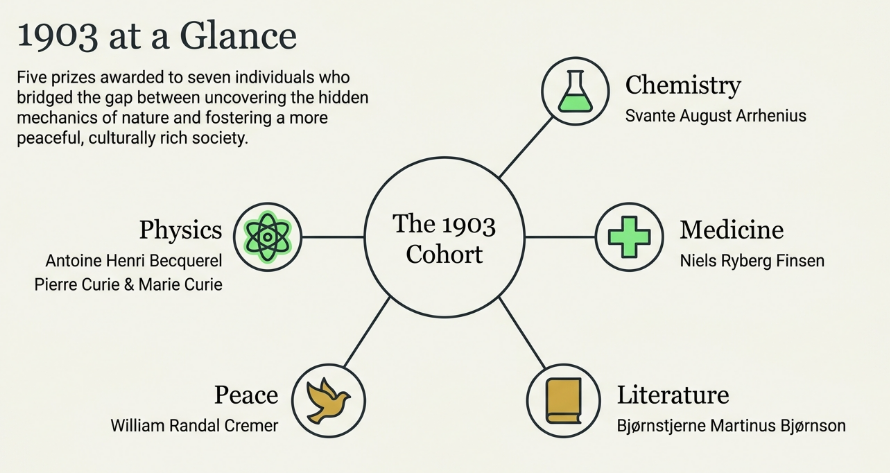
2. 1903: Pioneering Achievements in Physics, Chemistry, and Medicine
The year 1903 represented a profound strategic shift in the scientific consciousness. Researchers moved beyond the macroscopic observations of the Victorian era to scrutinize subatomic phenomena and the specific biological interactions of light. This period solidified the transition toward identifying internal mechanisms of energy and specialized therapeutic radiation, establishing the foundational knowledge of the modern age.
Scientific Laureates of 1903
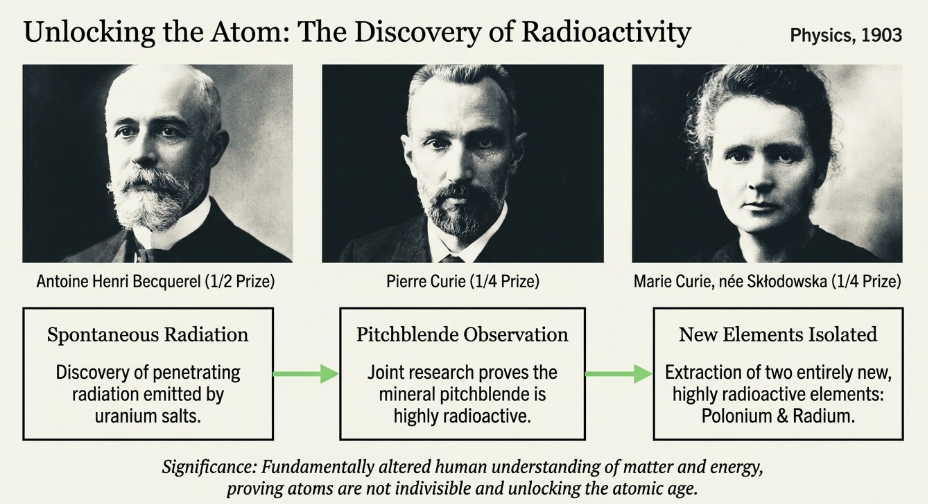
- Antoine Henri Becquerel
- Birth/Death: 15 December 1852 – 25 August 1908
- Affiliation: École Polytechnique, Paris, France
- Prize Motivation: “in recognition of the extraordinary services he has rendered by his discovery of spontaneous radioactivity”
- Pierre Curie
- Birth/Death: 15 May 1859 – 19 April 1906
- Affiliation: École municipale de physique et de chimie industrielles, Paris, France
- Prize Motivation: “in recognition of the extraordinary services they have rendered by their joint researches on the radiation phenomena discovered by Professor Henri Becquerel”
- Marie Curie (née Skłodowska)
- Birth/Death: 7 November 1867 – 4 July 1934
- Affiliation: École municipale de physique et de chimie industrielles, Paris, France (Collaborator and joint researcher with Pierre Curie)
- Prize Motivation: “in recognition of the extraordinary services they have rendered by their joint researches on the radiation phenomena discovered by Professor Henri Becquerel”
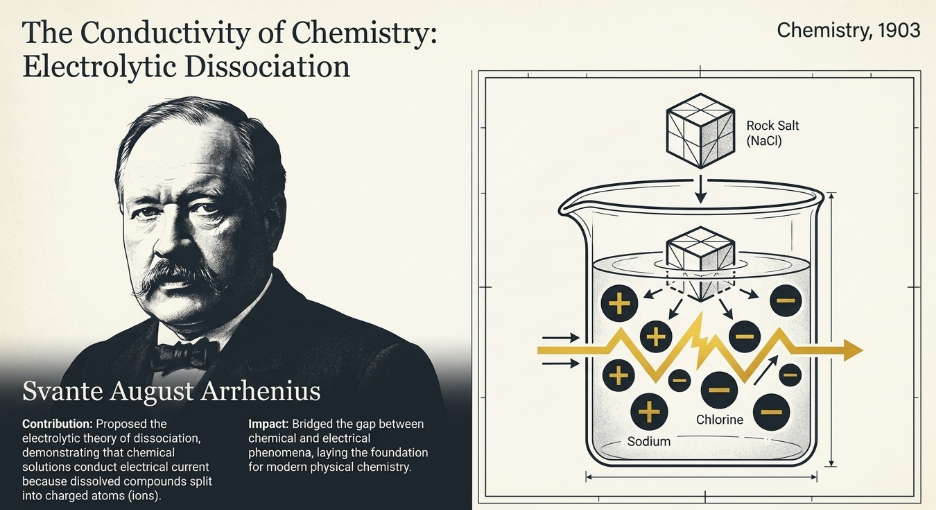
- Svante August Arrhenius
- Birth/Death: 19 February 1859 – 2 October 1927
- Affiliation: Stockholm University, Stockholm, Sweden
- Prize Motivation: “in recognition of the extraordinary services he has rendered to the advancement of chemistry by his electrolytic theory of dissociation”
- Niels Ryberg Finsen
- Birth/Death: 15 December 1860 – 24 September 1904
- Affiliation: Finsen Medical Light Institute, Copenhagen, Denmark
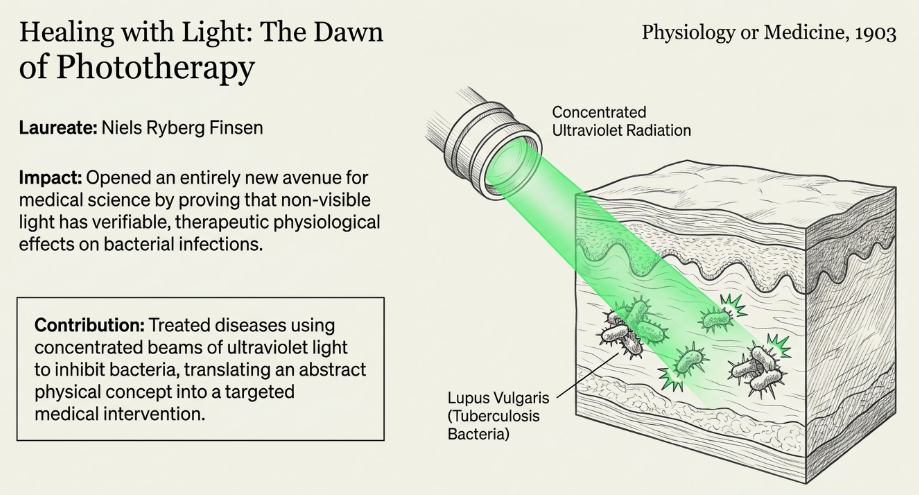
- Prize Motivation: “in recognition of his contribution to the treatment of diseases, especially lupus vulgaris, with concentrated light radiation, whereby he has opened a new avenue for medical science”
Synthesis of Scientific Work and Impact
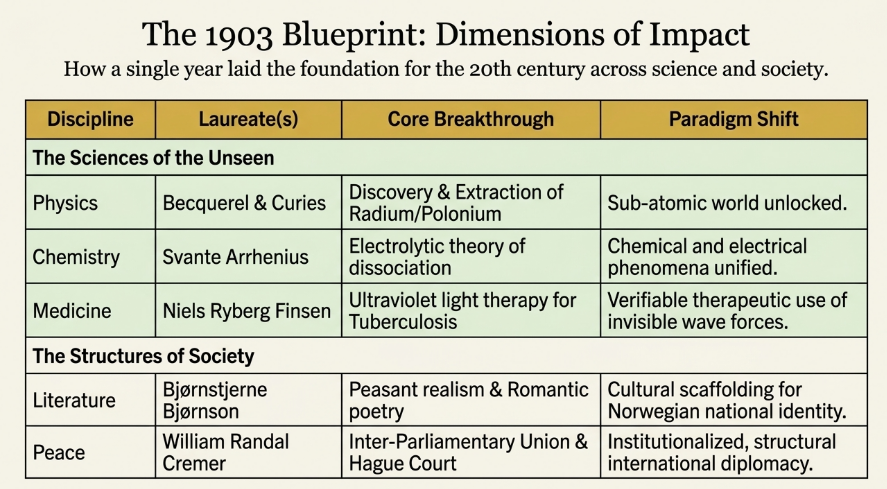
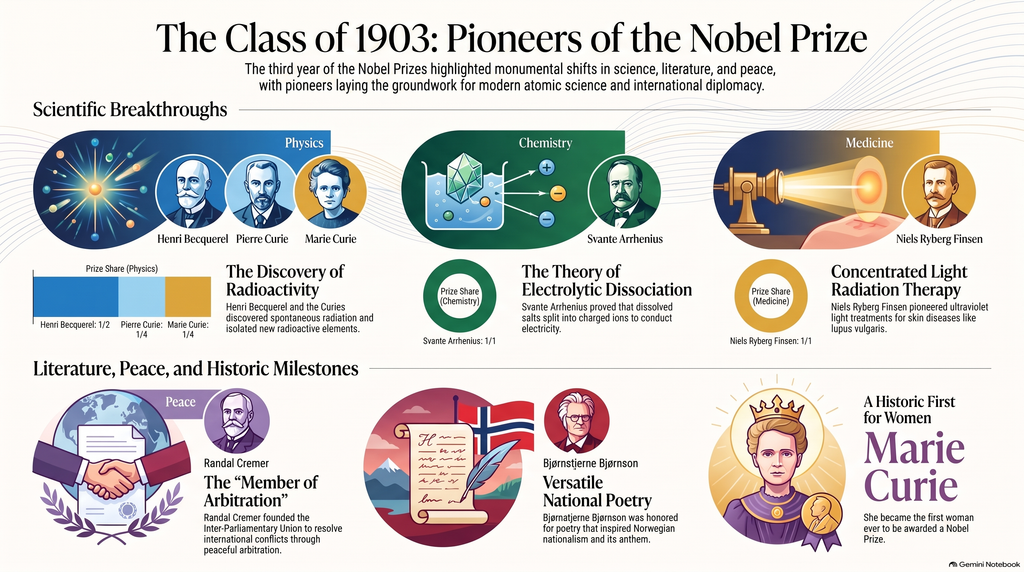
In Physics, the 1903 awards recognized the epochal discovery of spontaneous radioactivity. Henri Becquerel initially interrogated uranium salts to determine if they were affected by light through phosphorescence; however, he discovered by accident that these salts emitted a penetrating radiation independently of any external light source. This radiation was distinct from X-rays, representing an entirely new physical phenomenon. Pierre and Marie Curie expanded this inquiry by analyzing pitchblende, finding it significantly more radioactive than uranium. This led to the extraction of two previously unknown constituent elements, polonium and radium, effectively proving that certain matter possessed inherent, active energy.
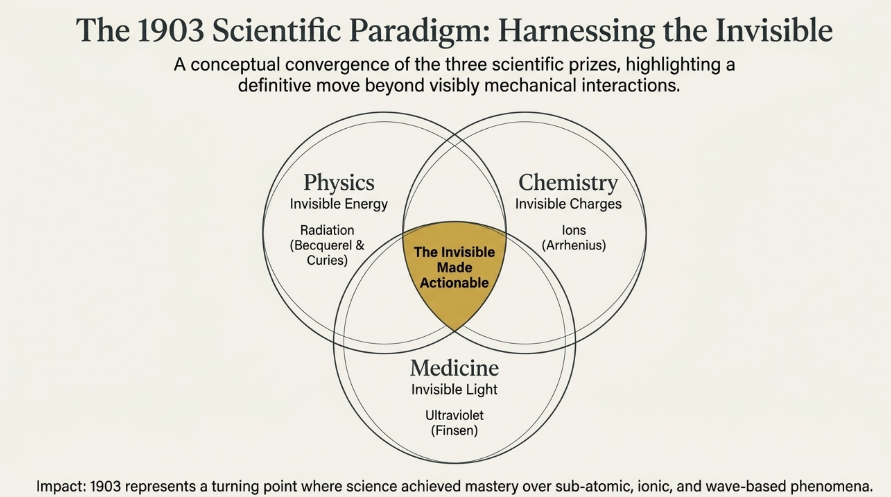
In Chemistry, Svante Arrhenius revolutionized the understanding of solutions through his electrolytic theory of dissociation. He identified the mechanism by which electrical current is conducted: when substances like rock salt dissolve in water, they split into positively and negatively charged atoms, or ions. This dissociation established a definitive scientific link between chemical and electrical phenomena.
In Physiology or Medicine, Niels Ryberg Finsen pioneered the use of concentrated light radiation. Recognizing that ultraviolet light possessed an inhibiting effect on bacteria, Finsen applied concentrated beams to treat lupus vulgaris (a skin-attacking form of tuberculosis). By harnessing this bactericidal mechanism, Finsen moved medical science toward non-invasive radiation therapy, a biological parallel to the radiation research occurring in physics.
Perspectives on the Laureates’ Lives
The archival records highlight that these breakthroughs were frequently shaped by personal adversity. Niels Finsen’s research was born of personal necessity; suffering from a metabolic disease that caused chronic fatigue, he observed that sunlight improved his vitality, prompting his study of light’s medical benefits. His illness was so debilitating that it prevented him from attending the award ceremony. Svante Arrhenius faced significant institutional resistance; his doctoral thesis was initially criticized at Uppsala University, forcing him to establish his international reputation in Germany before returning to Sweden, where he eventually became director of the Nobel Institute and helped negotiate the Nobel Foundation’s statutes. Marie Curie’s life was defined by a relentless pursuit of education, moving from Poland to Paris to study, eventually becoming the first person to win two Nobel Prizes despite the early loss of her husband and colleague, Pierre. Becquerel’s discovery remains the definitive example of scientific serendipity occurring within a rigorous investigative framework.
While these scientific advancements redefined the physical world, the 1903 awards cycle also emphasized the cultural and diplomatic infrastructures required to sustain such progress.
3. 1903: Excellence in Literature and the Promotion of International Arbitration
The non-scientific prizes of 1903 focused on the cultivation of national identity and the preservation of peace through legal frameworks. These awards recognized that progress is only sustainable when conflict is managed through arbitration and cultural expression reflects a “purity of spirit.”
Literature and Peace Laureates
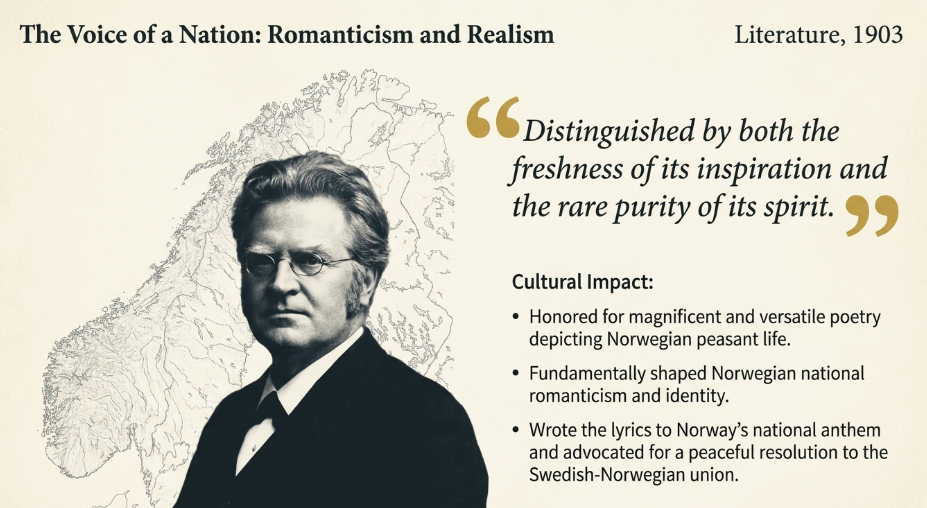
- Bjørnstjerne Bjørnson (Literature): A titan of Norwegian nationalism, Bjørnson used “national romanticism” to depict peasant life in the Norwegian countryside. He was a multifaceted author of poetry and drama, best known for writing the lyrics to Norway’s national anthem. Significantly, his commitment to peace and institutional memory was evidenced by his role as a member of the first Norwegian Nobel Committee.
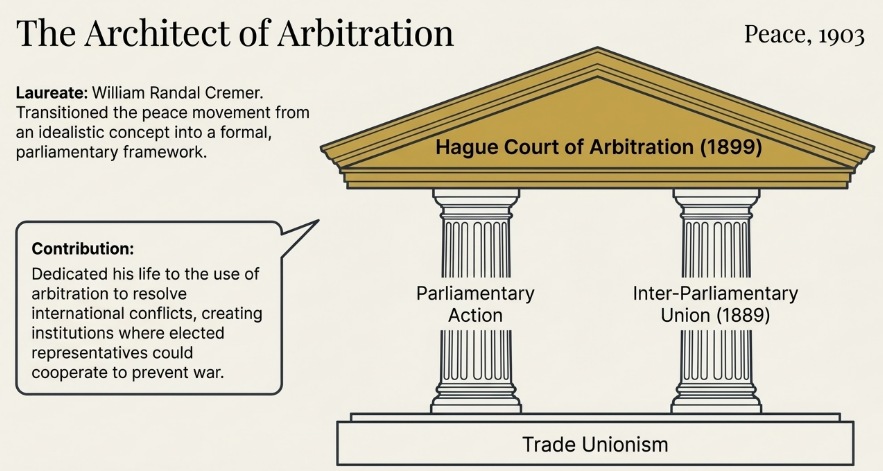
- William Randal Cremer (Peace): Rising from humble origins as a carpenter and trade unionist to a Member of the British Parliament, Cremer was nicknamed the “Member of Arbitration.” His strategic impact was realized through the establishment of the Inter-Parliamentary Union and his work at the 1899 Hague Conference, which achieved the strategic triumph of creating an international court of arbitration. In a notable archival detail, when King Edward VII knighted him in 1907, the King specifically released the old peace activist from the obligation to wear a sword at the ceremony.
Analysis of Prize Motivations
The 1903 motivations reflect a distinction between internal creative character and external diplomatic action. Bjørnson was honored for the purity of spirit and “freshness of inspiration” in his versatile poetry, emphasizing the noble quality of his literary output. In contrast, Cremer was recognized for his devoted effort in favor of ideas, highlighting a practical, lifelong commitment to replacing the violence of the Boer War and other conflicts with legal arbitration. Bjørnson defined the spirit of a nation, while Cremer provided the legal structures to preserve it.
This dual focus on excellence set the stage for a unique historical anomaly: the recognition of a repeat laureate.
Reference
https://www.nobelprize.org/prizes/lists/all-nobel-prizes/1909-1901


Related posts:
 Nobel Prize Laureates Series: The Inaugural 1901 Nobel Prize
 Nobel Prize Laureates Series: 1902, A Comprehensive Review of Scientific and Humanitarian Advancements
 World Economic Forum: Top 10 Emerging Technologies of 2023
 The Giant Bacterium: Ca. Epulopiscium viviparus
 Thiomargarita magnifica: The Bacteria Big Enough to be Visible by the Naked Eye