
1. Introduction: The Fragmentation of the Mind
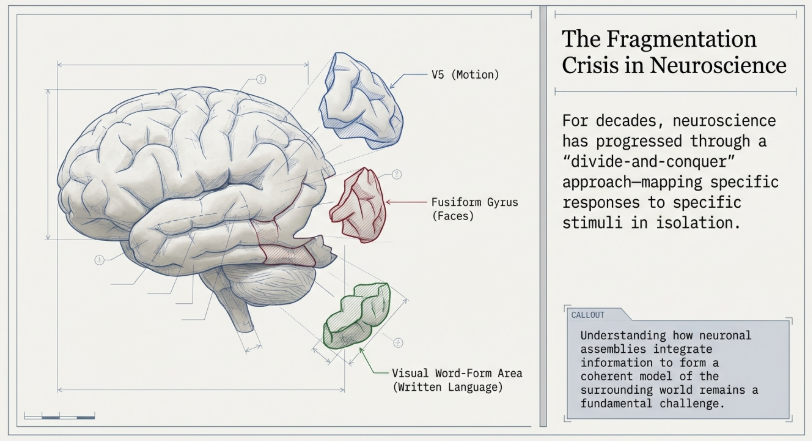
For decades, cognitive neuroscience has operated within a “fragmented landscape.” Research has traditionally relied on a divide-and-conquer strategy, mapping specific functions to isolated brain regions—such as area V5 for motion, the fusiform gyrus for faces, or the visual word-form area for reading. While this has yielded deep insights, the field has been left with a collection of specialized models that struggle to explain how the brain integrates diverse information into a coherent model of the world.
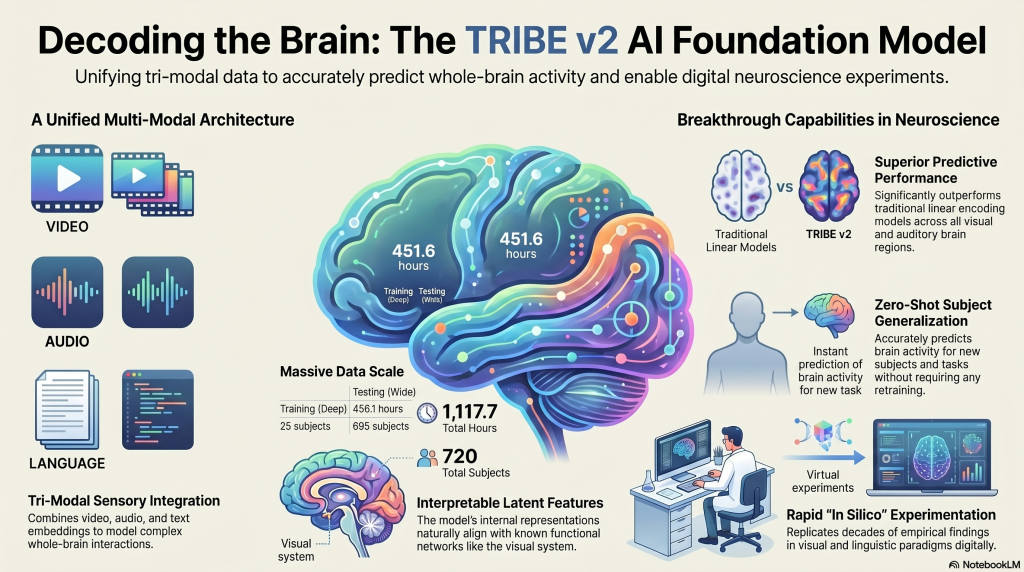
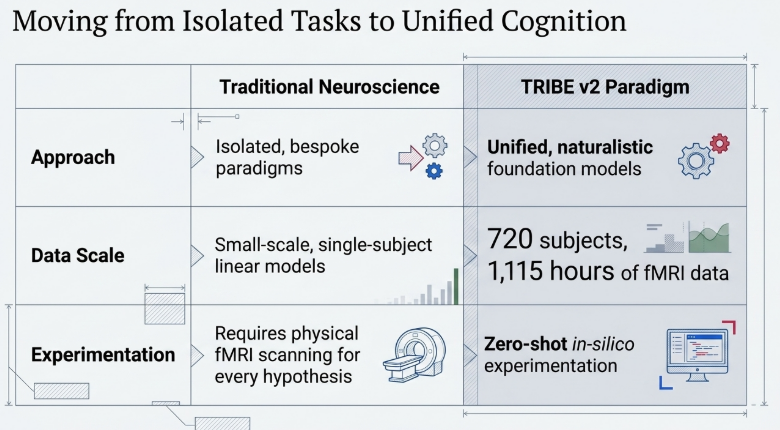
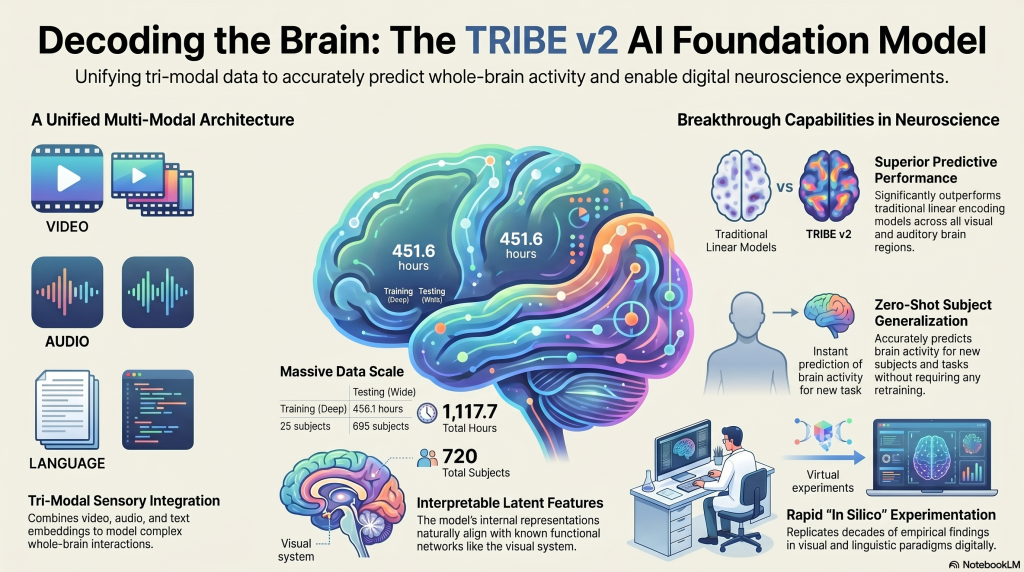
The fundamental challenge is building a unified framework of the mind. Meta’s TRIBE v2 (Trimodal Brain Encoder) represents a paradigm shift. It is a tri-modal foundation model—integrating video, audio, and language—designed to act as a unifying framework for understanding the functional organization of the brain. Leveraging a ground-truth dataset of over 1,000 hours of fMRI across 720 subjects—aggregating “deep” datasets (granularity and precision) and “wide” datasets (population-level scale)—TRIBE v2 offers a high-resolution window into the human experience.
2. The End of Specialized Silos: One Model to Rule Them All
In traditional neuroscience, researchers used linear encoding models tailored to specific individuals or narrow tasks. These models typically plateau when faced with complex, naturalistic data. TRIBE v2 replaces these specialized silos with a “Foundation Model” architecture.
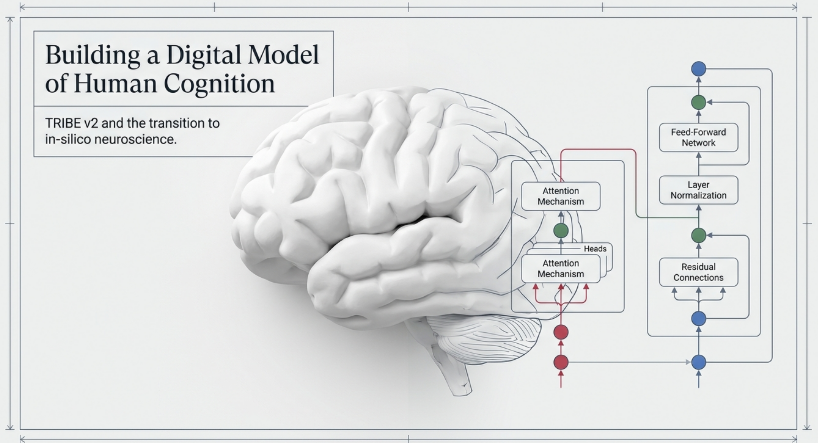
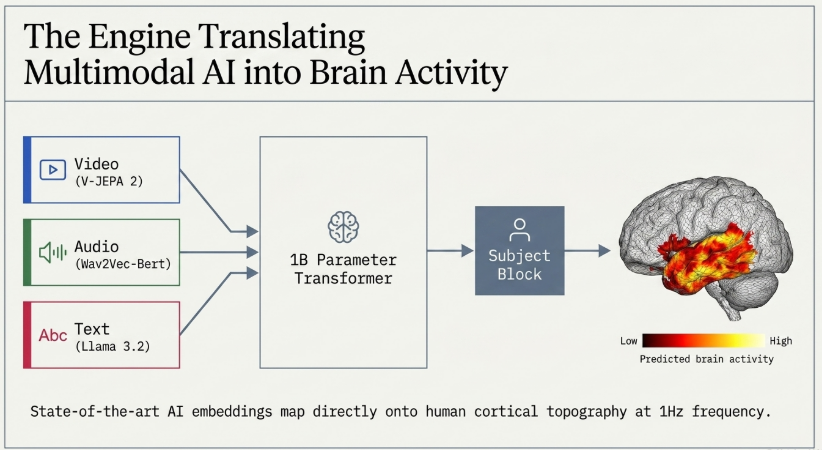
The model’s power stems from its integration of state-of-the-art pretrained backbones: V-JEPA2 for video, W2vec-Bert-2.0 for audio, and Llama-3.2-3B for text. These embeddings are fed into a transformer encoder that aggregates information across time. Finally, a subject-conditioned linear layer with 1 billion learnable parameters maps these representations to the brain. By capturing the representational geometry shared between artificial intelligence and the primate brain, TRIBE v2 predicts cortical responses across diverse naturalistic and experimental conditions more accurately than any previous model.
“These results establish artificial intelligence as a unifying framework for exploring the functional organization of the human brain.”
3. “Zero-Shot” Generalization: Predicting the Unseen
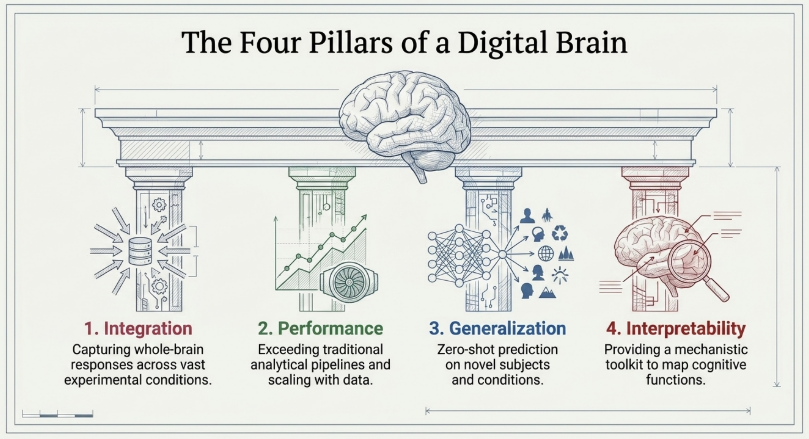
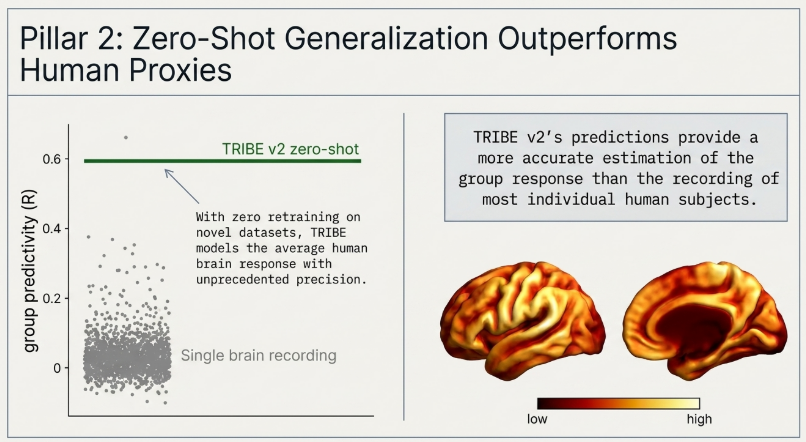
One of TRIBE v2’s most striking capabilities is “zero-shot” generalization—the ability to predict the brain activity of new subjects the model has never encountered. When tested on the Human Connectome Project (HCP) dataset, which utilizes high-resolution 7T scanners for superior signal-to-noise ratios, TRIBE v2 achieved a group-level correlation (Rgroup) near 0.4.
This yielded a surprising takeaway: the AI’s estimation of a group’s neural response is twice as accurate as the actual recording of a median individual subject. This suggests that the AI has learned a “universal” representation of human brain function that transcends individual noise. To achieve this, the model satisfies three key criteria:
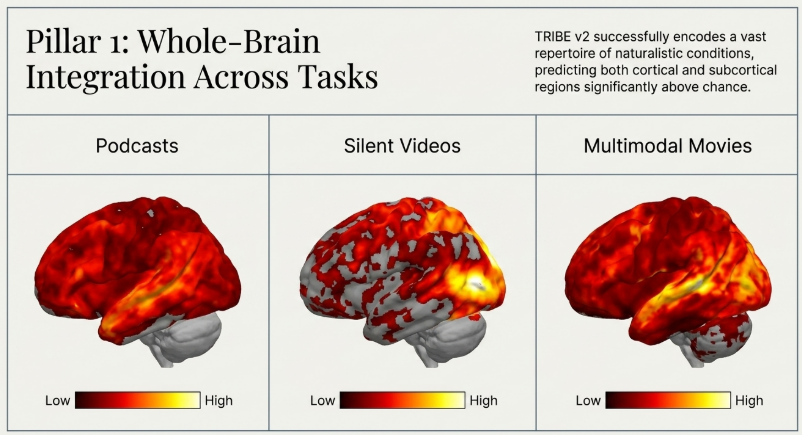
- Integration: Capturing whole-brain responses across a vast repertoire of stimuli.
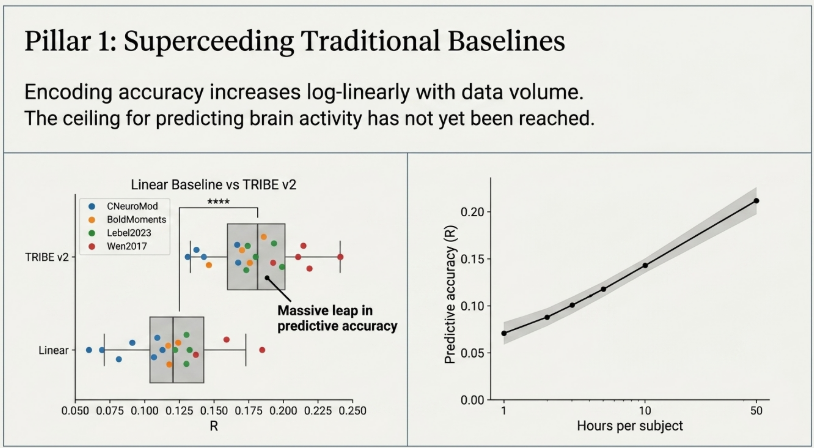
- Performance: Significantly outperforming optimized linear baselines and traditional FIR (Finite Impulse Response) models.
- Generalization: Predicting responses for novel experimental conditions and unseen subjects without retraining.
4. In Silico Experimentation: Testing Hypotheses Without a Scanner
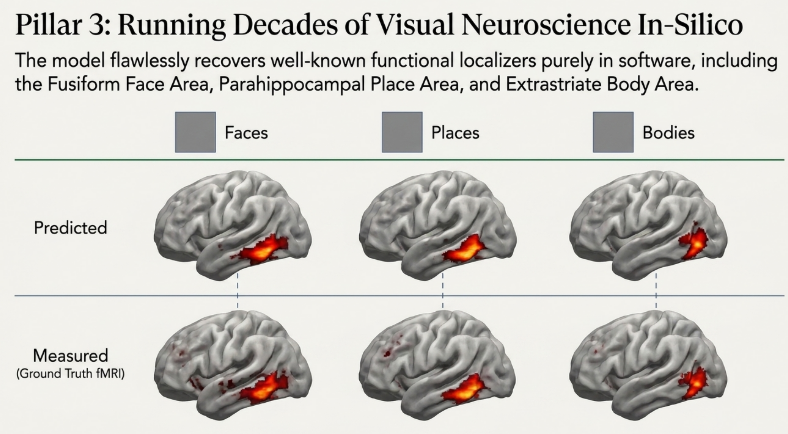
TRIBE v2 enables a new era of “in silico” (digital) neuroscience. Because the model has learned the underlying topography of brain activity, researchers can run virtual experiments, replicating decades of empirical research without requiring human subjects. Without being specifically trained on classic experimental paradigms, TRIBE v2 successfully recovered well-known functional localizers.
| Classic Paradigm | TRIBE v2’s Recovery |
|---|---|
| Faces vs. Places | Recovered the Fusiform Face Area (FFA) and Parahippocampal Place Area (PPA). |
| Written Characters | Correctly identified the Visual Word-Form Area (VWFA). |
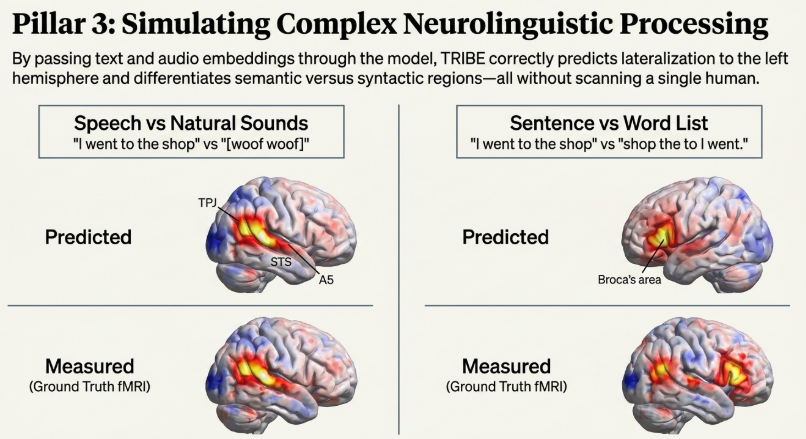
| RSVP (Sentences vs. Word Lists) | Recovered the TPJ and showed characteristic left-hemisphere lateralization. |
| Emotional vs. Physical Pain | Recovered the TPJ and MTG (Middle Temporal Gyrus) for emotional processing. |
| Body Parts | Recovered the Extrastriate Body Area (EBA). |
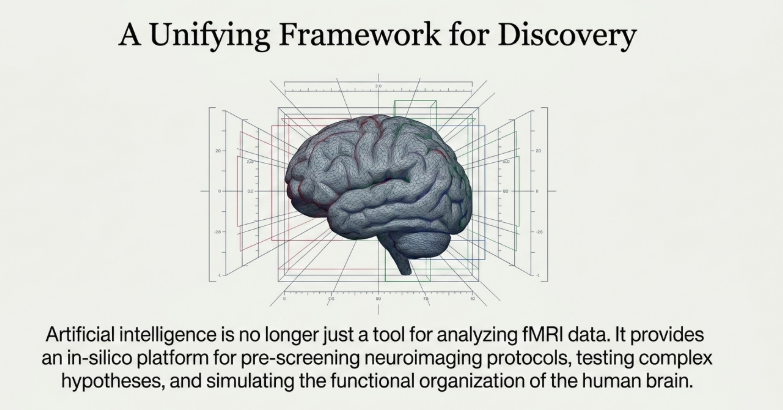
This digital twin is indispensable for pre-screening neuroimaging protocols and augmenting the statistical power of existing datasets, allowing researchers to refine hypotheses before conducting physical studies.
5. The ICA Breakthrough and the Multisensory RGB Map
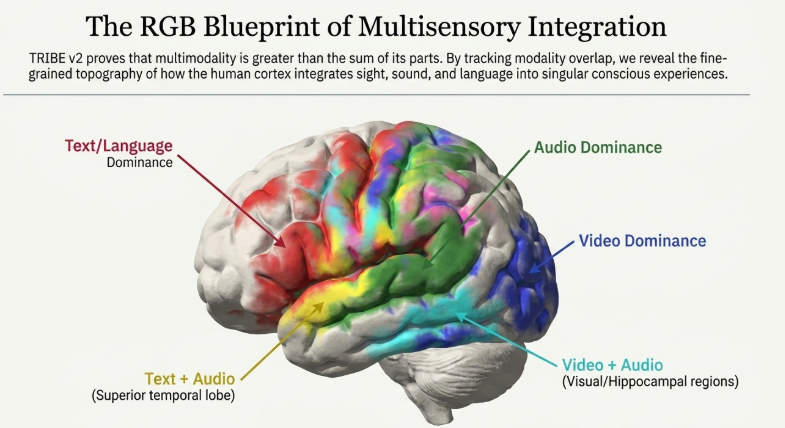
Beyond simple prediction, TRIBE v2 reveals the fine-grained topography of multisensory integration. Using an RGB mapping technique—where Red (text), Green (audio), and Blue (video) intensities reflect encoding scores—researchers identified several “Multisensory Hotspots.”
- TPOJ (Temporal-Parietal-Occipital Junction): The area of greatest gain from multimodality, showing up to a 50% increase in accuracy when all three inputs are present.
- Superior Temporal Lobe: A convergence zone for text and audio (appearing yellow).
- Ventral/Dorsal Visual Cortices: Key regions where video and audio merge (appearing cyan).
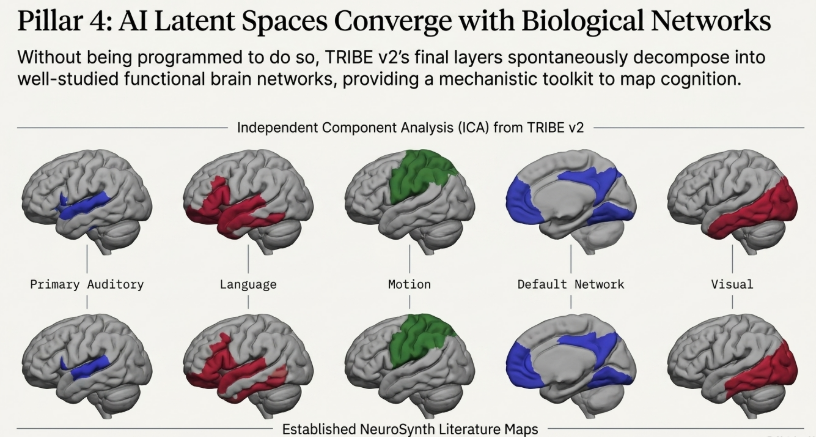
In a breakthrough for interpretability, applying Independent Component Analysis (ICA) to the model’s latent space allowed the AI to unsupervisedly discover five well-known functional networks: Primary Auditory, Language, Motion, Default Mode (DMN), and Visual. By contrasting these with NeuroSynth metadata, researchers proved the model isn’t just predicting activity; it is learning the brain’s fundamental functional topography.
6. The Log-Linear Law: AI Scaling Meets Neural Complexity
A core finding of the research is the relationship between data volume and accuracy. While traditional linear models (FIR) tend to plateau, TRIBE v2 exhibits a “log-linear increase” in encoding accuracy.
This scaling behavior mirrors the “Scaling Laws” seen in Large Language Models like GPT or Llama. It suggests that the “ceiling” for predicting human brain activity has not yet been reached. If we continue to scale these models with more diverse naturalistic data, we may eventually reach a point where AI “solves” the mapping of the human brain’s functional organization.
“The observed log-linear scaling of encoding accuracy… suggests that the ceiling for predicting human brain activity is yet to be reached.”
7. Conclusion: Toward a Digital Mechanic for the Brain
TRIBE v2 is a robust “digital model” of the human brain, providing a platform for interpreting neural function through intervention. However, as an expert, I must note its current boundaries: the model treats the brain as a passive observer rather than an active agent producing behavior. It also lacks the millisecond-level dynamics of neuronal firing, constrained by the temporal resolution of fMRI, and currently omits primary sensory modalities like olfaction and somatosensation.
Despite these hurdles, the model offers a provocative mirror for the human mind. If an AI can accurately predict how your brain will respond to any movie, podcast, or sentence before you even experience it, have we finally reached the era of the digital brain?
Image Summary
Reference
A foundation model of vision, audition, and language for in silico neuroscience


Related posts:
 How AI Can Secure the Future of Fruit Trees in a Changing Climate
 Smart Polymer-Enhanced Biotemplates from Fish Scales Pave the Way for Bone Tissue Regeneration
 Revolutionizing Potato Leaf Disease Detection with Deep Reinforcement Learning and Ocotillo Optimization
 Revolutionizing Crop Protection: Multi-Omics Meets AI for Next-Gen Biofungicides Against Fusarium Wilt
 How Volumetric Deep Learning is Revolutionizing Tomato Phenotyping for Vertical Farming