Different microbial populations frequently interact with one another. Some of these interactions or associations are indifferent or neutral, some are beneficial or positive (commensalism, synergism, and mutualism), and others are harmful (parasitism or predation). The intricate network of microbial interactions determines the balance of life itself. In the complex natural biological community, many of these interactions cannot be placed distinctly into fixed categories.1
Types of Microbial Interactions
Microbial interactions are basically categorized into three groups:
- Neutralism: Absence of any microbial interaction.
- Positive interaction: Increased metabolic and survival rate of the population.
- Negative interaction: Decreased metabolic and survival rate of the population.
A. Neutralism
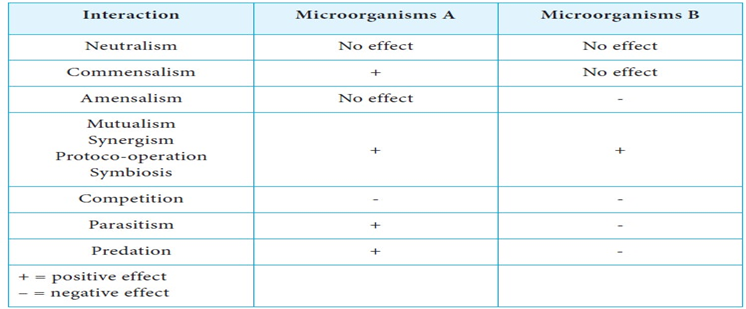
Neutralism refers to a condition where two microbial populations have no interaction with one another, though they occupy the same environment. The following are some of the conditions where neutralism might exist:
- When two microbial populations have extremely different metabolic capabilities.
- When microbial populations are low in density, spatially distant from one another, and do not sense the presence of one another. Example: marine habitats and oligotrophic lake habitats.
- When a microbial population exists in an environment that does not permit its active growth. Example: Microbes frozen in an ice matrix, such as in frozen food products, polar sea ice, etc.
- When both populations are outside their natural habitats. Example: Microbial population in the atmosphere which are all non-indigenous.
- When microorganisms are in resting stages. (For example: Spore, Cyst stage)
Neutralism might be transitional as there are constant changes in the environment. Thus, these relationships might change.1
Table: Different types of microbial interactions. (Source: Atlas RM. Microbial Ecology. 2nd ed. Benjamin/Cummings Publishing Company; 1984.)
B. Positive interaction
Positive interactions increase the growth and survival rate of the involved microbial population as the population density increases. These interactions enhance the ability of some populations to survive as a part of the community and enhance the use of available resources more efficiently. Such interactions might also reduce environmental stress. The positive interactions are categorized into: Mutualism, Commensalism, and Synergism.
i. Mutualism
Mutualism is an obligatory relationship between two populations that benefits both populations. Benefits are drawn during mutualism in various ways. A mutualistic relationship allows the participating microorganisms to act as if they were a single organism with a unique identity. It allows them to exist in habitats that could not be occupied by either population on their own. Metabolic activity and physiological tolerances of the population involved in a mutualistic relationship are quite different from those of the populations when alone.1 Some of the examples are:
- Relationship between certain algae, cyanobacteria, and fungi resulting in the formation of Lichens.
- Paramecium hosts numerous cells of the algae Chlorella within its cytoplasm, i.e., Endosymbiosis. (Ball 1969)
ii. Commensalism
Commensalism refers to a unidirectional interaction where one population receives benefits while the other remains unaffected. It is usually not obligatory.2 Commensalism is usually achieved when an unaffected population in its natural course of growth and metabolism modifies its habitat in such a way that favors another population. For example:
- Some facultative anaerobes use O2 and lower the O2 tension, creating a suitable habitat for obligate anaerobes.
- Beggitonia oxidizes H2S, which benefits the H2S-sensitive aerobic microbial population.
iii. Synergism
Synergism refers to a relationship between two microbial populations where both populations benefit from one another. However, this association, unlike mutualism, is not obligatory.1 Syntrophism is one of the examples of synergistic interaction. Syntrophy enables a second organism to utilize metabolic end products from another organism, enabling both organisms to grow at an optimal rate. It is largely based on the ability of one population to supply growth factors for another population.
For example, Only Enterococcus faecalis or E. coli alone cannot convert arginine to putrescine. But E. faecalis is able to convert arginine to ornithine, which can then be utilized by E. coli to make putrescine.1
C. Negative interaction
The negative interactions decrease the growth and survival rate of the involved microbial population as the population density increases. It involves competition for available substrates, prey, and host cells and production and accumulation of toxic substances by members of the population. Negative interactions include antagonism, parasitism, competition, and predation.
i. Antagonism
Antagonism involves the production of a substance by one microbial population that is inhibitory to the other population. It provides the first organism with a competitive edge. Antagonism is often referred to as amensalism.1 Such interactions are highly studied as they are the basis for the production of antibiotics and other inhibitory substances, which are medically essential. Some of the examples are as follows:
- Many microbes can produce antibiotics that kill or inhibit other microbial populations. However, conditions favoring the production of antibiotics are not normally found in natural habitats.
- Production of fatty acids by the skin’s normal flora prevents the growth of other microbes.
- Production of O2 by algae inhibits obligate anaerobes.1
ii. Parasitism
Parasitism is a relationship between organisms in which one organism lives in or on another organism. The population deriving benefits, the parasite, derives its nutritional requirements from the host, which is normally harmed in the process. The parasite is completely dependent on the host and lives in intimate physical and metabolic contact with the host.2 Ectoparasites remain outside the host cells, as endoparasites penetrate the host cells. Normally, the parasite-host relationship is quite specific. Some of the examples are:
- Bdellovibrio bacteriovorus is a bacterial parasite of Gram-negative bacteria.
- Viruses are obligate intracellular parasites affecting specific bacterial, fungal, algal, and protozoan populations.
- Soil Myxobacteria, an ectoparasite, can lyse gram-negative and gram-positive bacterial populations.
iii. Predation
Predation typically refers to the phenomenon where an organism, the predator, engulfs and digests another organism, the prey. Generally, this interaction only lasts for a short duration, and the predator is significantly larger than the prey. Coexistence between predator and prey populations can occur with periodic population oscillations if the prey species can temporarily escape predation pressure and recover in due time. Some examples are:
- Didinium nasutum preys on Paramecium caudatum. (Gause, 1914)
- Paramecium bursaria preys on the yeast Schizosaccharomyces. (Gause, 1914)
- Paramecium, Vorticella, and Stentor feed on Enterobacter aerogenes.
iv. Competition
Competition occurs when two populations use the same resource (i.e., space, nutrients, etc.). The greatest competition is among microbial populations occupying the same or overlapping niches. Under constant environmental conditions, competition results in the establishment of a dominant population and the extinction or elimination of unsuccessful competitors.
For example, Gause (1934) placed two closely related ciliated protozoans, Paramecium caudatum and P. aurelia, together with adequate bacterial prey. It was observed that only P. Aurelia survived after 18 days. P. Aurelia exhibited a rapid growth rate and outcompeted Paramecium caudatum for available food.1
Reference
- Atlas RM. Microbial Ecology. 2nd ed. Benjamin/Cummings Publishing Company; 1984.
- Pelczar MJ, Chan ECS, Krieg NR. Microbiology. 5th ed. McGraw-Hill; 1993.


Related posts:
 Antagonistic Effects of AMF and SOB in Soybean Rhizosphere: New Insights into Soil Microbial Interactions
 Unraveling Microbial Mysteries: How Pollution Shapes Coastal Sediment Ecosystems
 World Economic Forum: Top 10 Emerging Technologies of 2023
 Plasmid DNA Extraction from Bacteria by Alkaline Lysis Method
 How to reduce the number of screenings for transformed bacterial colonies?