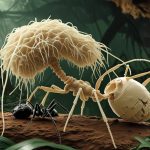
A team of Japanese researchers has uncovered a surprising twist in the war against crop pests: it might be easier to crash pest populations by killing the bacteria inside them, rather than the insects themselves.
The study, published in Frontiers in Microbiology, shows that applying a common agricultural antibiotic, MycoShield can wipe out essential reproductive bacteria in pests like leafminers and thrips, disrupting their ability to reproduce and potentially leading to population collapse—all without directly harming the plants.
This novel approach, called symbiont-targeted pest control, may offer a game-changing alternative to conventional pesticides.
The Hidden Puppeteers: Wolbachia and Rickettsia
Many insects aren’t in full control of their own biology. They’re hosts to endosymbiotic bacteria like Wolbachia and Rickettsia—microbes that tweak their reproduction in bizarre ways:
- In leafminers (Liriomyza trifolii), Wolbachia causes cytoplasmic incompatibility, making offspring unviable in certain crosses.
- In thrips (Hercinothrips femoralis) and parasitoid wasps (Neochrysocharis formosa), these bacteria induce thelytokous parthenogenesis, enabling females to reproduce without males.
But here’s the catch: no bacteria, no baby bugs.
The Experiment: MycoShield vs. Symbionts
Researchers treated kidney bean plants with MycoShield, a 17% oxytetracycline bactericide, and monitored the insects that fed on those plants. They found:
- Wolbachia was eliminated from both leafminers and thrips within days.
- Rickettsia was wiped out from parasitoid wasps when they fed on infected leafminer larvae.
- In thrips, the result was especially dramatic—only male offspring were produced, and in some cages, the population went extinct within 100 days.
Crucially, MycoShield didn’t kill the insects—it simply cut off their ability to reproduce by removing the microbes controlling their reproductive systems.
Sterile Insects Without Genetic Engineering?
This approach offers a powerful new tool that mimics the sterile insect technique (SIT)—a proven pest control strategy that typically requires radiation or genetic manipulation.
With antibiotic-treated plants, researchers can sterilize insect populations indirectly, offering a non-invasive, field-deployable alternative that could:
- Reduce pesticide use
- Delay resistance buildup
- Selectively target pest species by their microbial makeup
A Double-Edged Sword?
There’s one important caveat. Beneficial insects, like parasitoid wasps used in biological control, can also lose their symbionts—potentially disrupting pest management strategies.
For example, MycoShield exposure led Neochrysocharis formosa to lose its ability to reproduce asexually, drastically skewing sex ratios and reducing population viability. Since female wasps are critical for biocontrol, this poses a dilemma: How do we sterilize pests without harming their natural enemies?
What’s Next?
The study suggests that adjusting dosage, timing, or choosing more selective antibiotics could spare beneficial species while still targeting pests. Prior work on aphids has shown that specific antibiotics can selectively remove individual symbionts—hinting at a future of precision microbial targeting.
As endosymbionts like Wolbachia are estimated to infect over half of all arthropod species, the potential reach of this strategy is vast.
The Big Picture
This research shines a light on a powerful truth: sometimes, the key to pest control isn’t killing the insect, but hacking the microbes that run the show.
With the rise of antibiotic resistance and the environmental costs of chemical pesticides, symbiont-targeted pest control may emerge as a smarter, more sustainable weapon in the battle to protect crops and ecosystems.

Reference
Ohata, Y., & Tagami, Y. Antibiotic agrochemical treatment reduces endosymbiont infections and alters population dynamics in leafminers, thrips, and parasitoid waspsin agricultural pests and their natural enemies. Frontiers in Microbiology, 16, 1605308. https://doi.org/10.3389/fmicb.2025.1605308


Related posts:
 World Economic Forum: Top 10 Emerging Technologies of 2023
 Thiomargarita magnifica: The Bacteria Big Enough to be Visible by the Naked Eye
 Panama Wilt: Understanding and Managing the Banana Killer
 New Class of Antibiotics with a Novel Mode of Inhibition against World Health Organization’s Critical Listed Bacteria, Carbapenem-Resistant Acinetobacter baumannii
 Whats in your Gut? One ingestible pill coming up for understanding the microbiota inside small intestine