
Bioelectronics has rapidly evolved into one of the most promising frontiers in healthcare technology, bridging the gap between the human nervous system and intelligent devices. From brain–machine interfaces to neuromuscular monitoring, these systems offer transformative applications. However, traditional electrodes—rigid, immobile, and prone to tissue damage—have long limited the potential of implantable devices.
A new study published in Nature introduces a game-changing technology: NeuroWorm, a soft, stretchable, and movable implantable bioelectronic microfibre inspired by earthworms. This innovation promises a new era of minimally invasive, long-lasting, and intelligent bioelectronics.
What is NeuroWorm?
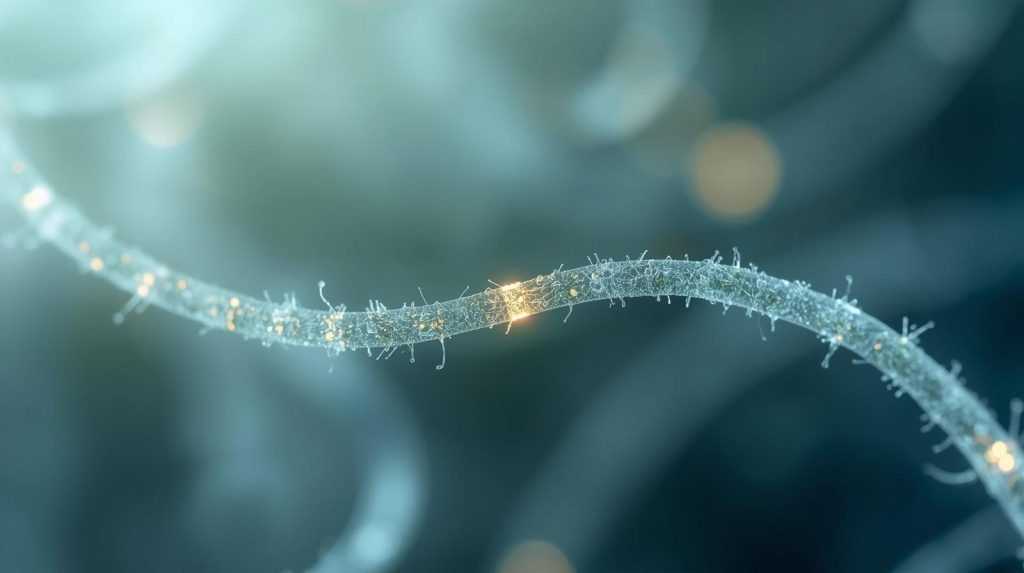
NeuroWorm is a flexible microfibre sensor designed to record bioelectrical and biomechanical signals from within the brain and muscles. Unlike conventional electrodes that remain fixed in place, NeuroWorm can move inside tissues—steered magnetically—enabling dynamic monitoring at different sites without repeated surgeries.
Key features include:
- Soft, stretchable structure: Conforms to natural tissue movements.
- Movability: Inspired by earthworms, it can “wander” through tissues.
- Long-term stability: Demonstrated reliable performance for over 43 weeks in rats.
- Minimal immune response: Shows negligible fibroblast encapsulation after 54 weeks.
- Multichannel sensing: Houses up to 60 electrode channels for high-resolution monitoring.
Why It Matters
Implantable bioelectronics play a pivotal role in neurological research, prosthetics, exoskeleton control, and chronic disease management. Yet, the rigidity and immobility of traditional electrodes often require reimplantation if misaligned, causing additional surgical trauma and infection risks.
NeuroWorm addresses these challenges by:
- Reducing invasiveness: Requires only tiny incisions.
- Improving adaptability: Can shift to optimal recording sites post-implantation.
- Enhancing signal quality: Offers superior signal-to-noise ratios compared to rigid electrodes.
- Supporting precision medicine: Opens pathways for personalized neural monitoring and treatment.
Potential Applications
- Brain–Machine Interfaces (BMI) – Precise monitoring of brain signals for advanced prosthetics and neuroprostheses.
- Neuromuscular Monitoring – Recording muscle activity for rehabilitation, exoskeleton control, and movement disorder therapy.
- Chronic Disease Management – Long-term tracking of neurological and muscular conditions.
- Minimally Invasive Diagnostics – Flexible movement allows targeting different tissue regions with reduced surgical risk.
Future Directions
While NeuroWorm represents a major leap, the study highlights areas for further development. Current prototypes rely on open-loop magnetic control, which limits speed and precision. Future research aims to integrate electromagnetic coil arrays for real-time, closed-loop navigation inside complex tissues.
Conclusion
The development of NeuroWorm signals a paradigm shift in implantable bioelectronics—from rigid, immobile probes to living, intelligent, and movable sensors. With its unique combination of softness, adaptability, and long-term stability, this earthworm-inspired innovation could redefine how we monitor and interface with the human nervous system.
Reference
Xie, R., Han, F., Yu, Q., Li, D., Han, X., Xu, X., Yu, H., Huang, J., Zhou, X., & Zhao, H. (2025). A movable long-term implantable soft microfibre for dynamic bioelectronics. Nature, 645(8081), 648–655. https://doi.org/10.1038/s41586-025-09344-w


Related posts:
 Novel Mock-Knitted Structures Improve Comfort and Performance of Seamless Medical Compression Garments
 New 3D Bioprinting Platform Combines Coaxial Nozzle and Rotating Bioreactor for Vascular Tissue Engineering
 Programmable Hydrogels Offer New Horizons for Smart Biomaterials and Tissue Engineering
 Aspiration-Assisted Bioprinting: A New Era in Tissue Engineering with Precision Spheroid Printing
 Smart Biosensors: Dual ACE2 Epitope Receptors Offer Rapid Detection of SARS-CoV Variants

