What happens when you combine the ancient power of bacteria with cutting-edge microrobotics and the precision of ultrasound? You get a medical breakthrough that could transform cancer therapy from the inside out—literally.
In a pioneering study from the Shenzhen Institute of Advanced Technology, scientists have created programmable ultrasound microrobots by fusing photosynthetic bacteria with red blood cells. These “biohybrid bots” can be directed with ultrasound waves to invade tumors, block their blood supply, and enhance photothermal destruction—all with minimal side effects.
A Living Robot Powered by Nature and Sound
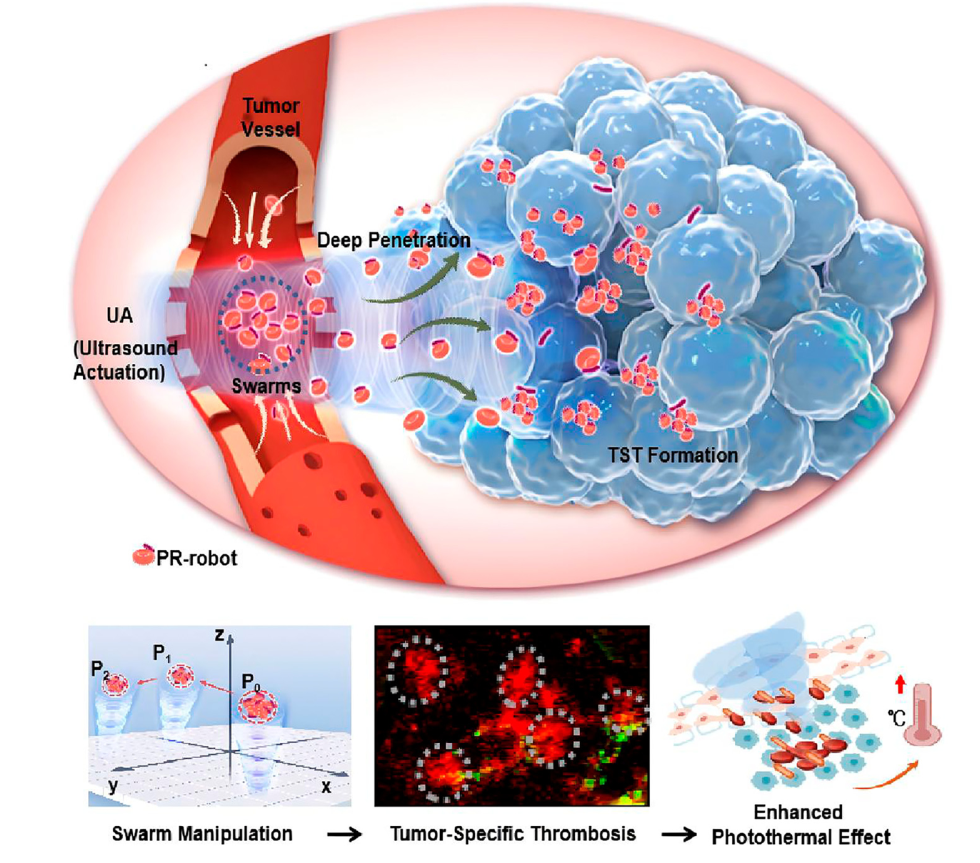
The engineered device, called a PR-robot, is not just synthetic—it’s alive. It’s made by attaching living photosynthetic bacteria (PSB) to red blood cells (RBCs). The RBCs protect the bacteria from the immune system, while the bacteria are naturally attracted to hypoxic (oxygen-poor) tumor regions.
Once inside the body, these PR robots are controlled by ultrasound to form cooperative groups called bioswarms. Like a programmable army, these swarms can be guided to move along predefined paths, navigate tight spaces, and infiltrate deep into tumors.
Dual Action: Clot the Tumor, Then Burn It
These microrobots don’t just swim—they fight. Under ultrasound guidance:
- They penetrate tumors with remarkable precision.
- They trigger tumor-specific thrombosis (clotting inside the tumor vessels), which cuts off the tumor’s blood supply.
- They convert light into heat using their bacterial pigments, making tumors vulnerable to photothermal therapy (PTT).
This two-pronged strategy—thrombosis plus PTT—led to complete tumor suppression in mouse models after just one laser treatment, outperforming standard bacterial therapy significantly.
Why Use Ultrasound?
Unlike magnetic fields or chemical gradients, ultrasound can reach deep inside the body, passing through soft tissue without harm. It can:
- Control swarm formation and movement in real-time.
- Temporarily expand blood vessels to facilitate the entry of microrobots into tumors.
- Reconfigure swarms to slip through tight biological spaces.
In the study, ultrasound increased tumor penetration by 35%, leading to a significantly greater accumulation of PR-robots inside tumors.
Is It Safe?
The researchers tested the safety of their system on multiple organs and blood parameters. The result? No significant side effects. The RBC coating helps the microrobots evade immune detection, and the ultrasound manipulation did not damage healthy tissues.
Even better, these bots are biodegradable, meaning they don’t hang around longer than necessary.
Beyond Cancer: A Platform for Precision Medicine?
While this system was tested on breast, melanoma, and colon tumors, its modular design means it could be adapted to:
- Target cardiovascular disease, like plaque buildup.
- Deliver drugs to inflamed tissues in autoimmune conditions.
- Or even distribute gene therapies to specific tissues in the future.
The Future: Smart Swarms, Precision Targeting, One-Treatment Cures?
This isn’t just a new tool. It’s a glimpse into a new era of programmable medicine—where doctors use biohybrid swarms to treat disease cell by cell, vessel by vessel, without invasive surgery or systemic toxicity.
With further development, programmable ultrasound microrobots could become the stealth assassins of modern oncology—smart, swift, and biologically engineered to kill only what’s killing us.
Reference
Ran, H., Yang, Y., Han, W., Liang, R., Zhu, D., Yuan, B., … & Cai, L. (2024). Programmable ultrasound-mediated swarms manipulation of bacteria–red blood cell microrobots for tumor-specific thrombosis and robust photothermal therapy. Trends in Biotechnology. DOI: 10.1016/j.tibtech.2024.11.018


Related posts:
 World Economic Forum: Top 10 Emerging Technologies of 2023
 Thiomargarita magnifica: The Bacteria Big Enough to be Visible by the Naked Eye
 Panama Wilt: Understanding and Managing the Banana Killer
 New Class of Antibiotics with a Novel Mode of Inhibition against World Health Organization’s Critical Listed Bacteria, Carbapenem-Resistant Acinetobacter baumannii
 Whats in your Gut? One ingestible pill coming up for understanding the microbiota inside small intestine