
The information below describes different types of controls that are generally kept while performing bacterial transformation using recombinant plasmids with antibiotics as a selectable marker. The purpose of these controls is to reduce the number of screening for transformed colonies downstream.
- Negative Control

Description:
The plate has antibiotics but is now spread with 100 μl of non-transformed competent cells.
Result:
Absence of colonies: No contaminating bacteria during the experiment as well as while being kept under incubation.
Error:
Presence of colonies: The experimental plates might also have been contaminated with bacteria.
Troubleshooting:
- The entire workbench needs to be thoroughly cleansed and sterilized.
- The autoclave machine needs to be checked for proper sterilization.
- Good Laboratory Practices need to be followed.
2. Positive Control

Description:
The plate has antibiotics but is now spread with 100 μl of competent cells transformed with non-recombinant plasmid.
Result:
Presence of colonies: The competent cells are viable and have survived the transformation procedure.
Error:
Absence of colonies: Either the competent cells were not viable or the transformation procedure needs to be corrected.
Troubleshooting
- The competent cells need to be cultured separately in non-antibiotics containing plain media to see whether they are viable or not.
- The machines being used for transformation need to be calibrated.
- The concentration of plasmid and antibiotics in the plate needs to be re-calculated.
3. Transformation with ligation mix of Single digested vector

Description:
The antibiotic-containing plate is now transformed with a ligation mixture of single restriction enzyme digested plasmid.
Result:
Presence of colonies: Single enzyme digested plasmid is linear, hence cannot be transcribed in-vivo, however, upon ligation, they re-circularize and become functional.
Note: You will have two plates if two different restriction enzymes for being used.
Error:
Absence of colonies: The ligase enzyme did not function properly, hence, no functional plasmids were generated.
Troubleshooting:
- The plasmid needs to be checked for the presence of additional restriction sites.
- Ligation buffer and enzyme need to be checked.
4. Transformation with unligated Single digested vector

Description:
The antibiotic-containing plate is now transformed with just the single-digested plasmids that have not undergone a ligation reaction.
Result:
Absence of colonies: As mentioned earlier, linearized plasmids become non-functional and, hence cannot provide a selection advantage to the transformed cells.
Note: You will have two plates if two different restriction enzymes for being used.
Error:
Presence of colonies: The restriction enzyme did not function properly resulting in intact plasmids capable of transforming the bacteria.
Troubleshooting:
- Restriction enzyme and their respective buffers need to be checked.
- The duration of the reaction as well as the concentration of the enzyme along with the concentration of plasmid DNA might also need to be adjusted.
5. Transformation with ligation mix of double-digested vector

Description:
The antibiotic-containing plate is now transformed with a ligation mixture of double restriction enzyme digested plasmid.
Result:
Absence of colonies: Since two restriction enzymes cut at two different sites, hence the resulting linearized plasmid does not re-circularize. As such the plasmid is not able to gain functionality, and no transformed colonies would be observed.
Error:
Presence of colonies: Either one or both of the restriction enzymes failed to perform their activity.
Troubleshooting:
- Enzymes need to be checked individually for their functionality.
- The buffer compatibility with both of the enzymes needs to be checked.
6. Transformation with a ligation mix of double-digested vector and insert. (Experiment)

Description:
The antibiotic-containing plate is now transformed with a ligation mixture of double restriction enzyme digested plasmid and the gene of insert that has been cut with the same set of restriction enzymes similar to the one used for plasmid digestion.
Result:
Presence of colonies: The re-circularized plasmid with the desired gene of interest inserted into the cut sites (hence the recombinant plasmid) becomes functional and provides the transformed cells with a selective advantage in the presence of selection pressure.
Error:
Absence of colonies: Transformation could not take place.
Troubleshooting:
- If all of the above controls have expected results, chances are ligation did not occur for the plasmid and the gene of interest. There could be a variety of reasons for this like low concentration of either plasmid or gene of interest or both. Hence, concentrations of both vector and the gene of interest need to be re-confirmed.
- The resulting recombinant plasmid size might be huge which leads to reduced transformation efficiency.
- The protein being produced by the recombinant gene might be toxic to the host cell.
- The molar concentration between the plasmid and the gene of interest needs to be calculated properly.


Related posts:
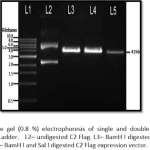 Plasmid DNA Extraction from Bacteria by Alkaline Lysis Method
 Manual Technique for Extraction of DNA from Bacteria
 Underlying Principle of Different Solutions Used for Isolation of Plasmid from Bacteria by Alkaline Lysis Method
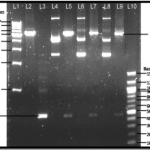 Factors affecting migration of Nucleic Acids in Agarose Gel Electrophoresis
 Comparison between Horizontal Gene Transfer Mechanisms in Bacteria: Transformation, Conjugation and Transduction


