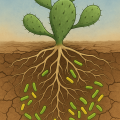
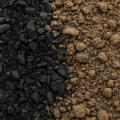
This study focused on the isolation and elucidation of bioactive secondary metabolites from two specific soil-derived Streptomyces strains, F9 and F4, isolated from Fereydunshahr, Isfahan, Iran. The overall goal was to discover new antibacterial agents, leveraging the fact that Actinobacteria, particularly the genus Streptomyces, are highly valued in the pharmaceutical industry for their ability to produce natural products with diverse biological activities.
Strain Identification and Activity:
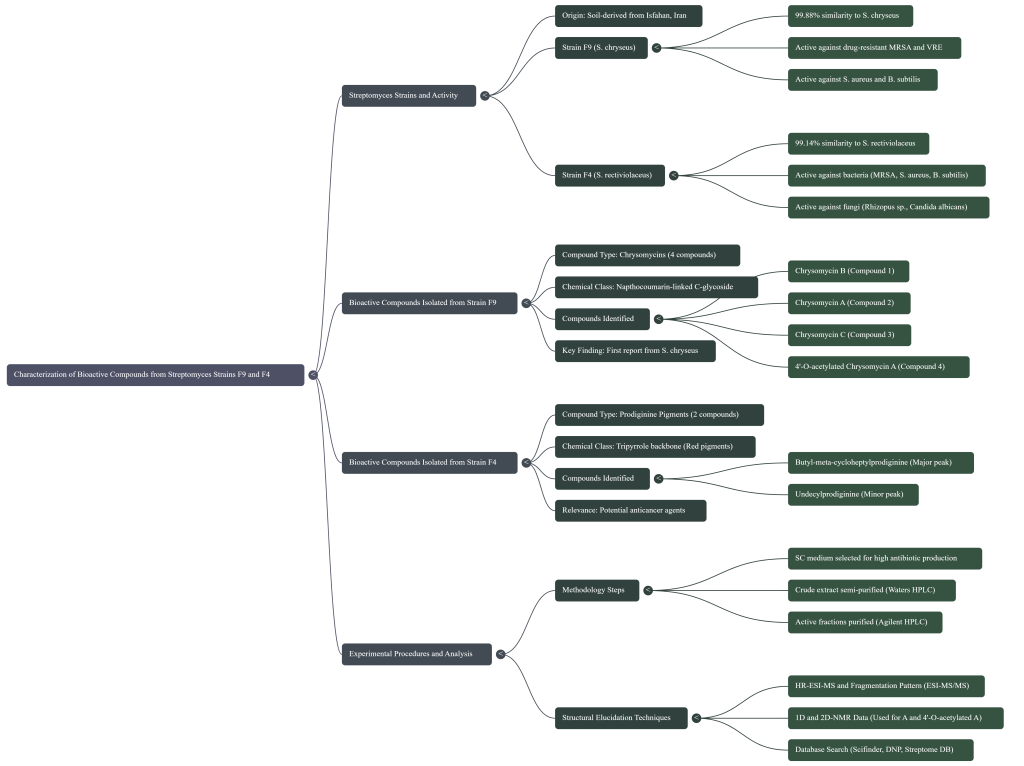
• Strain F9 showed 99.88% similarity with S. chryseus. This strain demonstrated antimicrobial activity against Staphylococcus aureus and Bacillus subtilis (ATCC strains), as well as two hospital-acquired, drug-resistant strains: methicillin-resistant S. aureus (MRSA) and vancomycin-resistant Enterococcus (VRE).
• Strain F4 showed 99.14% similarity with S. rectiviolaceus. This strain was active against S. aureus, B. subtilis, MRSA, Rhizopus sp., and Candida albicans.
Methodology and Production: The strains were selected for isolation and characterization of secondary metabolites. Among the tested cultivation media (starch casein (SC), SM, and M2), the SC medium was chosen for large-scale production as it supported the highest antibiotic level for both F4 and F9 strains, despite supporting a low growth rate. The crude extracts were semi-purified, and active fractions were further purified. Structural elucidation relied heavily on detailed spectroscopic analysis, including high-resolution electrospray ionization mass spectrometry (HR-ESI-MS), fragmentation patterns (ESI-MS/MS), and 1D and 2D nuclear magnetic resonance (NMR) data.
Characterized Compounds from Strain F9 (Chrysomycins): Strain F9 produced four bioactive compounds, which were found in four fractions showing antibacterial activity. These compounds belong to the chrysomycin group, a class of naphthocoumarin-linked antibiotics known to be potent antibacterial agents (effective against Gram-positive bacteria) and antitumor antibiotics. The characterized compounds were:
1. Chrysomycin B (compound 1)
2. Chrysomycin A (compound 2)
3. Chrysomycin C (compound 3)
4. 4′-O-acetylated A (compound 4)
Chrysomycins B and C were identified primarily by HR-ESI-MS, fragmentation pattern, and database search. The structures of chrysomycin A and 4′-O-acetylated A were confirmed using 1D and 2D-NMR data. Notably, the mass of compound 4 (m/z 551 [M+H]+) was 42 units higher than chrysomycin A (m/z 509 [M+H]+), suggesting the presence of an O-acetyl group, leading to its identification as 4′-O-acetylchrysomycin A. The study emphasized that **this was the first reported isolation of chrysomycins A-C and 4′-O-acetylated A from S. chryseus.
Characterized Compounds from Strain F4 (Prodiginine Pigments): Strain F4 produced two prodigiosin-like pigments, which are red-colored pigments consisting of a tripyrrole (pyrrolydipyrrolylmethene) backbone. Prodiginines are receiving attention for their potential as proapoptotic anticancer agents. The two compounds characterized from F4 were:
1. Butyl-meta-cycloheptylprodiginine (major peak)
2. Undecylprodiginine (minor peak)
These pigments were identified using HR-ESI-MS and fragmentation pattern (ESI-MS/MS). The major component, butyl-meta-cycloheptylprodiginine, was identified by its molecular formula (C25H33N3O) and fragmentation ions (m/z 377, 295, 252, and 238). The minor component, undecylprodiginine, was characterized by its molecular formula (C25H35N3O), UV-Vis absorbance, and fragmentation pattern (loss of CH3, C9H19, and C10H21).
In conclusion, the study successfully isolated six bioactive compounds—four chrysomycins and two pigments—from two soil-derived Streptomyces strains, F9 and F4. This finding is relevant to combating antimicrobial resistance, which is a global health threat, given that the strains showed activity against drug-resistant pathogens like MRSA and VRE
Reference
Ghashghaei, S., Bode, H. B., Etemadifar, Z., Shi, Y. N., Grün, P., & Mofid, M. R. (2025). Characterization of six bioactive compounds from two soil-derived Streptomyces strains, F9 and F4 from Iran. Research in Pharmaceutical Sciences, 20(6), 800-814.


Related posts:
 Red Sea Streptomyces Reveals New Bioactive Metabolites through Genomic and Metabolomic Integration
 New Study Reveals Optimal Drying Methods to Preserve Moringa’s Powerful Bioactive Compounds
 Marine-Derived Actinobacteria Boost Tomato Salt Tolerance Through ACC Deaminase and Phytohormone Modulation
 Iranian Streptomyces Strains Show Strong Biocontrol and Growth-Promoting Power in Citrus Orchards
 Eco-Friendly Mosquito Control: Bioactive Compounds from Phyllanthus acidus Leaves Show Strong Insecticidal Power