The conferral of the fifth annual Nobel Prizes in 1905 marks a pivotal juncture in the institutionalization of international intellectual honors. Awarded across five domain categories—Physics, Chemistry, Physiology or Medicine, Literature, and Peace—the 1905 awards reflect the dominant scientific paradigms, artistic movements, and diplomatic frameworks of the early twentieth century. Methodological advances in experimental physics and synthetic organic chemistry were matched by clinical breakthroughs in medical bacteriology, while epic historical literature and organized international advocacy addressed pressing questions of national identity and global militarism. Documenting this specific cohort provides an invaluable archival window into the individual research trajectories and humanistic contributions that laid the foundations for modern scientific and social progress.
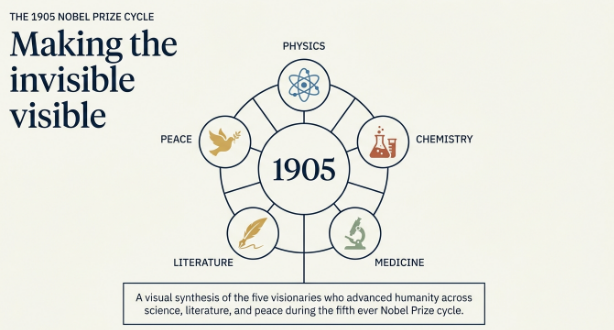
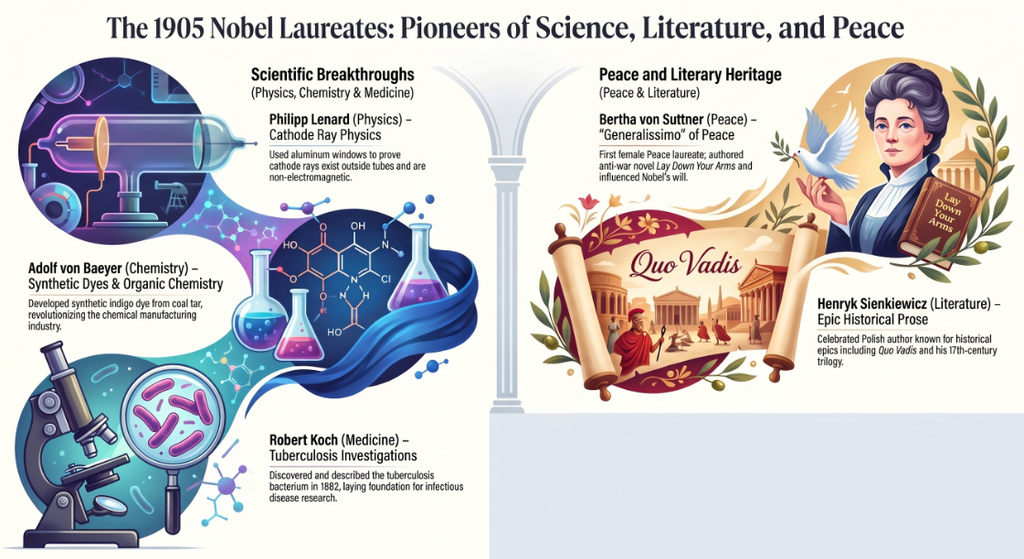
1905 Nobel Laureate Master Summary
| Category | Laureate Name | Affiliation / Residence | Prize Motivation | Prize Share |
|---|---|---|---|---|
| Physics | Philipp Eduard Anton von Lenard | Kiel University, Kiel, Germany | “for his work on cathode rays” | 1/1 |
| Chemistry | Johann Friedrich Wilhelm Adolf von Baeyer | Munich University, Munich, Germany | “in recognition of his services in the advancement of organic chemistry and the chemical industry, through his work on organic dyes and hydroaromatic compounds” | 1/1 |
| Physiology or Medicine | Robert Koch | Institute for Infectious Diseases, Berlin, Germany | “for his investigations and discoveries in relation to tuberculosis” | 1/1 |
| Literature | Henryk Sienkiewicz | Residence: Poland | “because of his outstanding merits as an epic writer” | 1/1 |
| Peace | Baroness Bertha Sophie Felicita von Suttner, née Countess Kinsky von Chinic und Tettau | Residence: Austria | “for her audacity to oppose the horrors of war” | 1/1 |
Year-Wise Summary: 1905
- 1905
- Philipp Lenard: For his work on cathode rays.
- Adolf von Baeyer: For his services in the advancement of organic chemistry and the chemical industry, through his work on organic dyes and hydroaromatic compounds.
- Robert Koch: For his investigations and discoveries in relation to tuberculosis.
- Henryk Sienkiewicz: For his outstanding merits as an epic writer.
- Bertha von Suttner: For her audacity to oppose the horrors of war.
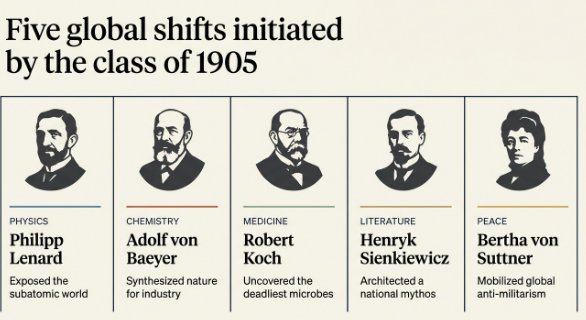
The following sections present a detailed historical and technical analysis of the empirical breakthroughs, methodological innovations, and societal impacts realized by the 1905 Nobel Laureates.
2. Advances in the Physical Sciences and Chemical Industry: Physics and Chemistry
The 1905 Nobel Prizes in Physics and Chemistry highlight the crucial role of rigorous laboratory experimentation in establishing fundamental physical laws and driving large-scale industrial chemical processes. During this era, physical science was advancing beyond classic macro-level mechanics to investigate energetic phenomena within evacuated vessels and the precise structural arrangements of organic molecules. Philipp Lenard’s isolation and analysis of cathode rays outside glass vessels and Adolf von Baeyer’s systematic synthesis of organic dyes and hydroaromatic compounds demonstrate how pure empirical inquiry simultaneously resolved foundational theoretical questions and established modern chemical manufacturing.
The 1905 Nobel Prize in Physics: Philipp Lenard
Biographical & Institutional Context
Philipp Eduard Anton von Lenard was born on 7 June 1862 in Pressburg, Hungary (now Bratislava, Slovakia), and died on 20 May 1947 in Messelhausen, Germany. At the time of his Nobel recognition in 1905, Lenard served as a professor of physics at Kiel University in Kiel, Germany. He was awarded the Nobel Prize in Physics as a sole recipient (1/1 prize share) for his systematic experimental investigations into the properties and behavior of cathode rays.
Experimental Breakthroughs in Cathode Radiation
During the late nineteenth century, experimental physics focused heavily on understanding cathode rays—a form of radiation emitted inside a glass tube filled with low-pressure gas when a high voltage was applied between two internal metal plates. Investigations into these discharge phenomena laid the indispensable experimental groundwork that led directly to the discoveries of electrons and X-rays.
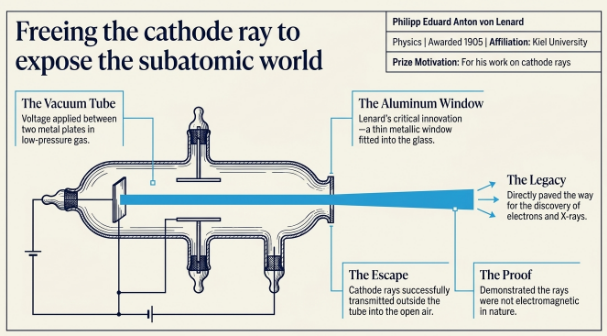
Lenard’s principal experimental breakthrough began in 1893, when he designed a specialized vacuum glass tube fitted with a thin aluminum window. Standard glass walls absorbed cathode rays, confining observation to the tube interior; Lenard’s thin metal window allowed the radiation to pass out of the evacuated glass vessel into the external air. By enabling the direct observation and physical analysis of the rays in open atmospheric conditions, Lenard conclusively demonstrated that cathode rays were not electromagnetic radiation in nature. This empirical proof provided crucial structural insight into the nature of radiant energy and particle streams, serving as a fundamental stepping stone for modern atomic physics.
The 1905 Nobel Prize in Chemistry: Adolf von Baeyer
Biographical Context & Academic Lineage
Johann Friedrich Wilhelm Adolf von Baeyer was born on 31 October 1835 in Berlin, Prussia (now Germany), and died on 20 August 1917 in Starnberg, Germany. Raised in Berlin, von Baeyer pursued higher education across several German universities, receiving advanced training under prominent nineteenth-century chemists, most notably Robert Bunsen and Friedrich Kekulé. At the time of his Nobel award, he held the chair of chemistry at Munich University in Munich, Germany, receiving an undivided 1/1 prize share for his sweeping contributions to organic chemistry and industrial chemistry.
Scientific & Industrial Contributions: Synthetic Dyes and Hydroaromatic Compounds
Beginning in the 1860s, von Baeyer initiated a series of detailed chemical studies on organic dyes that transformed synthetic chemistry and catalyzed the growth of the coal-tar dye industry. He systematically synthesized several major classes of artificial pigments, including phthaleins and indigo.
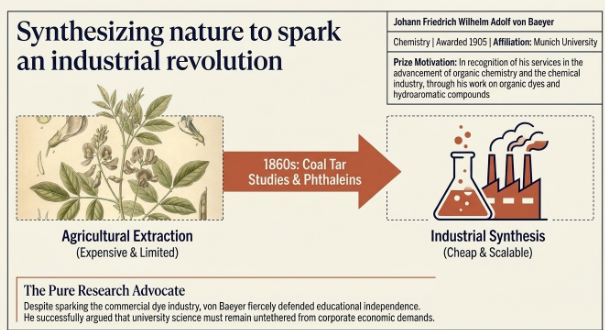
Prior to von Baeyer’s research, indigo—a culturally and economically vital blue dye—could only be obtained through labor-intensive agricultural cultivation and natural plant extraction. Von Baeyer successfully determined its chemical structure and developed a synthetic method for its industrial production. This synthetic pathway allowed indigo to be manufactured on a massive industrial scale at drastically reduced costs, fundamentally reshaping global chemical manufacturing and trade.
Beyond his celebrated achievements in dye synthesis, von Baeyer’s Nobel citation explicitly recognized his foundational investigations into hydroaromatic compounds. His structural determinations and analyses of reduced aromatic ring systems—such as hexahydrobenzene derivatives—helped resolve critical theoretical questions regarding molecular ring strain, stereochemistry, and unsaturated organic structures, expanding the theoretical framework of organic chemistry.
Defense of Academic Independence
In addition to his research contributions, von Baeyer was an influential advocate for university governance and academic philosophy at Munich University. As industrial dye manufacturing expanded into a major economic sector, corporate enterprises exerted increasing pressure on university chemistry departments to orient their curricula and research agendas toward commercial priorities. Von Baeyer forcefully resisted these institutional demands, maintaining that university-level scientific inquiry must remain independent and driven by theoretical exploration rather than commercial mandates or economic considerations.
Having examined the physical and industrial chemical milestones of 1905, the compendium turns next to parallel breakthroughs within medical bacteriology and public health.
3. Breakthroughs in Medical Bacteriology: Physiology or Medicine
The 1905 Nobel Prize in Physiology or Medicine reflects a transformative era in clinical pathology defined by the systematic isolation and identification of micro-organisms responsible for major global health threats. Throughout the nineteenth century, infectious diseases caused widespread mortality without clear diagnostic or therapeutic protocols. Robert Koch’s development of precise bacteriological techniques established the definitive causal link between specific pathogenic bacteria and catastrophic human illnesses, establishing the rigorous empirical standards of modern medical microbiology.
Laureate Profile and Pathological Discoveries: Robert Koch
- Laureate Profile: Robert Koch was born on 11 December 1843 in Clausthal (now Clausthal-Zellerfeld), Germany, and died on 27 May 1910 in Baden-Baden, Germany. At the time of his Nobel conferral, he was affiliated with the Institute for Infectious Diseases in Berlin, Germany. He was awarded an undivided 1/1 prize share in recognition of his pioneering investigations and diagnostic discoveries concerning tuberculosis.
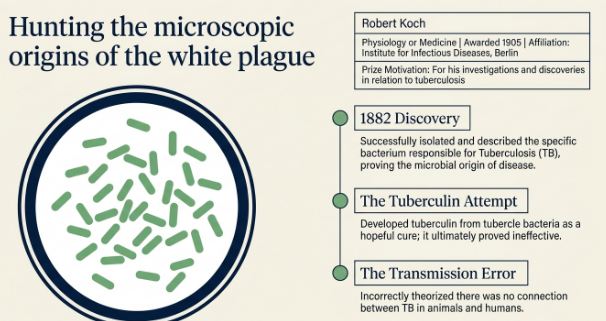
- The Etiology of Tuberculosis: Tuberculosis (TB) represented one of the most destructive infectious diseases of the nineteenth century, causing severe pathological degradation of organ tissue, particularly within human lungs. Building upon his previous foundational studies of diseases caused by micro-organisms, Koch achieved a major pathological breakthrough in 1882 by discovering, isolating, and describing the specific causative biological agent of the disease: the tubercle bacterium (tubercle bacteria). This landmark achievement proved that tuberculosis was a contagious bacterial infection rather than an inherited or environmental illness.
- Investigation of Tuberculin and Transmission Theory: Following his identification of the tubercle bacterium, Koch focused on developing therapeutic protocols, investigating tuberculin—a biological substance derived directly from tubercle bacteria. Although Koch initially hoped that tuberculin would function as an effective therapeutic cure for active tuberculosis cases, subsequent clinical evaluations demonstrated that it was ineffective as a curative agent. Additionally, Koch formulated a firm theoretical stance regarding pathogen transmission, maintaining that human tuberculosis and animal (bovine) tuberculosis were entirely distinct and non-interchangeable diseases. Subsequent medical research proved that Koch was not entirely correct on this point, as bovine tuberculosis can indeed infect human hosts, an insight that later altered public health interventions regarding milk pasteurization and livestock management.
Transitioning from clinical bacteriology, the 1905 Nobel cohort was completed by extraordinary achievements in epic historical literature and international peace organization.
4. Literary Epic and Global Diplomacy: Literature and Peace
The 1905 Laureates in Literature and Peace addressed complex political, social, and cultural realities at the opening of the twentieth century. Through historical fiction and public advocacy, Henryk Sienkiewicz and Baroness Bertha von Suttner engaged directly with broad international public audiences. Sienkiewicz utilized epic historical prose written in Polish to preserve cultural heritage and foster national unity during a period when Poland lacked sovereign statehood, while von Suttner harnessed literature and international organization to oppose European militarism.
The 1905 Nobel Prize in Literature: Henryk Sienkiewicz
Biographical & Cultural Standing
Henryk Sienkiewicz was born on 5 May 1846 in Wola Okrzejska, Poland, into an impoverished Polish noble family, and died on 15 November 1916 in Vevey, Switzerland. He pursued higher education at the University of Warsaw, where he studied literature, history, and philology, though he departed without completing a formal degree. Sienkiewicz began his public career as a working journalist and author, building early literary renown through serialized short stories and published travelogues.
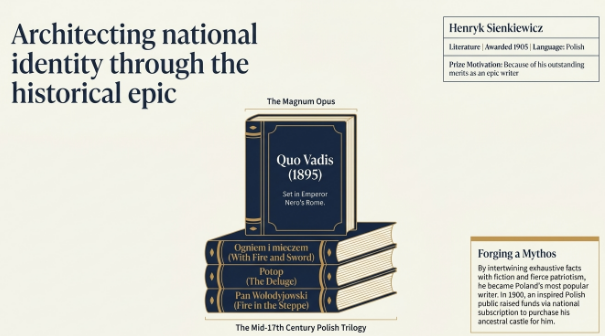
Writing exclusively in the Polish language, Sienkiewicz emerged as Poland’s most popular author at the turn of the century. His cultural standing as a unifying figure for Polish national identity was so significant that in 1900, a national public subscription raised private capital to purchase and present to him the ancestral castle where his family had historically lived.
Literary Masterpieces and Historical Epic Style
Sienkiewicz achieved widespread international acclaim through his epic historical novels, which were initially published as serial installments in Polish newspapers throughout the 1880s. His writing was grounded in comprehensive historical research, blending factual historical events with fictional narrative lines anchored by patriotic themes.
His most celebrated domestic works comprise a masterwork trilogy depicting mid-seventeenth-century Polish historical struggles:
- Ogniem i mieczem (With Fire and Sword)
- Potop (The Deluge)
- Pan Wolodyjowski (Fire in the Steppe)
Internationally, Sienkiewicz achieved vast global success with his 1895 epic novel Quo Vadis, a narrative detailing early Christianity in Rome during the reign of Emperor Nero. His epic style successfully translated national history and moral conflict into universal literature.
The 1905 Nobel Peace Prize: Baroness Bertha von Suttner
Biographical & Leadership Record
Baroness Bertha Sophie Felicita von Suttner, née Countess Kinsky von Chinic und Tettau, was born on 9 June 1843 in Prague, Austrian Empire (now Czech Republic), and died on 21 June 1914 in Vienna, Austria. Residing in Austria at the time of her award, she was designated as the sole recipient (1/1 share) of the 1905 Nobel Peace Prize.
Von Suttner was a principal organizational leader of the late nineteenth-century international peace movement. In 1891, she founded the Austrian Peace Society, and subsequently served as the Honorary President of the Permanent International Peace Bureau in Berne, Switzerland. As a prominent, liberal female voice in male-dominated international diplomatic congresses, she earned the popular moniker “generalissimo of the peace movement.”
First Female Peace Laureate & Anti-War Novel
As the first woman to be awarded the Nobel Peace Prize, von Suttner achieved widespread cultural impact through her major anti-war novel, Lay Down Your Arms (Die Waffen nieder!), published in 1889. Although the novel’s title was viewed as highly provocative by contemporary military establishments, its forceful anti-militaristic thesis resonated across Europe, positioning her as a primary intellectual voice in international disarmament movements.

Relationship with Alfred Nobel and Influence on the Peace Prize
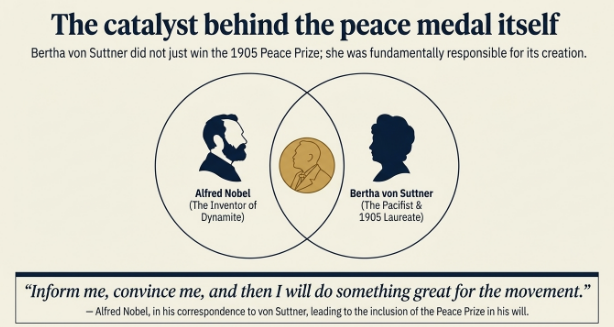
In the 1870s, von Suttner developed a close personal friendship with Swedish industrialist Alfred Nobel. For decades, the two maintained an active correspondence regarding peace initiatives and political conflict resolution. During their exchanges, Nobel highlighted his willingness to support her advocacy, writing directly to her:
> “Inform me, convince me, and then I will do something great for the movement.”
Von Suttner’s persistent correspondence and intellectual guidance directly influenced the drafting of Alfred Nobel’s final will and testament, convincing him to dedicate a specific portion of his estate to establishing an international peace prize.
Synthesizing these distinct domain achievements reveals structural patterns across the entire 1905 Nobel conferral.
5. Cross-Disciplinary Synthesis of the 1905 Nobel Awards
The 1905 Nobel conferrals offer an instructive cross-section of early twentieth-century scientific and cultural history, reflecting shared structural characteristics as well as stark contrasts in how intellectual figures engaged with public society.
Geographic & Demographic Distribution
Geographically, the 1905 cohort was centered entirely within Central and Eastern Europe, representing the contemporary territories of Prussia/Germany, Poland, and the Austrian Empire:
- Germany / Prussia: Adolf von Baeyer (Berlin/Munich), Robert Koch (Clausthal/Berlin), Philipp Lenard (Kiel University; born in Pressburg, Hungary [now Bratislava, Slovakia]).
- Poland: Henryk Sienkiewicz (Wola Okrzejska/Warsaw; residence Poland).
- Austrian Empire: Bertha von Suttner (born in Prague [now Czech Republic]; residence Austria).
Demographically, Bertha von Suttner stood out as the sole female laureate within the 1905 cohort, securing her historical distinction as the first woman to receive the Nobel Peace Prize and only the second female Nobel laureate in history (following Marie Curie in 1903).
Structural Uniformity of Prize Allocations
A defining structural feature of the 1905 conferrals is that 100% of the categories—Physics, Chemistry, Physiology or Medicine, Literature, and Peace—were awarded as undivided full shares (1/1) to single individual laureates. This complete absence of joint awards illustrates a historical moment when prize-awarding institutions still prioritized individual discovery and singular intellectual authority, prior to the mid-twentieth-century shift toward large-scale collaborative scientific teams and shared prize allocations.
Research Isolation versus Public Engagement
The 1905 cohort illustrates a spectrum of methodology ranging from pure laboratory detachment to direct social and political involvement:
- Physical Isolation and Academic Detachment: Philipp Lenard’s physical isolation of cathode rays through a thin aluminum window mirrored Adolf von Baeyer’s intellectual defense of academic autonomy. Von Baeyer actively resisted corporate industrial pressures, insisting that foundational research at Munich University must remain detached from commercial motives, even though his synthetic chemistry directly revolutionized international dye manufacturing.
- Clinical and Social Engagement: In contrast to von Baeyer’s academic detachment, Robert Koch’s bacteriological work was directly embedded in clinical diagnosis and public health intervention, despite his theoretical misstep regarding bovine-to-human disease transmission. Meanwhile, Henryk Sienkiewicz and Bertha von Suttner operated entirely within the public sphere. Sienkiewicz mobilized the Polish language and historical narrative to sustain national identity, while von Suttner used literature and organized diplomacy to shape public opinion, statecraft, and the foundational structure of the Nobel Prize itself.
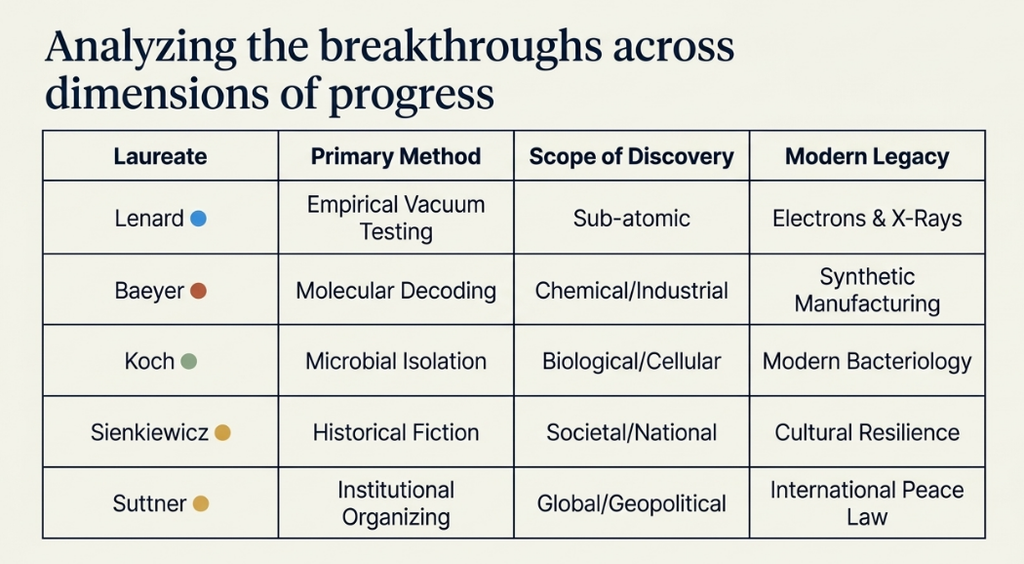
Together, the 1905 Nobel Laureates advanced physical theory, industrial chemistry, bacteriological diagnostics, epic national literature, and international peace organizational frameworks, leaving an enduring legacy that continues to define modern science and the humanities.
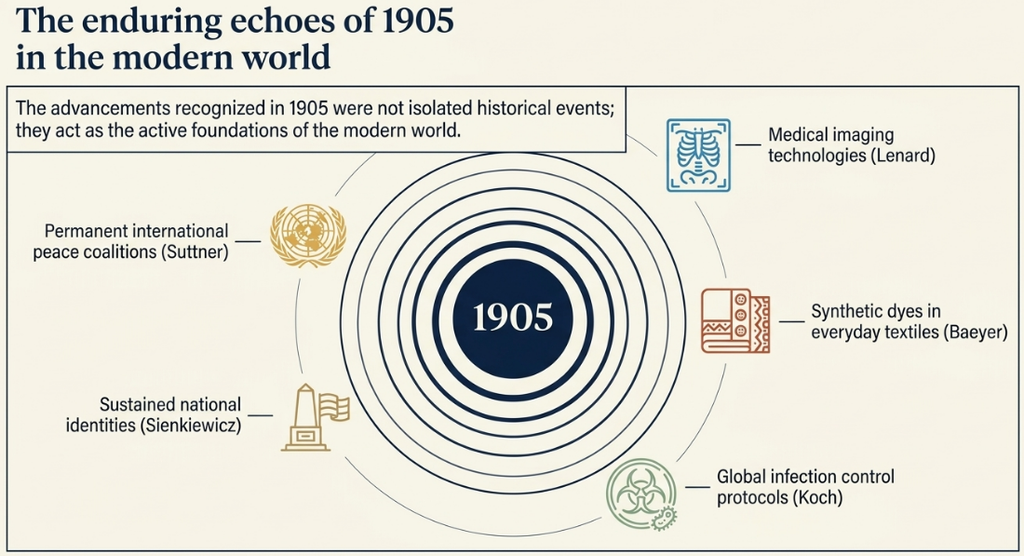
Image Summary
Reference
https://www.nobelprize.org/prizes/lists/all-nobel-prizes/1909-1901