1. The Dawn of the Nobel Legacy: 1901 in Context
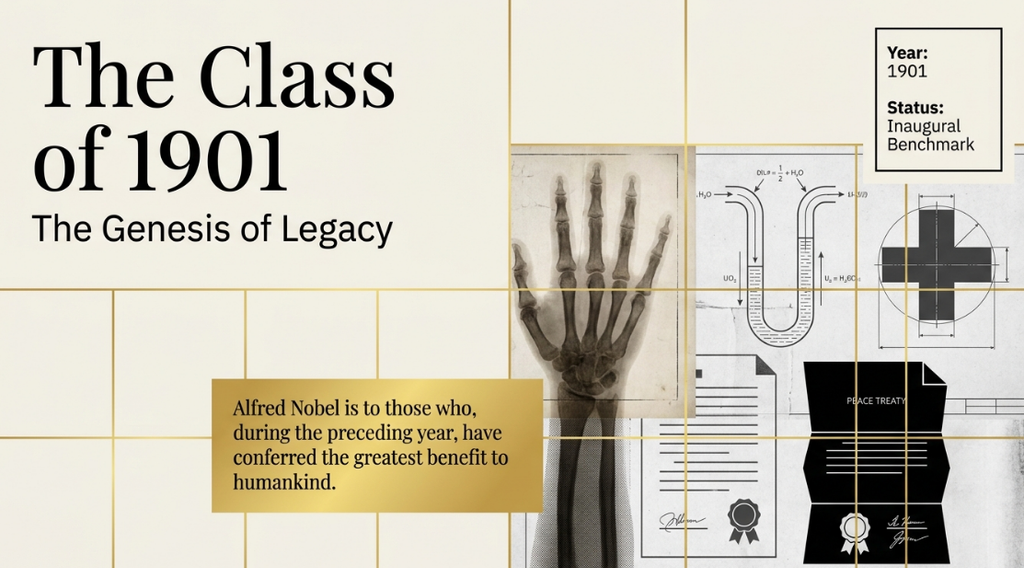
The year 1901 represents a foundational historical juncture, marking the first-ever implementation of the final testament of Alfred Nobel. This inaugural cycle was not merely a ceremony of recognition but a strategic institutionalization of excellence, establishing a rigorous framework that tasked independent academic bodies—such as the French Academy and the Berlin and Munich Universities—with the stewardship of human progress. By defining the “greatest benefit on mankind” through the lens of scientific, literary, and humanitarian achievement, the 1901 awards set an immediate global benchmark. These prizes signaled a transition into a modern era where intellectual labor was codified as a primary driver of international prestige and collective welfare. This institutional founding transformed Nobel’s personal vision into a permanent global legacy, moving human understanding from the mastery of nature to the pursuit of systematic excellence.
2. Pioneers of the Physical and Medical Sciences
The scientific prizes of 1901 were awarded at a transformative moment for the physical and medical landscapes, recognizing breakthroughs that rendered the “invisible forces” of the universe both visible and controllable. These awards celebrated the transition from descriptive observations to the analytical mastery of radiation, chemical dynamics, and the internal mechanisms of the human immune system.
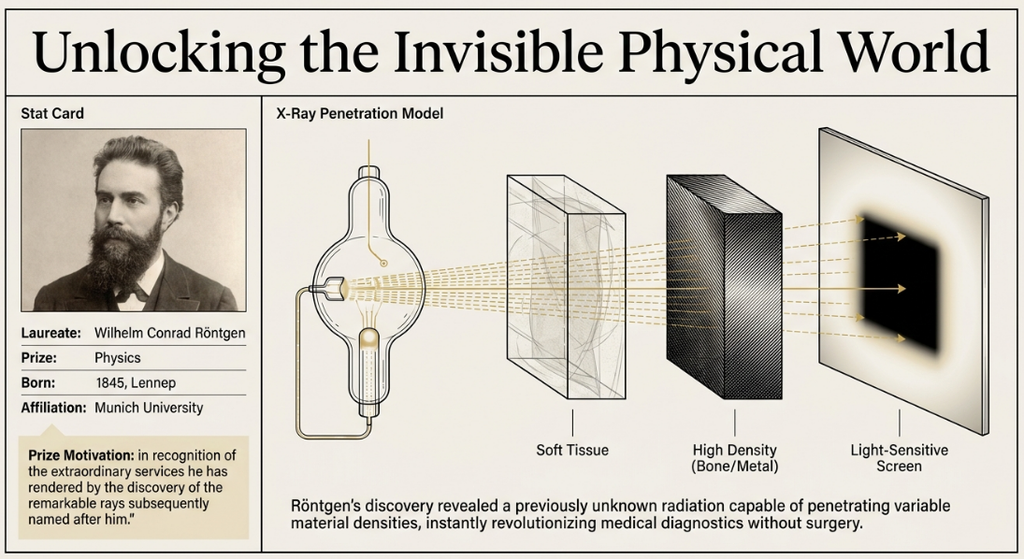
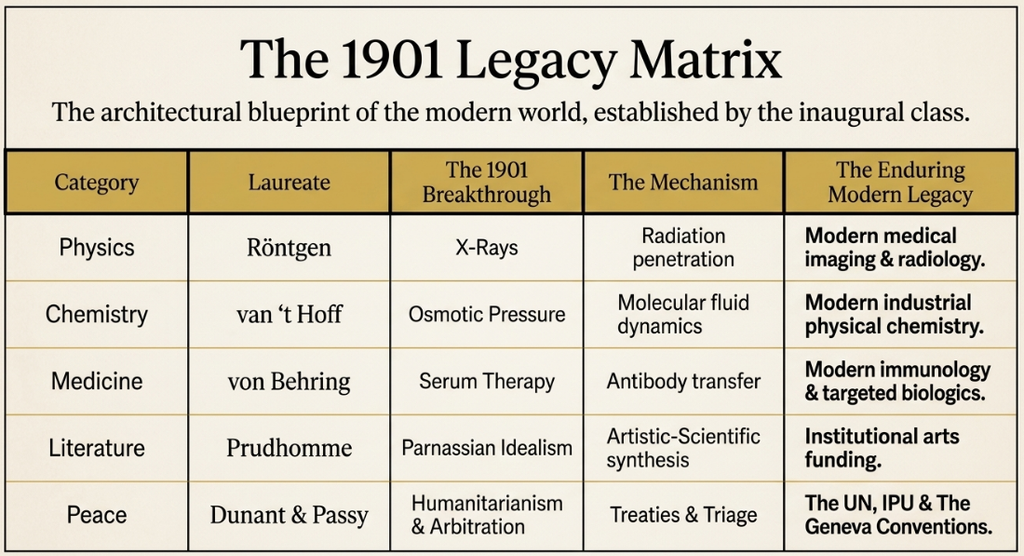
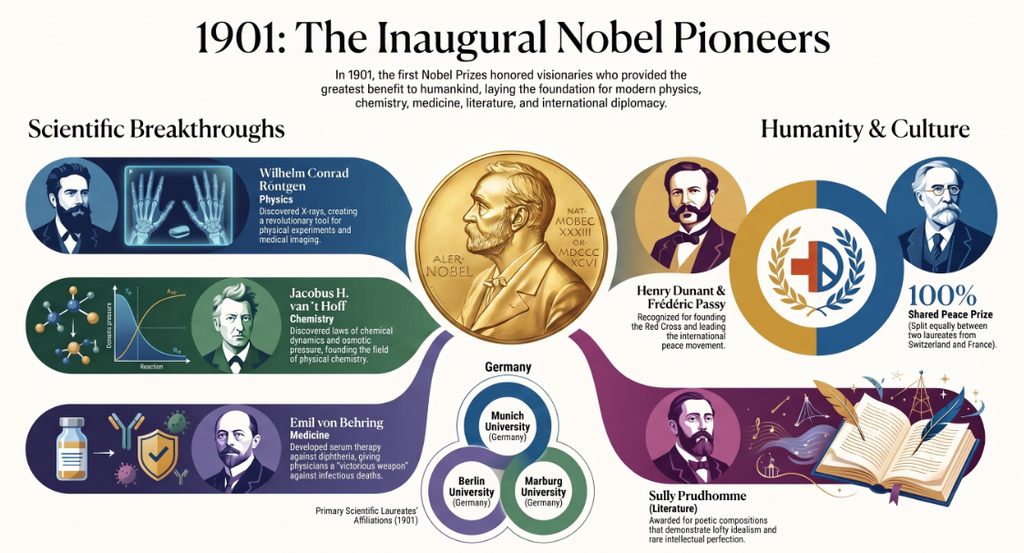
- Physics: Wilhelm Conrad Röntgen Affiliated with Munich University at the time of his award, Röntgen spent his formative years in Holland before conducting his seminal research. He was recognized for the discovery of the “remarkable rays” produced during his experiments with cathode radiation. The utility of Röntgen’s discovery was unparalleled; by bridging the gap between pure physical experimentation and clinical application, X-rays provided an immediate, non-invasive method for examining the body’s interior. This synthesis of physics and medicine effectively revolutionized diagnostics, allowing the invisible structures of the human frame to be analyzed without surgical intervention.
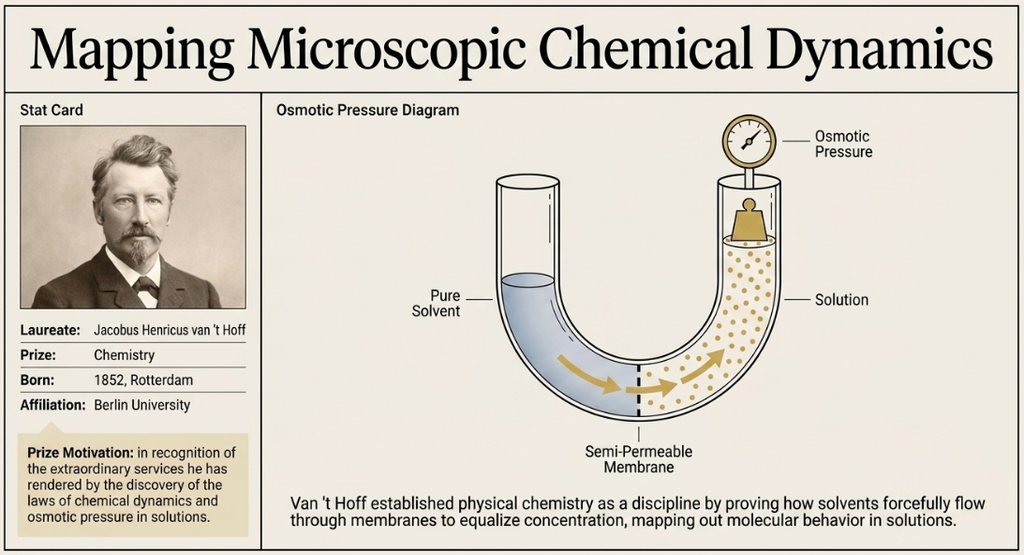
- Chemistry: Jacobus Henricus van ‘t Hoff A professor at Berlin University and a former student at Utrecht, van ‘t Hoff was honored for his discovery of the laws of chemical dynamics and osmotic pressure in solutions. His status as a founder of physical chemistry was cemented not only by his research into how temperature affects reactions and how concentrations even out across membranes but also by his 1887 founding of the Zeitschrift für Physikalische Chemie. His analytical synthesis successfully bridged molecular structure (stereochemistry) with the sequences of chemical events, providing the theoretical bedrock for modern chemical analysis.
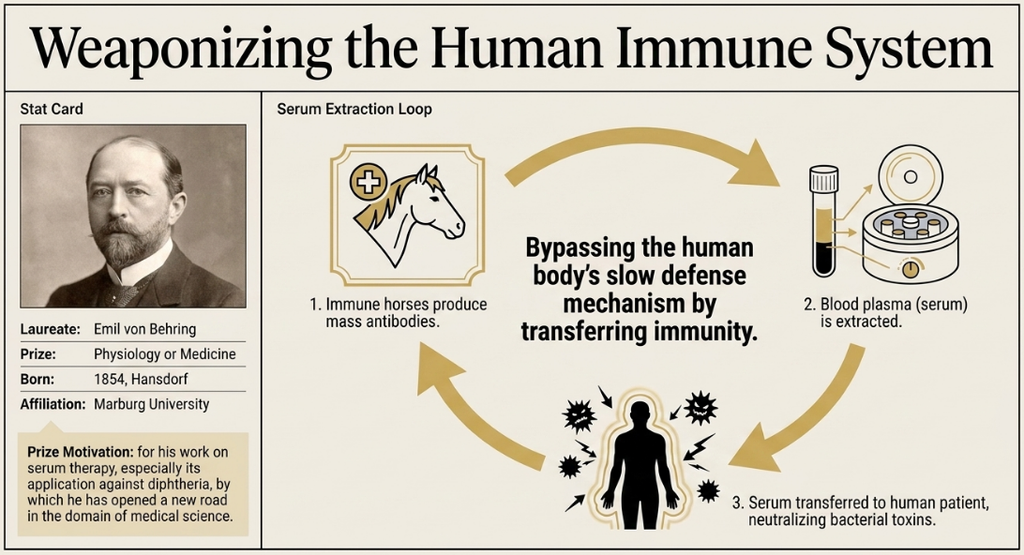
- Physiology or Medicine: Emil Adolf von Behring Educated at the Army Medical College in Berlin and a close collaborator of Robert Koch, von Behring held a chair at Marburg University during his laureateship. His work on serum therapy, specifically its application against the diphtheria and tuberculosis bacteria, provided physicians with what the Nobel Committee described as a “victorious weapon.” By demonstrating that antibodies could be transferred via blood plasma—utilizing serum from immune horses to prevent and cure disease—von Behring transitioned medicine from a passive study of microorganisms to the active, industrial-scale creation of immunity.
Having secured these triumphs over the invisible mechanics of nature, the 1901 cohort turned their gaze from the laboratory to the theater of international stability.
3. The Architecture of Global Humanitarianism
The 1901 Peace Prize was a strategic exercise in balancing frontline humanitarian intervention with the intellectual and political structures of diplomatic activism. By dividing the prize, the Norwegian Nobel Committee recognized that the cessation of conflict requires both the immediate relief of suffering and the long-term cultivation of international law and economic cooperation.
- Henry Dunant: As the founder of the International Committee of the Red Cross and the primary architect of the Geneva Convention, Dunant’s mandate was born from the carnage of the Battle of Solferino. In his seminal book, A Memory of Solferino, he proposed a plan for neutral relief associations. The definitive “So What?” of his mandate—the core strategic impact of his life’s work—rested on the revolutionary principle that all wounded soldiers on the battlefield, regardless of their nationality or allegiance, must be regarded and treated as friends.
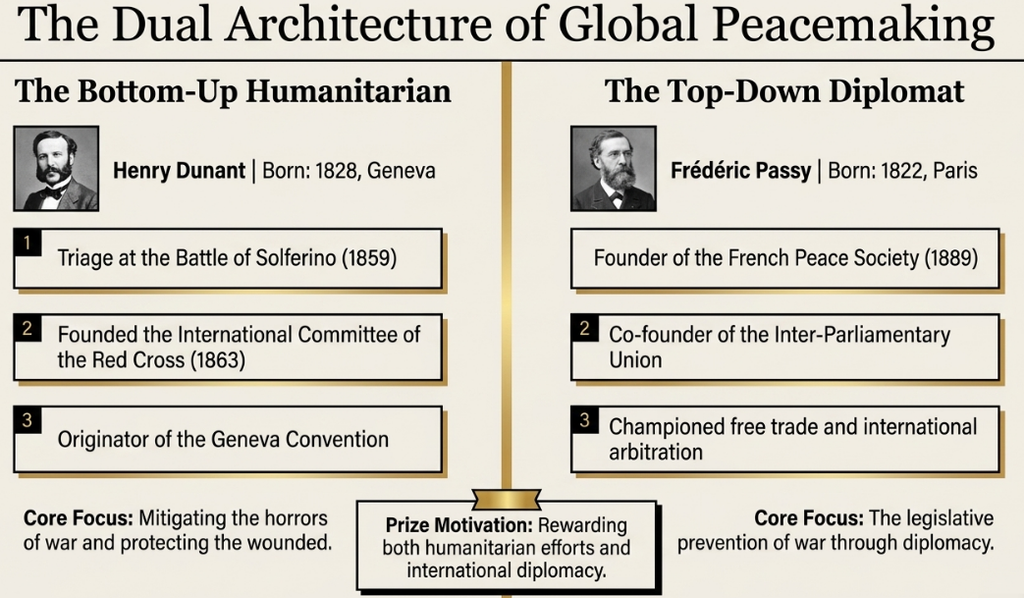
- Frédéric Passy: Known as the “dean of the international peace movement,” Passy served as an independent leftist republican in the French Chamber of Deputies and was a primary force at the 1878 World Exhibition peace congress. While Dunant focused on the battlefield, Passy approached peace through a political and economic lens. He maintained that free trade between independent nations was a primary deterrent to war, a conviction that led him to explicitly oppose France’s colonial policy. As a co-founder of the Inter-Parliamentary Union, he advocated for a world where arbitration supplanted the necessity for conflict.
As these laureates codified the laws of global diplomacy, the Nobel Foundation simultaneously sought to honor the elevation of the human intellect through the enduring power of letters.
4. The Idealism of the Human Spirit: Literature
The inaugural Literature prize was a critical instrument in defining the “ideal direction” specified in Alfred Nobel’s will. In selecting Sully Prudhomme, the Swedish Academy favored a literary tradition that harmonized aesthetic “formal perfection” with the intellectual rigors of science and philosophy, seeking an elevation of the human spirit through both heart and mind.
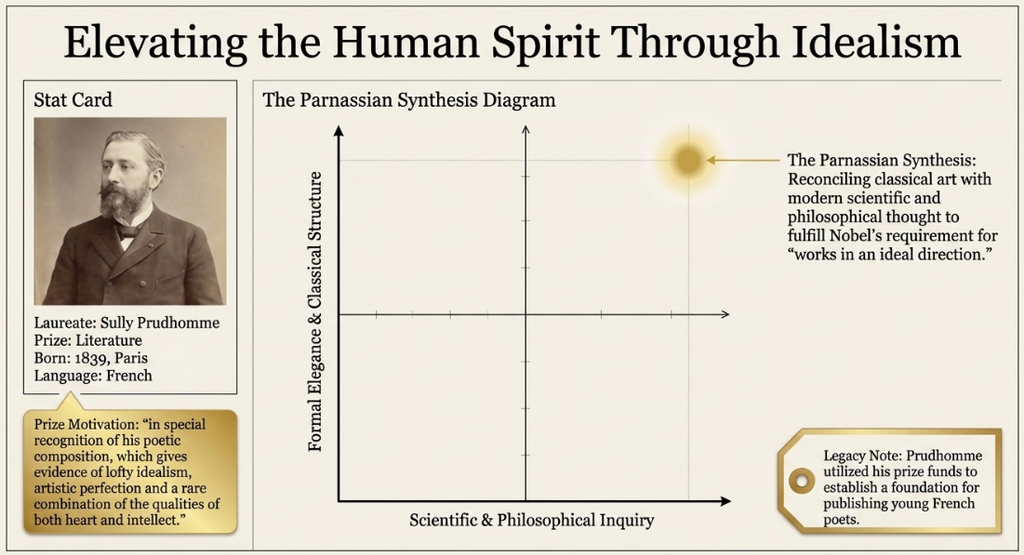
Prudhomme, an inductee of the French Academy since 1881, originally pursued engineering until an eye disease redirected his career toward law and, eventually, letters. As a prominent figure of the Parnassian school, he championed a classic and formally elegant style. His work was lauded for its “lofty idealism,” a rare quality that merged poetic sensibility with a deep-seated interest in philosophical inquiry. Prudhomme utilized the strategic impact of his award to establish a dedicated fund for the publication of works by young French poets, ensuring that his academic induction served as a bridge for future generations of literary excellence.
In these various domains, the 1901 laureates collectively established an enduring testament to human progress, bridging the material, the moral, and the metaphysical.
5. Executive Summary Table: 1901 Laureates
| Category and Laureate(s) (1901) | Core Contribution and Strategic Impact |
|---|---|
| Physics: Wilhelm Conrad Röntgen | Discovery of X-rays; bridged cathode radiation and medical diagnostics to enable non-invasive internal examinations. |
| Chemistry: Jacobus Henricus van ‘t Hoff | Laws of chemical dynamics; founded Zeitschrift für Physikalische Chemie and synthesized molecular structure with reaction sequences. |
| Physiology or Medicine: Emil Adolf von Behring | Development of serum therapy; collaborated with Robert Koch to create an antibody-based “victorious weapon” against diphtheria. |
| Peace: Henry Dunant | Founder of the Red Cross; established the strategic mandate that wounded combatants must be treated as friends under the Geneva Convention. |
| Peace: Frédéric Passy | Diplomatic arbitration; promoted peace through free trade and the Inter-Parliamentary Union while opposing colonial expansion. |
| Literature: Sully Prudhomme | Parnassian poetic composition; merged science and philosophy into verse and established a permanent endowment fund for young poets. |
Reference:
https://www.nobelprize.org/prizes/lists/all-nobel-prizes/1909-1901


Related posts:
 World Economic Forum: Top 10 Emerging Technologies of 2023
 The Giant Bacterium: Ca. Epulopiscium viviparus
 Thiomargarita magnifica: The Bacteria Big Enough to be Visible by the Naked Eye
 Integrated Pest Management (IPM): Fundamentals, Practice, and Professional Communication
 Panama Wilt: Understanding and Managing the Banana Killer