1. The Agricultural Arms Race: Moving Beyond Chemicals
The global agricultural landscape is undergoing a necessary, if difficult, paradigm shift. We are witnessing the steady transition from broad-spectrum synthetic neurotoxins toward targeted microbial biological control agents (BCAs). This pivot is driven by the urgent need to preserve ecosystem health and human safety while combatting the rising tide of insect pest populations. However, the adoption of low-risk microbial alternatives is progressing slowly. Field efficacy remains frustratingly inconsistent, often sabotaged by site-specific conditions, weather variability, and the evolutionary resilience of the pests themselves.
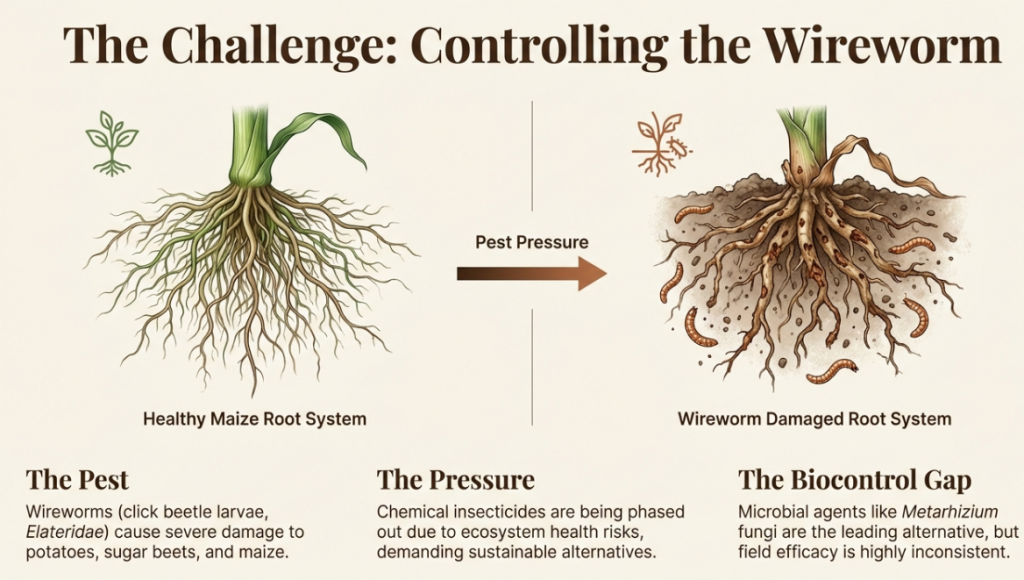
Nowhere is this challenge more apparent than in the management of wireworms—the soil-dwelling larvae of click beetles (Elateridae). These pests are a nightmare for potato, sugar beet, and maize growers, capable of devastating yields from beneath the soil surface. Because wireworms have evolved in habitats characterized by extreme microbial density and diversity, they are naturally adapted to resist biological pathogens. New research suggests that their resilience is not merely a matter of robust physiology, but rather a curated partnership with a microscopic “invisible bodyguard” that buffers them against the very fungi we use to control them.
2. Research Roadmap
To navigate this new frontier in crop protection, researchers must look beyond the insect and toward its ecological “home turf.” By analyzing four major wireworm species—Agriotes ustulatus, A. sputator, A. cf. gallicus, and A. obscurus—the team sought to understand the mechanisms of microbiome homeostasis.
The study’s central mission was to determine if a stable community of microbes facilitates wireworm survival. This required a rigorous distinction between ectosymbionts—the microscopic residents of the insect’s “skin” or cuticle that act as the first line of defense—and endosymbionts, which reside within internal tissues. By tracking these communities across different soil types and developmental stages, the research sought to answer the “So What?” of modern biocontrol: can we disrupt the stability of these microbial communities to make wireworms vulnerable to entomopathogenic fungi (EPF), such as Metarhizium?
3. The Cuticle Shield: Decoding Key Microbial Findings
In the world of insect pathology, the cuticle is the primary physicochemical barrier. It is the interface where an EPF spore must land, germinate, and penetrate to initiate a lethal infection. Wolfgang et al. discovered that this interface is not just a shell, but a highly specialized, species-specific ecosystem.
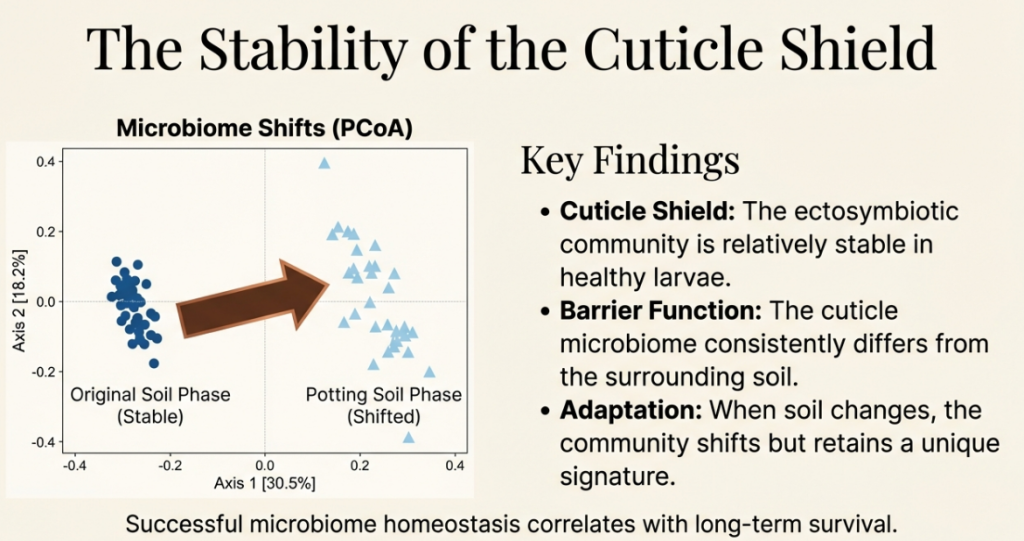
Critical Findings from the Cuticle Interface:
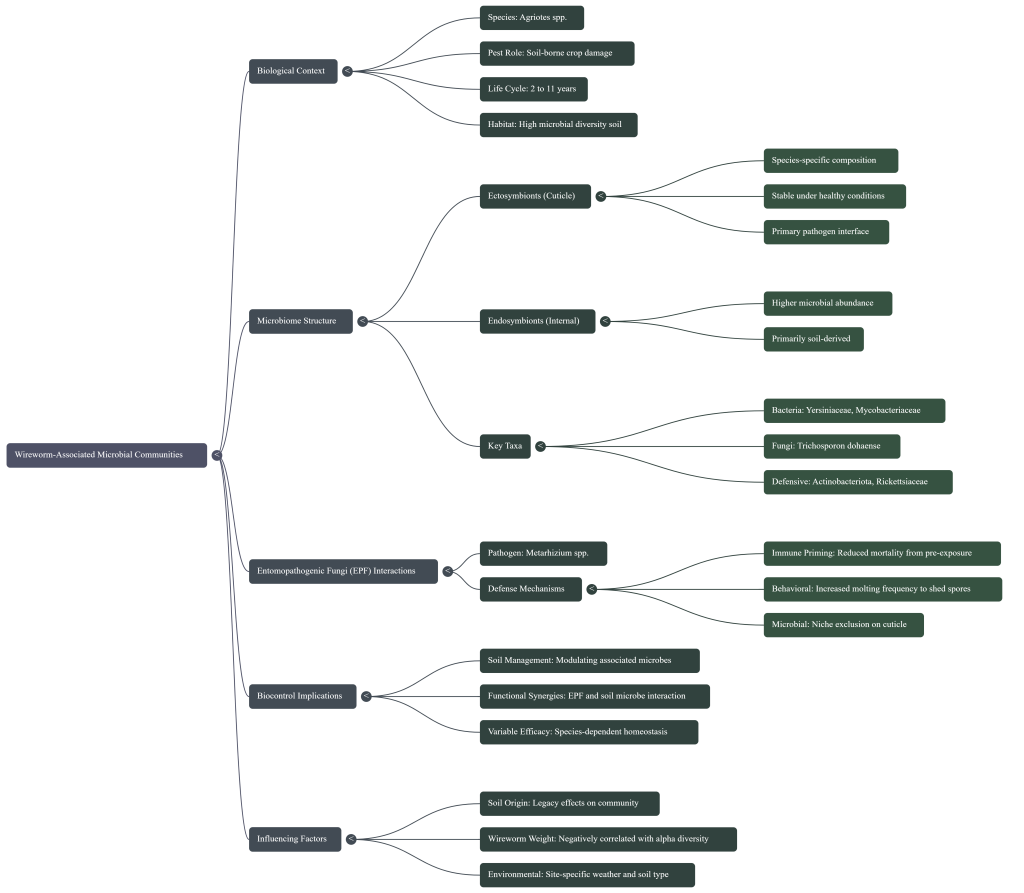
• Selective Filtering and Legacy Effects: While soil is a vast reservoir of microbial life, the wireworm acts as a selective filter. Interestingly, the study used “SourceTracker” analysis to reveal a significant Legacy Effect. Even after being moved into new potting soil, A. ustulatus specimens retained a microbial signature from their field of origin; up to 56% of their bacteria and 22% of their fungi were derived from their original “home soil” rather than their current environment. This suggests that wireworms carry their protective microbiome with them, maintaining homeostasis even in changing conditions.
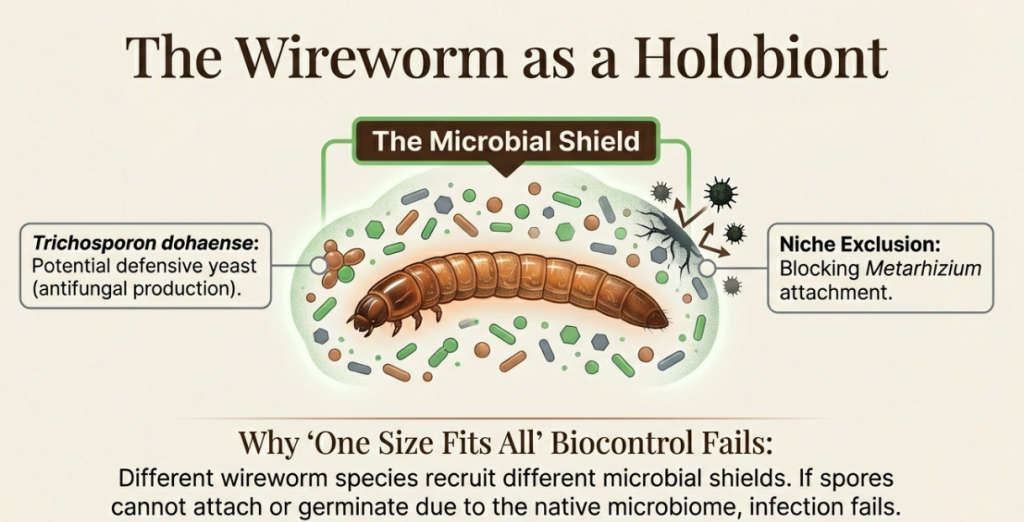
• Universal Bodyguards and Niche Exclusion: Across different species, specific taxa were identified as potential defensive symbionts. Actinobacteriota—known across the insect world for producing protective compounds—were prevalent, alongside Yersiniaceae and Mycobacteraceae. In the fungal realm, Trichosporon dohaense dominated. These microbes likely protect the host through “niche exclusion,” occupying the limited space on the cuticle to block pathogen attachment, or by producing antifungal metabolites that inhibit the germination of EPF spores.
• Species-Specific Biomarkers: Even in morphologically identical species like A. cf. gallicus and A. obscurus, the microbiomes were distinct. Key biomarkers included Variovorax for A. cf. gallicus and Serratia for A. ustulatus. Notably, A. ustulatus also harbored a high abundance of Rickettsiaceae, which may mediate tolerance toward toxins or biotic stress.
• A Window of Vulnerability: The research identified a negative correlation between larval weight and bacterial diversity. Smaller, younger larvae possessed more diverse but perhaps less “streamlined” microbial communities. As wireworms age, their microbiomes become more specialized and stable. For biotechnologists, this suggests that the early developmental stages may represent a critical window where the “invisible shield” is most unstable and susceptible to intervention.
4. Immune Priming and Strategic Molting: The Escape Artists
When the microbial shield fails, wireworms deploy a secondary tier of biological maneuvers. Wolfgang et al. investigated the effects of “sublethal” exposure to Metarhizium—levels of fungi commonly found in field soil that do not immediately kill the pest. This exposure leads to a phenomenon known as immune priming.
Through exposure tests, the study revealed that “primed” wireworms (those with prior low-level contact with Metarhizium) showed significantly higher survival rates when later hit with a high-dose fungal attack compared to “naïve” specimens. However, the study also uncovered a nuanced survival strategy involving strategic molting, and the behavior varied significantly by fungal strain:
1. Strain-Specific Molting Responses: For the highly virulent M. robertsii, primed wireworms molted more frequently than naïve ones. Here, molting serves as a “short-term emergency strategy,” a physical shedding of the old cuticle to remove spores before they can penetrate internal tissues.
2. Emergency Reactions: Conversely, when exposed to M. anisopliae and M. brunneum, it was the naïve wireworms that molted more often. In these cases, the larvae likely used molting as a desperate, last-ditch effort to survive an infection for which their immune systems were unprepared.
These adaptations represent an intensive energy trade-off. While molting and immune activation allow the wireworm to “shrug off” an infection, they drain resources. For farmers, this explains the “persistence gap” in the field: a single application of EPF often fails because the pests are either already primed by low-level soil background fungi or they simply molt to escape the treatment.
5. Contextualization: Implications for Modern Agriculture
These findings represent a significant leap forward for Integrated Pest Management (IPM). They confirm that a “spray and pray” approach to biological control is fundamentally incompatible with soil ecology.
• Microbiome-Based Soil Management: Future strategies may involve soil amendments designed to weaken the wireworm’s microbial homeostasis before applying EPF. By disrupting the recruitment of Actinobacteriota or Serratia from the soil, we might “strip” the pest of its cuticle-based protection.
• The Challenge of Mixed Populations: Because different species (like A. sputator and A. ustulatus) possess different ectosymbionts and respond differently to specific Metarhizium strains, field assessments must become more granular. A treatment that works against one species may be easily countered by another through immune priming or strategic molting.
• Designing Functional Synergies: The ultimate goal is the development of “synergistic packages”—combinations of specific soil-dwelling bacteria and fungi that work in tandem. Imagine a BCA that includes a bacteria to degrade the wireworm’s protective fungal “bodyguard” (Trichosporon dohaense) alongside a potent EPF to strike the weakened host.
6. Conclusion: A New Era of Biocontrol
The research marks a transition toward “ecological intelligence” in agriculture. We can no longer view biological control as a simple chemical replacement. The wireworm’s survival is underpinned by a sophisticated system of microbiome homeostasis and the strategic use of its cuticle as a curated physicochemical barrier. By acknowledging the power of immune priming and the behavioral escape of strategic molting, we can begin to design biocontrol strategies that are as sophisticated as the pests they target. This research paves the way for a more resilient, bio-based food system—one that moves away from chemical dependency and toward a deeper, more effective partnership with the soil’s natural microbial life.
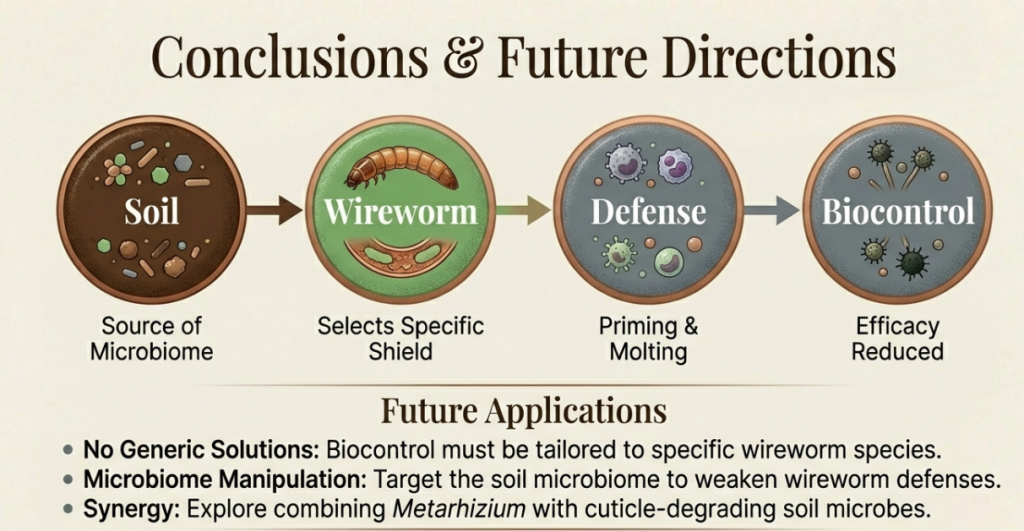
Image Summary
Reference
Wolfgang, A., Temme, N., Tilcher, R. et al. Wireworm-Associated Microbial Communities and their Implications on Biological Control. Microb Ecol 89, 31 (2026). https://doi.org/10.1007/s00248-025-02672-4


Related posts:
 Native Fungus Beauveria bassiana Offers Dual Pest Control and Plant Growth Boost Against Cabbage Aphids
 Eco-Friendly Fungal Biopesticide Offers Sustainable Control for Mango Leaf Hoppers
 Entomopathogenic Fungi Killing Cereal Leaf Beetles in Europe
 Powerful Bacterial Biocontrol Agents Against Citrus Rust Mite
 Arugula Vermicompost Fungi Offer Eco-Friendly Defense Against Tomato Root Rot