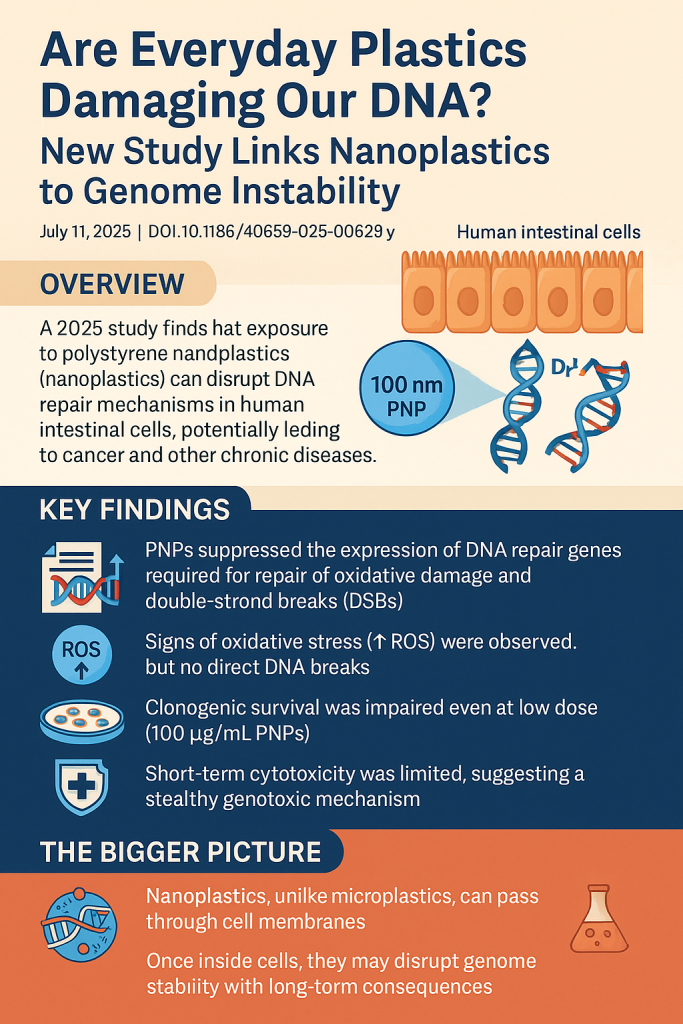
We’re surrounded by plastic—but what if the microscopic particles you can’t see are doing the most damage? A new study from the Warsaw University of Life Sciences shows that polystyrene nanoparticles (PNPs), a common type of nanoplastic, interfere with DNA repair mechanisms in human intestinal cells, even at low exposure levels.
“Our findings highlight a sublethal yet dangerous influence of polystyrene nanoplastics on genomic stability,” says lead author Dr. Kamila Maliszewska-Olejniczak.
Key Findings
- No direct DNA breaks, but critical repair genes were suppressed
- PNPs triggered oxidative stress and disrupted base excision repair (BER) and double-strand break (DSB) repair pathways
- Gene expression for key DNA repair proteins like OGG1, LIG1, XRCC1, PARP1, RAD51, and BRCA1 was significantly reduced
- Despite low immediate cytotoxicity, clonogenic survival was impaired, indicating long-term damage potential
- Cell cycle progression and apoptosis were not significantly affected, suggesting a stealthy genotoxic mechanism
Why This Matters
While short-term toxicity was minimal, the real threat lies in the suppression of DNA repair mechanisms, which could accumulate over time to cause:
- Cancer
- Accelerated aging
- Neurodegenerative diseases
- Reproductive toxicity
The study emphasizes that even “safe-looking” exposure to 100 μg/mL PNPs—common in environmental contamination—can damage intestinal epithelial barriers, a first line of defense in the human body.
Experimental Highlights
- Model used: Human colon cancer-derived Caco-2 cells
- Exposure: 50–1200 μg/mL of 100 nm polystyrene nanoparticles
- Assays conducted:
- Trypan Blue & Clonogenic Survival
- Flow cytometry for apoptosis & cell cycle
- ROS (oxidative stress) detection via DCFDA
- DNA damage via Comet Assay & γH2AX marker
- qPCR profiling of 14 DNA Damage Response (DDR) genes
The Bigger Picture
This research adds to growing global concern about nanoplastics in food, water, and air. Unlike microplastics, nanoplastics can:
- Penetrate cell membranes
- Travel via blood and lymphatic systems
- Interact with DNA, proteins, and organelles
Even if they don’t directly cut DNA strands, their long-term genomic effects might manifest as chronic diseases—especially in high-exposure populations or vulnerable individuals.
Reference
Kustra, A., Zając, M., Bednarczyk, P. et al. Exposure to polystyrene nanoparticles leads to dysfunction in DNA repair mechanisms in Caco-2 cells. Biol Res 58, 49 (2025). https://doi.org/10.1186/s40659-025-00629-y


Related posts:
 Natural Healers: Animals That Cure Themselves with Natural Solutions
 Three-Parent Babies: How Mitochondrial Donation is Redefining Reproductive Medicine
 A Visual Breakthrough: New Marker System Speeds Up Soybean Genome Editing
 Next-Generation Sequencing Pipeline Enhances Citrus Pathogen Detection for Safer Germplasm Exchange
 Genomics: Types, Methods and Applications