Importance of Structured Biological Data Storage
A database is a huge collection of well-organized data designed to maintain integrity over long periods. They are primarily associated with computer software capable of allowing users to modify or update, search, and retrieve specific sets of data which would provide ready-to-use relevant information. Biological databases primarily deal with biological data sets encompassing various types of bioinformatics data.
Given their nature, they take huge precedence for data analysis and interpretation. Hence, there is a huge need for a structured database, the relevant reasons have been discussed below:
Volume of Data:
- Technological advancements in machines, molecular research, and cost-effective high-throughput sequencing have resulted in the generation of enormous amounts of raw data. As such, if not properly stored, efficiency would reduce significantly, and finding any relevant information would be like searching for a needle in a haystack. Hence, to address the ever-rising amount of data, a structured system would go a long way towards easy access and effective analysis with minimal allocation of resources without compromising on the quality of output.
- As structured databases use indexing, data retrieval even from large datasets have minimal time requirements.
- Structured databases can be scaled both vertically (adding more resources to a single server) and horizontally (addition of more servers or nodes). These systems thus can handle high volumes of data with minimal change in performance.
- Structured databases can compress datasets, hence allowing for efficient storage.
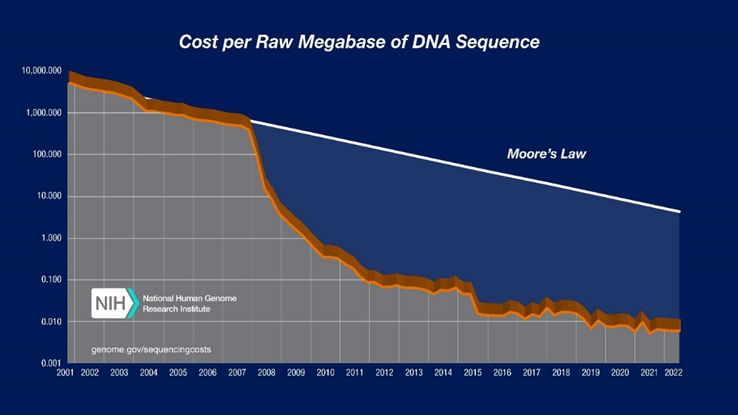
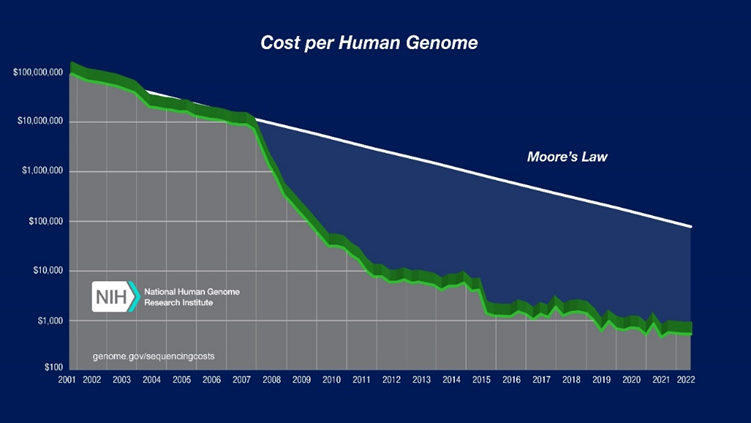
Source: https://www.genome.gov/about-genomics/fact-sheets/DNA-Sequencing-Costs-Data
Data Retrieval:
- Databases help in easier and quicker retrieval of specific data from a plethora of data sets, which is crucial for research and analysis.
- Databases make use of maps for allocating data to certain locations, hence making it easier for users to have quick access to data.
- Older data or less frequently accessed data can be archived while freeing up space for active data.
- Due to their structured nature, query optimization is possible for large datasets for improved efficiency.
Data Integrity:
- The structured storage of data ensures it is consistent while minimizing errors and obscurities.
- Structured databases maintain data integrity by following ACID (Atomicity, Consistency, Isolation, Durability) principles.
- Due to its structured nature, only valid data gets entered.
- Structured data reduces the risk of data duplication since they are split into smaller chunks.
- A structured database allows for keeping track of changes to the data with the ability to audit the changes and revert back to the previous version in case of error in the newer version.
- Structured databases usually have hierarchical access system ensuring sensitive data can be edited by authorized users only while maintaining accessibility to everyone.
- Multiple storage locations ensure that the data remains safe from any potential and unforeseen disasters.
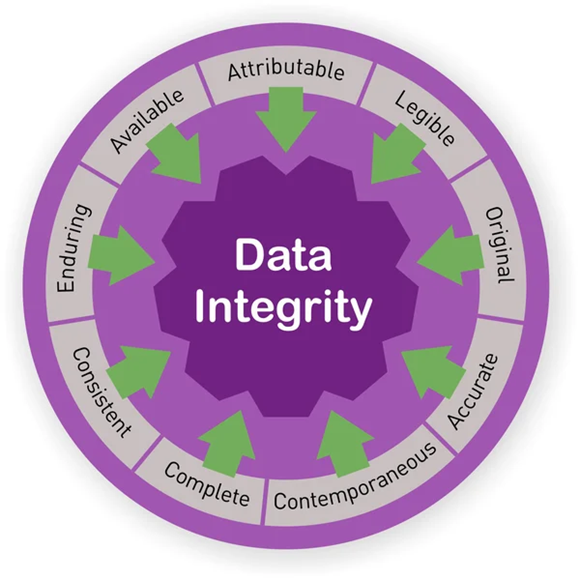
Source: https://www.labguru.com/blog/managing-data-integrity-and-compliance-guidelines
Interconnectivity and Collaboration:
- Structured databases enable to building of relationships between different datasets.
- Multi-user access facilitates collaboration between researchers, departments, universities, and even countries.
- Structured data format helps in quick exchange of information across different platforms.
- Due to its widespread accessibility, interdisciplinary and multidisciplinary approaches would be possible to a common problem. For example, a gene’s sequence data can be connected with its protein, expression pattern as well as related literature. This enables researchers worldwide to accelerate scientific discoveries through increased accessibility and data sharing.
Standardization:
- Standard data format and annotations make it easier for researchers to utilize the data.
- Structured databases have a uniform data structure, hence allowing for consistent data storage.
- As they enforce specific data types, they ensure only appropriate and valid data types can be entered.
- They help in the reduction of data redundancy and inconsistencies.
- They help in the easy sharing and migration of data across systems and applications, hence promoting smooth interconnectivity.
- The inclusion of metadata guarantees clear documentation and proper interpretation.
- Controlled access assures data security and compliance.
- Structured data also gives consistent and reliable reports through accurate data interpretation.
Data Analysis:
- Structured data storage promotes efficient computational analyses through methodical queries.
- Systematic organization of data assists in easier location and analysis of specific pieces of data.
- As discussed earlier, structure helps in establishing networks between seemingly different datasets, hence, helping to draw conclusions through multiple dimensions.
- Data to be analyzed can be retrieved faster through indexed databases, similar to the table of contents in a book.
- Data with high integrity guarantees reliable results with reduced errors or inconsistencies.
- When dealing with large data sets, analysts can simply partition the data through optimized queries resulting in smaller sections to analyse.
- Structured databases can help in the spatiotemporal analysis of the datasets.

Long-term Storage:
- Structured databases help in the long-term preservation of biological datasets as the technologies and algorithms evolve.
- Structured databases ensure that data is consistent, making it easier to retrieve and analyze over a long period of time
- Rarely accessed datasets are easier to archive when present in structured databases.
- Structured databases avoid duplication of datasets, hence promoting efficient data storage.
- Structured databases encompass metadata along with the primary data, hence allowing for understanding the context of the data for future users.
Relevant Articles:
Sapundzhi FI, Dzimbova TA. The importance of biological databases in modeling of structure-activity relationship.
Pal S, Mondal S, Das G, Khatua S, Ghosh Z. Big data in biology: The hope and present-day challenges in it. Gene Reports. 2020;21:100869. doi:10.1016/j.genrep.2020.100869
Leonelli S. The challenges of big data biology. Elife. 2019 Apr 5;8:e47381. doi: 10.7554/eLife.47381. PMID: 30950793; PMCID: PMC6450665.
Kleywegt GJ, Velankar S, Patwardhan A. Structural biology data archiving – where we are and what lies ahead. FEBS Lett. 2018 Jun;592(12):2153-2167. doi: 10.1002/1873-3468.13086. Epub 2018 May 25. PMID: 29749603; PMCID: PMC6019198.
Li Y, Chen L. Big biological data: challenges and opportunities. Genomics Proteomics Bioinformatics. 2014 Oct;12(5):187-9. doi: 10.1016/j.gpb.2014.10.001. Epub 2014 Oct 14. PMID: 25462151; PMCID: PMC4411415.
Related Articles
Scope and Applications of Bioinformatics


Related posts:
 Scope and Applications of Bioinformatics
 Types of Bioinformatics Data
 Seq2Saccharide: Unlocking Hidden Antibiotics with AI, Genomics, and Mass Spectrometry
 A Visual Breakthrough: New Marker System Speeds Up Soybean Genome Editing
 Red Sea Streptomyces Reveals New Bioactive Metabolites through Genomic and Metabolomic Integration